What changed in India–Iran relations in 2026
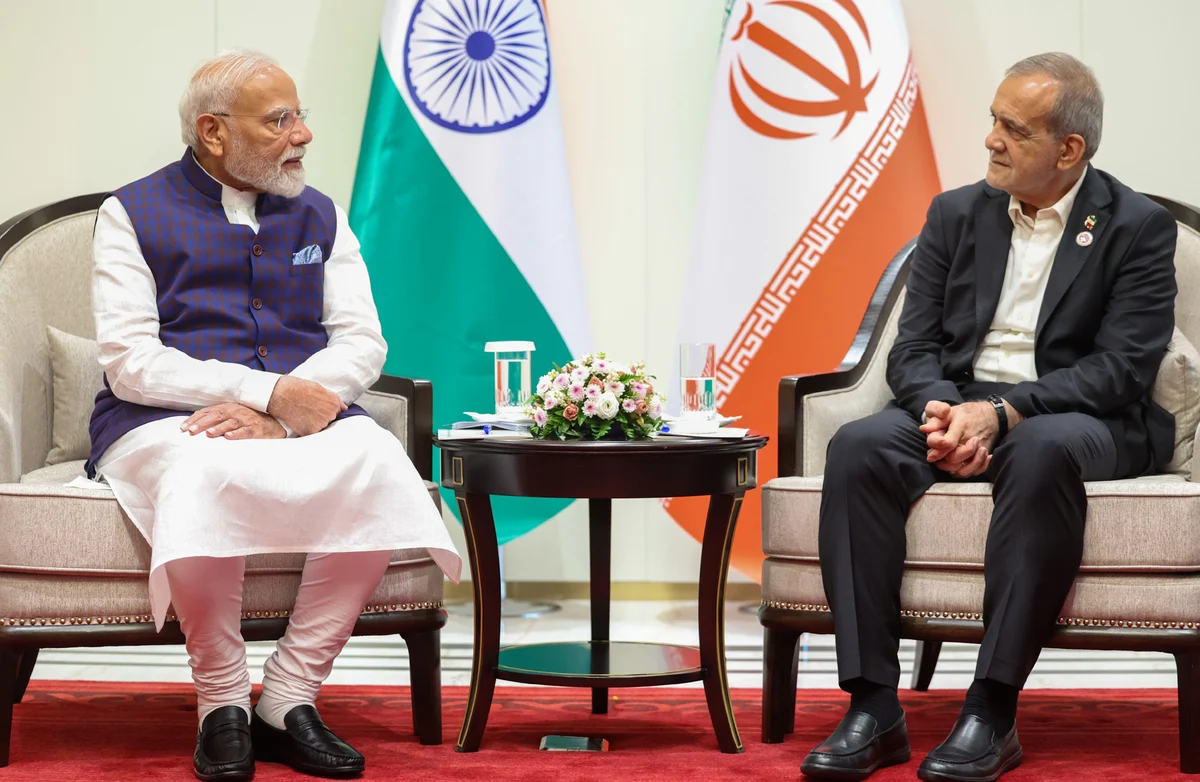
India and Iran continued bilateral engagement in 2026, with Prime Minister Narendra Modi and Iranian President Masoud Pezeshkian meeting on 31 August in Bishkek and again on 11 September in New Delhi. India highlighted diplomacy, civilian shipping and seafarer safety, while Iranian state media highlighted regional and economic cooperation, and the published accounts of the September meeting recorded no signed trade instrument or Chabahar renewal.
The Bishkek meeting took place on the sidelines of the Shanghai Cooperation Organisation summit in Kyrgyzstan. India’s account includes maritime commerce and seafarer safety among the topics discussed and records discussion of the forthcoming BRICS visit. The New Delhi meeting followed less than two weeks later. The recurrence of maritime safety in the Indian accounts makes it useful for tracking what New Delhi publicly emphasised across the two meetings.
Chabahar gives the relationship a concrete commercial project with a separate paper trail. The contract for the Shahid Beheshti terminal was signed in May 2024, more than two years before the New Delhi meeting. To assess a claim that bilateral cooperation has advanced, start by identifying the event and the action it records. A leader’s meeting establishes diplomatic engagement. A named agreement with parties, a facility and a term establishes a specific commitment whose implementation can be followed separately.
| Date | Record type | Milestone | Verified scope |
|---|---|---|---|
| 15 March 1950 | Diplomacy | Treaty of friendship | Date in the Indian Embassy’s bilateral account. |
| 22–23 May 2016 | Connectivity | Modi visit and trilateral transit agreement | India, Iran and Afghanistan transport and transit framework. |
| 13 May 2024 | Connectivity | Ten-year Chabahar terminal agreement | Shahid Beheshti terminal operation, with the scope specified in the contract release. |
| 31 August 2026 | Diplomacy | Modi–Pezeshkian meeting in Bishkek | Bilateral meeting on the sidelines of the SCO summit. |
| 11 September 2026 | Diplomacy | Modi–Pezeshkian meeting in New Delhi | Separate bilateral around the BRICS summit. |
| 12 September 2026 | Diplomacy | President Murmu received President Pezeshkian | Distinct meeting at Rashtrapati Bhavan. |
| 23 November 2026 | Travel advisory | Embassy notice | Partial relaxation of the earlier July advice for Indian nationals. |
- India Press Information Bureau: May 2024 Chabahar Contract
- Indian PMO readout of 11 September 2026 bilateral in New Delhi
- Iranian state news agency reporting of Pezeshkian's 11 September remarks
- Indian PMO Bishkek meeting and subsequent presidential reception
- Embassy of India bilateral relations history and consultative mechanisms
- Embassy of India in Tehran 23 November 2026 travel advisory
Read the New Delhi meetings in date order
The Modi–Pezeshkian bilateral took place on 11 September, around BRICS. The formal summit dates in the BRICS New Delhi Declaration are 12–13 September. A report can accurately place the leaders’ bilateral in the context of the summit while dating it to the preceding day. For someone checking a quotation or an announced outcome, that distinction determines whether to look in the bilateral readout or in the declaration adopted at the multilateral gathering.
The Iranian state news agency IRNA also placed the meeting on 11 September. Its original Persian report dates it to 20 Shahrivar 1405, the equivalent date in Iran’s calendar. IRNA reported Pezeshkian’s emphasis on building on common ground with India, expanding regional cooperation and strengthening economic and financial links across BRICS. The reference to finance has a wider BRICS context, so a claim about a specific India–Iran banking arrangement would require a document that identifies the countries, institutions and arrangement involved.
On 12 September, India’s President Droupadi Murmu received Pezeshkian at Rashtrapati Bhavan during his first visit to India as president. Her office recorded cultural and people-to-people ties in its account. That reception has its own participants and emphasis. When matching a report to an official release, use the host’s name as well as the date, especially when a single presidential visit generates several accounts.
How the diplomatic relationship developed
The Indian embassy’s chronology begins with the friendship treaty signed on 15 March 1950. It records the Tehran Declaration in April 2001 and the New Delhi Declaration in 2003. The latter shares a city name with the 2026 BRICS declaration, so include its year and context when identifying it. The older entries establish the diplomatic background and help a reader locate the specific document a historical claim relies on.
Connectivity appears explicitly in the record of Modi’s 22–23 May 2016 visit, which included the India–Iran–Afghanistan trade, transport and transit agreement. The embassy also lists a connectivity statement from Iranian President Hassan Rouhani’s 15–17 February 2018 visit. These entries document attention to transport and transit over successive visits. A claim about how a corridor operates at a given time would need evidence about facilities, services and traffic for that period.
Diplomacy also runs through named channels. The embassy lists the Joint Commission, Foreign Office Consultations, the Joint Consular Committee and working groups. The two countries’ foreign ministers co-chaired the 20th Joint Commission Meeting during Iranian Foreign Minister Seyyed Abbas Araghchi’s 7–8 May 2025 visit. If a report refers simply to bilateral talks, the participants and the name of the forum can help place it. The Indian Ministry of External Affairs’ January 2025 bilateral brief provides an earlier baseline on exchanges, commerce and Chabahar. The embassy chronology records the subsequent Joint Commission meeting.
What India’s Chabahar contract covers
India Ports Global Limited and Iran’s Ports and Maritime Organization signed the long-term Chabahar contract on 13 May 2024. The agreement concerns the Shahid Beheshti terminal, an identified facility within Chabahar’s wider commercial port. In its account to Parliament, India described a ten-year term starting in May 2024 for equipping and operating cargo and container terminals. The parties, scope and start date are the useful details to carry into any description of the agreement.
The operating responsibilities specified under the contract cover terminal activity. Ownership of the wider port is a separate question outside the stated scope. That matters when a headline uses shorthand such as India’s port in Iran. A reader can check whether the underlying source identifies Shahid Beheshti and whether it describes equipment, terminal operations, port ownership or some other subject. The wording in the parliamentary account supports claims about equipping and operating the specified facilities.
A contract announcement also has limited value for measuring how much commerce the terminal handles. If a report claims the project handled more cargo in one year than in another, look for dated traffic figures that use the same facility boundary, measure and reporting period. A figure for all of Chabahar can include activity outside the contract’s scope. The signed agreement gives a basis for identifying the facility, while actual cargo volumes and regularity of service require operating data.
What the published U.S. waiver dates establish
India’s Lok Sabha answer of 5 December 2025 says the previous U.S. waiver was revoked effective 29 September 2025. It also says an October 28 U.S. Treasury letter covered port activities through 26 April 2026. That is the end date explicitly documented in the parliamentary answer. The available official public records do not establish a later port-specific extension. A current status claim needs a subsequent official document with a stated scope and effective period.
The ten-year operating agreement and the dated U.S. sanctions coverage describe separate matters. The first concerns the responsibilities and term agreed by the contracting parties. The second concerns treatment of specified port activities under U.S. sanctions. For instance, a claim that U.S. coverage runs for ten years because the terminal contract has a ten-year term uses the duration of one document to answer a question governed by another.
To check a report of an extension, look for a subsequent U.S. Treasury release or applicable material from the Office of Foreign Assets Control under its Iran sanctions programme. Check which activity it describes, when it takes effect and whether it gives an end date. An Indian parliamentary answer or ministry statement can establish what India reported at that point. For an individual shipment or payment, a general account of the port project leaves transaction-specific authorisation unresolved.
What the goods trade figures show
Indian Department of Commerce figures published by India’s embassy in Tehran put bilateral merchandise trade at US$1.63 billion in FY2025–26, down 2.9% year over year according to the source. The series shows a decline in total goods trade across the four fiscal years listed. Indian exports edged up from US$1.24 billion to US$1.25 billion in the latest pair of years, while imports into India fell from US$0.44 billion to US$0.37 billion.
| Indian financial year | Exports from India | Imports to India | Published two-way trade |
|---|---|---|---|
| 2022–23 | 1.66 | 0.67 | 2.33 |
| 2023–24 | 1.22 | 0.62 | 1.85 |
| 2024–25 | 1.24 | 0.44 | 1.68 |
| 2025–26 | 1.25 | 0.37 | 1.63 |
Use the published totals, which the source rounds independently. The displayed FY2025–26 components add to US$1.62 billion, so adding them would introduce a difference from the reported total. Calculating the annual percentage change from the displayed totals can also give a slightly different result from the published rate. The table uses Indian fiscal years and covers goods. A calendar-year figure or a measure that includes services answers a different statistical question.
The embassy lists basmati rice, tea, sugar, fresh fruit and pharmaceuticals among India’s main exports to Iran, and apples, pistachios, dates and kiwi among Iran’s exports to India. These examples give the totals commercial context. Explaining the fall in imports would require figures by product and period. For a more recent observation, use the Commerce Ministry’s monthly country-wise lookup for Iran and compare the same months across years, with the direction of trade and period stated explicitly.
Construction material exports from India, suppliers and documents
What India’s November travel advisory says
India’s embassy in Tehran issued a notice dated 23 November 2026 that described itself as a partial relaxation of its 19 July 2026 advice. It addresses Indian nationals already in Iran and those considering travel there. It asks them to remain vigilant, follow credible local developments and comply with local authorities. It also calls for current and arriving Indian nationals to register with the embassy and monitor official updates.
The embassy listed the November notice as its latest advisory when the source was reviewed. To see whether that remains the case, open the advisory currently listed by the embassy and confirm the signed date inside the notice. Read the text for the audience it covers and any instructions it says it changes. The central Ministry of External Affairs advisory index can help locate earlier notices, including the July advice referenced by the embassy.
The central index also records a separate change concerning visa waivers in November 2025. Travellers checking entry eligibility need the applicable visa or entry notice for their passport and planned trip. The November 2026 advisory speaks to precautions and registration for Indian nationals. A headline about partially relaxed advice leaves individual entry eligibility and actual conditions at the time of travel unresolved. For readers following the diplomatic relationship, the notice provides a dated record of what the Indian embassy was asking its nationals to do.
The document dates the previous advice to 19 July. Its November wording asks people covered by the advisory to remain vigilant, follow local official directions and register with the Embassy. Check the embassy’s later notices before booking or travelling, as visa, flight and travel advisories are issued separately.
How to check a new claim about India and Iran
Start with the verb in the claim. A report that leaders met can be checked against dated releases naming the participants and venue. A report that they signed an agreement needs a release, signed text or official list of outcomes naming the instrument. The 11 September Indian and Iranian accounts agree that the leaders met in New Delhi. Their emphasis differs, which helps show what each side chose to make public.
For a claim that warrants a timeline entry, record the event date, who made the statement and what action the source documents. If a later article reports a new Chabahar arrangement and refers back to September, check whether it links the arrangement to that meeting through a dated document. An account that repeats the September discussion can establish what was said then. Evidence of a subsequent decision should identify its own parties, date and scope.
Look for independent coverage when the claim moves from an announced action to its consequences. The Indian readout and IRNA’s account offer perspectives from the two sides. Claims that a meeting changed trade flows, that an action altered shipping conditions or that a project reached an operating milestone need evidence matched to the outcome. For a numerical claim, find the series and period first. For a change in official policy, find the dated notice that sets out the change.
- Indian PMO readout of 11 September 2026 bilateral in New Delhi
- Iranian state news agency reporting of Pezeshkian's 11 September remarks
- Indian PMO Bishkek meeting and subsequent presidential reception
- Embassy of India bilateral relations history and consultative mechanisms
- Embassy of India Iran annual merchandise trade figures
- India’s Chabahar terminal contract scope and subsequent U.S. waiver dates
- Embassy of India in Tehran 23 November 2026 travel advisory
Sources
- Ministry of External Affairs: India–Iran Bilateral Brief
- India Press Information Bureau: May 2024 Chabahar Contract
- Press Information Bureau: Development of Chabahar Port
- Indian PMO readout of 11 September 2026 bilateral in New Delhi
- Iranian state news agency reporting of Pezeshkian's 11 September remarks
- Indian PMO Bishkek meeting and subsequent presidential reception
- Embassy of India bilateral relations history and consultative mechanisms
- Embassy of India Iran annual merchandise trade figures
- India’s Chabahar terminal contract scope and subsequent U.S. waiver dates
- Embassy of India in Tehran 23 November 2026 travel advisory
- Government Open Data licensed diplomatic photo from the August 2026 SCO meeting
- U.S. Treasury OFAC Iran programme notices
