What changed at the September 2026 talks?
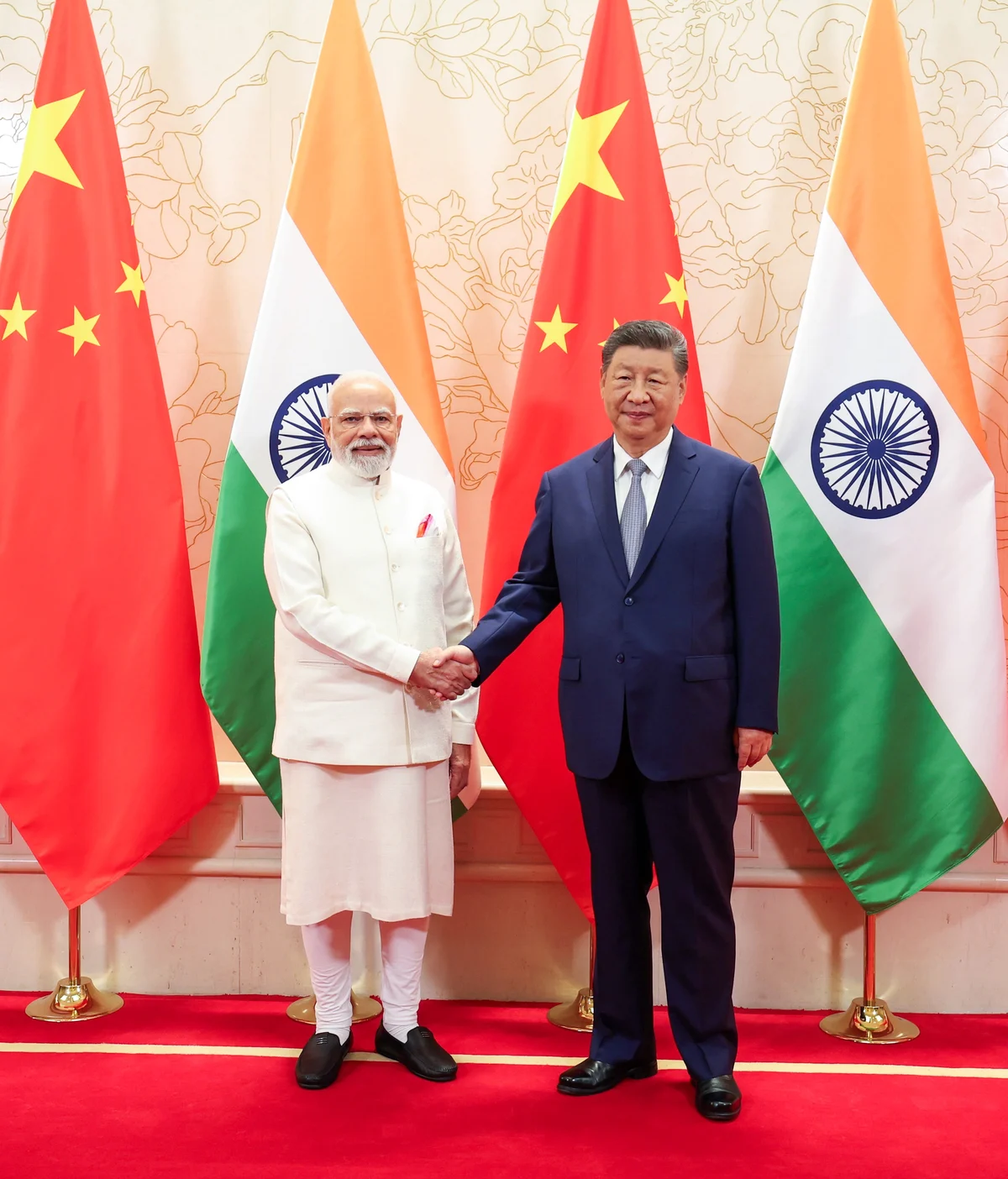
Narendra Modi and Xi Jinping met in New Delhi on 12 September 2026, the latest India–China leader meeting confirmed for this timeline, and India’s account records a commitment to pursue a mutually acceptable boundary resolution through further discussion. The boundary remained unsettled in the published accounts, while the governments highlighted work on trade, business ties, institutional exchanges and mobility.
The meeting took place on the sidelines of the 18th BRICS Summit, which New Delhi hosted on 12–13 September. The summit produced a multilateral declaration that records India’s 2026 BRICS chairship and support for China’s 2027 chairship and the 19th summit. The Modi–Xi conversation had its own record in separate releases from the Indian and Chinese governments. The date and venue connect those documents, and each describes a different set of proceedings.
India’s account puts market access, the structural trade imbalance, supply chains, business ties and mobility on the bilateral agenda. China’s Foreign Ministry emphasizes the gradual resumption of institutional exchanges, wider cooperation and a strategic perspective on the relationship. Both governments confirm that the leaders met. To assess the implications of a particular item, keep the wording attached to the government that issued it, especially when only one account names the issue.
A report about China’s 2027 BRICS chairship can be checked against the summit declaration. A report about terms discussed by Modi and Xi needs the bilateral readouts. Start with the document that covers the claim, then look at the verbs. Raising market access records an agenda item. A subsequent official notice would supply the details needed to establish which products or businesses gained access, on what terms and from what date.
How the talks moved from Kazan to New Delhi
The recent sequence starts with the October 2024 bilateral meeting in Kazan, on the margins of the 16th BRICS Summit. The official account provides a dated record of the encounter and what was discussed. Kazan belongs to an established diplomatic relationship with earlier agreements and longstanding trade and people-to-people exchanges, documented in India’s August 2023 bilateral brief. Use that older brief to follow the history of the relationship and use later releases to establish the status of specific measures.
The leaders next met in Tianjin on 31 August 2025. India’s account described tourist visas and the Kailash Manasarovar pilgrimage as having resumed, and treated direct flights as a step still ahead. That distinction matters when reconstructing the reopening sequence. By November, IndiGo reported that it had begun Delhi–Guangzhou service and had already reinstated Kolkata–Guangzhou in October. The airline’s announcement establishes an operational milestone for those routes after the leaders’ discussion.
The 25th round of Special Representatives’ talks took place in Beijing on 25 August 2026. The Chinese outcome described work on the terms of reference for two border-related groups. The leaders’ New Delhi meeting followed on 12 September, with the boundary question appearing alongside trade and mobility. The sequence shows where to look for different kinds of developments. Leaders’ readouts describe the broader agenda, while the Special Representatives’ outcome gives a closer view of the work assigned on the boundary.
Keep the event date alongside the place and the name of the meeting. Kazan and New Delhi were encounters on the margins of different BRICS summits, with Tianjin in between. A headline about a leaders’ meeting can circulate again when a later development brings the relationship back into the news. Matching those three details to the original release makes it possible to place the claim on the timeline before judging what it adds.
| Date | Track | Place or route | Documented milestone |
|---|---|---|---|
| 23 October 2024 | Leaders’ meeting | Kazan, Russia | Bilateral meeting during the 16th BRICS summit. |
| 31 August 2025 | Leaders’ meeting | Tianjin, China | Bilateral meeting during the Shanghai Cooperation Organisation summit. |
| October 2025 | Air transport | Kolkata to Guangzhou | IndiGo reports resumption of this route. |
| 10 November 2025 | Air transport | Delhi to Guangzhou | IndiGo says its direct service began. |
| 29 March 2026 | Air transport | Kolkata to Shanghai | IndiGo says its new direct service began. |
| July–September 2026 | Air transport | Kolkata to Shanghai | IndiGo announced a temporary suspension in June. |
| 25 August 2026 | Boundary dialogue | Beijing, China | 25th Special Representatives round. |
| 12 September 2026 | Leaders’ meeting | New Delhi, India | Bilateral meeting during the 18th BRICS summit. |
- Prime Minister of India: Bilateral Meeting with President Xi in Tianjin
- Prime Minister of India: Kazan BRICS Bilateral Meeting
- Ministry of External Affairs: India–China Bilateral Brief
- Prime Minister of India readout of Xi meeting in New Delhi, 12 September 2026
- Chinese Foreign Ministry September 2026 bilateral meeting readout
- Chinese Foreign Ministry outcome of the 25th Special Representatives round
- IndiGo official November 2025 daily Delhi–Guangzhou commencement
What the boundary talks can establish
The Beijing outcome identifies two tracks. A boundary delimitation expert group was to work on terms of reference, and a border-management working group under the relevant mechanism was also to work on terms of reference. Delimitation concerns defining the boundary. Border management concerns arrangements for handling conditions and interactions along it. The distinction explains why a development in managing the border and a development in agreeing where the boundary lies call for different evidence.
Terms of reference set out a group’s remit. Working on them is a procedural milestone, with substantive results still to be established through later records. The Indian account of the September meeting likewise describes continued discussion toward a mutually acceptable resolution. Read these two developments together as evidence of diplomatic work at different levels. The documents leave the location and legal status of a final agreed boundary unresolved.
Suppose a news alert says the countries have reached a border agreement and cites the Beijing outcome. The first question is what the agreement covers. If the underlying text describes groups preparing terms of reference, the alert can accurately describe progress in organizing talks. A claim that a particular stretch of boundary has been settled would require language identifying the stretch and recording an agreed outcome. A claim about a change in conditions on the ground would need dated evidence specific to that location.
For a later update, find the exact round of talks and compare the new document with the August account. Look for whether officials are still preparing a remit, have adopted one or are reporting a result under it. These stages answer different questions about progress. When a release gives a country’s own assessment, retain that attribution. A published joint text, if one becomes available, can establish the wording the two governments adopted together.
What the merchandise trade figures show
India’s merchandise trade with China reached US$151.10 billion in FY2025–26, up from US$127.71 billion in FY2024–25, in the Indian Consulate in Shanghai’s series based on Indian Commerce Department figures. Indian exports rose from US$14.25 billion to US$19.47 billion. Indian imports rose from US$113.46 billion to US$131.63 billion. The trade deficit widened from US$99.21 billion to US$112.16 billion. Each figure uses the Indian perspective, so exports are goods India sold to China.
| Period | India’s exports, US$ billion | India’s imports, US$ billion | India’s deficit, US$ billion | Two-way goods trade, US$ billion |
|---|---|---|---|---|
| Fiscal year 2024–25 | 14.25 | 113.46 | 99.21 | 127.71 |
| Fiscal year 2025–26 | 19.47 | 131.63 | 112.16 | 151.10 |
| April–May 2026 only | 3.79 | 24.70 | 20.91 | 28.49 |
The arithmetic explains how trade grew and the deficit widened at the same time. Exports increased by US$5.22 billion across the two full fiscal years and imports increased by US$18.17 billion. Adding those increases gives US$23.39 billion in additional turnover. Subtracting the export increase from the import increase gives the US$12.95 billion widening in the deficit. Turnover measures the size of trade in both directions, while the deficit measures the gap between the two flows.
The April–May 2026 row covers two months. Its US$20.91 billion deficit belongs to that period alone. To determine whether the deficit widened at the start of the fiscal year, obtain April–May figures from the previous year on the same basis. A full-year figure answers a question about a different span, and annualising two months would add an assumption about the pace of trade through the rest of the year.
The trade table helps put India’s September discussion of market access and structural imbalance in context. To establish whether access improved for a specific product, look for a later measure identifying the product and the conditions that changed. Aggregate merchandise values cover all recorded goods in the series. They leave the product mix, services and reasons for changes in individual flows to other evidence. When updating a comparison, pull both periods from the same release or data vintage so revisions do not create an artificial difference.
The consulate also reports year-on-year growth of 18.31% for total fiscal 2025–26 trade and 22.59% for the April–May 2026 total against its comparable two months. The lower value in the April–May row reflects its shorter coverage. This page uses the consulate’s published vintage, including its rounding, for every row.
India–Japan relations, investment and the November 2026 talksIndia–U.S. relations and the latest trade developments
Which flight developments are confirmed?
IndiGo says it began daily direct Delhi–Guangzhou flights on 10 November 2025, following the reinstatement of its Kolkata–Guangzhou service in October. It also says daily nonstop Kolkata–Shanghai service began on 29 March 2026. Those releases document service commencements for specific city pairs. A launch date can establish when a route entered the network, while a current schedule is needed to establish service for a planned trip.
Kolkata–Shanghai illustrates why the follow-up notices matter. On 4 June 2026, IndiGo announced a planned temporary suspension from 1 July through 30 September and envisaged bookings from 1 October. October was therefore a date in the forward plan. The supplied notices confirm the March launch and describe the later suspension plan. Whether service actually resumed, and on which dates seats were subsequently available, requires more recent evidence.
For a traveller considering Kolkata to Shanghai in November, the March announcement explains why the route appears in older coverage. The June notice tells the traveller where the uncertainty begins. Search the airline’s booking inventory for the exact date, check that the result is nonstop and verify the operating carrier. A search result that offers a connection answers whether a journey can be booked, while only a nonstop option answers whether that direct service is available on the chosen day.
For a news update claiming the route returned, look for an airline notice confirming resumed operations or a dated record of a flight that operated. A seat offered for a future date establishes availability for sale at the time of the search. It gives a more useful answer to a prospective passenger than an archived launch notice. An operated flight answers the historical question of whether service ran, and a schedule check remains necessary for other dates.
How to verify visa and pilgrimage updates
India’s Tianjin account treated the resumption of tourist visas and the Kailash Manasarovar pilgrimage as developments already reported by August 2025. The Chinese account of the August 2026 Beijing talks described plans to expand official pilgrimage batches. The first account establishes a reported reopening at that point in time. The second establishes an intention to expand a programme. A reader trying to apply needs the current intake details, which the diplomatic readouts do not supply.
For a tourist visa, begin with the consular authority responsible for the destination and check the guidance that applies to the applicant’s passport and place of application. Look for the visa category, the current application process and the date of any notice announcing a change. A leader-level commitment to facilitate visas can precede revised instructions. A diplomatic reference to mobility can also cover a broader set of exchanges than the category an individual traveller needs.
For the pilgrimage, look for the organiser’s notice for the relevant season and confirm that it covers the official programme. A notice with application dates and batch details supplies the evidence needed to report when applications open and what places are offered. The Beijing account supports saying that an expansion was planned. Use an official intake announcement for any eventual batch count, timing or participation requirements, and distinguish announced places from confirmed departures when reporting what took place.
A traveller may see a bookable flight and a headline about easier visas on the same day. The booking can establish an itinerary on sale, while eligibility and the process for applying come from the applicable consular guidance. Pilgrimage enrolment has its own confirmation through the organiser. Checking the document that controls each decision lets readers act on the current instructions while keeping the diplomatic announcements in their proper historical context.
Sources
- Prime Minister of India: Bilateral Meeting with President Xi in Tianjin
- Prime Minister of India: Kazan BRICS Bilateral Meeting
- Ministry of External Affairs: India–China Bilateral Brief
- Prime Minister of India readout of Xi meeting in New Delhi, 12 September 2026
- Chinese Foreign Ministry September 2026 bilateral meeting readout
- Chinese Foreign Ministry outcome of the 25th Special Representatives round
- BRICS New Delhi Declaration published by the Indian Prime Minister’s Office
- Indian Consulate in Shanghai — bilateral merchandise trade, Commerce Department basis
- IndiGo official November 2025 daily Delhi–Guangzhou commencement
- IndiGo official March 2026 commencement of Kolkata–Shanghai
- IndiGo network notice on July–September 2026 Shanghai suspension
- Government photograph of Narendra Modi and Xi Jinping in Tianjin
