Build a shortlist around the product you need
Shortlist construction-material exporters in India by exact product and destination, then verify the quoting entity, production site and evidence for the goods it would ship. Use council records and company disclosures to find candidates, and compare offers only after each supplier answers the same specification and documentation request.
CAPEXIL’s final 2025–26 electoral roll lists Exotica Tiles LLP of Morbi and Futura Ceramics Pvt. Ltd. of Ahmedabad under Ceramics and Allied Products including Refractories. Their own publications show why that category needs a second pass. Exotica Tiles LLP’s Stonex catalogue describes glazed porcelain products. Futura describes manufacturing and exporting inputs for the ceramic tile industry, including glaze frits and ceramic rollers. A buyer sourcing finished floor tiles can use the Exotica catalogue to frame an enquiry and reserve Futura for an input requirement.
Pacific Industries Limited identifies exporting, manufacturing and trading granite tiles and slabs and quartz slabs among its activities in its FY 2024–25 annual report. Ask which facility would process the offered material and request evidence specific to natural granite or engineered quartz, as applicable. For cement and clinker, Ambuja Cements’ FY 2025–26 business responsibility and sustainability report identifies both as manufactured products. Its standalone reporting scope, which includes the recently merged Sanghi and Penna, reports one international country served and exports of approximately 0.019% of entity turnover. The disclosure leaves the destination, export product mix and available volumes unspecified.
Record the publication and the claim it supports alongside each name. A council electoral roll documents a dated listing. A catalogue shows the range a firm chose to market. A corporate report describes activities and figures within its stated scope. Ask the sales team to confirm the exact product and shipping entity for your order before ranking any of these candidates on availability or export capability.
| Company | Sourcing example | Dated public evidence | What to verify next |
|---|---|---|---|
| Exotica Tiles LLP | Glazed porcelain tiles | CAPEXIL ceramics panel 2025–26 and the product catalogue for Stonex | Match the legal entity, exact tile classification and test report |
| Futura Ceramics Pvt. Ltd. | Frits and ceramic rollers | CAPEXIL ceramics panel 2025–26 and company manufacturing information | Check inputs individually, with a distinct spec for the finished tile |
| Pacific Industries Limited | Granite and quartz slabs or tiles | FY 2024–25 company annual report lists activities | Specify natural versus engineered material, source and test batch |
| Ambuja Cements | Cement and clinker | FY 2025–26 standalone reporting identifies both and limited export turnover | Confirm the grade, destination, available consignment and issuing entity |
- CAPEXIL — official panel product crosswalk
- CAPEXIL 2025–26 final electoral roll — dated ceramic-panel names
- Exotica Tiles LLP — Stonex first-party product catalogue
- Futura Ceramics — first-party manufacturing and export description
- Pacific Industries Limited FY 2024–25 annual report — natural stone example
- Ambuja Cements FY 2025–26 BRSR — cement/clinker reporting and denominator
Verify the quoting entity and production site
Request the supplier’s registered legal name and Importer–Exporter Code, or IEC, with the quotation. India’s Foreign Trade Policy generally requires an IEC for merchandise exports, subject to stated exemptions. The DGFT user manual documents the lookup under Services, then View IEC Related Details, then View Any IEC. Have the IEC and at least the first three characters of the firm name ready for the documented search, and complete the portal’s security prompt. Record the result and date when you perform the check.
Reconcile the IEC entity with the quotation, proposed commercial invoice and payment beneficiary. Record the actual factory, processor or mill separately. Where an exporter buys from another company, ask it to identify who makes or finishes the material, whose site appears on any licence and who issues the batch paperwork. Those answers let you trace a quotation through production, testing and shipment even when more than one entity participates.
Exotica illustrates the value of checking the full name. Its Stonex catalogue identifies Exotica Tiles LLP, which also appears in the CAPEXIL roll. Other Exotica-branded catalogues identify Exotica Ceramic Pvt. Ltd. If the quote names the private limited company, run the IEC check on that company and ask which entity and factory are responsible for the offered goods. Keep the identity check with the purchase file so that a later change of invoice issuer or beneficiary prompts a fresh reconciliation.
Specify the goods before comparing prices
Send every candidate the same enquiry and ask them to identify each proposed deviation. Give the product, intended use, dimensions or grade, quantity and quantity unit, delivery basis and evidence expected with the order. Keep the supplier’s sales description beside your own specification. That makes it easier to spot when an attractive price depends on a different finish, narrower supply scope or different material.
For pressed ceramic tiles, the BIS product manual for IS 15622:2017 groups tiles by water absorption and distinguishes glazing, surface finish, edge finish and size. Suppose two quotes offer glazed porcelain in a nominal 600 × 1,200 mm size. Put thickness and edge finish on both quote sheets and ask for the reported water absorption and breaking strength, with the test method and product identification. You can then judge each against the project requirements and see exactly which characteristics still lack evidence.
On stone enquiries, name the material, source, cut dimensions, thickness and finish and ask how the sample connects to the offered lot. A finished slab and a raw block leave different amounts of processing with the buyer. For cement, ask for the exact grade, specification, dispatch batch and mill certificate. IS 269:2015 covers ordinary Portland cement. Where the enquiry is for bulk clinker, put the clinker requirements and bulk shipping basis directly on the quote so they can be compared with other clinker offers.
| Product | Fields to compare | Evidence to request |
|---|---|---|
| Pressed ceramic tile | Absorption group, glazing, surface and edge finish, nominal size and thickness | Product or batch report for dimensions, absorption and breaking strength |
| Natural building stone slab | Stone and source, cut dimensions, thickness, finish and lot | Identified sample and any project-required results using the specified method and edition |
| Cement or clinker | Exact material, grade or agreed specification, packaging or bulk basis and dispatch batch | Mill certificate tied to the material and batch |
| Agreed specifications across offers | Intended use, quantity unit, delivery basis, tolerances and declared deviations | Written offer identifying the goods and documents included |
Check what licences and test reports actually cover
When a supplier claims a BIS licence, ask for its details and check the site, product and scope through BIS Care’s Verify Licence Details. BIS LIMS also supports searching by Indian Standard number. Use the standard search to identify the reference behind the claim and the licence check to establish which site and products the licence covers. Keep a separate record of the report that supplies the measurements your project needs.
For a report presented as NABL-accredited, search by laboratory name or certificate number. The NABL directory says its records synchronize daily and provides validity, status and linked scopes. Check the laboratory site and whether the accreditation covered the exact test method and material at the time of testing. Then trace the report’s sample or batch identifier to the goods on offer. Laboratory scope and sample identity answer different questions, and the buyer needs both to assess a result.
A supplier quoting natural stone for cladding might send a report citing IS 1124:1974. That method addresses water absorption, apparent specific gravity and porosity. If the report identifies a previous lot, the values describe the reported sample. Ask for evidence tied to the proposed lot and check whether the project calls for that method and edition. Compare the measurements with the specified acceptance limits. Where the project calls for additional properties, keep them visible as separate requirements and request the corresponding evidence.
Natural resources of India by mineral, region and measurement
Check the Indian export code and destination rules
Get the proposed eight-digit ITC-HS item from the supplier and check it against the exact product description. India’s classification aligns with the international Harmonized System at six digits. CAPEXIL panel crosswalks can help find candidate items, but use DGFT’s current Schedule II and applicable notices to verify the item and any conditions. Notification 50/2024–25 put an updated schedule and general notes into effect on 13 January 2025. Search DGFT Regulatory Updates for subsequent changes before relying on a code or policy status.
Check the destination using the actual material and intended use, and confirm the applicable requirements with the importer or project team. For an EU order, the main provisions of Construction Products Regulation 2024/3110 apply from 8 January 2026, with specified earlier and later provisions and transitions that depend on the product family and technical specification. Identify the harmonised technical specification or assessment pathway that applies, then check the required declaration, CE marking and importer responsibilities for that product and use.
Where an EU buyer receives a CE marking claim for a tile range, ask the supplier to identify the declaration for the exact tile and intended use in the quotation. Have the importer confirm the applicable regime and compare the declared performance with the project specification. Record the technical reference and declaration identifier alongside the product code. If a supplier changes the range or proposes a substitute, those references show which evidence needs another review.
India–Germany relations, trade, transit and the 2026 visitIndia–France relations, trade and the 2026 partnership
Agree what the supplier will provide for the shipment
India’s Foreign Trade Policy identifies baseline export paperwork covering the mode-specific transport record, commercial invoice and packing list, and the applicable shipping bill, bill of export or postal bill of export. Additional documents can apply to particular goods or cases. Separate the documents available for review before purchase from those generated for dispatch. A sample packing list can show how a supplier records packages, while the eventual order records should identify the actual goods and quantities.
Put the evidence due for your order into the quote comparison and agree when each item will be supplied. For packaged cement, ask how the dispatch batch on the mill certificate will be traced to the packaged goods and shipment records. If the supply would draw from multiple batches, ask how the supplier will identify each portion and document it. That gives the receiving team a way to apply the agreed acceptance criteria to the material delivered.
Compare offers at the same delivery point and on the same quantity and packaging basis. Have each bidder state what the price includes, who prepares any extra documents and which tests depend on allocation of the production lot. Keep open items visible in the comparison. An offer awaiting a required result or a confirmed dispatch window can remain a candidate while you establish whether it meets the purchasing deadline.
Use export figures to put the shortlist in context
CAPEXIL’s DGCI&S series shows the value of Indian exports across each full council panel. Among the five panels below, Ceramics and Allied Products had the largest FY 2024–25 value and fell 10.44% from the prior fiscal year. The panel covering cement and clinker rose 11.96%. Use these comparisons to see the scale and direction of the published categories. The categories also include goods outside the construction products a buyer may have in mind.
The values are nominal current US dollars in millions, and each Indian fiscal year runs from April through March. The annual change divides the difference between the two years by FY 2023–24 value. These are export flows by value. Questions about tonnes shipped or an individual supplier’s contribution require separate data. The historical cement panel title is reproduced in full to preserve the scope of the reported series.
| Panel name | FY 2023–24 | FY 2024–25 | Change versus prior FY |
|---|---|---|---|
| Ceramics and Allied Products | 3,275.59 | 2,933.66 | −10.44% |
| Natural Stones and Products | 1,907.14 | 1,827.56 | −4.17% |
| Cement, Clinkers and Asbestos Cement Products | 787.10 | 881.21 | +11.96% |
| Glass and Glassware | 1,121.85 | 1,162.07 | +3.59% |
| Plywood and Allied Products | 1,488.99 | 1,481.57 | −0.50% |
For a newer commodity figure, open the Department of Commerce’s annual TradeStat interface, select Exports and choose the reporting level, fiscal year and currency unit. Use Commodity × Country when you need the flow for a particular product and destination. The annual documentation makes quantity available at the eight-digit product level. When comparing quantities, record the stated unit and confirm it matches across the periods you choose.
Use monthly TradeStat when a full fiscal year would obscure the period you need. Match the months in both years, label any year-to-date window and record the displayed update and revision status. A comparison for a specific polished stone product should hold the item definition, destination and value basis steady across periods. Keep the resulting series labelled by its selection so readers can distinguish it from the broader Natural Stones and Products panel.
These panels include goods for other uses, so they work as reference points for the council’s named groupings. Keep the historical panel name and consult the actual commodity code when looking up only one product. The monthly TradeStat interface showed revised-final data through March 2026 and final data through September 2026 after its 18 November update. Compare matching months and retain the revision label with any newer figures.
Sources
- CAPEXIL panel export performance — DGCI&S series prepared 28 May 2025
- Department of Commerce annual TradeStat — export chapter and exact commodity route
- Department of Commerce monthly TradeStat — official September 2026 vintage
- CAPEXIL — official panel product crosswalk
- DGFT Foreign Trade Policy 2023 — Chapter 2
- DGFT Notification 50/2024–25 — the 13 January 2025 export schedule revision
- DGFT IEC Module User Help File V4.1 — View Any IEC procedure
- CAPEXIL 2025–26 final electoral roll — dated ceramic-panel names
- Exotica Tiles LLP — Stonex first-party product catalogue
- Futura Ceramics — first-party manufacturing and export description
- Pacific Industries Limited FY 2024–25 annual report — natural stone example
- Ambuja Cements FY 2025–26 BRSR — cement/clinker reporting and denominator
- BIS pressed ceramic tiles product manual — IS 15622:2017
- BIS building materials standards — natural building stones
- BIS ordinary Portland cement — IS 269:2015
- NABL — accredited laboratory and scope search
- EUR-Lex — EU Construction Products Regulation 2024/3110, destination example
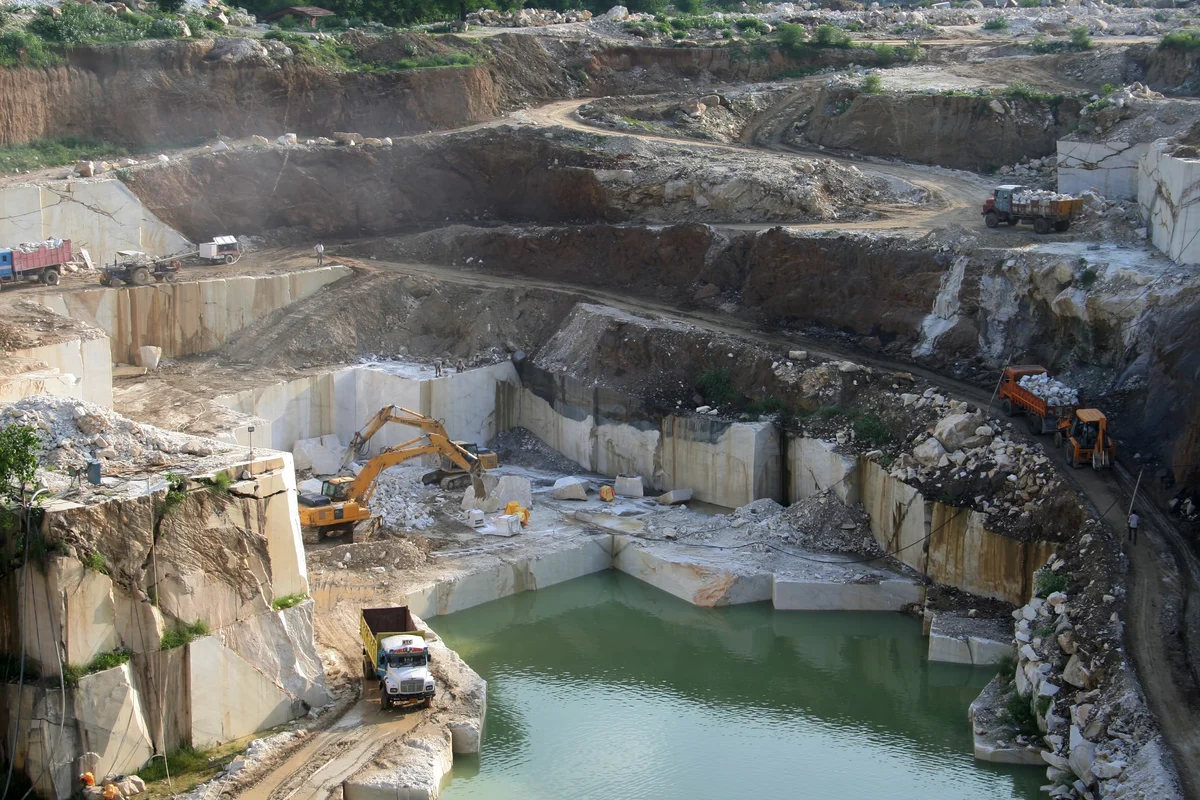
- Marble quarry near Jaipur, Rajasthan — original photo and license
- DGFT Importer–Exporter Code portal user manual
- India Foreign Trade Policy 2023
- NABL accreditation verification FAQ
