India’s official national dish status
India has no officially designated national dish in the government records reviewed. Khichdi was cooked at World Food India in 2017 to set a Guinness record and promote an Indian recipe, and the Union food processing minister explicitly rejected the claim that it was being made the national dish.
The 2017 story combined a world-record attempt and a campaign to promote an Indian recipe at a food industry event. The title of a record identifies the achievement Guinness measured. The ministry’s event coverage supplies the context and the cooked quantity. For an official national designation, look for an authoritative government decision granting that status to a named dish.
The Embassy of India’s national-symbols overview gives a practical cross-check. It lists the flag, anthem, national song and State Emblem, and includes no national dish. An overview can be selective, so its silence carries limited weight on its own. The wider search found no act, Gazette notification, Union resolution or government announcement conferring the designation. For the specific claim about khichdi, there is also direct evidence in the minister’s clarification and the ministry’s own account of what the event was for.
India’s national anthem: words, 52-second version and occasions
- Ministry of Food Processing Industries, World Food India 2017 record certificate and event report
- Union food processing minister’s World Food India clarification, 1 November 2017
- Embassy of India, official overview of India’s national identity elements
- Dhaka Tribune, archived contemporary embed of the minister’s original post
What happened to khichdi at World Food India in 2017?
On 1 November 2017, Union food processing minister Harsimrat Kaur Badal addressed the claim that khichdi was being made India’s national dish. She explained that the dish was entered for a record at World Food India. On 4 November, Sanjeev Kapoor and the Ministry of Food Processing Industries achieved the Guinness record in New Delhi. The ministry’s report puts the finished quantity at 918 kilograms, cooked in one vessel. The Food Safety and Standards Authority of India also describes the cooking as a record attempt involving a traditional dish.
The certificate reproduced in the ministry’s report gives the category as the largest serving of beans and rice. That wording matters because it identifies exactly what Guinness measured. The ministry describes the event as promotion for an Indian recipe. The President’s closing address gives another view of the occasion, celebrating local food traditions, diverse grains and multiple preparations of khichri and biryani. The address contains no announcement designating a national dish.
For a caption about the Delhi event, use 918 kilograms and describe the achievement as a record set in 2017. A preview gives an intended quantity, so the ministry’s completed-event report is the source for how much was actually cooked. Guinness lists a later achievement in the same category. Himachal Pradesh’s Department of Tourism and Civil Aviation recorded a serving of 1,995 kilograms at Tattapani in Mandi on 14 January 2020, during a Makar Sankranti event.
| Date | Event or statement | Established fact |
|---|---|---|
| 1 November 2017 | Food processing minister’s clarification | Khichdi was entered for the World Food India record |
| 4 November 2017 | World Food India, New Delhi | 918 kg in the largest serving of beans and rice category |
| 14 January 2020 | Tattapani, Mandi, Himachal Pradesh | Subsequent Guinness entry in the category, 1,995 kg |
The Ministry of Food Processing Industries describes World Food India as an event that promotes Indian food culture and investment in the food sector. It identifies the New Delhi event as the first edition of a continuing programme. The 2017 certificate describes what was achieved there and gives the record category, date and location. Those document fields are useful when a later caption shortens the story to a single line.
- Food Safety and Standards Authority of India: 2017 Khichdi Event
- Press Information Bureau: World Food India 2017 Closing Address
- Ministry of Food Processing Industries, World Food India 2017 record certificate and event report
- Union food processing minister’s World Food India clarification, 1 November 2017
- Guinness World Records, subsequent largest serving of beans and rice
- Dhaka Tribune, archived contemporary embed of the minister’s original post
- Ministry of Food Processing Industries, purpose and editions of World Food India
How to verify a new national-dish claim
Start with the exact words of the claim and the date it gives. If a post says that a ministry declared a national dish, look for the named ministry’s announcement or the text of the decision it cites. Search official releases and Gazette notices using the name of the dish and the phrase “national dish.” Open the document and read the relevant paragraph in context. Words such as “traditional” and descriptions of a recipe chosen for promotion establish how the source presents the food. An official designation would need wording that actually grants that status.
Suppose a new post uses a photograph of the 2017 cooking event and says India has just named khichdi its national dish. The ministry report can establish what the photographed event was and when it took place. Badal’s clarification addresses the interpretation attached to that event. A claim about a fresh decision still needs a current dated announcement or decision. Checking the photograph and checking the claimed change are separate pieces of verification, even when both appear in a single caption.
Use Guinness for the holder, weight and date of a record, since a later event can change the standing entry. Use a government document for a claim of official designation. For figures quoted from a speech, check whether the source documents how they were obtained. The President’s reference to about 290 variations was rhetorical, with no documented count or sampling method in the transcript. The speech supports the point that preparations vary, while a reliable numerical inventory would need evidence of its own.
- Press Information Bureau: World Food India 2017 Closing Address
- Ministry of Food Processing Industries, World Food India 2017 record certificate and event report
- Union food processing minister’s World Food India clarification, 1 November 2017
- Embassy of India, official overview of India’s national identity elements
- Guinness World Records, subsequent largest serving of beans and rice
How khichdi varies in Bihar and Bengal
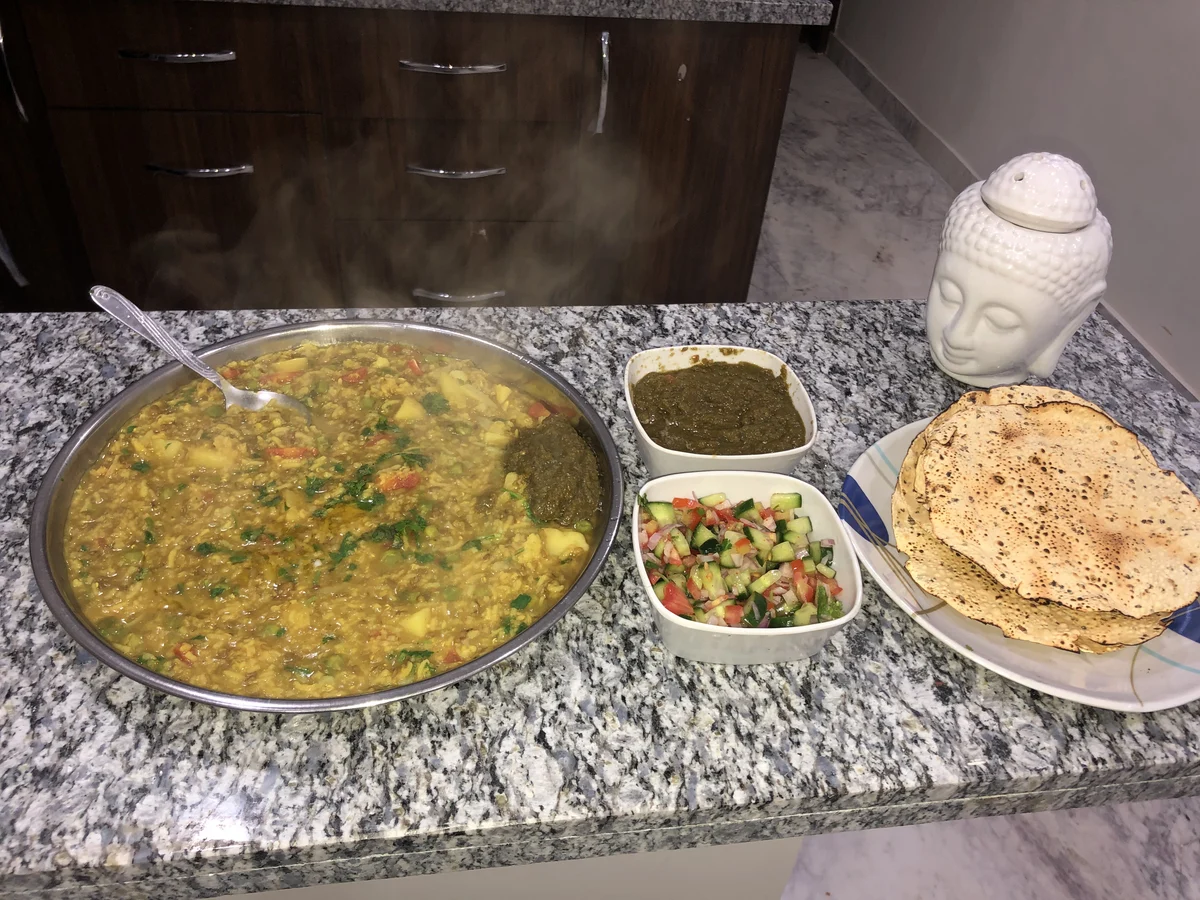
Bihar Tourism describes khichdi made with rice and lentils, with room for vegetables and spices. Its account gives aloo chokha, a seasoned mashed potato preparation, as a common accompaniment. It also describes a winter masala version with vegetables and ghee and mentions sides such as pickle, papad and chutney. These details explain why the name of the cooked dish tells you only part of what might arrive at the table. The accompaniments can be a meaningful part of the meal in their own right.
The Bihar account records associations with Saturday meals and Makar Sankranti. Those details are useful when explaining how the same dish can have a place in a regular meal and in an occasion marked on the calendar. The source describes local practices that vary by household. It gives a basis for discussing those associations without assigning one schedule, set of sides or combination of ingredients to every family in the state.
For a Bengali example, a Food Safety and Standards Authority of India collection includes Subhasish Banerjee’s kichudi. The recipe specifies Gobindo Bhog rice and moong dal, uses turmeric, onion and tomato, and calls for cumin, dried chilli and bay leaf in the tempering. The named contributor and ingredient list make it possible to describe a specific preparation. A description of devotional bhog kichudi would need a recipe or account tied to that setting, since this collection entry supports claims about Banerjee’s version.
If you are choosing a recipe because you want to serve khichdi with seasoned mashed potatoes, Bihar Tourism gives you a documented pairing to look for. If the rice variety and the cumin, chilli and bay leaf tempering are what you want to reproduce, Banerjee’s entry gives you those details. A recipe title offers a starting point. Reading the ingredients and what is served alongside them is what lets you choose the meal you have in mind.
Indian rice varieties by growing region and dishIndian spices and how to use them
Gatte ki khichdi and ven pongal
Rajasthan Tourism identifies Gatte ki Khichdi, also called Ram Paulo in its account, as a rice dish made with gatta, a gram-flour dumpling preparation. The dumplings are the detail to look for when identifying the dish. This example broadens what a reader may expect from the word khichdi after seeing recipes built around rice and dal. The same tourism account also describes dal baati churma, a separate dish that brings together lentils, baked wheat balls and sweet churma. Knowing the names and components makes both easier to recognise on a menu.
In Tamil Nadu, ven pongal provides a related rice-and-lentil preparation with its own name. The NCERT account describes a savoury dish seasoned with pepper, cumin, ginger and clarified butter. It also mentions sweet chakkarai pongal and discusses Pongal as a harvest festival. The fuller name makes clear which preparation is meant in a recipe or menu description. In a calendar or an account of celebrations, Pongal can refer to the festival itself. Keeping ven pongal’s Tamil name also makes the comparison easier to follow when a reader looks for the dish locally.
The details worth checking depend on where you encounter the name. An ingredient list can tell you whether a preparation uses moong dal or gram-flour dumplings. A menu description may give you the savoury or sweet distinction. An account of a celebration can explain when a dish is eaten and what role it has there. These sources answer different questions, so the most precise description of a serving starts with what the cook, menu or recipe actually calls it.
| Name to look for | Documented detail | What to check on the menu or in the recipe |
|---|---|---|
| Bihar khichdi | Rice and lentils, with aloo chokha given as an accompaniment | Whether it comes with chokha and which other sides are served |
| Banerjee’s Bengali-style kichudi | Gobindo Bhog rice, moong dal and a cumin, dried chilli and bay leaf tempering | Which rice, dal and tempering the recipe specifies |
| Gatte ki Khichdi or Ram Paulo | Rice with gram-flour dumplings in the Rajasthan Tourism account | Whether the listing mentions gatta |
| Ven pongal | Savoury rice and lentils with pepper, cumin, ginger and clarified butter | Whether the listing specifies ven pongal or sweet chakkarai pongal |
What other regional foods can represent
The President’s closing address at World Food India gives examples beyond khichdi. It names taenga in Assam, sarson da saag in Punjab, dhokla in Gujarat and dosa in Tamil Nadu and elsewhere in southern India. These associations are specific enough to give someone useful names to look up. The wording around dosa is particularly helpful because it names Tamil Nadu and explicitly acknowledges a wider area. A place named alongside a dish gives a starting point for learning about it, while claims about origin or exclusive association would require separate evidence.
The address also mentions multiple preparations of biryani. If someone suggests biryani as a food that represents India, the immediate choice is which preparation they want to show and why. The speech can support an account of variety. It supplies neither a ranking of dishes by popularity nor the recipe details needed to describe a specific biryani. To write a useful menu note or decide what to order, look for the preparation’s full name and a description from the cook, restaurant or recipe author.
For a short introduction to Indian food, choose examples that let you say something concrete within the space available. If a museum caption has room for only two dishes, it could pair Bihar khichdi served with aloo chokha with Rajasthan’s Gatte ki Khichdi, provided it draws on the separate state accounts for those details. That pairing lets a reader see what goes beside one dish and what goes into the other. For a caption based solely on the closing address, the named regional examples can illustrate the foods the President chose to mention. Broader claims about how often people eat any of those dishes would call for a different source.
Hyderabadi vs Thalassery biryani: rice, dum and two chicken recipesIndia Gate basmati rice compared: Classic, Super, Tibar and more
Sources
- Food Safety and Standards Authority of India: 2017 Khichdi Event
- Press Information Bureau: World Food India 2017 Closing Address
- Ministry of Food Processing Industries, World Food India 2017 record certificate and event report
- Union food processing minister’s World Food India clarification, 1 November 2017
- Embassy of India, official overview of India’s national identity elements
- Guinness World Records, subsequent largest serving of beans and rice
- Bihar Tourism, Bihar khichdi and accompaniments
- FSSAI recipe collection, Subhasish Banerjee’s Bengali-style kichudi
- Rajasthan Tourism, Rajasthani cuisine
- NCERT, India: Unity in Cultural Diversity, Tamil Nadu food and festival section
- Reusable photograph, daal khichdi with salad, chutney and papad
- Dhaka Tribune, archived contemporary embed of the minister’s original post
- Ministry of Food Processing Industries, purpose and editions of World Food India
