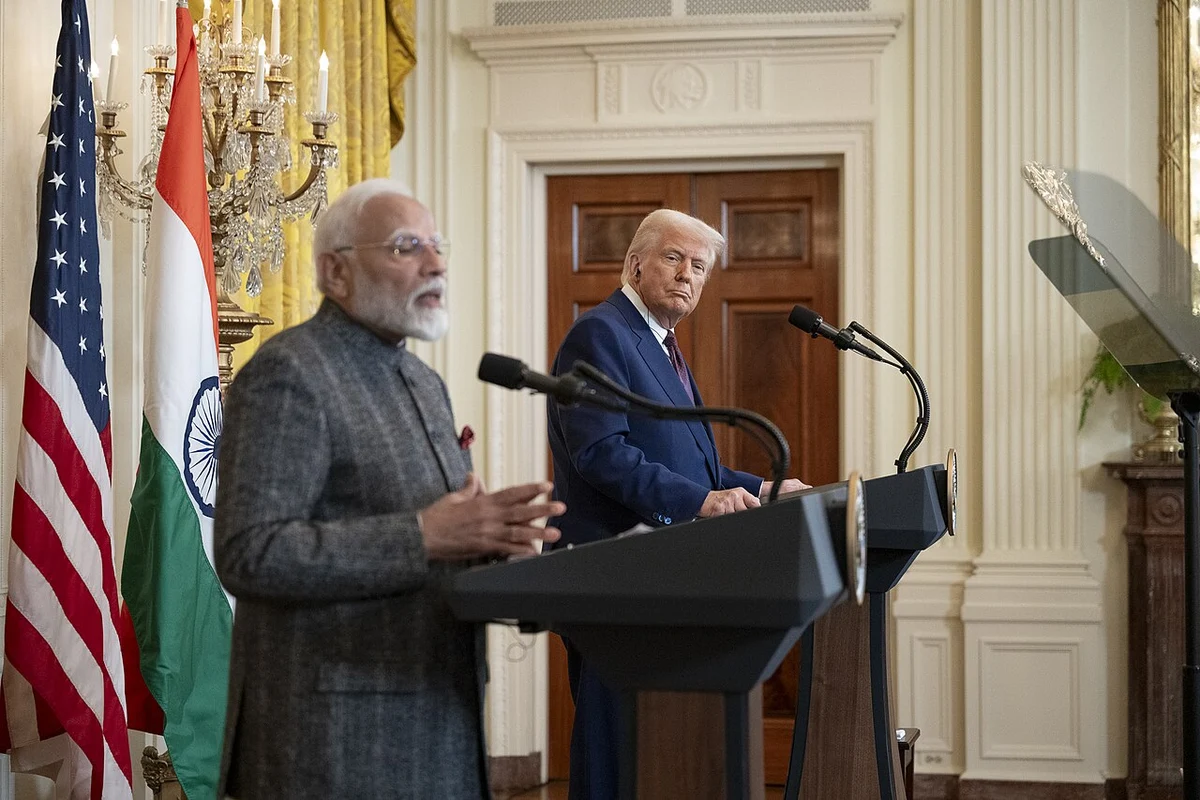
Trump and India in November 2026
Donald Trump’s relationship with India under Prime Minister Narendra Modi combined strategic cooperation with a running trade negotiation that produced an interim framework in February 2026 and remained open in November. Trump and Modi joined the Quad summit in Manila on 17 November, and on 25 November the US proposed additional tariffs on Indian goods of up to 25% net of existing Section 301 tariffs, with the proposed rates still awaiting any final action.
The November events took place in different settings. At Manila, Trump and Modi joined the Australian and Japanese prime ministers, and the leaders’ joint release covered critical-mineral supply chains and maritime cooperation. The tariff announcement came from the Office of the United States Trade Representative, or USTR, through a US trade proceeding. The summit record establishes that the leaders continued to work together in the four-country grouping. It supplies no evidence of a bilateral tariff settlement.
For readers following the trade dispute, the latest proposal sits alongside a separate July measure that imposed an additional 10% duty on covered Indian products. The February framework also mentioned an 18% rate, but the US ended the legal authority used for that tariff action. Each figure belongs to a particular document and stage of the process. The timeline starts with Trump’s first presidential visit to India and tracks how those stages diverged.
| Date | Record or legal basis | Status | What it establishes |
|---|---|---|---|
| 13 February 2025 | Joint leaders’ statement | Negotiation goal | First trade tranche planned and Mission 500 two-way trade goal announced. |
| 6–7 February 2026 | Joint interim framework | Framework | Contemplated 18% under the then applicable IEEPA reciprocal order. |
| 7 February 2026 | Executive Order 14384 | Removal | Separate additional 25% duty linked to Russian oil was removed. |
| 20 February 2026 | U.S. Supreme Court ruling and termination order | Ended IEEPA duties | Ruling and Executive Order 14389 ended the affected IEEPA tariff actions. |
| 24 February–24 July 2026 | Trade Act Section 122 | Expired | Temporary 10% surcharge applicable to covered goods under that provision. |
| 24 July 2026 | Forced-labour Section 301 final action | Effective final action | Additional 10% on covered Indian products under the separate notice and exceptions. |
| 25 November 2026 | Structural excess capacity Section 301 notice | Proposal | Up to 25% net of existing Section 301 duties, with comment requested on a conditional 17% option. |
| 5 and 25 January 2027 | USTR India-specific proceeding | Scheduled process | 5 January written comments and 25 January start of hearing in published notice. |
- White House: U.S.–India Joint Statement, February 2026
- USTR final Section 301 forced-labour action and Indian government confirmation, July 2026
- USTR Section 301 structural excess capacity and production proposal, 25 November 2026
- India Ministry of External Affairs, United States trade portal
- Quad leaders' joint press release, 17 November 2026
- USTR’s proposed India action and public comment schedule
- Supreme Court of the United States, Learning Resources decision of 20 February 2026
- Executive Order 14389 ending certain tariff actions
- Government of India confirmation of the July Section 301 action
- White House: U.S.–India Joint Leaders' Statement, February 2025
- India Lok Sabha written answer on US tariffs, Ministry of Commerce and Industry, 10 March 2026
February 2020 to January 2025 — From the India visit to the first call
Trump visited India on 24–25 February 2020 during his first presidency. In their joint statement of 25 February, the leaders committed to strengthening the Comprehensive Global Strategic Partnership. The archived White House statement and the record preserved by India’s Ministry of External Affairs establish the visit and its diplomatic outcome. The partnership is the clearest first-term milestone in this timeline because both governments recorded what the leaders agreed to pursue.
The January 2025 call between Trump and Modi provides the next dated record in this account. The White House readout records an intention to work on bilateral economic relations. A call readout captures the topics and intentions a government chooses to report. Here, its place in the sequence matters because it establishes an economic agenda before Modi’s working visit to Washington in February, when the leaders gave that agenda a trade target and a plan for negotiations.
The two records therefore answer different questions about continuity between Trump’s terms. The 2020 statement gives the diplomatic relationship a formal name and records a commitment to strengthen it. The January 2025 readout shows an early economic priority in the second term. Neither document settles what the countries would agree on market access. For that, the first record in this timeline with a negotiating timetable is the February 2025 joint statement.
February 2025 — Mission 500 and the first trade negotiations
Following Modi’s working visit to Washington in February 2025, the leaders announced Mission 500, an aspiration to raise two-way trade in goods and services to US$500 billion by 2030. They also announced plans to negotiate the first tranche of a bilateral trade agreement, initially aiming for fall 2025. The joint statement gives the trade target and negotiating timetable separate jobs. One describes the scale the governments wanted trade to reach. The other describes when they initially hoped to deliver a first part of an agreement.
A second US$500 billion figure appeared in the February 2026 framework. That figure describes India’s stated intention to purchase specified US products over the following five years. Direction and timing are essential to reading the two figures. Mission 500 counts trade flowing in both directions and sets a target for 2030. The later purchase intention concerns one direction and covers a five-year period. The announcements provide no basis for adding the figures or using either as a record of completed purchases.
One way to see the difference is to consider a US services export to India. It contributes to total bilateral goods and services trade under the Mission 500 measure. To determine whether a purchase also belongs within the separately announced intention, a reader would have to check whether it falls within the specified products and period. The shared headline number alone cannot answer that question.
February 2026 — What the interim framework said
The United States and India published a joint framework for an interim trade agreement on 6 February US time. India’s Press Information Bureau posted the same statement at 04:29 IST on 7 February. Those dates mark publication of a single announcement. The framework dealt with an interim agreement and explicitly distinguished it from the wider negotiations on a comprehensive bilateral trade agreement. That distinction matters when headlines refer simply to an India–US trade deal.
The framework contemplated an 18% US reciprocal tariff for covered Indian goods under Executive Order 14257. It also envisaged possible relief for specified goods after successful conclusion. Both qualifications matter. Coverage depended on the measure’s terms, and the prospective relief depended on a later step. The framework records the governments’ position in early February. To establish duties on a later date, the relevant record is the sequence of US legal actions that followed.
The original fall 2025 aim also needs to stay attached to the February 2025 announcement. It was the leaders’ initial timetable for a first tranche. The February 2026 text establishes that the two sides subsequently announced terms for an interim framework while the broader negotiations continued. An account that dates both documents lets the reader see how the public milestones changed without inferring the reasons for the timing from the dates alone.
February to July 2026 — Which duties ended and which began
India’s Ministry of Commerce and Industry set out the February tariff changes in a written Lok Sabha answer on 10 March. The separate US 25% duty linked to purchases of Russian oil was removed effective 7 February under Executive Order 14384. That removal concerned the oil-linked duty. The base reciprocal duties belonged to a different action. On 20 February, the US Supreme Court ruled that the International Emergency Economic Powers Act, or IEEPA, does not authorize tariffs. Executive Order 14389 then directed the termination of listed IEEPA duties, including those under Executive Order 14257.
The US began applying a general temporary 10% import surcharge on covered goods on 24 February under Section 122. It expired on 24 July, according to the US proclamation and World Trade Organization monitoring. A separate USTR action published on 23 July imposed an additional 10% ad valorem duty on covered Indian products from 00:01 US Eastern time on 24 July. That action arose from a Section 301 forced-labour investigation. The two 10% figures shared a transition date but had different legal bases and product coverage.
India’s July statement cited generic pharmaceuticals, smartphones and goods covered by Section 232 among the exemptions. It estimated that around 45% of Indian exports to the US were outside coverage at the time. India’s release gave no calculation for that estimate. For exact exclusions, the relevant source is the schedule in the US legal notice.
India–U.S. relations and the latest trade developmentsIndia–Russia relations, trade figures and the 2026 meetings
- White House: U.S.–India Joint Statement, February 2026
- India Lok Sabha written answer on US tariffs, Ministry of Commerce and Industry, 10 March 2026
- USTR final Section 301 forced-labour action and Indian government confirmation, July 2026
- Supreme Court of the United States, Learning Resources decision of 20 February 2026
- Executive Order 14389 ending certain tariff actions
- Government of India confirmation of the July Section 301 action
November 2026 — What the US proposed and what comes next
Eight days after the Manila Quad summit, USTR announced a proposed Section 301 action following investigations into structural excess capacity and production. The proposal described an additional tariff structure for India of up to 25% net of existing Section 301 tariffs, with possible product exclusions. The wording on existing tariffs is part of the proposal itself. Adding 25 percentage points to the separate July 10% duty would misstate the published proposal.
USTR also asked for views on a possible 17% rate if a responsive Agreement on Reciprocal Trade were reached. That rate appears as a conditional option in the US notice. The notice establishes neither that such an agreement exists nor that either rate has taken effect. Its India-specific schedule sets 5 January 2027 as the deadline for written comments and 25 January 2027 as the start of the hearing. Those dates describe the consultation process.
For the next update, look for a final action in the USTR proceeding and check its effective date, product schedule and treatment of existing duties. An Indian government response would establish India’s public position on the proposal. Evidence of a completed bilateral agreement would come from an official agreement text and any applicable entry-into-force or implementation notices. India’s July parliamentary update still listed the comprehensive agreement among ongoing negotiations, and the available official records through late November do not establish a completed signed agreement.
The notice describes the proposed figure as net of existing Section 301 duties. Treat the 17% as an option for public input conditional on a responsive reciprocal agreement. Use the final legal action, product coverage and effective date for a current tariff calculation. The hearing and written comment dates are milestones in the proposal process.
- USTR final Section 301 forced-labour action and Indian government confirmation, July 2026
- USTR Section 301 structural excess capacity and production proposal, 25 November 2026
- India Ministry of External Affairs, United States trade portal
- Quad leaders' joint press release, 17 November 2026
- USTR’s proposed India action and public comment schedule
How much the US and India actually traded
USTR estimates US–India trade in goods and services at US$239.6 billion for calendar 2025. Its separately rounded components are US$149.1 billion in goods and US$90.4 billion in services. This is the closest supplied comparison to Mission 500 because both measures encompass two-way trade in goods and services. The estimate is about 48% of the US$500 billion target, a comparison of the two published amounts. It gives no forecast for the remaining years to 2030.
From the US perspective, goods exports to India were US$45.4 billion and goods imports from India were US$103.8 billion, producing a US goods deficit of US$58.4 billion. US services exports to India were US$42.9 billion and services imports were US$47.6 billion, with a US services deficit of US$4.7 billion. The total measures the volume of trade, while the balances measure the difference between exports and imports.
The Reserve Bank of India publishes a separate merchandise series for the fiscal year from 1 April 2025 to 31 March 2026. Its provisional figures put Indian goods exports to the US at US$87.316 billion and imports from the US at US$53.4887 billion, for about US$140.8 billion in two-way goods trade. The roughly US$33.8 billion surplus belongs to that Indian fiscal-year series. Quoting it beside the US goods deficit requires keeping the reporting country and period visible. The two series cover different months, so subtracting their balances cannot isolate a reporting discrepancy.
India–U.S. relations and the latest trade developmentsConstruction material exports from India, suppliers and documents
How to verify the next trade headline
Start with the date and the kind of document behind the claim. The February joint statement records a framework, the July USTR notice records final action with a product schedule, and the November notice records a proposal with a comment deadline. Those records have different consequences even when coverage of each leads with a percentage. For a claim about a duty taking effect, find the instrument that sets the effective date and read the relevant schedule alongside any later amendments, termination orders or expiry provisions.
If a headline says the India tariff rose to 25%, identify the measure before comparing it with any previous rate. The 25% oil-linked duty was removed in February. The separate figure of up to 25% in November belongs to a proposal that accounts for existing Section 301 tariffs. A publication date on a press release can establish when officials made an announcement. The effective-date provision in a final legal instrument establishes when that action applies.
For a claim that negotiations have concluded, compare USTR’s presidential tariff actions archive with India’s Ministry of External Affairs trade portal and any official release from India’s commerce ministry. Look for the agreement’s scope and the dates the parties give for signature and entry into force. A joint announcement can establish that both governments reached a framework. A later official text or implementation notice is needed to establish which commitments took effect and when.
- White House: U.S.–India Joint Statement, February 2026
- India Lok Sabha written answer on US tariffs, Ministry of Commerce and Industry, 10 March 2026
- USTR final Section 301 forced-labour action and Indian government confirmation, July 2026
- USTR Section 301 structural excess capacity and production proposal, 25 November 2026
- India Ministry of External Affairs, United States trade portal
Sources
- White House: Trump–Modi Call, January 2025
- White House: U.S.–India Joint Leaders' Statement, February 2025
- White House: U.S.–India Joint Statement, February 2026
- United States and India joint statement from Trump's first presidential visit, archived White House
- India Lok Sabha written answer on US tariffs, Ministry of Commerce and Industry, 10 March 2026
- USTR final Section 301 forced-labour action and Indian government confirmation, July 2026
- USTR Section 301 structural excess capacity and production proposal, 25 November 2026
- India Ministry of External Affairs, United States trade portal
- Quad leaders' joint press release, 17 November 2026
- USTR India trade fact sheet, calendar-year 2025 US estimates
- Reserve Bank of India Table 119, country-wise merchandise trade, 31 July 2026 vintage
- Trump and Modi in the White House, exact event photograph by Molly Riley
- USTR’s proposed India action and public comment schedule
- Supreme Court of the United States, Learning Resources decision of 20 February 2026
- Executive Order 14389 ending certain tariff actions
- Government of India confirmation of the July Section 301 action
