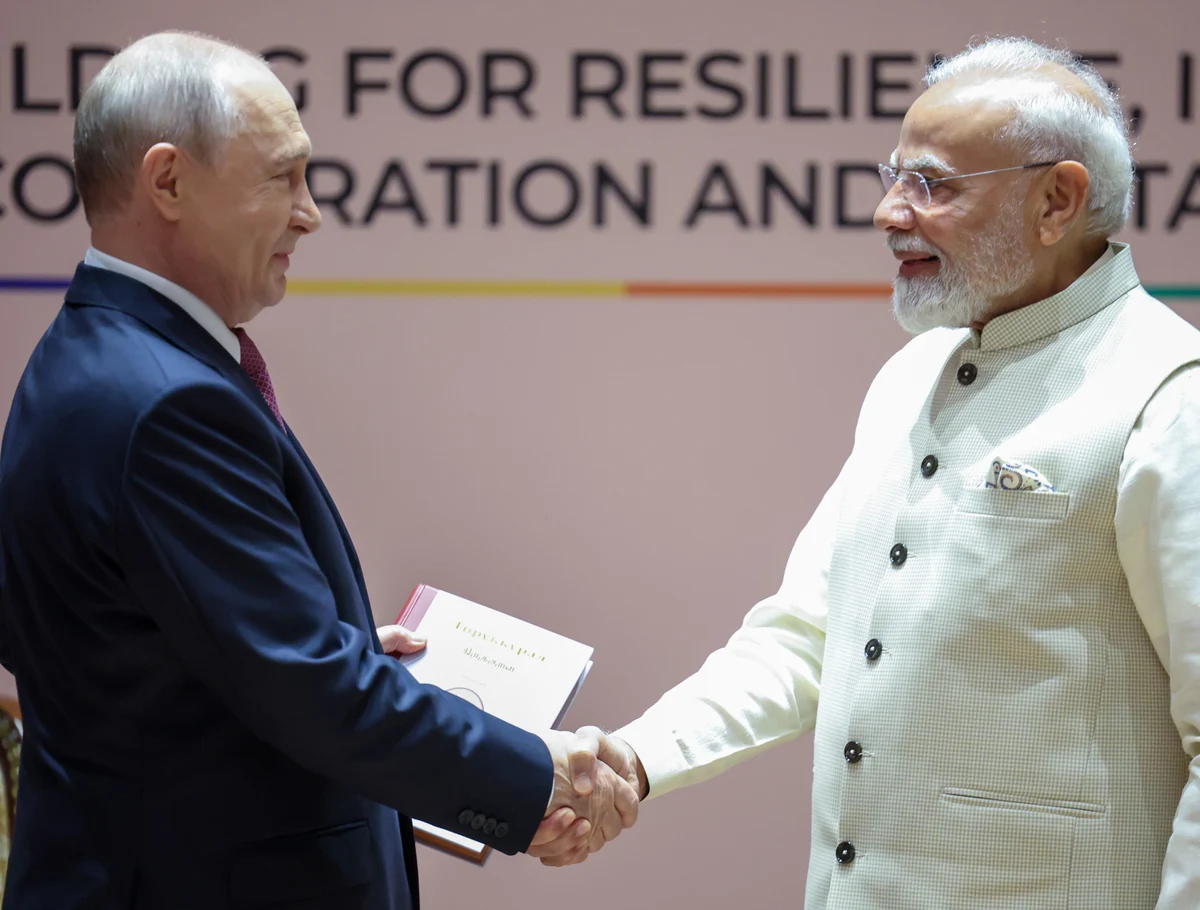
Where India–Russia relations stand
India and Russia maintain a Special and Privileged Strategic Partnership, and Narendra Modi and Vladimir Putin held two bilateral meetings in 2026, in Bishkek on 31 August and New Delhi on 11 September. Modi accepted Putin’s invitation to Russia for the 24th India–Russia Annual Summit, with the date still awaiting confirmation in the available official record.
The latest completed annual summit in that record was the 23rd, held during Putin’s 4–5 December 2025 state visit to New Delhi. The leaders adopted an economic cooperation programme through 2030. Its agenda included trade, energy and transport connectivity, alongside work on investment arrangements. A September 2026 business engagement then put figures on India’s ambitions for bilateral trade and investment.
The diplomatic and economic records answer different questions. Summit statements document what the governments agreed to pursue. Merchandise statistics show how much India exported to and imported from Russia during a completed financial year. The latest provisional figures put two-way goods trade at about US$59.86 billion in FY 2025–26, with imports from Russia accounting for most of that value. That year ended on 31 March 2026, several months before the two leaders met in Bishkek and Delhi.
- Ministry of External Affairs: India–Russia Bilateral Brief
- Prime Minister of India: 23rd India–Russia Annual Summit
- Modi–Putin meeting on the sidelines of the 18th BRICS Summit, 11 September 2026
- India Ministry of Commerce on the bilateral economic agenda, 10 September 2026
- Reserve Bank of India Table 119, country-wise merchandise trade, 31 July 2026 vintage
From the 2000 partnership to the 2026 meetings
India and Russia established their Strategic Partnership in October 2000 and elevated it to a Special and Privileged Strategic Partnership in 2010. That title describes the framework for the relationship. The numbered annual summit is a mechanism within it, with an official record for each edition. Leaders also meet bilaterally when they attend a wider gathering, which gives them another occasion to discuss the relationship between annual summits.
The sequence begins with Modi’s visit to Moscow for the 22nd annual summit on 8–9 July 2024. Putin then travelled to New Delhi for the state visit that included the 23rd annual summit in December 2025. The December joint statement is the source for the adoption of the programme through 2030 and for the language the two governments used about prospective trade and investment arrangements.
The venue and host forum changed in 2026. Modi and Putin met in Bishkek on 31 August during the Shanghai Cooperation Organisation summit. Their second bilateral meeting of the year took place in New Delhi on 11 September during the 18th BRICS Summit. The number 18 belongs to the BRICS summit. In India’s account of the Delhi meeting, the number 24 refers to the future India–Russia annual summit for which Putin extended the invitation.
To identify a meeting in a headline or archive, match its date, city and event name to the official release. Putin met Modi in New Delhi both in December 2025 and in September 2026. The December visit supplies the annual summit’s adopted economic programme. The September readout supplies the invitation for the next edition and records Modi’s acceptance.
| Date | Area | What the official record says |
|---|---|---|
| October 2000 | Partnership | Established strategic partnership. |
| 2010 | Partnership | Elevated to the Special and Privileged Strategic Partnership. |
| 20 August 2025 | Trade talks | India and EAEU signed terms of reference for talks on goods. |
| 26–28 November 2025 | Trade talks | First India–EAEU negotiating round reported in New Delhi. |
| 4–5 December 2025 | Annual Summit | 23rd India–Russia Annual Summit during Putin’s state visit. |
| 31 August 2026 | 2026 bilateral meeting | Modi and Putin met on the sidelines of the SCO summit in Bishkek. |
| 11 September 2026 | 2026 bilateral meeting | BRICS sideline meeting in New Delhi, with invitation for the 24th annual summit. |
What the 2030 trade and investment targets mean
At the September 2026 India–Russia business engagement, India’s Ministry of Commerce stated a goal of US$100 billion in annual bilateral trade and US$50 billion in bilateral investments by 2030. The trade figure refers to a yearly flow. The investment figure describes a separate objective. Adding them together would mix economic measures and give the impression of a single US$150 billion target.
The annual summit programme and the ministry’s business agenda give some context for how the governments hope to expand the relationship. The December statement covered energy, trade and connected transport. The September engagement addressed market access, industrial cooperation and diversification. Those topics identify areas of discussion. Evidence that a particular investment is going ahead would need to identify the project, the parties and the stage it has reached.
The FY 2025–26 merchandise total of about US$59.86 billion gives a sense of the scale of current goods trade alongside the headline ambition. A progress percentage would require confirmation that the target uses the same coverage and reporting period. Check whether the official measure includes services and whether the target is assessed by financial year or calendar year before using a merchandise series as the denominator for progress.
Market access and diversification also have distinct implications for India’s side of the trade figures. Higher Indian exports to Russia could lift total trade while narrowing India’s goods deficit if imports stayed steady. Higher imports from Russia could also lift total trade while widening the deficit if exports stayed steady. Reporting the two directions separately shows which change produced a larger headline total.
India–China relations, the 2026 talks, trade and flightsDonald Trump and India, trade, tariffs and the November 2026 proposal
How much India trades with Russia
The Reserve Bank of India’s Table 119 publishes country-wise merchandise figures from India’s Directorate General of Commercial Intelligence and Statistics. Its 31 July 2026 edition measures flows from India’s perspective. Indian exports are goods sent to Russia, while Indian imports are goods sourced from Russia. The financial years run from 1 April to 31 March, and the edition marks FY 2025–26 as provisional.
| Indian fiscal year | Goods exported to Russia | Goods imported from Russia | Two-way goods trade | India’s goods deficit |
|---|---|---|---|---|
| 2021–22 | 3,254.7 | 9,870.0 | 13,124.7 | 6,615.3 |
| 2022–23 | 3,147.0 | 46,212.7 | 49,359.7 | 43,065.7 |
| 2023–24 | 4,261.3 | 61,159.2 | 65,420.5 | 56,897.9 |
| 2024–25 | 4,881.3 | 63,811.4 | 68,692.7 | 58,930.1 |
| 2025–26 provisional | 4,493.5 | 55,369.6 | 59,863.1 | 50,876.1 |
The largest jump in the selected years came between FY 2021–22 and FY 2022–23. Two-way goods trade rose from US$13.12 billion to US$49.36 billion. Indian imports from Russia increased from US$9.87 billion to US$46.21 billion, while Indian exports to Russia edged down. The increase in imports accounts for the jump in the total, and India’s goods deficit widened to about US$43.07 billion that year.
Trade reached its highest value in the selected series in FY 2024–25, at about US$68.69 billion. The provisional figure for the following year was about US$8.83 billion lower, a decline of nearly 13%. Imports accounted for about US$8.44 billion of that fall. Indian exports fell by about US$388 million over the same interval. The goods deficit narrowed by about US$8.05 billion because imports fell by more than exports.
The deficit column expresses the gap as a positive magnitude. To reproduce it for FY 2025–26, subtract US$4,493.5 million in exports from US$55,369.6 million in imports. The result is US$50,876.1 million. A source that expresses the trade balance as exports minus imports will show the same gap with a minus sign. Both calculations here cover merchandise alone, so a broader measure of bilateral economic activity would need separate services and investment data.
For fiscal 2025–26, the table’s goods turnover is about $59.86 billion after converting millions to billions. Its last row is provisional. The 2030 objective of $100 billion in annual trade belongs to a policy target, while the $50 billion investment objective has a different measure. Preserve the fiscal period and source before comparing the current merchandise series with those objectives.
How much of India’s imports from Russia is petroleum
The India Brand Equity Foundation’s FY 2025–26 trade profile records US$44.38 billion in Indian imports of crude petroleum and petroleum products from Russia. The same profile puts total Indian merchandise imports from Russia at US$55.36 billion. Dividing the first figure by the second gives about 80.2%. In other words, roughly four out of every five dollars of Indian goods imports from Russia in that profile came from the combined petroleum category.
The denominator matters if the question is how dependent India is on Russian oil. To calculate Russia’s share of India’s crude oil imports by value, use a Russia-only crude import figure and divide it by India’s crude import bill from all suppliers over the same period. To calculate the share by physical volume, use matching volume figures. The supplied petroleum category combines crude and petroleum products, and the 80.2% calculation measures the composition of imports from Russia.
Use the IBEF figures together when reproducing that share. Its rounded import total differs slightly from the RBI figure because the publications round and revise separately. A full-year customs value also combines the effects of prices, quantities and the mix of products purchased. Determining whether shipments rose or fell after March 2026 would require evidence for the later period. A claim about the treatment of a particular shipment would require separate evidence specific to that shipment and the rules in force at the time.
Natural resources of India by mineral, region and measurement
Where the India–Eurasian Economic Union goods talks stand
Russia is a member of the Eurasian Economic Union, and the goods agreement India has been negotiating has an EAEU scope. India and the EAEU signed terms of reference in Moscow on 20 August 2025. India’s Commerce Department records the first negotiating round in New Delhi on 26–28 November 2025. The December India–Russia summit statement discussed work towards the agreement, and India’s 21 July 2026 parliamentary update still listed it as under negotiation.
The terms of reference set up the talks. The negotiating round shows that discussions had begun, and the bilateral summit statement records political support for carrying the work forward. To establish that a preferential tariff applies, look for an agreement in force and a published tariff schedule covering the product and trade direction in question. The available record establishes the negotiating milestones and leaves entry into force unconfirmed.
An Indian exporter reading that talks have advanced can use the announcement to track the negotiations. To assess a future shipment, the exporter would need the product’s tariff classification, the applicable schedule, its effective date and any origin conditions attached to the preference. The investment work referenced at the annual summit sits on a separate track. Progress on an investment arrangement would require its own documentation and would leave the goods tariff question to the trade agreement and its implementation.
What to check when a new development is reported
For the 24th annual summit, the September meeting readout is the starting point. India’s Prime Minister’s Office said the dates would be set through diplomatic channels. A later official announcement that specifies the dates would establish the schedule. A joint statement or official account issued after the leaders meet would establish that the summit took place and show which outcomes they announced. Check the date and event name in each release, since leaders can meet in person at other forums while the annual summit is pending.
For trade negotiations, compare the latest Ministry of Commerce or parliamentary update with the July 2026 wording. Look for the step that a new announcement actually documents, whether it is another round, the conclusion of negotiations, signature or entry into force. A report about signature answers a different question from a published effective date. The distinction matters especially when someone cites an agreement as the basis for a claim about duties on goods.
For a new annual trade number, record the publication edition, the period it covers and any provisional label. An updated series can revise previous years as well as add a new one. Use two observations from the same edition where possible when calculating a year-on-year change. For a report issued partway through a financial year, compare the same months in the previous year and keep the result separate from the full-year figures.
Sources
- Ministry of External Affairs: India–Russia Bilateral Brief
- Prime Minister of India: 23rd India–Russia Annual Summit
- Modi–Putin meeting on the sidelines of the 18th BRICS Summit, 11 September 2026
- India Ministry of Commerce on the bilateral economic agenda, 10 September 2026
- India–Eurasian Economic Union goods talks, Ministry of Commerce official record
- Reserve Bank of India Table 119, country-wise merchandise trade, 31 July 2026 vintage
- IBEF India–Russia trade profile, 2025–26 merchandise and import category
- Modi and Putin at the Delhi BRICS summit, exact 11 September 2026 PMO photo
