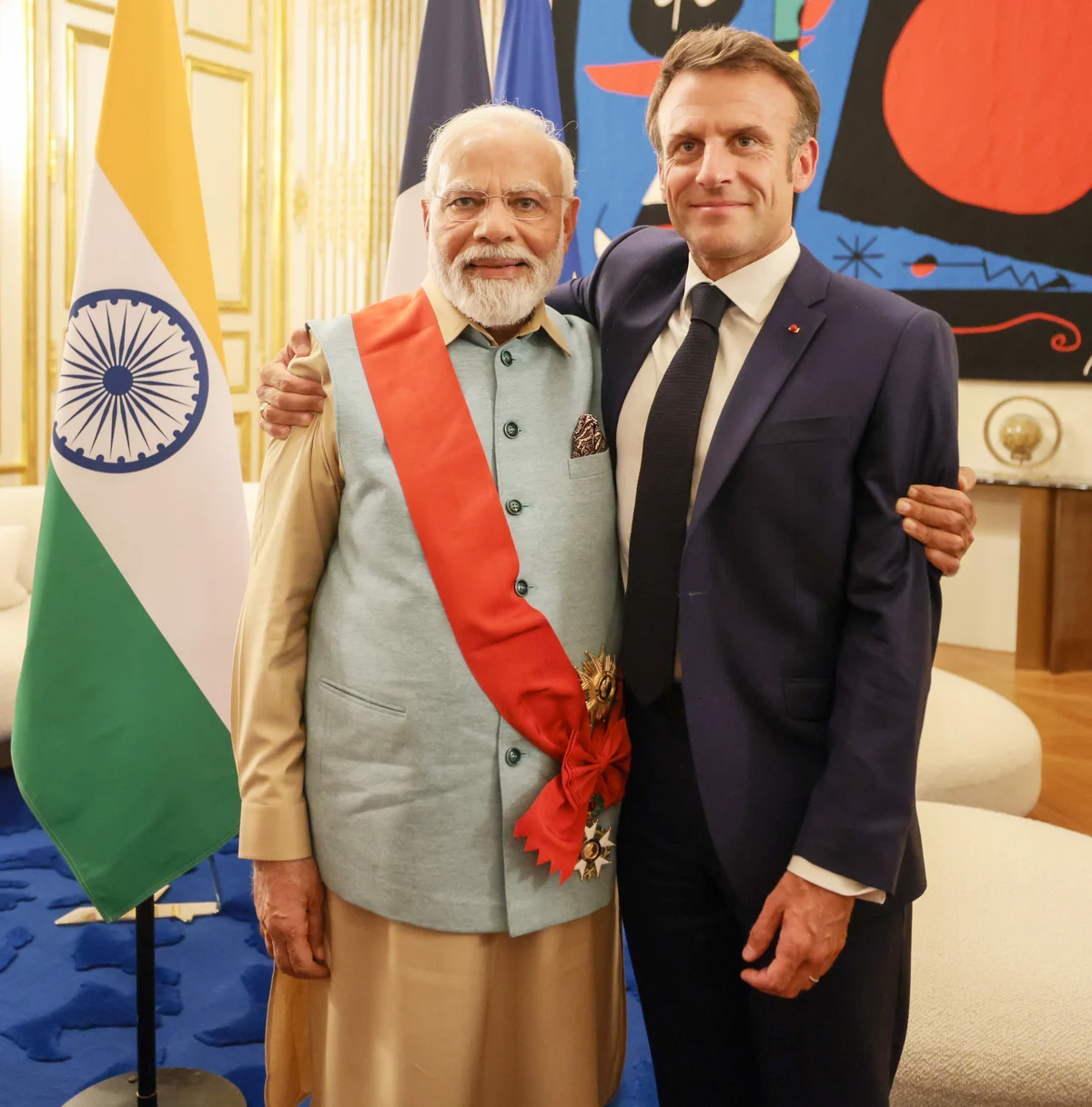
India’s allies and partners at a glance
India is outside NATO, and India’s Ministry of External Affairs has historically described the country as outside major military alliances. The United States, France, Russia, Japan and Australia are documented strategic partners, while Bhutan has a friendship treaty with India that sets out specific security commitments.
The word “ally” can refer to a government that works closely with India or, in a narrower military sense, one bound by a defence commitment. For the narrower meaning, look for a treaty in force and read the provision that says what happens after an attack. For the diplomatic meaning, a dated joint statement can establish the name of a partnership and show what the two governments have agreed to work on.
| Country | Documented relationship | Dated record |
|---|---|---|
| United States | Comprehensive Global Strategic Partnership | Joint leaders’ statement, 13 February 2025 |
| France | Special Global Strategic Partnership | Joint statement, 17 February 2026 |
| Russia | Special and Privileged Strategic Partnership | 23rd annual summit joint statement, 5 December 2025 |
| Japan | Special Strategic and Global Partnership | 15th annual summit and Joint Vision for the Next Decade, 29 August 2025 |
| Australia | Comprehensive Strategic Partnership | Bilateral leaders’ statement, 4 June 2020 |
| Bhutan | India–Bhutan Friendship Treaty, including Article 2 security commitments | Signed 8 February 2007 and entered into force 2 March 2007 |
The table gives a set of documented relationships to look up. The adjectives in their titles come from separate bilateral records, so there is no common scale on which “special,” “privileged” and “comprehensive” rank one country above another. The dates identify the source for each entry. Australia’s date marks the announcement of an upgrade, while Russia’s marks a reaffirmation of an existing partnership.
- Ministry of External Affairs — Indian Treaties Database and legal document search
- MEA — stated foreign policy context on alliance membership and partner relationships
- NATO — official North Atlantic Treaty, 4 April 1949
- NATO — official member countries list
- White House — United States–India Joint Leaders’ Statement, 13 February 2025
- Élysée — India–France Joint Statement, 17 February 2026
- Ministry of Foreign Affairs of Japan — 15th Japan–India Annual Summit, 29 August 2025
- Australian DFAT — India–Australia Comprehensive Strategic Partnership, 4 June 2020
- Indian PMO — 23rd India–Russia Annual Summit joint statement, 5 December 2025
- MEA — India–Bhutan Friendship Treaty, signed 8 February and in force 2 March 2007
- Australian DFAT — the Quad’s institutional overview, participants and programmes
What a military alliance can require
Article 5 of the North Atlantic Treaty, signed on 4 April 1949, gives a concrete example of collective defence. The parties agree to consider a covered armed attack against one or more of them an attack against them all. Each party must assist and decides what action it deems necessary. The treaty says that action may include armed force, so even an express collective-defence obligation leaves room for different responses by different members.
NATO’s official list names 32 member countries and excludes India. Cooperation with an individual NATO member gives India no Article 5 coverage. If a report calls France a defence ally of India, for example, the French government’s NATO membership answers a question about France’s obligations within that alliance. Any obligation France owes India would need a separate basis that applies to the two countries.
India’s older official foreign-policy overview links its position outside major military alliances to its history of non-alignment and describes deeper relationships with major powers and the European Union. That overview explains how the ministry presented its approach. To evaluate a claim about a specific obligation today, check the legal instrument and its status. A national policy description and a membership list answer different questions, and each has a defined scope.
- U.S. State Department Archive: Collective Defense Arrangements
- Ministry of External Affairs — Indian Treaties Database and legal document search
- MEA — stated foreign policy context on alliance membership and partner relationships
- NATO — official North Atlantic Treaty, 4 April 1949
- NATO — official member countries list
The United States and France
The United States and India used the title Comprehensive Global Strategic Partnership in their joint leaders’ statement of 13 February 2025. The statement identifies work on prosperity, technology and other areas of cooperation. It provides a direct source for calling the United States a strategic partner. A claim that Washington owes India military assistance after an attack would require a separate legal basis, since the statement creates no such obligation.
India and France established their strategic partnership in 1998. In 2023 they marked its 25th anniversary with Horizon 2047, a roadmap organised around named fields of cooperation and milestones. At their Mumbai talks on 17 February 2026, the leaders announced an elevation to a Special Global Strategic Partnership. Both governments published the joint statement, making its wording available through the French Presidency and India’s Prime Minister’s Office.
The French and Indian statement describes an annual comprehensive dialogue between foreign ministers and work spanning space, research, health, education and culture. The leaders also inaugurated the 2026 India–France Year of Innovation on 17 February. To explain what changed at the Mumbai meeting, use the new title, the dialogue and the inauguration. To explain where the relationship came from, use the 1998 starting point and the 2023 roadmap. Each date answers a distinct question.
Japan, Australia and the Quad
Japan and India used their Special Strategic and Global Partnership as the framework for the Joint Vision for the Next Decade at their 15th annual summit on 29 August 2025. Japan’s foreign ministry identifies investment, innovation and exchanges between people among the areas of cooperation. Australia and India announced their Comprehensive Strategic Partnership on 4 June 2020, upgrading a strategic partnership dating to 2009. Their bilateral statement identifies trade and investment, education and innovation among its areas of work.
Australia, India, Japan and the United States also participate in the Quad. Australia’s foreign ministry describes it as a diplomatic partnership for an open, stable and prosperous Indo-Pacific. Its account covers consultations and practical cooperation on humanitarian assistance and disaster response, technology and economic resilience. The four leaders met in Manila on 17 November 2026. Their joint press release sets out a public agenda and records participation at that summit. It establishes no shared obligation to come to a participant’s military defence.
The timing of two November meetings illustrates how to attribute an announcement. Japan’s foreign ministry separately records the 19th Japan–India Foreign Ministers’ Strategic Dialogue on 19 November 2026, two days after Manila, and identifies economic security among its topics. Use that record for what the Japanese and Indian ministers discussed. Use the Manila release for the agenda the four governments put forward together. A country can pursue a topic bilaterally and in the Quad, so the participants and document determine whose commitments a report describes.
- Ministry of External Affairs: Quad Bilateral and Multilateral Brief
- Ministry of Foreign Affairs of Japan — 15th Japan–India Annual Summit, 29 August 2025
- Ministry of Foreign Affairs of Japan — 19th Japan–India Foreign Ministers’ Strategic Dialogue, 19 November 2026
- Australian DFAT — India–Australia Comprehensive Strategic Partnership, 4 June 2020
- Australian DFAT — the Quad’s institutional overview, participants and programmes
- Australian Prime Minister — shared Quad Leaders’ Summit joint press release, 17 November 2026
Russia today and the 1971 Soviet treaty
India and the Russian Federation set out their strategic partnership in an October 2000 declaration and upgraded it in December 2010 to a Special and Privileged Strategic Partnership. The joint statement issued on 5 December 2025 after the 23rd India–Russia Annual Summit reaffirmed that title and marked 25 years since the 2000 declaration. It records cooperation in trade, education and culture. These documents establish the dates of the modern diplomatic partnership and show how both governments described it at the summit.
The Treaty of Peace, Friendship and Cooperation that India signed with the Soviet Union on 9 August 1971 contained specific security provisions. Article IX calls for immediate mutual consultations in the event of an attack or threat and for appropriate effective measures to safeguard peace and security. It also commits each party to withhold assistance from a third party in armed conflict with the other. The clause leaves the choice of measures open and specifies no automatic troop contribution.
Article XI of the 1971 treaty set an initial 20-year term and successive five-year extensions unless a party gave timely notice. It tied entry into force to the exchange of instruments of ratification. The October 2000 declaration refers to a Treaty of Friendship and Cooperation dated 28 January 1993 and describes continuity with the Soviet-period relationship. To determine what that continuity means for Article IX today, the next records to consult are the full 1993 treaty, its effective status and any provisions governing the earlier agreement. The declaration’s reference establishes the existence of the 1993 treaty in the parties’ account, while leaving those legal questions open.
- Indian PMO — 23rd India–Russia Annual Summit joint statement, 5 December 2025
- MEA — India–Russia relationship brief and historical upgrade dates
- MEA — Republic of India and Russian Federation Declaration on Strategic Partnership, October 2000
- MEA — India–USSR Treaty of Peace, Friendship and Cooperation, 9 August 1971
What Bhutan’s friendship treaty commits both countries to do
India and Bhutan signed their Friendship Treaty in New Delhi on 8 February 2007. It entered into force on 2 March 2007 when they exchanged ratifications in Thimphu. Article 2 provides for close cooperation on issues relating to their national interests. Each government also undertakes to prevent its territory from being used for activities harmful to the other’s national security and interests. The treaty gives a reader both a specific commitment to cite and a recorded date when it took effect.
Suppose a report says the treaty guarantees Indian troops would intervene if Bhutan came under attack. Article 2 supports a narrower account. It commits both governments to cooperate and to address harmful use of their own territory. It does not prescribe an armed response to an attack. To check the report’s stronger claim, ask which provision establishes an attack as the trigger and which provision requires troops. The territorial undertaking matters on its own terms, including in situations where no armed attack has occurred.
What BRICS and SCO membership tells you
India chaired the 18th BRICS Summit in New Delhi on 12–13 September 2026. The resulting declaration addresses global governance, multilateral cooperation and economic topics. India’s participation in the Quad leaders’ meeting in Manila that November is a documented example of the same government working in both forums. The New Delhi declaration provides evidence of what participants addressed together at that BRICS summit. It supplies no bilateral defence guarantee between them.
The Shanghai Cooperation Organisation is an intergovernmental organisation with a charter dated 7 June 2002. Article 1 sets out objectives that include mutual trust, regional stability and economic, social and cultural cooperation. The Astana Declaration of 9 June 2017 records the decision to admit both India and Pakistan as members. That document answers whether the two countries joined the same organisation. To answer whether one has promised to defend the other, look for a provision binding those countries to act after an attack. Shared membership alone supplies no such provision.
- Australian Prime Minister — shared Quad Leaders’ Summit joint press release, 17 November 2026
- Indian PMO — BRICS New Delhi Declaration, 12–13 September 2026
- Shanghai Cooperation Organisation — Charter of 7 June 2002 and institutional purposes
- Shanghai Cooperation Organisation — Astana Declaration, 9 June 2017
How to verify an alliance claim or an updated partnership title
Start with the exact claim. For an updated partnership title, find the latest dated bilateral statement relevant to the wording and check whether it announces an upgrade or reaffirms a title already in use. If both governments publish the joint text, use their copies to check the wording and date. Read the passage itself. A title can stay in use across several summits, and a meeting date alone cannot tell you when the designation began.
For a legal claim, search the Indian Treaties Database by country, year and keywords from the instrument’s title. The Ministry of External Affairs describes the collection as generally covering agreements made by the Republic of India since 1950. Where the record supplies them, compare signature, ratification and entry into force. A signature date tells you when the text was signed. The entry-into-force record tells you when it became effective, and later instruments may be needed to determine whether the same clause still applies.
Read the operative clause for who is bound, what triggers action and what response is required. If the claim concerns NATO specifically, confirm the country’s membership on NATO’s official list. Where the database search yields only a reference to an agreement, report that reference and treat the precise legal obligation as unresolved. The public collection can verify a document it holds, but a missing result cannot establish the absence of every agreement.
| Name | Scope | Official record | Date |
|---|---|---|---|
| Quad | India, Australia, Japan and United States | Dated leaders’ summit joint release | 17 November 2026 |
| BRICS | Multilateral grouping | New Delhi declaration and scope in its own text | 12–13 September 2026 |
| Shanghai Cooperation Organisation | Multilateral organisation | Charter purposes and separate Astana membership record | 9 June 2017 membership record |
| India–France bilateral partnership | India and France | Special Global Strategic Partnership joint statement | 17 February 2026 |
| India–Japan bilateral dialogue | India and Japan | Nineteenth foreign ministers’ strategic dialogue | 19 November 2026 |
India–Nepal relations, treaties, trade and the 2026 state visitIndia–Türkiye relations, diplomacy, trade and travelIndia–Afghanistan relations, civilian projects and recent talks
- U.S. State Department Archive: Collective Defense Arrangements
- Ministry of External Affairs — Indian Treaties Database and legal document search
- NATO — official member countries list
- Élysée — India–France Joint Statement, 17 February 2026
- Indian PMO — 23rd India–Russia Annual Summit joint statement, 5 December 2025
- MEA — India–Russia relationship brief and historical upgrade dates
- MEA — India–Bhutan Friendship Treaty, signed 8 February and in force 2 March 2007
Sources
- Ministry of External Affairs: Quad Bilateral and Multilateral Brief
- U.S. State Department Archive: Collective Defense Arrangements
- Prime Minister of India: India–France Horizon 2047
- Ministry of External Affairs — Indian Treaties Database and legal document search
- MEA — stated foreign policy context on alliance membership and partner relationships
- NATO — official North Atlantic Treaty, 4 April 1949
- NATO — official member countries list
- White House — United States–India Joint Leaders’ Statement, 13 February 2025
- Élysée — India–France Joint Statement, 17 February 2026
- Ministry of Foreign Affairs of Japan — 15th Japan–India Annual Summit, 29 August 2025
- Ministry of Foreign Affairs of Japan — 19th Japan–India Foreign Ministers’ Strategic Dialogue, 19 November 2026
- Australian DFAT — India–Australia Comprehensive Strategic Partnership, 4 June 2020
- Indian PMO — 23rd India–Russia Annual Summit joint statement, 5 December 2025
- MEA — India–Russia relationship brief and historical upgrade dates
- MEA — Republic of India and Russian Federation Declaration on Strategic Partnership, October 2000
- MEA — India–USSR Treaty of Peace, Friendship and Cooperation, 9 August 1971
- MEA — India–Bhutan Friendship Treaty, signed 8 February and in force 2 March 2007
- Australian DFAT — the Quad’s institutional overview, participants and programmes
- Australian Prime Minister — shared Quad Leaders’ Summit joint press release, 17 November 2026
- Indian PMO — BRICS New Delhi Declaration, 12–13 September 2026
- Shanghai Cooperation Organisation — Charter of 7 June 2002 and institutional purposes
- Shanghai Cooperation Organisation — Astana Declaration, 9 June 2017
- Existing India IRL visual — Narendra Modi and Emmanuel Macron at Paris ceremony, 14 July 2023
