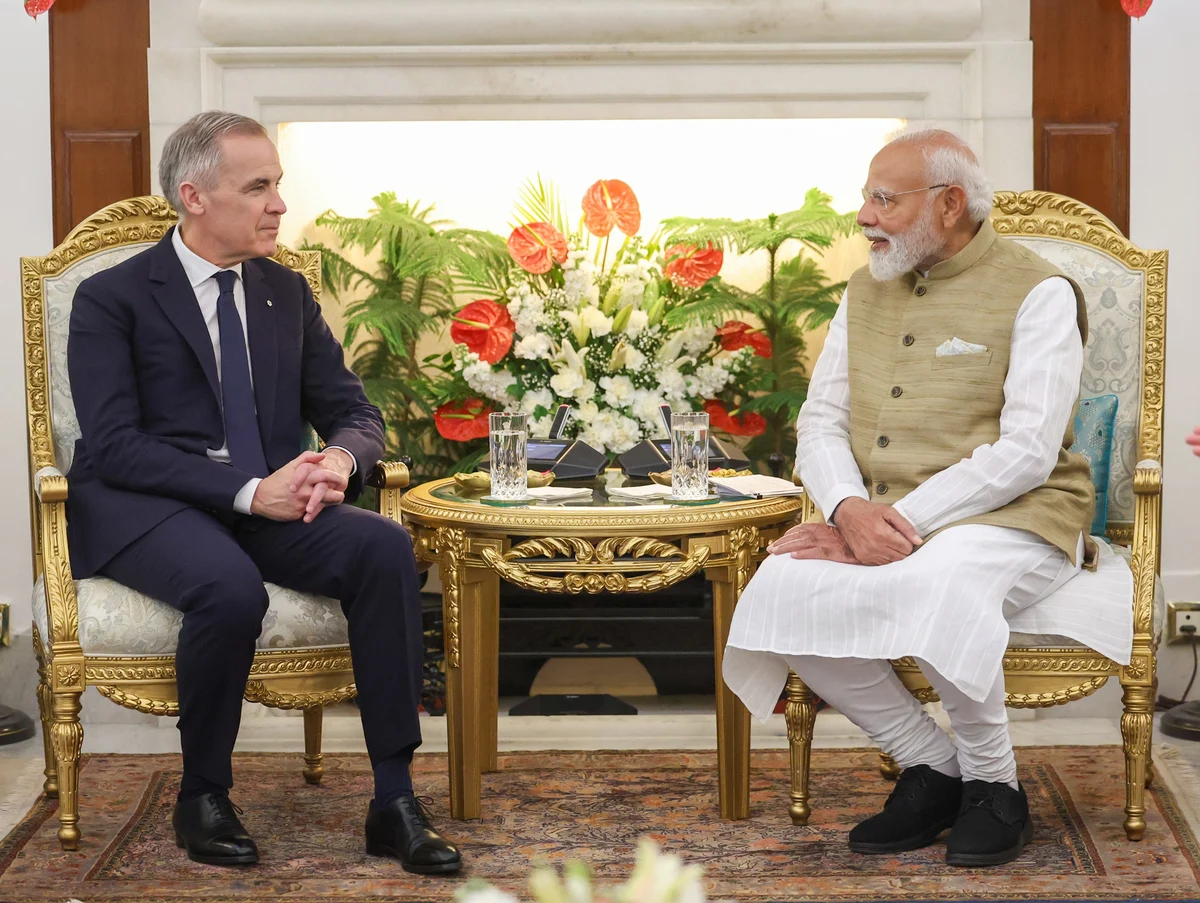
Who Mark Carney is and why India is in the news
Mark Carney is Canada’s 24th prime minister, and his India connection centres on work with Prime Minister Narendra Modi to restore diplomatic representation and negotiate a comprehensive economic partnership. Carney visited India from 27 February to 2 March 2026, and Canada’s public tracker still lists the proposed trade agreement as in negotiations after the sixth round in New Delhi.
Carney took office when he was sworn in at Rideau Hall on 14 March 2025, ahead of Canada’s April federal election. His earlier posts as governor of the Bank of Canada and the Bank of England explain why older profiles refer to him as a central banker. The India meetings covered here took place in his capacity as head of the Canadian government, with Modi as his Indian counterpart.
The March visit brought several kinds of commitments into one set of announcements. The prime ministers set out work on energy, skills and technology, and the governments signed terms for trade negotiations. A commercial civil energy supply agreement and memoranda in fields such as renewables and education accompanied the visit. The trade talks, the supply agreement and the education plans each have their own parties and stages of implementation. The document or programme behind a headline is the best starting point for understanding what changes in practice.
- Prime Minister of Canada: March 2026 Carney–Modi Statement
- Prime Minister of Canada official officeholder biography
- Canada Prime Minister's Office, swearing-in of the 30th ministry
- India Ministry of External Affairs, April 2026 Canada bilateral brief
- Ministry of Commerce and Industry, sixth India–Canada CEPA negotiation round conclusion
- Global Affairs Canada official CEPA status tracker
From the first Carney–Modi meeting to the India visit
India’s Ministry of External Affairs dates the first in-person bilateral meeting between Carney and Modi to 17 June 2025 in Kananaskis, Canada. Its bilateral brief says high commissioners returned by September. That gave each country a senior diplomatic representative in the other again, an identifiable step in restoring government contact. The brief then records a separate trade decision five months after the Kananaskis meeting.
The trade decision came on 23 November 2025 at the G20 in Johannesburg, where the leaders agreed to launch negotiations for a Comprehensive Economic Partnership Agreement, or CEPA. Canada’s tracker lists a notice to Parliament the following day. The notice belongs to the Canadian parliamentary record, while the Johannesburg meeting supplies the date of the two leaders’ agreement to open talks.
India’s ministry describes Carney’s February–March trip as the first bilateral visit to India by a Canadian prime minister since 2018. The official Indian photo record places his meeting with Modi at Hyderabad House in New Delhi on 2 March, the final day of the visit. Both governments record agreement on the terms of reference for the trade talks that day. Those terms formalised the basis for negotiations that the leaders had agreed to launch in November.
| When | Where or which record | What happened |
|---|---|---|
| 17 June 2025 | Kananaskis, Canada | Carney and Modi held their first in-person bilateral meeting. |
| By September 2025 | India’s bilateral brief | High commissioners had returned. |
| 23 November 2025 | G20 in Johannesburg | The leaders agreed to launch CEPA negotiations. |
| 24 November 2025 | Canadian parliamentary notice | Canada recorded its notice concerning the negotiations. |
| 27 February to 2 March 2026 | Carney’s India visit | The governments signed the CEPA negotiating terms on 2 March. |
| 16 June 2026 | Évian, France | Carney and Modi discussed bilateral cooperation on the G7 sidelines. |
| 13 October 2026 | Carney–Modi phone call | Both countries published accounts of the leaders’ discussion. |
| 11–20 November 2026 | Sixth CEPA round, New Delhi | India’s official notice confirmed completion of the round. |
- India Ministry of External Affairs, April 2026 Canada bilateral brief
- Canada Prime Minister's Office, 2 March visit deliverables
- Global Affairs Canada official CEPA status tracker
- PIB photo album, Carney–Modi at Hyderabad House
- Ministry of Commerce and Industry, sixth India–Canada CEPA negotiation round conclusion
What the March announcements covered
The joint statement set out an agenda for cooperation, while the visit fact sheet identified specific documents and arrangements. For trade, the signed document was the CEPA terms of reference. For civil energy, India’s brief records a CAD 2.6 billion commercial supply agreement between Cameco and India’s Department of Atomic Energy. The amount attaches to that particular supply agreement. It is a separate figure from the value of annual trade between the countries.
Renewable energy, critical minerals and culture appear as separate memoranda of understanding in the visit records. Education has its own memorandum between the All India Council for Technical Education, or AICTE, and Mitacs. The Canadian fact sheet describes the programme at a scale of up to 300 eligible Indian students annually for three years from 2027, with funded research internships lasting 12 weeks. The annual figure describes the programme’s intended capacity. Individual participation depends on eligibility and selection, and any visa requirements apply separately.
An engineering student planning research experience for 2027 can use the announcement to identify AICTE and Mitacs and assess whether a 12-week placement could fit their academic calendar. An actual application decision requires a programme call that specifies who qualifies, when applications open and what documents to submit. The March fact sheet gives the duration and intended scale. For application dates and eligibility, look for a published notice from the programme partners before making commitments around the placement.
What the June meeting and October call added
Carney and Modi met again on 16 June 2026 on the sidelines of the G7 in Évian, France. The Canadian readout reaffirmed the goal of concluding CEPA talks in 2026 and recorded Carney’s invitation for Modi to visit Canada. It left the date to diplomatic channels. Anyone looking for when Modi is due in Canada needs a separate official announcement that gives a date. The Évian meeting establishes when the invitation was recorded.
On 13 October 2026, the two leaders spoke by phone. Canada’s account emphasised work to conclude the economic partnership negotiations and the goal of doubling two-way trade by 2030. India’s account described a broader range of work that included trade, energy, technology, security and people-to-people ties. Read together, the two statements show what each government highlighted about the same conversation and establish that both were still discussing the partnership in the context of negotiations.
The succession of events also matters for readers following the leaders’ movements. February and March were the dates of Carney’s bilateral trip to India. The June meeting took place in France, and October’s contact was by phone. Renewed attention to India–Canada relations can follow any of these contacts. The location and format in the official record tell you whether a headline refers to a visit, a meeting at a summit or a call.
What happened in the sixth CEPA negotiating round
Canada’s 12 November release records a meeting in New Delhi between Canadian minister Maninder Sidhu and India’s commerce and industry minister Piyush Goyal on 11 November. The release gave 11–20 November as the schedule for the sixth round. India’s Ministry of Commerce and Industry reported on 21 November that the round had taken place over those dates. The Canadian record establishes the ministerial contact and announced schedule. The Indian record confirms that negotiators went through with the round.
India listed goods, services, rules of origin, trade remedies, intellectual property and investment promotion among the subjects discussed. Those labels have different consequences for readers. Rules of origin, for instance, determine which goods qualify for preferential treatment under an agreement. Services provisions concern access and conditions in service markets. The round report identifies the subjects negotiators covered. A business would need published provisions to assess whether any resulting terms applied to its goods or activities.
The March fact sheet set an aim of finishing talks by the end of 2026. The Canadian tracker still displays the stage as in negotiations after the November round. A completed round establishes that one set of meetings took place within the larger process. To establish the conclusion of talks, look for an official announcement about the negotiations as a whole. Treaty signature and entry into force are further milestones, each requiring its own confirmation.
How to read the trade figures and the 2030 goals
Global Affairs Canada reports CAD 30.4 billion in two-way goods and services trade for 2025. That figure covers trade in both directions and includes services. The same release cites an ambition to reach CAD 70 billion in annual two-way trade by 2030. India’s bilateral brief expresses the 2030 goal as USD 50 billion in bilateral trade. Retain each government’s currency and wording when quoting it, since the supplied figures contain no exchange-rate basis for an exact conversion between them.
The Canadian figures also give a way to interpret the October call’s language about doubling trade. Twice the reported Canadian-dollar total for 2025 is CAD 60.8 billion. The stated CAD 70 billion aim is approximately 2.3 times that total. This calculation uses the published 2025 aggregate as the comparison point. The call readout states the ambition to double trade without specifying the baseline calculation behind that wording.
A reader comparing the performance of exporters across years should first check what each release counts. Merchandise figures describe trade in goods and can appear alongside the broader goods-and-services number in the same announcement. To measure growth in the aggregate, use totals that cover equivalent periods and the same flows, currency and categories. The 2025 total supplies one observed year for that comparison. The 2030 figures supply benchmarks for judging progress once comparable annual data becomes available.
| Record | Period or date | What it measures |
|---|---|---|
| CAD 30.4 billion | Calendar 2025 | Canadian account of actual two-way goods and services trade |
| CAD 70 billion | Stated annual aim for 2030 | Canadian target as reported in the October 2026 release |
| Sixth negotiating round | 11–20 November 2026 | Completed official talks in New Delhi |
| CEPA tracker | Checked 26 November 2026 | Canada lists the agreement as under negotiation |
How to verify a new trade or visit headline
Start with Global Affairs Canada’s CEPA tracker for the agreement’s formal stage and India’s Ministry of Commerce and Industry for details of negotiating rounds. Match the verb in the headline to the act described in the government record. Launching negotiations, signing negotiating terms, holding a round and concluding negotiations refer to different events. For signature or entry into force, look for language that expressly confirms that step and gives its date. A projected deadline tells you when negotiators aimed to finish.
For an Indian exporter pricing goods for Canada, the commercially relevant evidence would be an operative tariff schedule and any product-specific origin rules that determine eligibility for its rates. A headline saying that negotiators discussed goods and origin rules gives a reason to follow the talks. The eventual schedule, its effective date and its terms for that product would determine whether a preferential rate can be incorporated into a quote.
For a leaders’ visit, compare the event date and the named participants with a readout from either prime minister’s office. A release can appear after the event it describes, as Canada’s November account of the Sidhu–Goyal meeting illustrates. A ministerial meeting can also generate coverage of the wider relationship while the prime ministers are elsewhere. For trade totals, verify the year and the definition in the statistical release or government announcement before carrying a number into a new comparison.
India current affairs, 22–26 November 2026 official timelineIndia’s allies and strategic partners, treaties and groupingsSend money from Canada to India, rates, fees and payout
- Canada Prime Minister's Office, 2 March visit deliverables
- Canada Prime Minister's Office, 16 June Évian bilateral
- Global Affairs Canada, 12 November Sidhu–Goyal readout
- Ministry of Commerce and Industry, sixth India–Canada CEPA negotiation round conclusion
- Global Affairs Canada official CEPA status tracker
- Global Affairs Canada, bilateral trade baseline and 2030 target
Sources
- Prime Minister of Canada: March 2026 Carney–Modi Statement
- Prime Minister of Canada: October 2026 Carney–Modi Call
- Prime Minister of Canada official officeholder biography
- Canada Prime Minister's Office, swearing-in of the 30th ministry
- India Ministry of External Affairs, April 2026 Canada bilateral brief
- Canada Prime Minister's Office, 2 March visit deliverables
- India PMO 13 October Carney–Modi call readout
- Canada Prime Minister's Office, 16 June Évian bilateral
- Global Affairs Canada, 12 November Sidhu–Goyal readout
- Ministry of Commerce and Industry, sixth India–Canada CEPA negotiation round conclusion
- Global Affairs Canada official CEPA status tracker
- Global Affairs Canada, bilateral trade baseline and 2030 target
- PIB photo album, Carney–Modi at Hyderabad House
- Licensed photo candidate, Carney and Modi at Hyderabad House
