What changed in November 2026
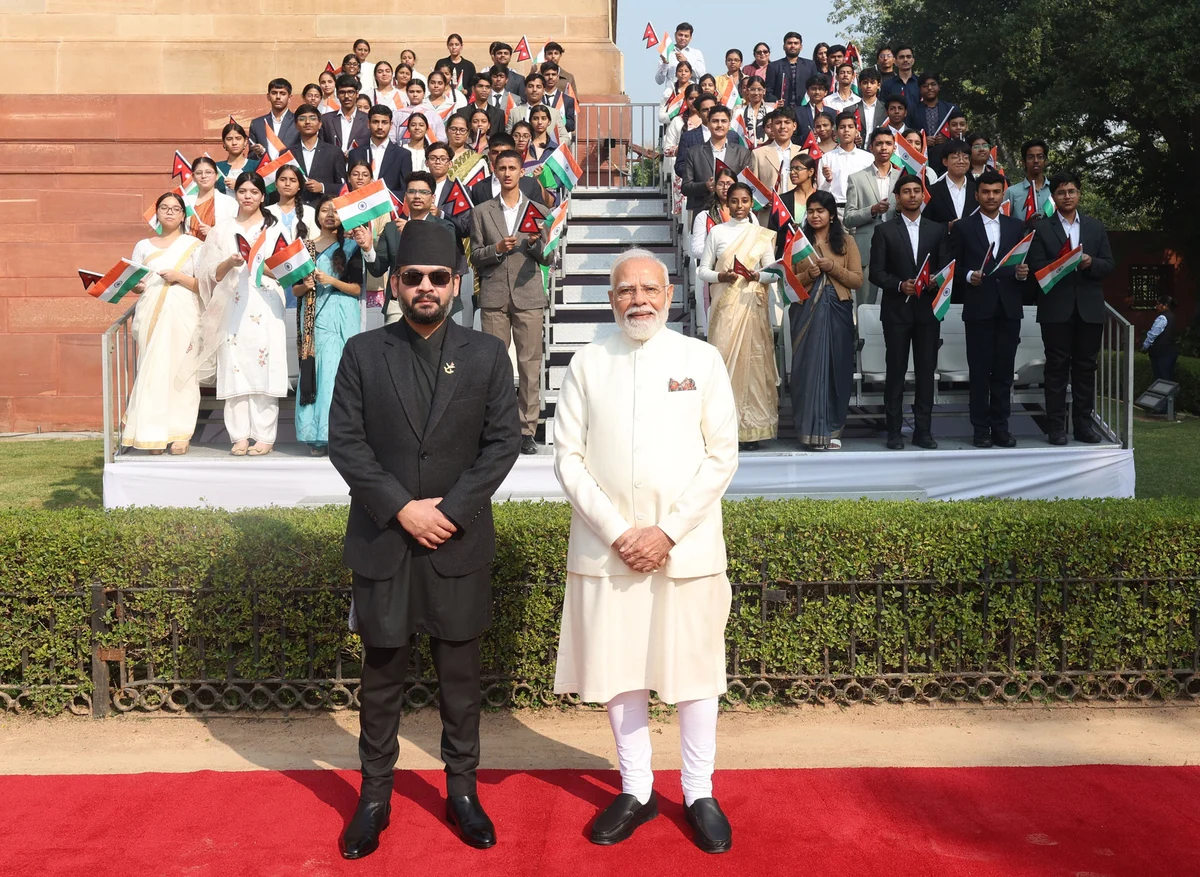
India and Nepal expanded cooperation on transport, energy and development during Nepali Prime Minister Balendra Shah’s 22–23 November 2026 visit to India, while outstanding boundary questions remained unresolved. Nepal’s account lists three inaugurations, three foundation stones and eight memoranda of understanding, and the Indian prime minister announced a development package worth NPR 24,000 crore on 23 November.
Shah met Indian President Droupadi Murmu and Prime Minister Narendra Modi on 23 November. Nepal’s Foreign Ministry identifies the projects marked at the visit. India’s published outcomes list identifies the memoranda by subject and counterparties, while the joint statement records commitments across areas including power trade, transit, development, water and boundary management. The documents answer different questions about the same visit. The joint statement is the clearest record of what the two governments publicly agreed to pursue together.
Each announcement has a different practical consequence. An inauguration records an opening ceremony or launch, a foundation stone marks a project milestone before completion, and an exchanged memorandum records cooperation between named parties. A reader following a particular outcome can look for the next record appropriate to it, such as operating information for a passenger service, a construction update for a project or implementation details from the bodies named in a memorandum.
Sovereignty and the 1950 friendship treaty
The Treaty of Peace and Friendship was signed in Kathmandu in July 1950 and entered into force on signature under Article 9. Article 1 recognises the sovereignty, territorial integrity and independence of India and Nepal. The two countries are separate signatories. That provision supplies the legal starting point for reading a relationship in which close cooperation and unresolved questions about the boundary can coexist.
Article 7 provides for reciprocal privileges in specified respects, including residence, ownership of property, participation in trade and commerce, and movement. Reciprocity describes the undertaking made by the two states. For an individual question about travel, work or property, the next source is the current rule from the authority responsible for the particular activity and jurisdiction. The treaty wording alone cannot establish what documents an authority currently accepts or whether a particular person qualifies.
The two countries also concluded a separate Treaty of Trade and Commerce in 1950. References to the friendship treaty should therefore identify the article at issue, especially when a discussion moves from sovereignty or reciprocal privileges to commercial access. The November 2026 joint vision gives the governments scope to consider reviewing existing instruments by mutual consent. Establishing that a provision actually changed would require the text of the relevant instrument and confirmation of when the change took effect.
Was Nepal ever part of India? A history of borders and treatiesIndia’s neighbouring countries: borders, disputed areas and official maps
A timeline of the main agreements and announcements
The dates matter because different agreements govern different activities. The 1950 friendship treaty sets out principles for the relationship and specified reciprocal privileges. The modern trade and transit instruments address commercial questions, and the 2024 power agreement sets a separate electricity objective. The November 2026 visit added project milestones and cooperation instruments to that existing framework. A headline about a new agreement is easiest to interpret once its date, name and subject are clear.
| Date | Record | What it establishes |
|---|---|---|
| July 1950 | Treaty of Peace and Friendship | Signed in Kathmandu and effective on signature. Article 1 recognises each state’s sovereignty, territorial integrity and independence. |
| 2004 and June 2021 | Rail Services Agreement and Letter of Exchange | A separate instrument and subsequent exchange relevant to commercial rail freight. |
| 1 June 2023 | Revised Transit Treaty | Signed for seven years, with later automatic renewal under its terms. |
| October 2023 | Modern Trade Treaty and cooperation instrument | Renewal recorded by the Indian Embassy in Kathmandu. |
| January 2024 | Agreement for Long-Term Power Trade | Records the objective of working towards 10,000 MW of exports from Nepal to India within ten years. |
| 22–23 November 2026 | Shah’s state visit to India | Visit records identify inaugurations, foundation stones and exchanged memoranda. The joint statement directs follow-up on outstanding boundary questions. |
The 2023 transit and trade entries illustrate why the names matter. The Indian Embassy records a June signing for the revised Transit Treaty and an October renewal for the modern Trade Treaty and a cooperation instrument. The seven-year term and subsequent automatic renewal belong to the Transit Treaty. Someone checking a current commercial provision should start with the instrument that covers the question and then look for the latest official text or notice that applies to it.
- Ministry of External Affairs: India–Nepal Treaty of Peace and Friendship
- Nepal Foreign Ministry on the 22–23 November 2026 visit
- Joint India–Nepal November 2026 visit release via PIB
- India’s November 2026 state-visit outcomes list
- India Embassy Kathmandu commerce wing bilateral trade and transit brief
- India Embassy January 2024 long-term power trade signing record
The bridge, passenger rail and projects announced at the visit
Nepal’s Foreign Ministry lists three inaugurations during the visit. They were the Darchula–Dharchula Motorable Bridge, the Janakpur–Ayodhya Passenger Rail Service and Phase II of the Motihari–Amlekhgunj Petroleum Pipeline. These projects serve different purposes. The bridge is a road connection, the rail announcement concerns a passenger service, and the pipeline is petroleum infrastructure. The common inauguration date leaves each project’s operating details to its own authorities or operator.
The same release names three foundation-stone projects. These were the Lower Arun Hydropower Project, the Integrated Check Post at Banbasa–Chandani–Dodhara and a petroleum terminal in Jhapa. The check post and the motorable bridge appear in different categories in the release, as do the terminal and the pipeline phase. If a later report says a project has opened, look for a commissioning or opening record bearing the same project name. That check prevents an inauguration elsewhere in the programme from being mistaken for completion of the project in question.
Suppose someone is deciding whether to travel from Janakpur to Ayodhya by train on a particular day. The visit release gives them the service name to search for. Before committing to the journey, they need the responsible operator’s current timetable and a booking listing or ticket-office confirmation for their date. Those records can establish whether there is a departure and how tickets are issued. The November release supports the inauguration date, and the supplied record leaves present service frequency and availability unverified.
| Stage in official notice | Project or service |
|---|---|
| Inaugurated | Darchula–Dharchula Motorable Bridge |
| Inaugurated | Janakpur–Ayodhya Passenger Rail Service |
| Inaugurated | Phase II, Motihari–Amlekhgunj Petroleum Pipeline |
| Foundation stone | Lower Arun Hydropower Project |
| Foundation stone | Integrated Check Post, Banbasa–Chandani–Dodhara |
| Foundation stone | Petroleum terminal in Jhapa |
Trade, transit and the size of the goods relationship
The Indian Embassy in Kathmandu puts India–Nepal goods trade at about US$9.38 billion in fiscal year 2025–26 and says it accounted for over 60% of Nepal’s external goods trade. The embassy also says India received over 80% of Nepal’s goods exports. The first percentage measures India’s share of Nepal’s goods trade with all partners, including imports and exports. The second measures India’s share as a destination for Nepal’s goods exports. Both describe Nepal’s trade, with different totals as their bases.
These figures establish the scale of the goods relationship from Nepal’s side for the stated period. They leave several common questions open, including the value of bilateral services trade and Nepal’s share of India’s goods trade. A defensible comparison over time uses the same fiscal period convention, currency, trade direction and goods coverage for each observation. If a later figure differs, check those definitions and the reporting authority before treating the difference as growth or decline.
Trade and transit also pose different practical questions. A trade instrument can be relevant to the terms under which a good enters the other market. A transit instrument becomes relevant when goods pass through a country on their way to another market. For a commercial rail shipment, the embassy also identifies the 2004 Rail Services Agreement and the June 2021 Letter of Exchange. Current freight arrangements should be checked against the applicable commercial instruments and notices. The passenger rail inauguration answers a separate question about the service announced during the visit.
Electricity exports and the development package
The long-term power trade agreement reported in January 2024 envisages working towards exports of 10,000 megawatts from Nepal to India within ten years. Megawatts measure the rate at which power can be supplied or transferred. A report of electricity delivered over a month or year would use an energy unit such as megawatt-hours and specify the period. The signing record establishes the capacity objective, while actual flows and cumulative deliveries require separate operating data.
The Lower Arun foundation stone is a construction milestone recorded in November 2026. Anyone tracking its contribution to exports would look for later evidence on commissioning and the relevant power sale and transmission arrangements. A question about progress towards the bilateral objective calls for a clearly dated capacity figure with the category identified. Capacity covered by commercial agreements, capacity available to export and power actually flowing at a particular time describe different stages or measurements.
In his published 23 November statement, the Indian prime minister announced a Development Cooperation Package worth NPR 24,000 crore for reconstruction and long-term development. The amount is in Nepali rupees. The statement establishes the announced total and stated purpose. To establish how much support has reached a named project, look for records of allocations or signed financing and then for disbursement records. A project completion report answers the separate question of what that financing delivered.
The boundary questions and what to watch next
The joint November statement refers to outstanding boundary questions and directs the foreign secretaries to work on them. Its wording establishes that there is an agreed channel for follow-up and that questions remained open at the time of the visit. To assess a later claim of resolution, look for a subsequent joint release or agreed document that identifies the issue, states the decision and specifies any further action. If only one government has issued a statement, attribute the position to that government and check the other foreign ministry’s account.
The joint vision treats open, secure and regulated border management as a field for cooperation. The same vision sets out work on trade and investment, physical and digital connectivity, health, agriculture, disaster resilience and culture. Those priorities describe the intended direction of the relationship. A change affecting a specific crossing or activity would require a separate dated record from the responsible authority, while a settlement of a boundary question would call for evidence of agreement between the governments.
The eight memoranda have a more specific public record in India’s outcomes list. It identifies counterparties and covers areas including satellite communications, civil service training, traditional medicine, sustainable urban development, healthcare and livestock and fisheries. For a claim that one of these agreements launched a service or created a new entitlement, start with the named counterparties. Their published instrument or subsequent implementation notice would establish the scope, timing and any practical effect for the people or institutions it covers.
Sources
- Ministry of External Affairs: India–Nepal Treaty of Peace and Friendship
- Nepal Ministry of Foreign Affairs: Bilateral Relations
- Nepal Foreign Ministry on the 22–23 November 2026 visit
- Joint India–Nepal November 2026 visit release via PIB
- India’s November 2026 state-visit outcomes list
- Joint vision, developed India and prosperous Nepal
- India Prime Minister’s published November 23 statement
- India Embassy Kathmandu commerce wing bilateral trade and transit brief
- India Embassy January 2024 long-term power trade signing record
- Prime Minister’s Office photograph of Shah’s November 2026 reception
