1526–1857: The political timeline at a glance
Mughal rule in North India began with Babur’s victory over Ibrahim Lodi at Panipat on 21 April 1526, and the dynasty’s political rule ended after the uprising of 1857. Read the surviving sites in layers, starting with Akbar’s Fatehpur Sikri and rebuilding of Agra Fort, then following Jahangir’s patronage in Kashmir and Shah Jahan’s Taj Mahal in Agra and Red Fort in Delhi.
Panipat, in present-day Haryana, anchors the chronology with a named event and an exact date. The battle established a new ruling dynasty in North India. The territory under Mughal rule changed over time, so any map showing the empire’s extent needs a date. A map marking Panipat, Agra and Delhi answers a different question from a map of the territory under an emperor’s control.
The first major interruption came in the generation after Panipat. Humayun succeeded Babur in 1530, lost Delhi and Agra during the Sur interruption, conventionally dated around 1540–1555, and recovered both cities in 1555. Akbar’s reign began in 1556. A timeline showing a single bar for Humayun from succession to death needs to mark the years of lost control explicitly, especially if the chart is being used to assign buildings to whoever held Delhi at the time.
The dates below record different kinds of events. A reign provides the political setting, a building phase dates specific work, and a transfer dates a change of capital. Read the event description alongside each year or range, particularly where several entries overlap.
| Date | Place or record | What the date marks |
|---|---|---|
| 21 April 1526 | Panipat | Babur defeated Ibrahim Lodi |
| Around 1540–1555 | Delhi and Agra | Sur interruption, ending with Humayun’s recovery of both cities in 1555 |
| 1560s | Humayun’s Tomb, Delhi | Main building phase of the posthumous garden tomb |
| 1565–1573 | Agra Fort | Akbar’s red-sandstone rebuilding |
| 1571–1573 and 1585 | Fatehpur Sikri | Initial planned city works and later transfer of the capital to Lahore |
| Around 1620 | Shalimar Bagh, Kashmir | Jahangir’s lower garden, Farah Bakhsh |
| 1632, 1648 and 1653 | Taj Mahal, Agra | Construction start in the detailed record, main mausoleum completion and additional complex works |
| 1639–1648 | Red Fort, Delhi | Construction of Shah Jahan’s palace-fort |
| 1707 | Mughal court | Death of Aurangzeb and accession of Bahadur Shah I |
| After 1857 | Delhi and British Library trial and exile file | End of dynastic rule, followed by trial and exile |
| Ruler | Reign or dated scope | Associated landmark or record |
|---|---|---|
| Babur | 1526–1530 in India | First Battle of Panipat and Baburnama |
| Humayun | 1530–1540 and 1555–1556 | Recovered Delhi and Agra in 1555. His garden tomb was built after his death. |
| Akbar | 1556–1605 | Agra Fort rebuilding and Fatehpur Sikri |
| Jahangir | 1605–1627 | Kashmir garden patronage and illustrated court works |
| Shah Jahan | 1628–1658 | Taj Mahal in Agra and Red Fort in Delhi |
| Aurangzeb | 1658–1707 | Moti Masjid in Delhi’s Red Fort |
| Bahadur Shah I | 1707–1712 | Early eighteenth-century court patronage |
| Muhammad Shah | 1719–1748 | Renewed court patronage described by the Met |
| Bahadur Shah II | Last emperor. Removed after 1857. | India Office papers on trial, banishment and transfer |
- UNESCO World Heritage Centre: Taj Mahal
- First Battle of Panipat, 21 April 1526 — Panipat District Administration
- Mughal chronology through Akbar, with court objects — The Metropolitan Museum of Art
- Humayun's Tomb cultural property and garden — World Heritage Centre
- Agra Fort rebuilding and interior patronage — Archaeological Survey of India
- Fatehpur Sikri city and capital — World Heritage Centre and Archaeological Survey of India
- Mughal gardens of Kashmir — India's Tentative List submission
- Red Fort at Delhi — Archaeological Survey of India and UNESCO property description
- Jahangir through later Mughal patronage — The Metropolitan Museum of Art
- Bahadur Shah II trial and exile papers, 1858–1859 — British Library India Office Records
- NCERT’s Mughal chronology and Sur interruption
Babur’s reign and the illustrated Baburnama
Babur’s Indian reign ran from 1526 to 1530. The memoir known as the Baburnama gives that short reign a documentary counterpart to the battlefield at Panipat. It also connects the founder’s lifetime to the court culture of his grandson Akbar. Babur composed the memoir in Chaghatai Turkish. In 1589, at Akbar’s request, Mirza Abd al-Rahim Khan translated it into Persian. The British Library dates its illustrated imperial copy, Or 3714, to around 1590–93 and records 143 illustrations.
An illustrated page can therefore carry several dates, each answering a separate question. The dates of Babur’s reign place the author and the events of his Indian rule. The translation date identifies Akbar’s commission, and the date range on the library record places the making of the surviving volume. If a caption accompanies a reproduction of Or 3714, the date of that volume belongs alongside the manuscript identifier. The reference to Babur belongs with the authorship of the memoir.
The Metropolitan Museum of Art’s separate folio Three Trees of India offers a concrete way to see what an illustrated edition adds. Its two sides depict jackfruit, monkey jack and lote. The Met dates the folio to the late sixteenth century and associates it with the 1589 Persian manuscript. Use the Met’s object number, 2013.576, to verify the date for this particular sheet. The British Library’s record supplies the date and illustration count for its own volume.
Humayun’s Tomb and the garden built after his death
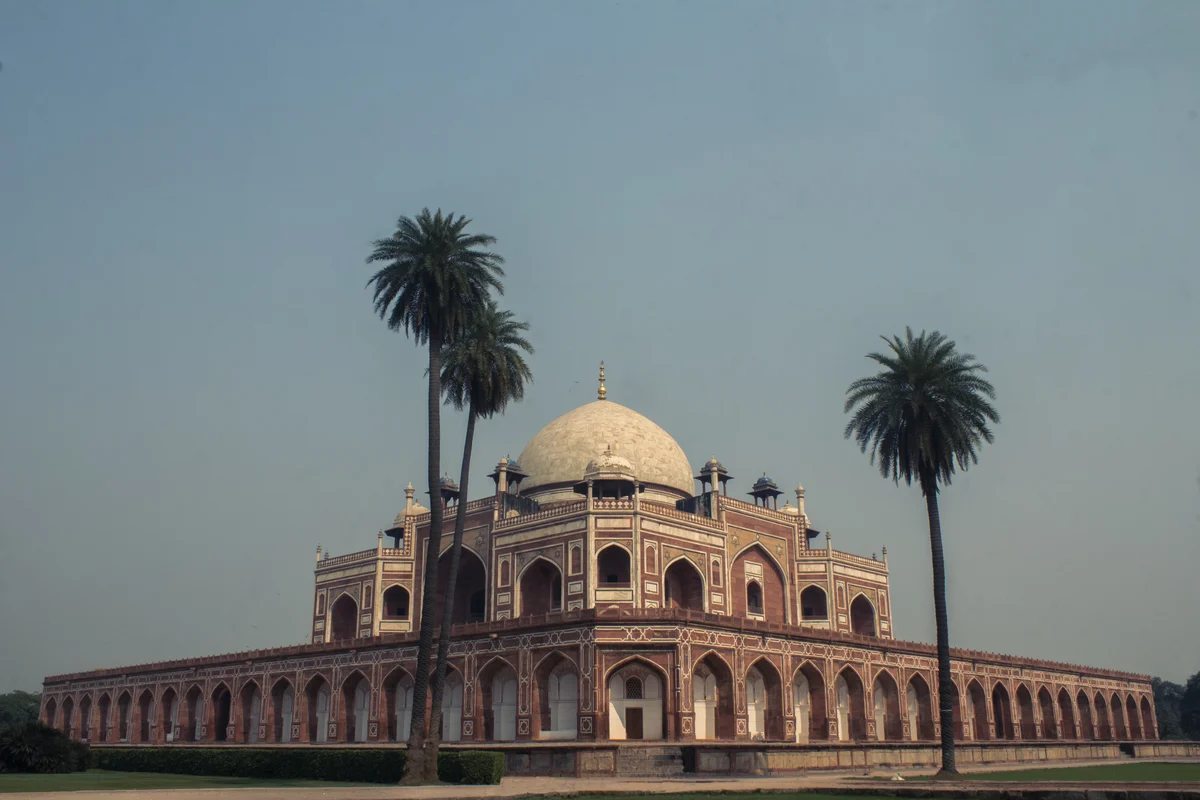
Humayun recovered Delhi and Agra in 1555 and died in 1556. His tomb in Delhi belongs to the building history of the succeeding reign. The World Heritage property record places the main phase in the 1560s and gives 1570 in its summary. Use the earlier dates for the final years of Humayun’s rule and the later dates for the monument. The distinction puts the surviving fabric in its proper period while retaining the emperor’s name as the person commemorated.
Read the garden and tomb together. The four-part charbagh is laid out with water channels that divide the grounds. A plan lets you trace those divisions in relation to the tomb, a distinction that can be hard to see in a close photograph of the facade. The property description also records the involvement of Persian and Indian craftspeople. The site therefore offers evidence of the garden layout and the people involved in the building project as well as the commemoration of Humayun.
The published records describe patronage differently. The World Heritage property summary names Akbar. The ICOMOS advisory evaluation of the 1992 nomination credits the building to Humayun’s widow Biga Begum, also recorded as Hajji Begum, and dates it to 1569–70. A study of the historical sources distinguishes that widow from Akbar’s mother, Hamida Banu Begum. A citation can name the record it follows and keep the identities, construction dates and person commemorated in separate fields.
Akbar’s Agra Fort and the planned capital at Fatehpur Sikri
Akbar ruled from 1556 to 1605. The Archaeological Survey of India dates his red-sandstone rebuilding of the earlier Agra Fort to 1565–1573. The fort served as an imperial residence and contains work from later reigns. Shah Jahan’s white-marble Moti Masjid, Nagina Masjid and Mina Masjid belong to that later history. A date attached to the fort’s rebuilding gives the period for a major project. Identifying an individual building inside calls for its own date or attribution.
At Fatehpur Sikri, the detailed World Heritage account places the initial planned city construction in 1571–1573. The surviving buildings include administrative, residential and religious spaces. Their functions explain why a description of the site as a palace alone would give an incomplete picture of Akbar’s capital. The Jama Masjid there belongs to the religious part of the city. Use the place name alongside the mosque name, since Shah Jahan’s later Jama Masjid in Delhi is a separate landmark.
The first works at Fatehpur Sikri overlapped with the last years of Akbar’s rebuilding of Agra Fort. Read those projects alongside each other to see how an existing imperial residence and a planned court city fit into the same reign. The detailed account records the capital’s transfer to Lahore in 1585. UNESCO’s summary describes about a decade of capital use. Keep the initial construction range and the transfer year distinct when checking the timeline, since construction dates alone cannot establish the exact duration of capital use.
Jahangir and the Mughal gardens of Kashmir
Jahangir ruled from 1605 to 1627. India’s submission for the Mughal gardens of Kashmir identifies the lower garden at Shalimar Bagh, Farah Bakhsh, with Jahangir around 1620. It also records the involvement of Prince Khurram, the future Shah Jahan, and his subsequent addition of Fayz Bakhsh. The lower garden and the later addition give a more precise account of patronage than assigning the whole surviving site to one ruler.
Verinag is a separate site in the same submission. Its description cites a Persian inscription dated 1619–20. Use that date with Verinag and retain the approximate date for Farah Bakhsh. These two dates place work at distinct sites within the same period. For comparing the gardens, look at how the records describe terraces, channels and the setting of each property. That comparison brings out the use of the landscape in court gardens, a different function from the four-part setting around Humayun’s tomb.
The Kashmir gardens appear in India’s UNESCO Tentative List submission. Agra Fort and the Taj Mahal are already inscribed World Heritage properties. If a current guide calls the Kashmir gardens a World Heritage Site, look up the series by name in UNESCO’s records and check whether it appears under Tentative Lists or has an inscription entry. The submission is useful for reading the individual garden descriptions even while the status label needs to be checked separately.
Shah Jahan’s Taj Mahal and Delhi Red Fort
Shah Jahan ruled from 1628 to 1658. In Agra, he commissioned the Taj Mahal for Mumtaz Mahal, who died in 1631. The mausoleum stands within a funerary and garden complex on the right bank of the Yamuna. UNESCO’s short summary gives 1631–1648, while its detailed account dates the start of construction to 1632 and completion of the main mausoleum to 1648. It dates additional work on the mosque, guest house, gateway and courtyards to 1653. Name the phase when citing any of these years.
In Delhi, the Archaeological Survey of India dates the start of Shah Jahan’s palace-fort to 1639 and its completion to 1648. The Met also dates the capital shift to 1648. The overlap shows that the court completed a new fortified residence in Delhi in the same year as the main mausoleum in Agra. The capital transfer, the completion of the Delhi fort and the completion of the Agra mausoleum each belong on their own line in a detailed chronology.
When an index gives only ‘Red Fort’ or ‘Moti Masjid,’ verify the city before assigning the building a patron. Agra Fort can be called the Red Fort of Agra, and its Moti Masjid is attributed to Shah Jahan. Delhi’s Moti Masjid is a later addition attributed to Aurangzeb. The inscribed Red Fort Complex in Delhi also includes Salimgarh, the older fort built by Islam Shah Suri in 1546. Check the property description for the scope of the complex and the individual entry for the structure you want to date.
Things to do in Delhi: one, two and three-day itinerariesAgra Fort: tickets, Amar Singh Gate and what to see
- UNESCO World Heritage Centre: Taj Mahal
- Agra Fort rebuilding and interior patronage — Archaeological Survey of India
- Red Fort at Delhi — Archaeological Survey of India and UNESCO property description
- Jahangir through later Mughal patronage — The Metropolitan Museum of Art
- UNESCO World Heritage property boundary for the Delhi Red Fort Complex
Aurangzeb, the later court and the end of Mughal rule
Aurangzeb ruled from 1658 to 1707. His Moti Masjid inside Delhi’s Red Fort gives that reign a specific architectural reference within a complex whose main palace-fort belongs to Shah Jahan. The year 1707 marks a succession. The Met identifies renewed court patronage under Bahadur Shah I, who ruled from 1707 to 1712, and under Muhammad Shah, who ruled from 1719 to 1748. Those reigns belong in a cultural chronology even if the landmarks in the preceding centuries provide most of its architectural examples.
Bahadur Shah II, also known as Zafar, was the last Mughal emperor. The numeral matters because Bahadur Shah I belongs to the early eighteenth century. After the uprising of 1857, the last emperor faced trial and exile. The British Library’s India Office Records catalogue describes papers concerning his banishment and removal from Delhi via Calcutta to Rangoon. The file spans November 1858 through February 1859. Use those dates to identify the archival file and look within the records to establish when a particular proceeding or transfer occurred.
The end of Mughal dynastic rule and the transfer of governing authority from the East India Company to the Crown answer different questions about the same period. For the emperor’s fate, use the trial and exile records. For the change in governing authority, use the 1858 statute. A timeline with room for both can identify the institution involved in each event and avoid implying that the emperor’s trial itself accomplished the statutory transfer.
East India Company flag, seal and merchant cloth mark
- Red Fort at Delhi — Archaeological Survey of India and UNESCO property description
- Jahangir through later Mughal patronage — The Metropolitan Museum of Art
- Bahadur Shah II trial and exile papers, 1858–1859 — British Library India Office Records
- Government of India Act 1858, United Kingdom legislation archive
Sources
- UNESCO World Heritage Centre: Fatehpur Sikri
- UNESCO World Heritage Centre: Taj Mahal
- First Battle of Panipat, 21 April 1526 — Panipat District Administration
- Babur's memoir, imperial Baburnama copy Or 3714 — British Library manuscript record
- Mughal chronology through Akbar, with court objects — The Metropolitan Museum of Art
- Humayun's Tomb cultural property and garden — World Heritage Centre
- Agra Fort rebuilding and interior patronage — Archaeological Survey of India
- Fatehpur Sikri city and capital — World Heritage Centre and Archaeological Survey of India
- Mughal gardens of Kashmir — India's Tentative List submission
- Red Fort at Delhi — Archaeological Survey of India and UNESCO property description
- Jahangir through later Mughal patronage — The Metropolitan Museum of Art
- Bahadur Shah II trial and exile papers, 1858–1859 — British Library India Office Records
- Humayun's Tomb, Delhi — original photograph by Vishnu Rema Jayaram
- NCERT’s Mughal chronology and Sur interruption
- The Met, Baburnama folio Three Trees of India, 2013.576
- ICOMOS advisory evaluation of the Humayun’s Tomb nomination
- Journal of the Royal Asiatic Society archival study of Biga Begum and Hamida Banu Begum
- UNESCO World Heritage property boundary for the Delhi Red Fort Complex
- Government of India Act 1858, United Kingdom legislation archive
