What survives from ancient Indian religions
Ancient India had multiple religious traditions, including Vedic recitation and the Buddhist, Jain and Vaishnava traditions documented in surviving monuments and sculpture. The religious meanings of Indus civilisation objects remain harder to establish because the signs on them are undeciphered.
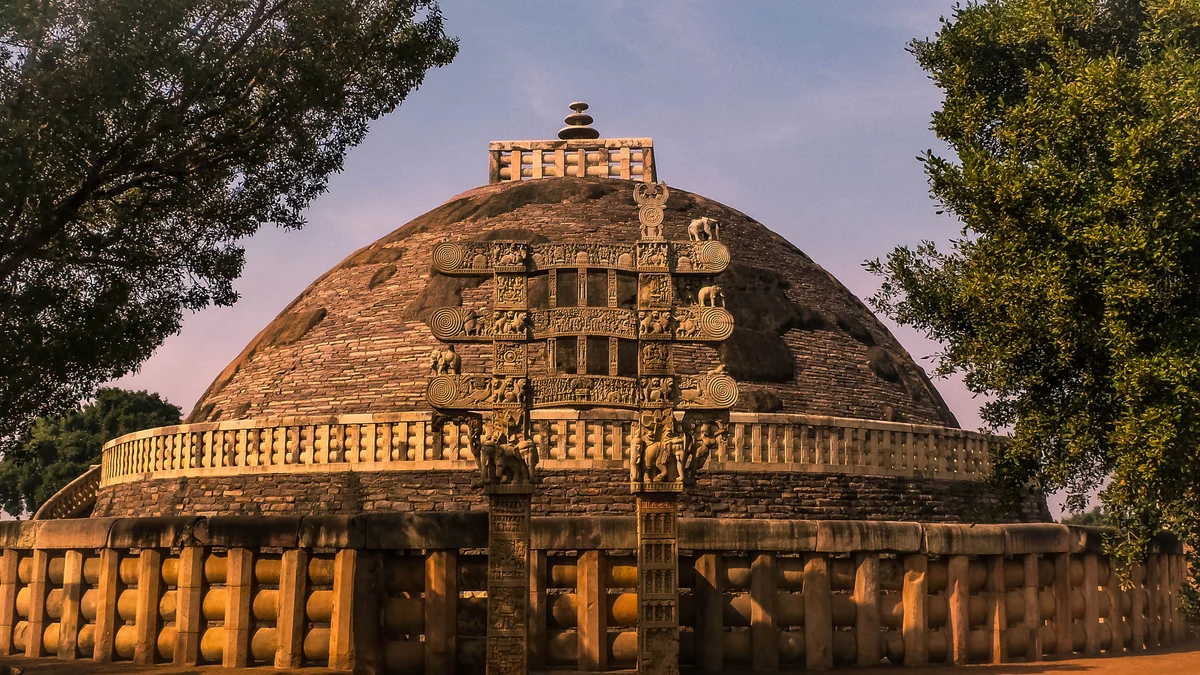
These traditions enter the historical record through different kinds of evidence. A chant preserves words and patterns of pronunciation through repeated performance. A royal inscription records a message a ruler chose to make public. A sculpture can show which figures artists represented and how they made those figures recognisable. A complex such as Sanchi brings several centuries of building and decoration together in one place, so even neighbouring features can belong to different phases.
The dates can attach to very different things. The third-century BCE Kālsī edict dates a royal statement about relations among religious groups. A late fifth-century CE sandstone Buddha dates one surviving representation of the Buddha. A modern heritage inscription dates recognition of a practice still being performed. Give each date its subject and the record becomes much easier to read, especially when an ancient figure, a later object and a modern catalogue appear together.
| Evidence | What it can establish | What needs separate evidence |
|---|---|---|
| Inscribed object from Harappa | Signs and motifs on an excavated object | The reading of the signs or the name of a deity |
| Vedic chanting heritage record | A living practice of oral transmission and its modern recognition | The composition dates of particular texts |
| Kālsī Major Rock Edict XII | A Mauryan ruler’s public guidance on relations among religious groups | How communities responded to that guidance |
| Stupa 1 at Sanchi | A Mauryan origin and gateways assigned to a later phase | The date of any individual feature visible in a photograph |
| Dated museum sculpture | A catalogued identification, material and period for an individual work | How widespread its associated religious practice was |
- Inscribed Objects from Harappa Excavations, 1986–2007 — Kenoyer and Meadow, Harappa Archaeological Research Project
- Tradition of Vedic chanting — Indian Ministry of Culture heritage documentation
- Kālsī Major Rock Edict XII — Ashokan inscription, English edition by Eugen Hultzsch
- Buddhist monuments at Sanchi — Archaeological Survey of India and World Heritage property record
- Standing Four-Armed Vishnu, 1987.142.293 — The Metropolitan Museum of Art
- Standing Buddha Offering Protection, 1979.6 — The Metropolitan Museum of Art
- Standing Jain Tirthankara Parshvanatha, 1993.477.2 — The Metropolitan Museum of Art
- UNESCO Intangible Cultural Heritage: Tradition of Vedic Chanting
Reading Indus seals while the script remains undeciphered
The Indus civilisation flourished around 2600–1900 BCE, the range used in a study of its inscriptions. Archaeologists Jonathan Mark Kenoyer and Richard Meadow describe inscribed and incised objects found at Harappa during excavations from 1986 to 2007. Those are the years of the modern fieldwork. For the ancient date of a particular object, look for the period assigned to the find or its context in the excavation record. A range for the civilisation gives a broad frame and may cover much more time than an individual find can be dated to.
A seal can have both an image and a sequence of signs. The image can be described by its visible features, and the signs can be recorded in the order they appear. Excavators can then ask how the object relates to other finds and what that association might reveal about social or economic activity. Those questions remain open to investigation even when the signs themselves cannot be read. A proposed religious interpretation has to account for the archaeological context as well as the design.
Suppose a caption identifies a figure on an Indus seal by the name of a deity familiar from later Indian art. Check whether the caption is reporting a proposed resemblance or claiming an identification. A similar pose or arrangement of figures can explain why someone made the comparison. The name and any claim that the practice continued into a later period would require independent evidence. The unread signs cannot supply a deity’s name or tell us how people used the image in worship.
What Vedic chanting preserves
The Sangeet Natak Akademi and UNESCO document Vedic chanting as a living practice of transmitting Vedic texts orally. Pronunciation is part of what gets passed on. The heritage record therefore concerns more than the existence of words that could be written down. It documents people sustaining a way of voicing those words. UNESCO inscribed the tradition in 2008, a firm date for international recognition of a practice with a much longer history.
Three questions about age arise when you encounter a chant. When was the text composed? How was it transmitted in the intervening centuries? When and where did the performance you are hearing take place? An institutional record of the living practice can explain what the performance preserves. Dating the composition of a particular passage requires historical scholarship and may yield an estimated range. An account of the intervening transmission would need evidence for the communities and periods it describes.
The way the evidence survives also shapes the picture it gives us. A tradition that maintains exacting practices of recitation can preserve detailed material for later generations to study. The resulting record tells us about what those practitioners transmitted. To assess how widely any particular recitation was practised in an ancient region, or what people outside those communities believed, a historian would need additional evidence specific to that place and time.
Ashoka’s public instructions at Kālsī
In the third century BCE, the Mauryan ruler Ashoka addressed relations among religious groups in Major Rock Edict XII. In Eugen Hultzsch’s English translation of the Kālsī version, the ruler urges restraint in praising one’s own group and criticising another. He also encourages people to honour and learn from other groups. Hultzsch uses the word “sects” in his translation. That English term belongs to an editor’s rendering of the inscription and may carry different associations for present-day readers.
The edict gives direct evidence of the conduct the ruler publicly advocated. Its appeal makes sense in a setting where people recognised different religious affiliations and could speak about one another’s practices. The text gives no measure of how often such encounters occurred or how individuals responded to the appeal. A claim that a particular community changed its conduct would require evidence about that community, beyond the ruler’s statement of what he wanted people to do.
Keep the version attached to the interpretation when checking a quotation. Kālsī identifies the inscription being translated, Major Rock Edict XII identifies the text, and Hultzsch identifies the English edition. Those details let you check whether a modern description has broadened an instruction about speech and respect into a claim about the whole empire. A site catalogue can help locate the inscription. The translated words supply the basis for interpreting the specific appeal.
Dating Buddhist sites at Sanchi and Bodh Gaya
The Archaeological Survey of India traces the principal stupa at Sanchi to the Mauryan period and dates the carved gateways of Stupa 1 to the first century BCE. The gateway carvings include episodes associated with the Buddha and stories from the Jatakas. Someone examining a carving on a gateway should start with that later date for the structure that bears it. The origin of the stupa explains why the monument has an earlier date in accounts of the site.
UNESCO’s property record describes Buddhist remains at Sanchi spanning the third century BCE through the twelfth century CE. It covers monasteries, temples, pillars and stupas, so the full range belongs to the site as a whole. A wide photograph can compress several building phases into one view. A close view of a gateway offers a more specific question about the subjects and workmanship of carvings on that part of the monument.
At Bodh Gaya, Buddhist tradition locates the Buddha’s enlightenment at the site of the Mahabodhi Temple Complex. UNESCO dates the first temple there to Ashoka’s time in the third century BCE and assigns the principal fabric of the standing brick temple to the fifth or sixth century CE. The record also documents later repairs and restorations, including work in the nineteenth and twentieth centuries. The association with the enlightenment explains the sacred significance of the place. The dates of temples and repairs describe successive episodes in its material history.
Recognising Vishnu, the Buddha and Parshvanatha
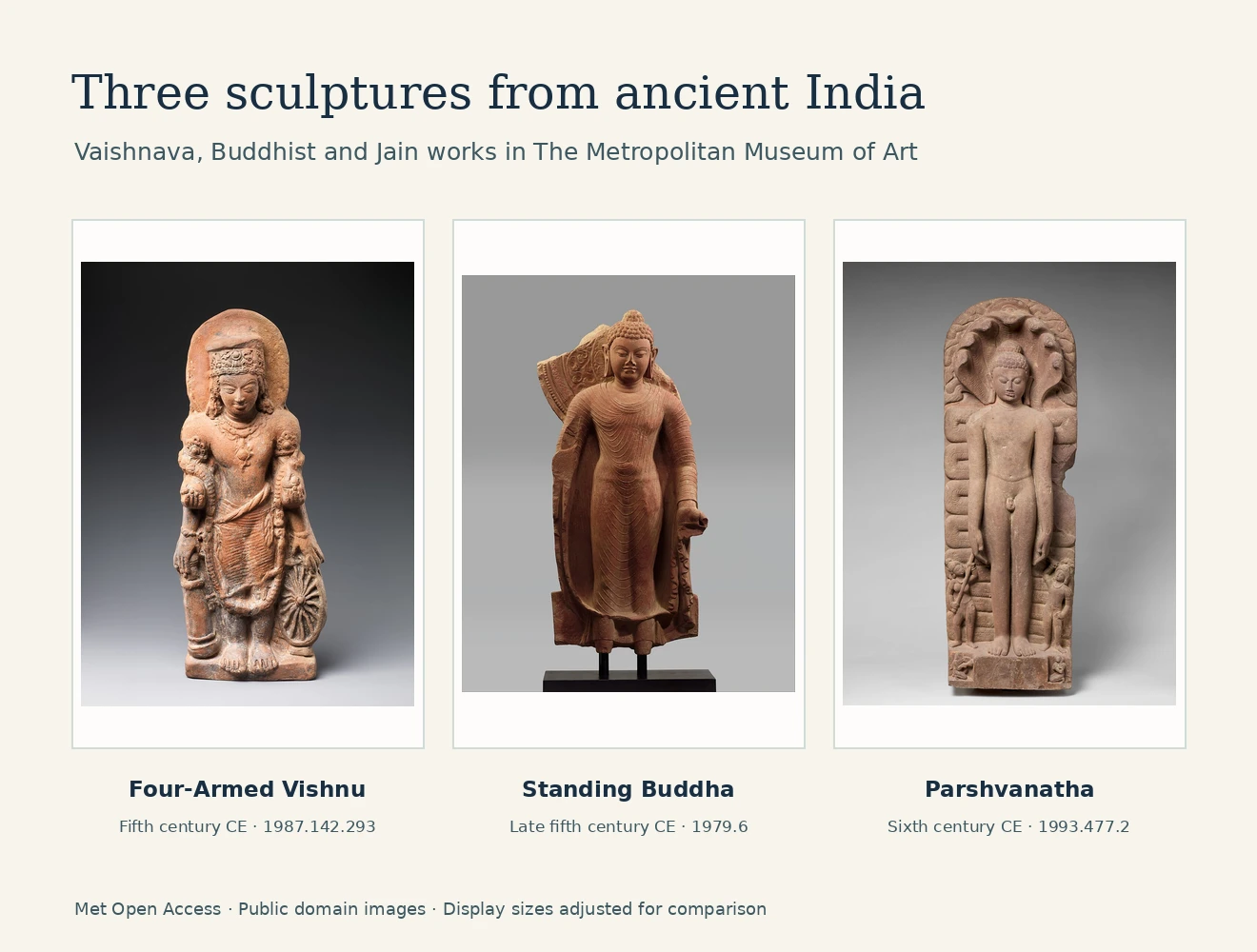
Three collection records at the Metropolitan Museum of Art bring different religious images into view across the fifth and sixth centuries CE. The museum dates its Standing Four-Armed Vishnu, accession 1987.142.293, to the fifth-century Gupta period and identifies it as terracotta from Uttar Pradesh. The title draws attention to the four arms, which give a reader a feature to locate on this particular image of Vishnu. The medium also shows that dated Vaishnava imagery survives in clay as well as in monumental work.
The Standing Buddha Offering Protection, accession 1979.6, is a late fifth-century red sandstone sculpture from Mathura, Uttar Pradesh. The Met interprets the figure as originally raising its right hand in a protective gesture called abhaya mudra. That hand is missing from the surviving statue. The drapery and halo remain visible. This is one instance where the museum’s reading of the original pose explains a title that a present-day photograph cannot fully show.
The sixth-century Standing Jain Tirthankara Parshvanatha, accession 1993.477.2, is a sandstone relief from India. The meditating figure stands beneath a seven-headed cobra and has attendants on either side. The date belongs to the carving. The chronology associated with Parshvanatha in Jain tradition is a separate question. Read together, the three entries document recognisable Jain, Buddhist and Vaishnava figures in adjoining centuries. Establishing how many people worshipped, commissioned or encountered such images would require records beyond these individual works.
| Object | Accession | Museum date | Visible or catalogued feature |
|---|---|---|---|
| Standing Four-Armed Vishnu | 1987.142.293 | Fifth century CE, Gupta period | Terracotta from Uttar Pradesh |
| Standing Buddha Offering Protection | 1979.6 | Late fifth century CE | Mathura red sandstone. The right hand is missing |
| Standing Jain Tirthankara Parshvanatha | 1993.477.2 | Sixth century CE | Sandstone relief with a seven-headed cobra and two attendants |
Accession numbers are useful if a search brings up similarly titled objects. Comparing the three records puts material, date and identification in a single place. Vishnu’s terracotta and the Buddha’s Mathura sandstone can both be dated to the fifth century while belonging to different traditions. The sixth-century carving of Parshvanatha dates the surviving relief and its imagery. The documented date of a representation gives a point in the material record for comparison with inscriptions or architecture.
Regional monuments and religious diversity today
At the Gupta-period Udaigiri caves near Vidisha in Madhya Pradesh, Vaishnava imagery survives in rock-cut shrines. India’s UNESCO Tentative List submission describes a monumental Varaha relief in Cave 5 and a reclining Vishnu, identified as Anantasayana, in Cave 13. It discusses the shrines alongside Gupta inscriptions. The cave numbers matter when checking descriptions, especially because the Udayagiri–Khandagiri caves near Bhubaneswar are a different site with a similar name. To verify current heritage status, find the Vidisha entry and check the listing category. The submission dated 8 July 2026 appears on the Tentative List. An inscription as a World Heritage property would be recorded separately.
Khajuraho offers a later regional comparison. The surviving temples developed under the Chandella dynasty include Hindu and Jain examples with extensive sculpture. Their presence in the same medieval group gives historians material for comparing communities within a shared building setting. To extend that comparison to another region, start with a securely dated set of temples there and check the evidence for its patrons and the identification of its imagery. A single group can tell a detailed regional story while leaving those wider questions open.
Modern religious diversity calls for evidence about people living today. The Vedic chanting inscription documents one living practice in detail. To answer a contemporary question about how a tradition varies by locality, look for recent research that names the communities studied and describes where and when the work took place. A question about the share of people reporting a religious affiliation calls for dated population data with a defined geographic area. Those two kinds of modern evidence address different questions about practice and affiliation.
Sources
- Inscribed Objects from Harappa Excavations, 1986–2007 — Kenoyer and Meadow, Harappa Archaeological Research Project
- Tradition of Vedic chanting — Indian Ministry of Culture heritage documentation
- Kālsī Major Rock Edict XII — Ashokan inscription, English edition by Eugen Hultzsch
- Buddhist monuments at Sanchi — Archaeological Survey of India and World Heritage property record
- Mahabodhi Temple Complex at Bodh Gaya — World Heritage property record
- Udaigiri Caves State Party submission — UNESCO World Heritage Tentative List
- Standing Four-Armed Vishnu, 1987.142.293 — The Metropolitan Museum of Art
- Standing Buddha Offering Protection, 1979.6 — The Metropolitan Museum of Art
- Standing Jain Tirthankara Parshvanatha, 1993.477.2 — The Metropolitan Museum of Art
- Sanchi Stupa, Sanchi — original photograph by achi28
- UNESCO World Heritage Centre: Buddhist Monuments at Sanchi
- UNESCO World Heritage Centre: Khajuraho Group of Monuments
- UNESCO Intangible Cultural Heritage: Tradition of Vedic Chanting
- The Metropolitan Museum of Art’s Open Access terms
