Where Agra Fort fits into a visit
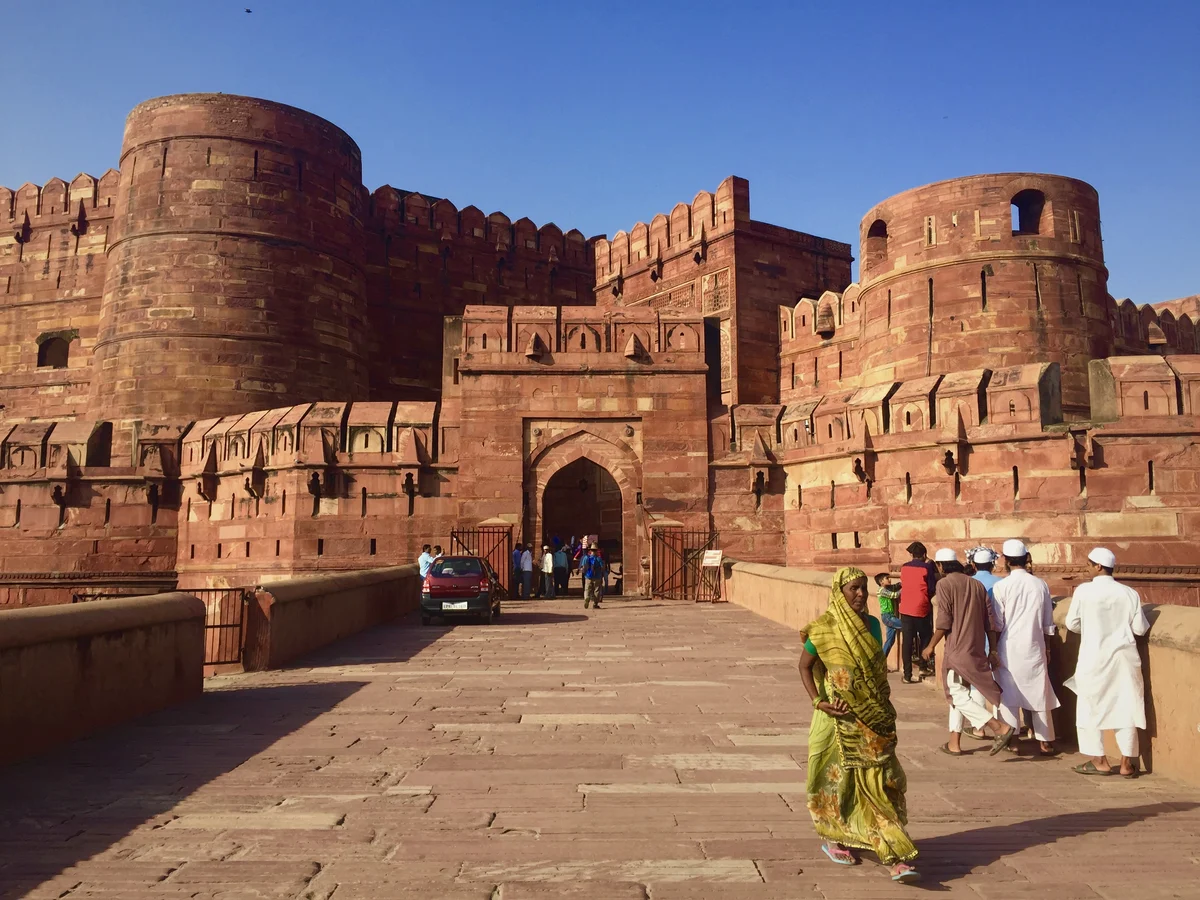
Enter Agra Fort through Amar Singh Gate. Agra district lists the fort as open sunrise to sunset every day, including Friday, when the Taj Mahal is normally closed to general visitors. The fort is a UNESCO World Heritage property in its own right. Allow roughly two hours for the courtyards and public buildings, with more time for guided interpretation or for a group moving at different speeds.
The right bank of the Yamuna explains much of the fort’s setting. To the south-east are views toward the Taj Mahal when the skies are clear. The fort itself tells an earlier story of Mughal imperial government and residence. Its red sandstone outer walls and later marble palaces make a productive pairing, even if the Taj is closed or you plan to see it on another day.
Agra district and the Archaeological Survey of India publish different admission figures in their information pages. Use both as dated references below, and confirm the checkout amount for your ticket category or the fee at Amar Singh Gate. Children below 15 are listed free in both references. The Taj Mahal is a separate admission, even when an eligible same-day local levy applies across multiple sites.
How to compare admission options
The ASI monument page publishes ₹50 cash and ₹35 online for Indian citizens and visitors in its specified SAARC or BIMSTEC categories. It shows ₹600 for other foreign visitors, broken into ₹550 for the ASI and ₹50 for the Agra Development Authority at the counter, and lists ₹550 online. The Agra district page instead displays ₹50 for Indian citizens, ₹90 for SAARC or BIMSTEC nationals and ₹650 for other foreign nationals. It directs readers to the ASI portal for current rates.
When buying online, select Agra Fort before selecting a nationality or age category. Review the final total the official site gives you and keep the dated ticket details together. If the checkout cannot be reached or the appropriate category is unclear, ask at Amar Singh Gate before committing to a price. Agra district lists card and UPI payments at the counter. Keep age and nationality proof handy where the ticket type depends on it.
If you visit more than one Agra monument in a day, ask the ticket desk to identify the local levy separately from site entry. ASI says a foreign visitor who has purchased the specified ₹500 Taj Mahal pathkar can use that levy for a named set of sites on the same day, including Agra Fort. Each monument still has its own admission. The district page also describes a Friday exception for its levy listing. Confirm which component applies to your order.
| Published category | ASI visitor page | Agra district visitor page |
|---|---|---|
| Indian citizen | ₹50 counter cash or ₹35 online. | ₹50 listed. |
| Listed SAARC or BIMSTEC visitor | ₹50 counter cash or ₹35 online. | ₹90 listed. Verify category and current checkout total. |
| Other foreign visitor | ₹600 counter total or ₹550 listed online. | ₹650 listed. Check admission and any local levy separately. |
| Child below 15 | Free entry. | Free entry. Ask what proof is accepted. |
How to read the location map
A pin for Agra Fort may land in the middle of the property. Save Amar Singh Gate as your visitor entrance. The district’s guide identifies the same gate for entry and on-site ticketing. Share that exact name if a driver or friend will meet you after the visit. The historic Delhi Gate and the Yamuna-facing Water Gate belong to the fort’s architecture and are different map points.
The district places the fort about 2.5 km from the Taj Mahal and 3 km from Agra Cantonment station. Treat those as orientation, since a walk from a named Taj gate to a particular ticket counter can have a different length. Public entry hours apply to the site gate. The railway and metro have separate timetables, so preserve a margin if you plan to visit between trains.
A driver agrees to pick up a group after its fort visit. Before splitting up, the group and driver agree on a landmark at the pickup point and save the same map pin. The group checks its walking directions from the visitor exit while everyone still has a connection. That gives them a way to regroup if the fort's main map label appears far from the curb.
Choosing how to get to the fort
For a metro journey to the monument, use Dr. Ambedkar Chowk, which the tourism department’s priority-corridor map associates with Agra Fort. The map labels the nearby Manka Meshwar stop for Agra Fort railway station and Bijli Ghar Bus Stand. The metro operator spells its endpoint Mankameshwar in the annual report. Walking or an e-rickshaw from the appropriate exit is a separate last leg to Amar Singh Gate.
When starting near the Taj Mahal, distinguish the two metro stops serving different sides. The tourism map pairs Taj East Gate with the East Gate side and Taj Mahal station with the West Gate side. From either point take the corridor toward Mankameshwar and confirm the sign for Dr. Ambedkar Chowk. When travelling directly from an intercity train, use the actual railway station from your reservation to plan a cab or onward metro.
A traveler arriving by train wants to visit the fort before checking in. They use the station shown on their ticket as the starting point, identify a confirmed place to leave their bag and check the onward route from there. If luggage storage adds another stop, they judge whether the fort still fits before check-in using that longer route.
What to look for inside the walls
Look for two major building phases. The ASI places Akbar’s rebuilding in red sandstone from 1565 to 1573 and names the Delhi Gate, Akbari Gate and Bengali Mahal among the works representative of his reign. Later Shah Jahan commissioned white marble buildings and mosques inside the fortress. UNESCO inscribed the Agra Fort in 1983 and identifies an enclosure wall extending roughly 2.5 km.
A first visit can follow the public route from the entry toward Jahangir Mahal, then the palaces and court areas that are open. Compare the public audience setting of Diwan-i-Aam with the private audience setting of Diwan-i-Khas. Khas Mahal and the Musamman Burj help explain the residential side and the orientation toward the Yamuna. View these places from the authorised visitor route and ask which interiors are accessible that day.
Shah Jahan spent his final years confined within the fort. ASI dates his death to 1666 and notes that he was buried at the Taj Mahal. The buildings at Agra Fort include religious, administrative and residential spaces, so the tour tells more than a single emperor’s story. A closed room or limited view on the day can still be read in that larger ensemble. Use the signs and the district’s list to name individual buildings accurately.
Visiting Agra Fort and the Taj Mahal on the same day
On a day when both sites are open, protect your Taj Mahal entry first if there is a particular sunrise or admission slot you want. Travel to the fort after allowing for the actual gate exit and transfer. With a morning train or a late start, start with the attraction whose opening or closing window is most important. Leave time for checks and queues at both sites, because a fort ticket does not carry you through Taj security.
A Friday itinerary can begin at Agra Fort and use the rest of the day for another site that is officially open. The usual Taj Mahal general-visitor schedule excludes Fridays, with a separate provision for prayers. If you can use two mornings, a Friday fort visit and Saturday Taj admission gives each attraction its own daylight window. Confirm holiday notices and ticket categories before arranging a driver or accepting a combined quote.
Two visitors have a fixed Taj Mahal booking and a train later that day. They check the Taj Mahal booking terms and verify the fort's admission cutoff. They compare a fort visit before the booking with a visit afterward, including the ride to the station in both cases. If neither plan leaves enough time to see the fort and exit comfortably, they schedule it for another day.
Fitting the fort into a Golden Triangle trip
India's Ministry of Tourism groups Delhi, Agra and Jaipur in its Golden Triangle itinerary. Use those cities to frame the trip, then place the fort on the Agra day that gives you a workable arrival and departure. Different sequences change what you can do in Agra. A same-day transfer can leave a usable visit window if your confirmed transport times and the fort's admission hours line up.
If you are considering an overnight stay, compare the time it would give you at the fort with any commitments in the next city. If you are visiting between travel legs, work backward from the departure point and check what you will do with your bags. Include any trip back to collect them when you calculate how long you can spend inside.
A traveler comparing Delhi–Agra–Jaipur with Jaipur–Agra–Delhi puts the two versions side by side using actual scheduled arrivals and departures for their dates. In each version, they mark where they arrive in Agra, the first attraction admission they can reasonably make and when they must leave the last site. They choose the sequence that gives their preferred Agra visit enough time, including the approach to the gate.
What to confirm close to your visit
There are three practical details to verify on the date of travel. Check the monument’s daylight and last-entry conditions. Confirm the current counter or official portal price for the visitor category. Ask about access conditions for the named courtyards, rooms or terraces if they are central to your visit. A visit confirmed for the site generally does not guarantee entry to every room shown in an old photograph.
Check access in terms that match your party's needs. Ask about the surface and any steps from drop-off to the public gate, then ask which portions of the interior circuit the same visitor can reach. A usable entrance leaves open the question of access to a particular palace area. If someone needs a place to rest, find out where seating is available along the route they can use.
On the day, check for notices affecting the public gate, the approach road and the buildings you most want to see. Save the booking and the confirmed meeting point where you can retrieve them without relying on mobile data, using the ticket format the authority accepts. If there is a change to the entry gate, check the pickup arrangement again before your party goes inside.
Sources
- UNESCO | Agra Fort
- Ministry of Tourism | Traversing the Golden Triangle
- Archaeological Survey of India, Agra Fort history and visitor information
- Agra district, Agra Fort and Amar Singh Gate
- ASI official monument ticket portal
- Uttar Pradesh Tourism, Agra Metro station names for visitors
- Uttar Pradesh Metro Rail Corporation, 2024–25 annual report
- Archaeological Survey of India, Taj Mahal hours and ticket terms
- UNESCO, original 1983 Agra Fort inscription decision