Which flag belonged to the East India Company?
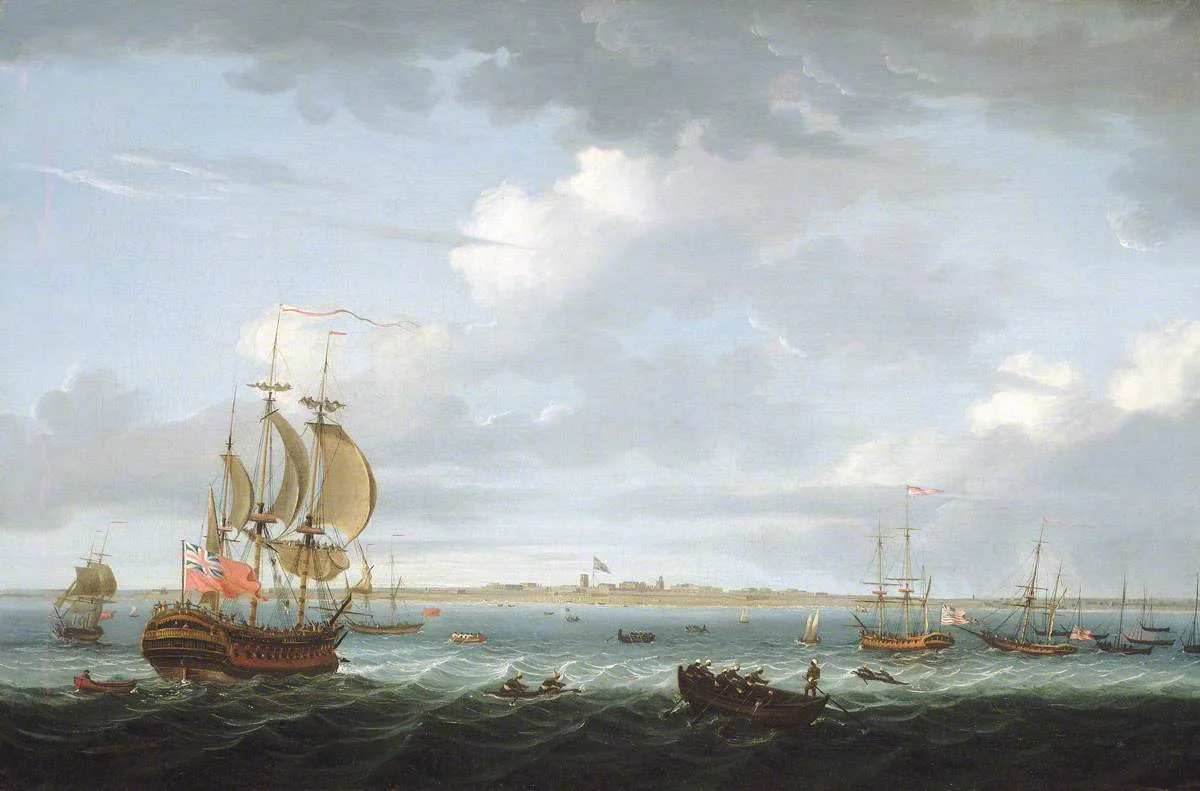
The British East India Company flew a striped maritime ensign, and the familiar version with nine alternating red and white stripes and the modern-pattern Union Flag in the upper hoist corner is documented in a Royal Museums Greenwich reproduction made around 1911. For a dated view of the flag in use, look at the ship right of centre in Adam Callander’s 1780 painting Shipping off Madras, which the museum identifies as flying the Company’s flag.
The Company’s charter belongs to a different part of the timeline. The British Library catalogue dates the letters patent to 31 December 1600 and identifies its record as a copy of the grant creating the Governor and Company of Merchants of London trading into the East Indies. This record establishes the date of the grant. The design and whereabouts of any first Company ensign require separate evidence.
The later dates matter when a flag image accompanies a story about Company rule. Sections I and II of the Government of India Act 1858 transferred the Company’s governing powers and the territories under its government to the Crown. Section 36 of the later stock dividend redemption act specified dissolution on 1 June 1874, subject to the stock-dividend provisions it sets out. The Greenwich reproduction dates from decades after both milestones. Its image can illustrate the design represented by that copy, with the object’s own date visible in the caption.
- Elizabeth I's East Indies charter, copy record IOR/A/1/2 — British Library archives
- Shipping off Madras, BHC1890, 1780 — Royal Museums Greenwich
- Honourable East India Company ensign, AAA0970 — Royal Museums Greenwich
- Government of India Act 1858 and East India Stock Dividend Redemption Act 1873 — UK statute archive
- The East India Stock Dividend Redemption Act 1873, section 36
Early flag charts and what they can date
Before the surviving reproduction, flag charts provide evidence of how mariners and publishers identified corporate flags. A small online scan attributed to a chart by B. Lens around 1700 offers a possible early depiction, with limited catalogue evidence for its attribution and date. Treat it as a lead. A securely catalogued chart that identifies its publisher and names the Company gives a firmer starting point for a historical comparison.
A later maritime chart in the Royal Museums Greenwich archive has a more specific record. Under reference SIG/D/8, the archive describes a coloured chart printed and sold by H. Overton and I. Hool, with an East India Company flag among French and admirals’ flags. The catalogue description says pre-1789 and the date field indexes 1789. Preserve those distinctions when dating the chart. The catalogue text establishes that the Company flag appears in it, while a legible view of the plate is needed to describe its graphic details.
A flag chart dates a depiction. A date on a charter dates a grant. Even a fully legible view of the Lens illustration would show how one chart represented the flag around the date attributed to it. Establishing when the design came into use would require evidence tied to that question. Keep the source type beside the date when comparing early and later images, where a sequence of pictures can otherwise suggest a sequence of formally adopted designs.
Reading the 1780 flag off Madras
Callander’s harbour scene places the Company ensign among several flags in use at Madras, now Chennai. In the Royal Museums Greenwich record for BHC1890, the ship right of centre carries the Company flag. The museum separately identifies red ensigns on other vessels and the British flag at Fort St George. Those neighbouring flags give the reader a way to check the identification within the scene, where red appears in several places.
The buildings and vessels give useful reference points in the full harbour view. Start with the ship right of centre identified by the curator, then follow its rigging upward to locate the ensign. A stripe count taken from the tiny painted example would be difficult to verify. For a counted nineteenth- or twentieth-century comparison, use a catalogue entry that records the object’s construction, such as the Greenwich reproduction described below.
The museum’s catalogue number BHC1890 identifies the painting when a copy is reposted under a title mentioning Chennai or Fort St George. The number links the harbour scene to Adam Callander and the date 1780. To compare this record with a surviving cloth or a catalogue drawing, record the medium and date beside each image. A painter representing a ship in port and a flag maker following a supplied design leave different kinds of visual evidence.
Nine stripes and the Union Flag in the canton
In the Greenwich ensign AAA0970, five red stripes and four white stripes run horizontally. The canton, the upper corner next to the hoist, contains a modern-pattern Union Flag. The hoist is the edge by which a flag is attached. The museum describes the rectangular object as a machine-sewn wool bunting reproduction made around 1911 to a design supplied by William Foster. Those details identify a particular piece of cloth and explain why a clear image of it can be so useful.
The diagonal red cross of St Patrick helps identify the canton’s pattern. The pre-1801 Union Flag in Royal Museums Greenwich and the parliamentary briefing provide the comparison. The new pattern, which added that red diagonal cross, was proclaimed on 1 January 1801. The museum’s circa-1911 date for AAA0970 comes from the object record. The 1801 date belongs to the design of the Union Flag shown within it.
If you were choosing a lead image for an account of shipping at Madras in 1780, Callander’s scene would anchor the page in the right harbour and year. A separately captioned view of AAA0970 could give readers a clear look at nine stripes and the modern-pattern canton. Each image would then answer a different question. The painting shows which vessel the museum identifies as flying the Company ensign, while the reproduction gives countable details for the specific design it represents.
A caption for AAA0970 can therefore carry three facts in close succession. Identify it as a Company ensign reproduction, give its circa-1911 date, and describe the nine stripes and modern-pattern canton. If a digital drawing matches those features, the comparison supports a description of the resemblance. Identifying the drawing’s source would still require its own attribution or a record of how it was made.
The Company’s arms and its cloth mark
The phrase East India Company logo can lead to two very different objects. The large seal represented by Royal Museums Greenwich cast SEC0264 is catalogued to 1675. Its arms show three sailing ships with crosses on their sails and flags. Two heraldic sea lions flank the arms, and the design includes a globe with a zodiac band between pennants. The catalogue also transcribes two Latin inscriptions and the surrounding corporate legend, which are useful checks when identifying a rendering of the seal.
The ships and their little flags belong to that heraldic composition. A caption for the cast can identify the arms and explain the relationship of the cast to the seal it represents. An image of the arms is a useful choice for a reader asking about the Company’s formal corporate symbols. AAA0970 answers the separate question of what the striped maritime ensign looks like in a documented reproduction.
A smaller lead seal, ZBA0441, records the Company’s identity on merchandise. The museum dates it to circa 1780–1800 and describes VEIC inside a heart with a 4 above it. On the reverse are a St George cross and a shield. Seals of this kind authenticated merchant cloth by clamping over its edge, and some cloth remains attached to this example. That surviving material helps explain the object’s function alongside the mark stamped into the lead.
The lead seal was recovered from a Thames Estuary wreck site in 1975. Use that year for the recovery and the museum’s approximate range for the object. Where only one face can be shown, a caption should name the features visible on that face. A pair of images can show how the VEIC device and the cross and shield belong to opposite sides of a single commercial seal.
| What you see | Reference | Date to put in context |
|---|---|---|
| Company flag on a ship right of centre off Madras | Shipping off Madras, BHC1890 | 1780 painting |
| Nine red and white stripes and a modern-pattern Union canton | Ensign AAA0970 | Circa 1911 reproduction |
| Three ships, sea lions and a globe with a zodiac band | Great Seal represented by cast SEC0264 | 1675 date of the seal represented |
| VEIC in a heart with a 4 above | Cloth or bag seal ZBA0441 | Circa 1780–1800 object, recovered in 1975 |
The cloth seal and formal arms solve different identification problems. A collector examining a small lead object can start with its material and size, then look for the heart and VEIC initials. A seal impression with ships and sea lions points toward the corporate arms. A painted or woven flag at the stern calls for the ensign record. The cited object numbers make those comparisons possible without asking one image to represent every institutional mark.
Distinguishing the U.S., British and Dutch flags
For a comparison with the United States flag, look first at the canton and then at the stripes. The Continental Congress resolution of 14 June 1777 called for thirteen alternating stripes and thirteen white stars in a blue field. AAA0970 has nine stripes and the Union design in the canton. The resolution establishes the adopted American design, and the museum catalogue describes one Company reproduction. The comparison works at the level of those specific records.
Charles Fawcett proposed a historical connection in a 1937 article in The Mariner’s Mirror. The shared arrangement of stripes and a distinct canton explains why the designs are compared. A claim about borrowing would require evidence connecting the Company ensign to the people or proceedings involved in adopting the American design. The article documents the published hypothesis, and the congressional resolution documents the design that Congress adopted.
The modern British Union Flag can also appear in a search for the Company ensign because it forms the canton of the Greenwich reproduction. Read the full outline of the image. On AAA0970 the Union pattern occupies the upper hoist corner of a larger striped flag. In Callander’s painting the museum identifies a British flag at Fort St George separately from the Company ensign aboard ship. Both examples make the placement of the flag part of its identification.
The name East India Company also appears in English descriptions of material from the Dutch company. For a documented comparison, use Plate 36 of Carolus Allard’s work published in 1705, held by Maritime Museum Rotterdam under accession BWAE461-P121. The plate’s text concerns the Dutch East India Company and Amsterdam chamber marks. For an illustration with a vague caption, check the institution’s object title, the attribution on the original plate and whether it names a chamber. A caption that includes the company and the plate date makes the comparison intelligible even when the image is displayed on its own.
- Shipping off Madras, BHC1890, 1780 — Royal Museums Greenwich
- Honourable East India Company ensign, AAA0970 — Royal Museums Greenwich
- The Striped Flag of the East India Company and its Connexion with the American Stars and Stripes — original author Charles Fawcett in The Mariner's Mirror
- Early British Company illustration attributed to B. Lens and separate Dutch company flag chart
- Journals of the Continental Congress volume 8, 14 June 1777 resolution
- Maritime Museum Rotterdam, Allard’s 1705 Dutch flag plate BWAE461-P121
Sources
- Elizabeth I's East Indies charter, copy record IOR/A/1/2 — British Library archives
- Great Seal of the Honourable East India Company, SEC0264 — Royal Museums Greenwich
- Shipping off Madras, BHC1890, 1780 — Royal Museums Greenwich
- Contemporary maritime flag chart, SIG/D/8 — Royal Museums Greenwich archive
- East India Company cloth or bag seal, ZBA0441 — Royal Museums Greenwich
- Honourable East India Company ensign, AAA0970 — Royal Museums Greenwich
- Government of India Act 1858 and East India Stock Dividend Redemption Act 1873 — UK statute archive
- The Striped Flag of the East India Company and its Connexion with the American Stars and Stripes — original author Charles Fawcett in The Mariner's Mirror
- Adam Callander, Shipping off Madras, 1780 — public-domain artwork image
- Early British Company illustration attributed to B. Lens and separate Dutch company flag chart
- The East India Stock Dividend Redemption Act 1873, section 36
- Royal Museums Greenwich’s pre-1801 Union Flag object AAA0598
- House of Commons Library on the Union Flag’s design
- Journals of the Continental Congress volume 8, 14 June 1777 resolution
- Maritime Museum Rotterdam, Allard’s 1705 Dutch flag plate BWAE461-P121


