India’s Muslim population in the census
India’s latest published nationwide census count by religion recorded 172.25 million Muslims in 2011, or 14.23% of the population. Islam’s history in India varies by region, as records of merchant patronage in coastal Kerala, Sultanate-era building in Delhi and Bengal, and later urban foundations in Gujarat and the Deccan show.
The Census of India’s C-01 table supplies the exact national figures. It counted 172,245,158 residents in the Muslim category out of 1,210,854,977 residents overall. Divide the first number by the second and multiply by 100 to get 14.23% to two decimal places. The total includes people whose religion was recorded as not stated. Using only residents assigned to a named religion category would answer a different question and produce a different share.
To check whether a newer count is available, open the Census of India’s table index and look for a newer C-01 release or another published nationwide table of enumerated residents by religion. Check the census reference year inside the table and confirm that its geography covers India as a whole. The Census 2027 preparation material and notifications concern a separate stage of the census process. A population projection or survey estimate has its own reference period and method.
C-01 records a religion category for each resident. Its breakdowns let readers compare reported population by state, sex and rural or urban residence. Questions about denomination, language, religious observance, migration and individual conversion histories require other evidence. Even within a state with an accurately measured Muslim population share, the table tells you little about how particular communities formed or which cultural practices residents maintain.
Kerala’s coastal mosques and their founding traditions
At Kodungallur, the founding tradition of Cheraman Juma Masjid links Malik ibn Dinar and Cheraman Perumal to the mosque’s origins in the seventh century. Kerala Tourism’s mosque account gives 629 CE, while its Islamic History Museum gives a qualified date of 628 CE. Both are modern accounts of the tradition. Neither supplies a contemporary seventh-century foundation inscription. The source material supports identifying the region and century of the founding tradition while leaving the precise foundation year unresolved.
The mosque account also describes earlier renovations and a change to the façade in 1974. Those details help explain why the appearance of a building today can belong to a different period from its founding story. A description of a photograph should identify visible or documented features. To assign an age to a specific feature, such as a doorway or roof, look for records of that feature in architectural surveys, conservation files or dated photographs.
Kozhikode offers a separate Malabar port setting. In Kuttichira, Kerala Tourism associates the timber-rich Mishkal Mosque with the merchant Nakhuda Mishkal and records repairs following damage in 1510. Its account also associates Muchundi Mosque with a thirteenth-century building history. The merchant association at Mishkal gives the history of coastal Islam a named patron, while the two Kozhikode sites give readers specific places to compare. Explaining the spread of Islam across Kerala would require wider evidence about settlement, patronage and religious affiliation.
Delhi, Srinagar and successive building phases
At Delhi’s Qutb complex, the Quwwatu’l-Islam mosque and the Qutb Minar form part of a site associated with early Sultanate patronage. UNESCO’s detailed account records work on the minaret between 1199 and 1503. This span covers multiple phases and gives the site a history extending well beyond its earliest construction. A date used for the beginning of minaret work carries a narrower meaning than a date assigned to the full complex.
Srinagar’s Jamia Masjid has a different building sequence. The architectural history in the IGNCA and ASI archive places its foundation in 1393–1394 under Sultan Sikandar and records enlargement under Zain ul-Abidin, who ruled from 1420 to 1470. It also discusses later rebuilding of the timberwork after fires, including in Aurangzeb’s era. The timber building thus carries evidence of repairs as well as of the mosque’s long history at the site.
A second Srinagar building is easy to confuse with the Jamia Masjid when reading a short caption. The Shah-i-Hamadan shrine and mosque stands on the Jhelum and has its own chronology. Incredible India describes an origin in 1395 and rebuilding in 1732. When two accounts appear to give different dates for a Srinagar mosque, check the building name, location and phase first. Foundation, enlargement and reconstruction can each have a different date even within the history of one landmark.
Bengal’s Adina Mosque and the delta frontier
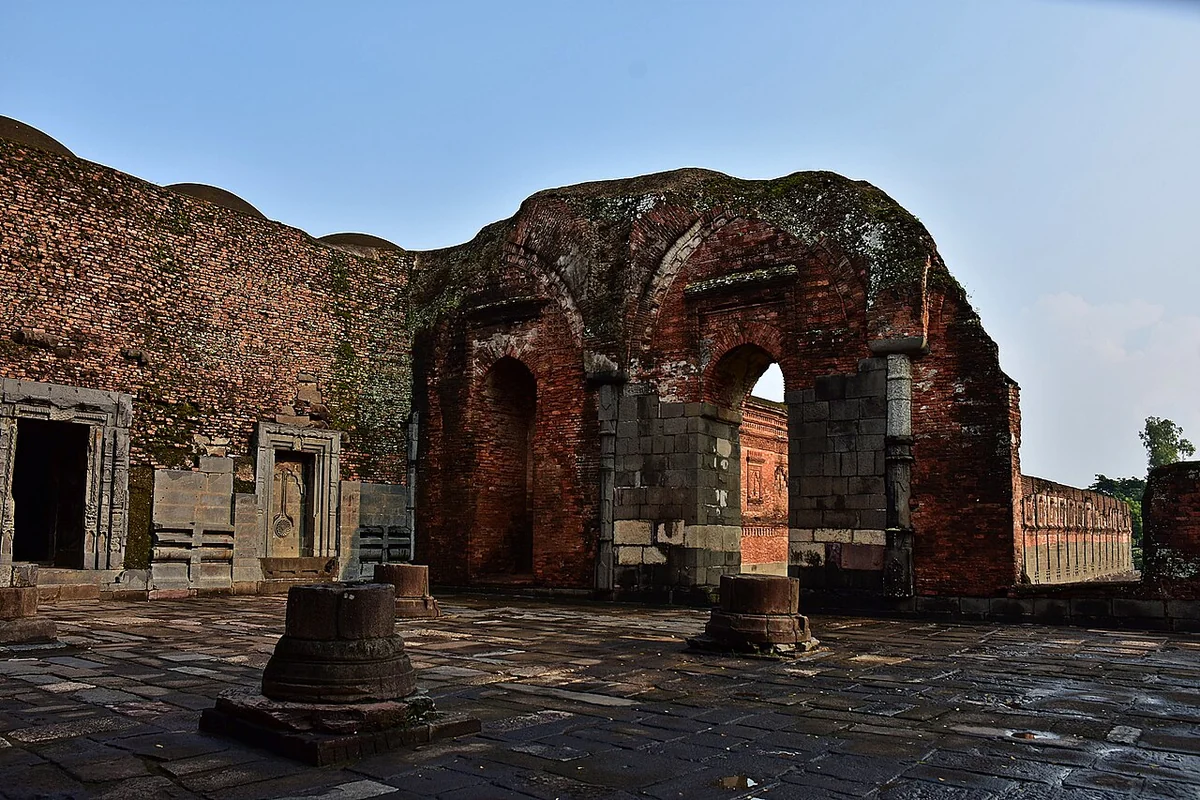
Adina Mosque at Pandua near Malda is a fourteenth-century monument in present-day West Bengal. An archaeological report archived by the Indira Gandhi National Centre for the Arts attributes it to Sultan Sikandar Shah and gives two readings of the mosque inscription. The report renders 770 AH as 1369 CE and 776 AH as 1374 CE. A separate ASI study reports that work began in 1364. A precise date should identify which reading or building event it refers to.
The mosque establishes a case of royal patronage at Pandua. For a wider historical question about how Islamic institutions grew, Richard M. Eaton’s 1993 study of Bengal from 1204 to 1760 examines frontier settlement, changing agriculture and local patronage. His interpretation gives particular attention to eastern delta regions that now lie largely in Bangladesh. That geographical distinction matters when bringing the study into a discussion of a monument or census figure from today’s West Bengal.
A royal building can anchor a timeline of political authority and expenditure at a particular place. To study changes in religious affiliation, historians need evidence about communities over time, including the settlement and patronage patterns Eaton examines. The date on a mosque inscription can help establish when an institution received support. The timing and extent of changes in religious affiliation across the surrounding region remain separate historical questions.
City foundations in Gujarat and the Deccan
The walled city of Ahmadabad was founded in 1411 under Sultan Ahmad Shah on the eastern bank of the Sabarmati. The UNESCO property includes Sultanate mosques and tombs, temples, residential pols and archaeological evidence that predates the Sultanate. The city provides a view of Islamic architecture within a larger urban fabric, where religious buildings can be read alongside homes and neighbourhoods. The foundation year applies to the walled city, and individual monuments need their own dates.
| Place | Present-day state or UT | Recorded date or period | What is dated |
|---|---|---|---|
| Cheraman Juma Masjid, Kodungallur | Kerala | Seventh century in tradition | Local foundation tradition. Kerala Tourism pages give 628 and 629. |
| Mishkal Mosque, Kozhikode | Kerala | 1510 damage and later repairs | Named merchant tradition and a later chapter in the structure’s history. |
| Qutb complex, Delhi | Delhi | 1199–1503 | Successive phases of work on the minaret. |
| Jamia Masjid, Srinagar | Jammu and Kashmir | 1393–1394 | Foundation in the architectural account, followed by enlargement and repairs. |
| Adina Mosque, Pandua | West Bengal | 1369 or 1374 | Alternative CE readings of a fourteenth-century building inscription. |
| Walled City of Ahmadabad | Gujarat | 1411 | Sultan Ahmad Shah’s city foundation, distinct from individual monument dates. |
| Charminar, Hyderabad | Telangana | 1591 | Construction under Sultan Muhammad Quli Qutb Shah. |
Ahmadabad’s World Heritage registration in 2017 records when UNESCO inscribed the property. At Hyderabad, the district administration records 1591 as the construction year of Charminar under Sultan Muhammad Quli Qutb Shah. Telangana Tourism describes its position in the original city plan and identifies a mosque within the structure. The district also records several explanations for why it was built and describes the reason as uncertain. The patron, date and urban setting provide firmer grounds for describing the landmark than any single account of its purpose.
- UNESCO World Heritage Centre: Historic City of Ahmadabad
- Hyderabad District and Telangana Tourism: Charminar
- Kerala Tourism Muziris Heritage: Cheraman Juma Masjid
- Kerala Tourism: Mishkal Mosque, Kuttichira and Muchundi in Kozhikode
- Indira Gandhi National Centre for the Arts: archival archaeological report on Gaur and Panduah
- IGNCA/ASI archive: Indo-Islamic architecture, Kashmir, printed p. 123
- UNESCO World Heritage Centre: Qutb Minar and its Monuments, Delhi
Chaar Bayt as a living oral tradition
The Sangeet Natak Akademi’s national inventory lists Chaar Bayt as a Muslim lyrical oral poetry tradition in Uttar Pradesh, Madhya Pradesh and Rajasthan. It appears as entry 43. The listing gives readers a named practice and a starting point for finding documentation in three states. It also gives regional cultural history a subject that can be studied through the transmission of verse alongside the architectural record.
The inventory’s origin account leaves the date when the form began uncertain. Its state names establish the geographical coverage of the entry. For a closer account of Chaar Bayt in a particular place, look for a dated performance record or a documented collection that names the performers and locality. Those details allow a reader to connect a specific rendition to the broader tradition and to distinguish the date of a recording from the age of the verse it preserves.
Indian music traditions, recordings and a listening guideReligions in India and Census 2011 population by community
Sources
- Census of India: Population by Religious Community, 2011
- Kerala Tourism: Cheraman Juma Masjid
- UNESCO World Heritage Centre: Historic City of Ahmadabad
- Ministry of Minority Affairs: published Census 2001 numbers, table and Manipur scope
- Registrar General of India: Census table index and Census 2027 updates
- Kerala Tourism Muziris Heritage: Cheraman Juma Masjid
- Kerala Tourism: Mishkal Mosque, Kuttichira and Muchundi in Kozhikode
- Indira Gandhi National Centre for the Arts: archival archaeological report on Gaur and Panduah
- Richard M. Eaton: The Rise of Islam and the Bengal Frontier, 1204–1760, open UC Press text
- IGNCA/ASI archive: Indo-Islamic architecture, Kashmir, printed p. 123
- Hyderabad District and Telangana Tourism: Charminar
- UNESCO World Heritage Centre: Qutb Minar and its Monuments, Delhi
- Sangeet Natak Akademi: Chaar Bayt national intangible heritage inventory
- Wikimedia Commons: Adina Mosque, Pandua, Malda
- Original 2011 Census C-01 workbook
- 2015 Census release with the 2001–2011 official growth rate
