How many Christians live in India?
India’s 2011 Census counted 27,819,588 Christians, or 2.3% of the country’s 1,210,854,977 residents. The Syro-Malabar Church traces its origins to Saint Thomas’s traditional arrival in 52 CE, and a separate written source describes Christian communities in western and southwestern India by the mid-sixth century.
The familiar figure of about 27.8 million answers how many people the census recorded as Christian in 2011. A comparable later national release was not located in the Census of India catalogue. The catalogue carries Census 2027 notifications and preparations, and the figure to use for the national religious breakdown remains dated Census 2011 in the available evidence. The date of an article or a census announcement tells you when it appeared. The year on the population table tells you when the people in it were counted.
The national percentage uses the entire resident population, including people whose religion was unstated. Dividing 27,819,588 by 1,210,854,977 gives about 2.2975%. The census reports Christian as a single religious affiliation category, so one total covers people from churches with very different histories. When a historical source introduces a particular church or movement, its name identifies the community in that account. To put a population figure beside that name, you would need a separate count with a defined year, area and membership basis.
- Census of India 2011: C-01 Population by religious community, India
- Office of the Registrar General and Census Commissioner: Census updates
- Syro-Malabar Church Commission for Mission: Mission Policy, historical context §§2.1–2.4
- Cambridge University Library Special Collections: history and provenance of the Buchanan Bible
- Cosmas Indicopleustes, Christian Topography III, J. W. McCrindle translation (1897)
- Census of India: 2011 Religious Communities
- Census of India: download original C-01 India workbook and verify figures
Where Christian populations were largest
Kerala recorded 6,141,269 Christians in 2011, the largest count among the states and union territories in the census workbook. Tamil Nadu followed with 4,418,331. Nagaland had the highest share, 87.93%, followed by Mizoram at 87.16% and Meghalaya at 74.59%. Those three states alone exceeded half of their resident populations among the workbook’s 35 state and union territory units. Meghalaya counted more Christians than either Nagaland or Mizoram because it had a larger total population.
| 2011 geography | 2011 type | Christians | All residents | Local share (%) |
|---|---|---|---|---|
| Kerala | State | 6,141,269 | 33,406,061 | 18.38 |
| Tamil Nadu | State | 4,418,331 | 72,147,030 | 6.12 |
| Meghalaya | State | 2,213,027 | 2,966,889 | 74.59 |
| Nagaland | State | 1,739,651 | 1,978,502 | 87.93 |
| Jharkhand | State | 1,418,608 | 32,988,134 | 4.30 |
| Manipur | State | 1,179,043 | 2,855,794 | 41.29 |
| Assam | State | 1,165,867 | 31,205,576 | 3.74 |
| Odisha | State | 1,161,708 | 41,974,218 | 2.77 |
| Karnataka | State | 1,142,647 | 61,095,297 | 1.87 |
| Andhra Pradesh (undivided) | State | 1,129,784 | 84,580,777 | 1.34 |
| Maharashtra | State | 1,080,073 | 112,374,333 | 0.96 |
| Mizoram | State | 956,331 | 1,097,206 | 87.16 |
| West Bengal | State | 658,618 | 91,276,115 | 0.72 |
| Chhattisgarh | State | 490,542 | 25,545,198 | 1.92 |
| Arunachal Pradesh | State | 418,732 | 1,383,727 | 30.26 |
| Goa | State | 366,130 | 1,458,545 | 25.10 |
| Uttar Pradesh | State | 356,448 | 199,812,341 | 0.18 |
| Punjab | State | 348,230 | 27,743,338 | 1.26 |
| Gujarat | State | 316,178 | 60,439,692 | 0.52 |
| Madhya Pradesh | State | 213,282 | 72,626,809 | 0.29 |
| Tripura | State | 159,882 | 3,673,917 | 4.35 |
| NCT of Delhi | Union territory | 146,093 | 16,787,941 | 0.87 |
| Bihar | State | 129,247 | 104,099,452 | 0.12 |
| Rajasthan | State | 96,430 | 68,548,437 | 0.14 |
| Andaman and Nicobar Islands | Union territory | 80,984 | 380,581 | 21.28 |
| Puducherry | Union territory | 78,550 | 1,247,953 | 6.29 |
| Sikkim | State | 60,522 | 610,577 | 9.91 |
| Haryana | State | 50,353 | 25,351,462 | 0.20 |
| Uttarakhand | State | 37,781 | 10,086,292 | 0.37 |
| Jammu and Kashmir | State | 35,631 | 12,541,302 | 0.28 |
| Himachal Pradesh | State | 12,646 | 6,864,602 | 0.18 |
| Chandigarh | Union territory | 8,720 | 1,055,450 | 0.83 |
| Dadra and Nagar Haveli | Union territory | 5,113 | 343,709 | 1.49 |
| Daman and Diu | Union territory | 2,820 | 243,247 | 1.16 |
| Lakshadweep | Union territory | 317 | 64,473 | 0.49 |
Consider a regional profile comparing Goa and Jharkhand. Goa’s 366,130 Christians made up about one quarter of its residents. Jharkhand’s 1,418,608 were nearly four times as numerous and made up 4.30% of its residents. If the profile asks where Christians formed a larger part of the local population, Goa is the answer. If it asks where more Christians lived, Jharkhand is the answer. Showing both measures lets readers make either comparison from the same table.
The rural and urban figures offer another way to see the effect of the denominator. About 16.66 million Christians lived in rural areas and about 11.16 million in urban areas. Christians made up 2.00% of India’s rural residents and 2.96% of its urban residents. India’s rural population was more than twice its urban population, so the smaller rural percentage still represented more people. These two percentages describe the religious composition of rural and urban India. To find the share of Christians who lived in either setting, divide the relevant Christian count by the national Christian count.
Sort by the share column to see a different order from the count column. Both calculations use all residents within the applicable 2011 boundary as the denominator. The workbook has seven union territories and 28 states. It counts Andhra Pradesh before division and uses Jammu and Kashmir’s former state boundary. For rural and urban areas, the corresponding national counts are 16,657,065 and 11,162,523.
What the Saint Thomas tradition says
The Syro-Malabar Church’s mission policy records a received tradition that the apostle Thomas arrived in 52 CE and was martyred at Mylapore in 72 CE. Both dates belong in an account of how the church understands its origins. Attribute them to the church even in a short timeline, where a bare year can make a traditional date look like the date of a surviving record. The account also preserves Mylapore’s particular role in the story as the place of martyrdom.
Cambridge University Library discusses the gap between the first-century events and the surviving narratives about them. The third-century Acts of Thomas belongs to that later literary tradition. The date of the Acts helps place a written account of the mission in time. The available evidence supplies no contemporary first-century record that fixes the arrival or martyrdom dates or traces the places Thomas visited. A historical account can therefore give the church’s dates, identify the later text and say explicitly which details remain outside the surviving documentation.
The same library shows how uncertainty can arise even when a physical manuscript survives. The Syriac Buchanan Bible has a documented connection to the Malankara Church and to Claudius Buchanan by the early nineteenth century. Cambridge reports differing accounts of how it reached Malabar. Evidence for who held the manuscript at one point establishes part of its history. Working further back requires evidence for earlier transfers, and dating the manuscript itself would still leave the question of when it came to Malabar.
What the sixth-century text and Kollam plates record
In the mid-sixth century, Cosmas Indicopleustes wrote of a church in Malê, a pepper-producing region usually identified with Malabar, and a bishop at Calliana, often identified with Kalyan, who was appointed from Persia. The passage describes a church in one place and an episcopal appointment in another. The second detail gives a specific example of ecclesiastical links with Persia. Both modern place identifications deserve wording that signals how scholars read the names in the text.
Cosmas separately mentions Taprobanê and Dioscoridês, conventionally identified as Sri Lanka and Socotra. Those references help explain the geographic spread of the passage and should remain separate from its evidence for the mainland. The passage does not establish that Cosmas personally visited every place he mentions. You can date his testimony to the sixth century while leaving open when the individual communities took shape and how he learned about each one.
The Kollam Tarisappalli copper plates give a different kind of evidence. Commonly dated to about 849–850 CE, they record a grant by Ayyan Atikal, ruler of Venad, associated with a church and the merchant Maruvan Sapir Iso. The charter ties the church to land, trade and privileges in a Malabar port. Witnesses recorded in multiple languages and scripts add detail about the networks around the grant. The record shows a Christian institution taking part in the commercial and political life of the port.
To check the date, look for the fifth regnal year of Sthanu Ravi in the text and the conversion to about 849–850 CE in the modern scholarship. T. A. Gopinatha Rao’s 1916 edition supplies a transcription and historical translation. Cambridge’s brass plates reproduce the copper originals in reverse and belong to a later chapter in the record’s history. Buchanan commissioned those copies in Cochin in 1805 and presented them in 1809. A catalogue description or image should identify which object it shows before using either date.
| Date | Place or record | Evidence type | What it establishes |
|---|---|---|---|
| 52 and 72 CE | Saint Thomas tradition, including Mylapore | Church tradition | The church’s received arrival and martyrdom dates. |
| Third century CE | Acts of Thomas | Literary tradition | A later surviving narrative of the apostle’s mission. |
| Mid-sixth century CE | Cosmas, Christian Topography III | Historical text | A church in Malê, generally read as Malabar, and a Persian-appointed bishop at Calliana, often read as Kalyan. |
| c.849–850 CE | Tarisappalli plates, Kollam | Inscription | A grant associated with the church and the merchant Maruvan Sapir Iso in the fifth year of Sthanu Ravi. |
| 1594 and 1605 | Basilica of Bom Jesus, Old Goa | Building milestones | Foundation stone on 24 November 1594 and consecration on 15 May 1605. |
| 23 December 1872 | Molungkimong, Naga Hills | Council history | Baptism of fifteen people, from the Nagaland Baptist Church Council’s account. |
| 11 January 1894 | Aijal, now Aizawl | Education history | Arrival of J. H. Lorrain and F. W. Savidge, as dated by the state commission. |
- Cosmas Indicopleustes, Christian Topography III, J. W. McCrindle translation (1897)
- Cambridge University Press research article on early medieval South Indian Christianity and the Kollam inscription
- T. A. Gopinatha Rao, Travancore Archaeological Series II (1916), Kottayam plates of Sthanu Ravi, no. I
- Library of Congress digital volume: Sanskrit Manuscripts in the UL
- Cambridge University Library Special Collections: history and provenance of the Buchanan Bible
- Government of Goa: Basilica of Bom Jesus
- Nagaland Baptist Church Council: institutional history
- Government of Mizoram School Education: Education Reforms Commission historical record
Portuguese-era Catholic history in Goa and Kerala
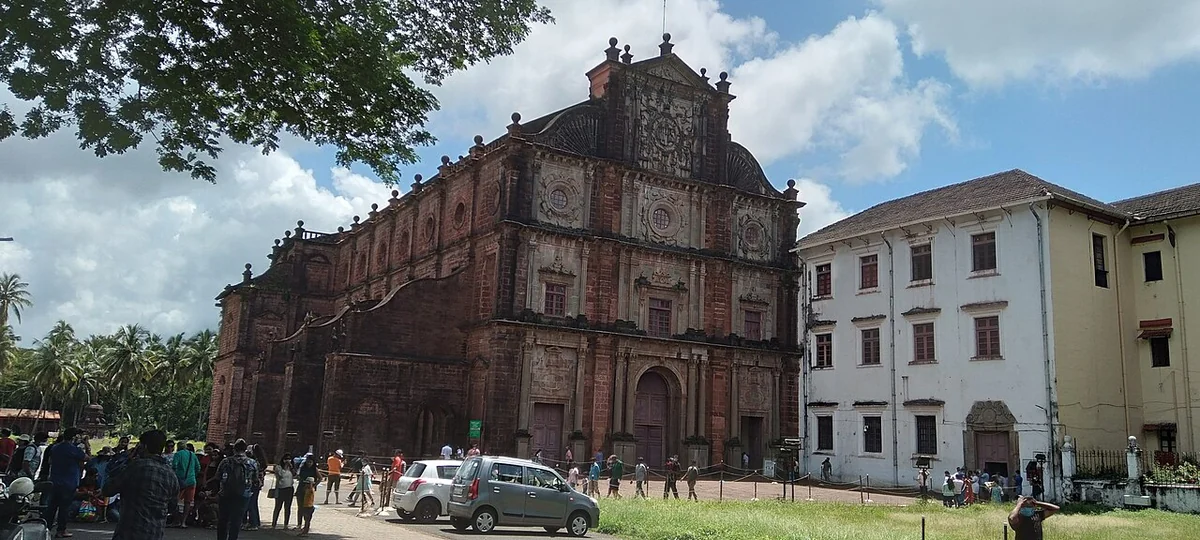
At the Basilica of Bom Jesus in Old Goa, the foundation stone was laid on 24 November 1594 and the church was consecrated on 15 May 1605, according to the Government of Goa. The dedication is to Bom Jesus, the infant Jesus. The basilica houses the remains of Francis Xavier. Each detail answers a different question about the same site, from when construction began to whom the church was dedicated and why Xavier is associated with it.
UNESCO inscribed the Churches and Convents of Goa as a group in 1986. The inscription date marks recognition of the ensemble. The foundation and consecration dates belong to the individual basilica. The ensemble documents Portuguese Catholic missions and architectural exchange, and the basilica provides a specific building through which to read that history. A description of the monument can use the documented dates for the building while leaving the beginnings of Christian communities to sources that address those communities directly.
Portuguese ecclesiastical authority also affected Saint Thomas Christians in Kerala. The Syro-Malabar Church’s institutional account identifies the Synod of Diamper in 1599 and the Coonan Cross Oath in 1653 as milestones in those changes. The Kollam charter places a Christian institution in the region centuries before either event. To trace how particular Saint Thomas Christian branches developed after the oath, consult each branch’s own historical records alongside scholarship that follows the subsequent disputes and affiliations.
Baptist history in Nagaland and educational history in Mizoram
The Nagaland Baptist Church Council’s account of Baptist beginnings in the Naga Hills centres on Molungkimong and names local collaborator Subongmeren, Assamese evangelist Godhula and missionary E. W. Clark. The council dates the baptism of fifteen people at Molungkimong to 23 December 1872. That wording gives readers a specific event, place and source. Other local institutional accounts mark founding milestones on adjacent days, so check what each date commemorates before deciding whether the accounts differ over the timing of the same event.
The Mizoram Education Reforms Commission dates the arrival of J. H. Lorrain and F. W. Savidge in Aijal, now Aizawl, to 11 January 1894. Its history links their work and local participation with schooling, publications and the use of a Roman alphabet for written Mizo. The date identifies an arrival, while those educational developments describe work that followed. Together the commission’s account and the Baptist council’s history let readers distinguish what happened in each place and what the reporting institution was set up to document.
Nagaland and Mizoram both recorded Christian shares above 87% in 2011. Estimating how much of that population belonged to a church associated with either historical account would require denominational data. Tracing the change from the nineteenth-century events to those census shares would require records covering the intervening years. The population table shows the scale of affiliation in 2011. The institutional accounts supply dated episodes and named participants for two regional histories.
How to check a census figure or a newer release
Open the Census of India C-01 workbook and use the sheet named C01. For a national or state lookup, choose the row marked Total for residence and use the Persons columns. Column H gives all residents and column Q gives Christians. Divide Q by H and multiply by 100 to reproduce the share. A workbook also contains rows for smaller geographic units, so confirm the name and level before copying values. For a residence comparison, select Rural or Urban explicitly and use both cells from that same row.
Use the 35 full-area state and union territory rows for a national ranking. Their two sets of counts each sum to the corresponding national count. Adding district or town rows would count people already included in a larger unit. Keep the 2011 boundaries visible when using figures for undivided Andhra Pradesh or the then state of Jammu and Kashmir. A comparison with a later geography needs equivalent boundaries or a published breakdown that can be combined into comparable areas.
To update the national answer, check the Census of India release catalogue for a population-by-religion table with an identified census year, national coverage and a resident denominator. A notice about preparations can tell you which census to watch for. Once the figures appear, verify the geography and religious category before copying the count or recalculating its percentage. A table with a newer publication date may still report an older census, so read the reference year in the table itself.
Sources
- Census of India 2011: C-01 Population by religious community, India
- Census of India: download original C-01 India workbook and verify figures
- Office of the Registrar General and Census Commissioner: Census updates
- Syro-Malabar Church Commission for Mission: Mission Policy, historical context §§2.1–2.4
- Cambridge University Library Special Collections: history and provenance of the Buchanan Bible
- Cosmas Indicopleustes, Christian Topography III, J. W. McCrindle translation (1897)
- Cambridge University Press research article on early medieval South Indian Christianity and the Kollam inscription
- T. A. Gopinatha Rao, Travancore Archaeological Series II (1916), Kottayam plates of Sthanu Ravi, no. I
- Library of Congress digital volume: Sanskrit Manuscripts in the UL
- Government of Goa: Basilica of Bom Jesus
- UNESCO World Heritage Centre: Churches and Convents of Goa
- Nagaland Baptist Church Council: institutional history
- Government of Mizoram School Education: Education Reforms Commission historical record
- Wikimedia Commons: Exterior view of the Basilica of Bom Jesus, Old Goa
- UNESCO World Heritage Centre: Churches and Convents of Goa
- Census of India: 2011 Religious Communities
