Read the vessel through its opening
Perfume bottle design in India ranges from a rock-crystal pomander worn at the sash and a glass and enamel perfume container made in Lucknow to contemporary fragrance packaging with sculpted glass and screen-printed illustrations. To understand what makes each design interesting, start with how the vessel was carried, opened or used to release scent, then check what its museum record or design credit actually establishes.
On the Cleveland Museum of Art’s pomander, the hanging loop puts wearability in view before the object is opened. The Aga Khan Museum’s ruby-inlaid bottle keeps its most informative feature out of sight. A tiny spoon is fastened inside the twist-off cap. The museum proposes perfume or snuff, so the spoon tells us more about how someone could retrieve the contents than about what the contents were.
That difference matters when reading photographs. Start with a full view to establish the silhouette, then look for a detail of the fitting that would have met the user’s hand. An open view of the pomander can explain the relationship between its hinge and perforations. A closed view of the spoon-fitted bottle gives the ruby work due attention, while a second view of the cap explains why its use is still a question.
| Object and accession | Documented use | Catalogued place and date | Materials | Design evidence |
|---|---|---|---|---|
| The Met 1982.142.1, Perfume Container | Perfume container | Lucknow, India, circa 1860 | Silver alloys, enamel and glass | Museum catalogues perfume function; maker unnamed |
| The Met 1993.18, Mango-Shaped Flask | Uncertain contents | Attributed to India, mid-17th century | Rock crystal, gold, enamel, rubies and emeralds | 6.5 cm flask. Perfume or cosmetics suggested; another teaching record also considers lime for paan. |
| Cleveland Museum 1989.349, Pomander | Wearable scent vessel | Mughal India, 1600s–1700s | Rock crystal and enameled silver mounts | Hanging loop and documented sash use; 4.5 × 3.2 cm |
| Aga Khan Museum AKM891 | Uncertain contents | India, 17th or 18th century | Gold inlaid with rubies | Twist-off cap has a small spoon. Catalogue suggests perfume or snuff. |
| LACMA M.89.83.3, Rosewater Sprinkler | Rosewater sprinkler | Kapadwanj, Gujarat, circa 1750–1800 | Dark blue glass | Raised foot and ribbed neck on a 20.96 × 8.89 cm vessel |
| The Met 2016.90a–c, Rosewater Sprinkler | Rosewater sprinkler | Made in Birmingham for the Indian market, circa 1850 | Cut lead glass and silver mounts | Attributed as possibly F. & C. Osler |
| Science Museum Group A641818, Perfume Sprinkler | Perfume sprinkler | India | Glass in a silver filigree case | Heart-shaped body. Catalogue lists 29 × 85 × 47 mm. |
- MUSE Design Awards: Mirsaal Perfume Packaging
- Kyoorius Design Awards: The Amal Jain Perfumery
- Metropolitan Museum of Art, Lucknow Perfume Container 1982.142.1
- Metropolitan Museum of Art, Mango-Shaped Flask 1993.18
- Cleveland Museum of Art, wearable Pomander 1989.349
- Aga Khan Museum, ambiguous Perfume or snuff bottle AKM891
- Los Angeles County Museum of Art, Kapadwanj rosewater sprinkler M.89.83.3
A mango in rock crystal and a Lucknow perfume container
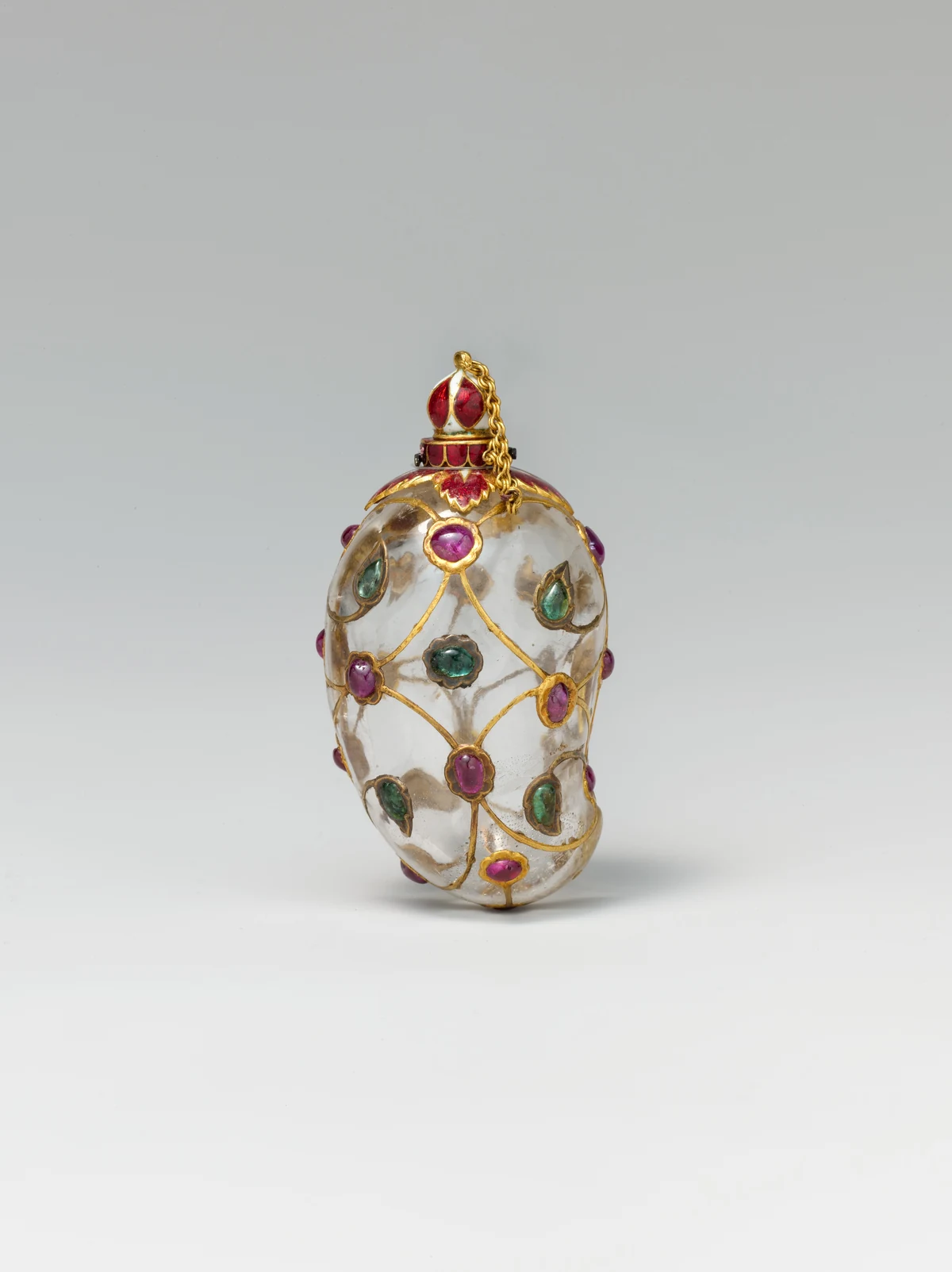
The Met’s mango-shaped flask is just 6.5 cm high. Attributed to India and dated to the mid-17th century, it combines rock crystal with gold, enamel, rubies and emeralds. The fruit outline gives the eye a familiar form to follow, while the scrolling inlay supplies a finer scale of detail. The Met considers the reign of Shah Jahan a likely context and draws a comparison with Safavid motifs. The catalogue leaves the maker unnamed.
The Met’s object record proposes perfume or cosmetic use for the flask. Its teaching material also considers lime for paan. If a photograph of the mango flask is used to introduce the subject, a caption can give its form, material and date first, then give the competing readings of its contents. This preserves the reason it belongs in a feature on scent vessels and gives readers enough information to recognise it if they encounter it in a discussion of personal adornment or paan.
The museum’s Lucknow container has a firmer identification. The Met records it as a perfume container made in Lucknow, Uttar Pradesh, circa 1860, with a height of 10 cm and materials listed as silver alloys, enamel and glass. The change from rock crystal to glass and the difference in scale give the two objects a useful visual relationship. For the Lucknow piece, the documented production city is the strongest geographical detail. The record leaves both the maker and the original perfume formula unidentified.
Mughal India from Babur to Bahadur Shah IIWhat paan is and how its ingredients vary across India
A pomander for the sash and a bottle with a spoon
Cleveland’s pomander is catalogued as Mughal India, from the 1600s–1700s, and measures 4.5 × 3.2 cm overall. Enameled silver mounts frame the pear-shaped rock-crystal vessel. Its hanging loop and the curator’s account of wearing it at the sash put the object in relation to clothing. The hinge opens to reveal a perforated component with fine filigree and enamel. That construction makes the inside worth examining with the same care as the crystal exterior.
The museum describes scented water or oil as probable contents. The perforations suggest how scent could reach the wearer’s surroundings. The loop explains why the size matters beyond the difficulty of making such a small object. A vessel that can hang from dress has a different relationship to movement and access from a container set down between uses.
At 5 cm high, the Aga Khan Museum’s Indian bottle is close to the pomander in scale. Dated to the 17th or 18th century, it is catalogued as gold inlaid with rubies. The museum describes gold granules and different cuts of ruby, details that reward a magnified view. For function, the decisive feature to inspect is the little spoon. The museum points to a comparable small Jaipur snuff vessel, a reason to keep both uses visible when discussing the bottle. Together these objects show how closely two small luxury containers can agree in scale while suggesting different gestures.
Gulabpash from Kapadwanj and Birmingham
A gulabpash is a sprinkler for rosewater or other scented liquids. The National Museum in New Delhi places it in courtly, social and ritual settings and discusses examples in glass and precious metal. Sprinkling introduces a different design problem from carrying a fragrance on the body. Here the shape needs to be read with the grip and outlet in mind, since the action described by the museums is the distribution of droplets.
LACMA’s dark blue sprinkler is recorded as blown glass from Kapadwanj, Gujarat, circa 1750–1800. It measures 20.96 × 8.89 cm. A low foot supports the rounded body and a tall ribbed section gives the hand a distinct place to grip. LACMA associates related colours and shapes with glassmaking in Kapadwanj. Its record gives a production place and technique while leaving the individual glassmaker unknown.
The Met’s sprinkler, circa 1850, is almost the same height at 20.6 cm. It was made in Birmingham, Britain, for the Indian export market, in cut lead glass with silver mounts. The museum identifies F. & C. Osler as a possible maker. A rounded body and long tapering neck give it a silhouette comparable to the Kapadwanj piece, with a different treatment of glass and metal. An effective caption keeps Birmingham and the Indian market together so a reader can follow where the vessel was made and where it was intended to go.
How metal changes a glass vessel
Silver can have quite different jobs on a fragrance vessel. The Science Museum Group’s Indian perfume sprinkler encloses glass in an openwork silver filigree case. The flattened heart-shaped body sits on a foot and leads to a tapered neck with a rounded terminal. The openwork leaves the inner material visible through the metal pattern. That makes the overlap between case and vessel a useful detail to study alongside the complete silhouette.
On the Birmingham sprinkler the Met describes silver mounts with cut lead glass. The Lucknow container has a broader materials entry listing silver alloys, enamel and glass. Those records offer different levels of detail. The filigree case and the Birmingham mounts can be discussed as identified parts. For Lucknow, the materials list gives a starting point for close looking, and a more specific account of assembly would require a technical description of the object.
The same care applies to a modern award entry. Mirsaal’s description specifies a circular embossed gold-alloy medallion on a sculpted glass bottle. A close view can show the relief and the relationship of the medallion to the glass. The wording records the project team’s material description and leaves the exact alloy formulation and the method used to attach the medallion open. Across the examples, a material name is most useful when the record also says which part it describes.
Kannauj attar, leather kuppis and heritage references
Corning Museum of Glass describes sandalwood oil as a traditional base for Indian attar. A separate term, gulabpash, describes a sprinkler for scented liquid. The distinction is useful when a label or a seller’s description uses several fragrance terms together. The sprinkler’s form tells a reader something about dispensing, while identifying a particular attar calls for evidence about the liquid itself.
The Museum of Material Memory’s account of Kannauj leather kuppis offers a view of containers from the working side of perfumery. It distinguishes large leather vessels associated with storage or maturation from miniature kuppis given to researchers at M. L. Ramnarain Perfumers. The account attributes moisture reduction through the permeable vessel to traditional perfumers. It names Mohammed Mustakin as a maker documented in a separate interview. The gift history identifies where those miniatures came into the researchers’ hands, while their individual maker and date remain open.
For a current check on the name Kannauj Perfume, search India’s Geographical Indications Registry for application 157. The supplied registry record lists it as registered in class 3, with certificate 203 dated 31 March 2014. This establishes the registration for the named perfume indication. When evaluating a contemporary package, check the project credit separately for the designer and look for production information specific to the bottle. A Kannauj reference in an illustration can be documented even when the glassmaker’s location is unknown.
The geographic indication and the vessel catalogue answer different provenance questions. India’s register gives 9 February 2009 as the filing date for Kannauj Perfume application 157 and 31 March 2014 as the certificate date. Use the accessioned object for the fabrication or materials of a container and the registration and supplier information for a particular fragrance claim.
What Mirsaal and Amal Jain bring to modern packaging
Mirsaal builds its visual reference into the glass. In the 2026 MUSE Design Awards entry, Sol Benito describes flowing contours that evoke wax on parchment and a circular embossed gold-alloy medallion that reinforces the seal motif. The entry gives Sol Benito as entrant, Elite Brands as client and India as the entry country. The sculpted contour is visible at the scale of the whole bottle, while the embossing carries the idea in relief. The award year dates the entry. The record leaves the production city and glassmaker unspecified.
The Amal Jain Perfumery uses the deg-bhapka as a motif for an identity tied to the perfumer’s Kannauj heritage. The 2026 Kyoorius entry credits Mumbai-based Miso Inc., creative director Jennita Shah and designers Khyati Patel and Raj Damani. The project includes screen-printed illustrations, embossed labels and Day and Night editions. A bookmark doubles as a scent-testing strip, extending the design into the act of sampling. The deg-bhapka reference belongs to that visual identity, and the credited studio location identifies where the design team is based.
For a side-by-side view, give Mirsaal enough space for the glass outline and medallion, and show the Amal Jain editions with the bookmark visible. The first composition makes the shape of the bottle legible. The second shows how illustration, labelling and the sampling piece work across a set. The award galleries document the projects. Before reproducing any view, confirm permission for the selected photograph and its required credit with the relevant rights holder.
Sources
- MUSE Design Awards: Mirsaal Perfume Packaging
- Kyoorius Design Awards: The Amal Jain Perfumery
- Studio 3003BC: House of Pataudi Fragrance Case Study
- Metropolitan Museum of Art, Lucknow Perfume Container 1982.142.1
- Metropolitan Museum of Art, Mango-Shaped Flask 1993.18
- Cleveland Museum of Art, wearable Pomander 1989.349
- Aga Khan Museum, ambiguous Perfume or snuff bottle AKM891
- Los Angeles County Museum of Art, Kapadwanj rosewater sprinkler M.89.83.3
- Metropolitan Museum of Art, Birmingham rosewater sprinkler for the Indian market 2016.90a–c
- Science Museum Group, filigree Perfume sprinkler A641818
- National Museum New Delhi and Corning Museum of Glass on attar and gulabpash terminology
- India Geographical Indications Registry, Kannauj Perfume application 157
- Museum of Material Memory first-person Kannauj kuppi object history
- The Met’s teaching material on the mango-shaped flask and possible contents