What paan means when it’s served
In India, paan is a preparation made by wrapping fillings in a betel leaf, and one documented tradition in Varanasi is to serve it after a meal. The fillings vary and may include areca nut, also called supari, slaked lime, flavourings or tobacco.
The word can refer to different things depending on where you see it. At a restaurant, paan generally names the prepared serving. In an agricultural record, the same word can be part of the name of a betel-leaf crop. A description of the crop concerns the wrapper, while a description of the serving can tell you what has been put inside it and when it is offered.
Incredible India, the Ministry of Tourism’s site, describes a Varanasi preparation with areca nut and other toppings rolled inside a betel leaf. The after-meal setting helps explain why paan might appear at the end of a meal alongside sweeter offerings. Its place in the meal gives you a clue about how it is served. The description of the Varanasi preparation gives you a separate clue about what might be in it.
A menu might list simply ‘paan’ at the end of a meal. If you’re trying to picture what will arrive, ask whether it’s a filled betel leaf. If you’re deciding whether to order it based on the fillings, ask what goes into that version. The tourism description gives you a concrete example of the finished serving, and the person preparing yours can answer for the ingredients they actually use.
Betel leaf, supari and the other fillings
Betel leaf comes from the vine Piper betle. Supari is areca nut, the seed of the areca palm. The nickname ‘betel nut’ can make the two sound like parts of the same plant, so ‘betel leaf’ and ‘areca nut’ are the clearer names to use together. The leaf forms the wrapper. Areca nut, when used, goes inside as one of the ingredients.
IARC uses the term ‘betel quid’ in its research on chewing preparations. Its description of the ingredients can help you make sense of a recipe or a vendor’s explanation. It lists betel leaf, areca nut, slaked lime, flavourings and sometimes tobacco as possible components across different preparations. Read that as a range of ingredients encountered in the research. A recipe needs to specify which of those components it actually uses.
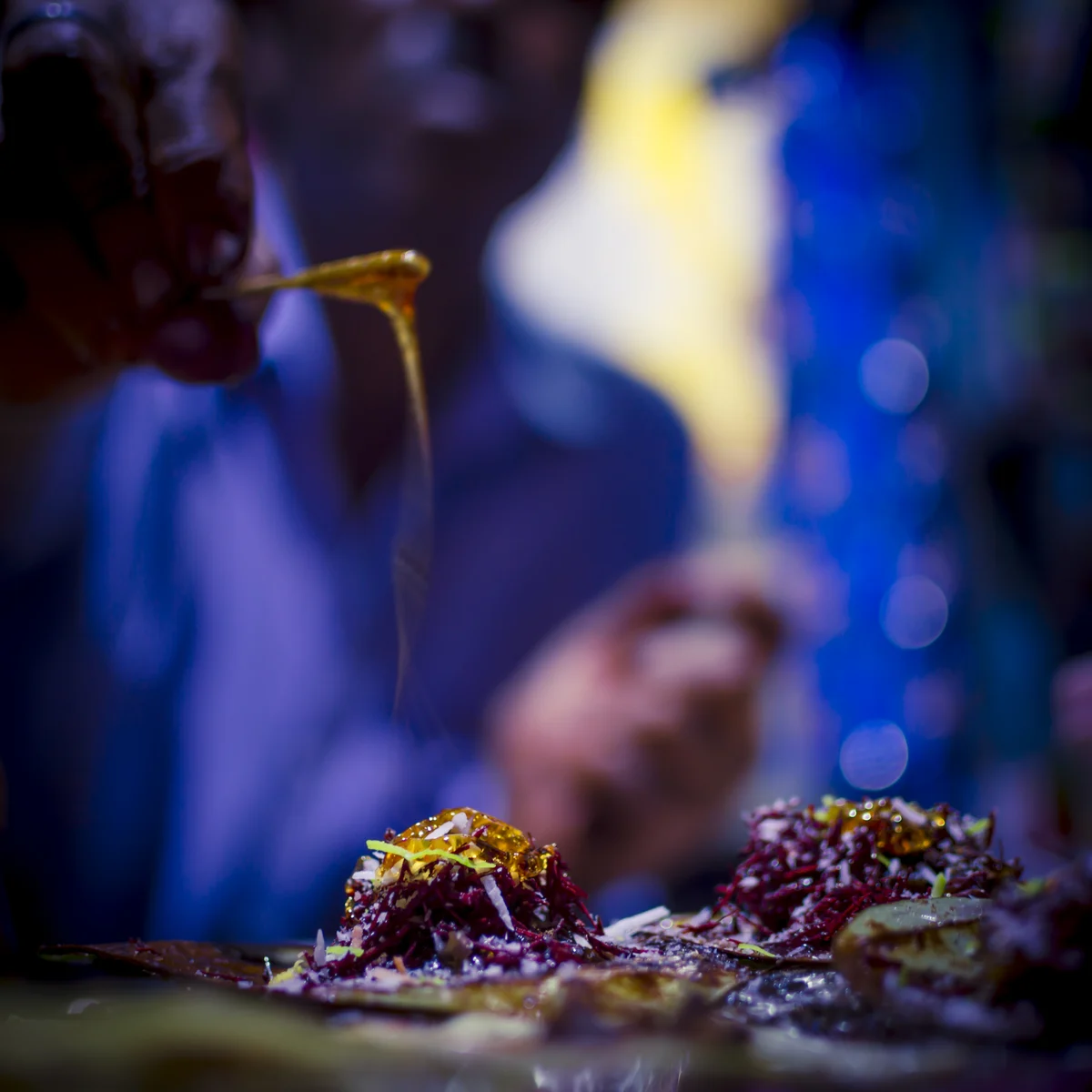
A photograph by Kartik Iyer shows a vendor spreading gulkand onto a betel leaf while making sweet paan. It gives you a view of an ingredient going onto the leaf before the serving is closed. The image captures that step and that ingredient. The complete filling of the serving remains unknown from the photograph, as does the exact location where it was made.
If a recipe for a filled leaf calls for ‘betel nut’, read that ingredient as areca nut, or supari. Look for the wrapper separately in the ingredient list. This small translation matters when you’re comparing recipes: a list that names both betel leaf and betel nut is describing two ingredients, and a label that names only the wrapper leaves the contents of the filling open.
What meetha and other labels tell you
Meetha paan means sweet paan. The term tells you about the flavour style, which can help you decide what you want to order. The same description leaves the presence of supari and tobacco open. A sweet filling, a sweet taste and a menu entry under desserts all give you information about how a serving is presented. For the composition, you need the ingredient list or an answer from the person making it.
If a counter offers ‘meetha paan, no tobacco’, the second part answers one ingredient question. If you also want to know about areca nut, ask ‘Does this have supari?’ Use the word for the ingredient you mean. Asking ‘Is it sweet?’ at that point would settle a flavour question the label has already answered, while asking for ‘paan without betel’ could leave it unclear whether you mean the leaf or the nut.
When a serving comes from an already mixed filling, ask about the mixture as well as any toppings added at the counter. Watching the last few steps can show what the vendor adds in front of you, just as a preparation photo can show gulkand being spread. A vendor’s ingredient list or a clear account of what went into the mixture is more informative about what was prepared earlier. If neither is available, those ingredients remain unconfirmed.
| Words you see or hear | What they tell you | What to check |
|---|---|---|
| Meetha paan | The flavour style is sweet. | Ask whether the serving contains supari or tobacco. |
| Tobacco-free | The description addresses tobacco. | Ask separately about supari. |
| Supari | The word names areca nut. | Check which serving or filling contains it. |
| Banarasi paan | The name refers to the Banaras association of the serving. | Ask what leaf and filling the vendor uses if either matters to your choice. |
| Banaras Pan (Betel Leaf) | This is the registered name of the agricultural product. | For a prepared serving, check the filling separately. |
Banarasi paan and the registered Banaras leaf
Banarasi paan has a documented place in Varanasi food culture. The tourism account describes a finished preparation and its after-meal setting. A second kind of record covers the region’s crop. Intellectual Property India lists ‘Banaras Pan (Betel Leaf)’ as an agricultural geographical indication, or GI, under class 31. Application 730 was filed on 30 December 2020 and appears under certificate 467, dated 31 March 2023.
The agricultural specification describes a production area across eight districts in eastern Uttar Pradesh. It names Varanasi, Mirzapur, Jaunpur, Chandauli, Ghazipur, Ballia, Azamgarh and Sonbhadra. That list helps explain why the crop’s registered name can invoke Banaras while the production area extends beyond the city. Read the boundaries as information about where the leaf is grown. The tourism description is the relevant source for the example of a finished preparation served in Varanasi.
At a restaurant outside Varanasi, you might see Banarasi paan on the menu and wonder whether its wrapper comes from the registered growing area. The menu wording identifies the serving by its Banarasi association. To establish the leaf’s provenance, ask the restaurant which leaf it buys and where it is sourced. To establish the contents of the serving, ask about the recipe separately. Even a confirmed crop origin leaves room for variation in the fillings.
For the public record, search Intellectual Property India’s GI register by application number and look at the registered name and class. The associated GI Journal specification is where the listed production districts come from. These are two useful levels of detail for a reader checking a claim. The register identifies the product covered by the entry, and the specification shows the geography behind the name.
Varanasi itinerary: ghats, Kashi Vishwanath and Sarnath in two days
Magahi Paan in Bihar and Tirur Vettila in Kerala
Bihar’s Magahi Paan has a separate GI entry, application 554, with certificate 313 dated 28 March 2018. The registered applicant is Magahi Paan Utpadak Kalyan Samiti. The National Portal of India’s One District One Product entry highlights Nawada, Bihar, names the betel vine and describes a rolled-leaf preparation with areca nut and flavourings. Read Nawada as the district featured by that entry. A claim about the full production area would need the applicable geographic specification.
Kerala has a separate agricultural registration for ‘Tirur Betel Leaf (Tirur Vettila)’. Intellectual Property India records it under application 641 with a certificate dated 14 August 2019. The registered applicant’s address is in the Tirur area of Malappuram. The name is useful when you want to identify a south Indian example of a named leaf. It gives you a product to look up with both the local and English names used in the official entry.
| Registered name | Geographic association | GI application |
|---|---|---|
| Banaras Pan (Betel Leaf) | Varanasi and its specified surrounding production area, Uttar Pradesh | 730 |
| Magahi Paan | Bihar, including production described in Nawada | 554 |
| Tirur Betel Leaf (Tirur Vettila) | Kerala, with the applicant in the Tirur area of Malappuram | 641 |
These records let you compare named products at the level of the leaf and its regional association. For a claim about how people prepare or serve paan in any of these places, look for a description of the actual serving, like the National Portal’s description of a rolled leaf for the Nawada entry. If all you have is an applicant’s address, use it to locate the applicant. For a district-by-district account of where a crop is produced, use the geography in the relevant registration documents.
What a Lucknow paan set shows
The National Gallery of Victoria catalogues a paan set from Lucknow, Uttar Pradesh, dated circa 1970. The catalogue identifies betel leaf, areca nut, related ingredients and tools as separate parts of the set. That gives the reader a dated example of paan as something people had equipment to prepare and present. A prepared serving might reach the table with the ingredients enclosed in the leaf. A set brings those separate elements into view.
The museum object and the Varanasi tourism account document different aspects of paan. One gives you the equipment and components associated with a set from a particular city and period. The other puts a particular preparation at the end of a meal. Together they help explain why paan can come up in a discussion of objects and serving practices as readily as in a menu. Both descriptions have a place attached, which matters when using them to illustrate a practice found across India.
The date also helps when comparing the Lucknow set with a photograph of sweet paan being prepared. For the set, the catalogue gives the date, place and identified components. For the photograph, the photographer identifies the action and the visible spread. Each supports a different detail. A claim about who used the museum set, which occasions it was used for, or how its owners mixed the filling would need more information about that particular object.
Why tobacco and supari need separate checks
The International Agency for Research on Cancer evaluated betel quid with tobacco, betel quid without tobacco and areca nut itself as three separate exposures. IARC classified all three as carcinogenic to humans. Its monographs linked betel quid without tobacco to oral cancer, and betel quid with tobacco to cancers of the mouth, pharynx and oesophagus. In the Oral Cancer Prevention handbook, IARC found sufficient evidence for the benefit of stopping areca nut use for oral-cancer prevention, including when the nut is taken in a quid with or without tobacco.
These findings explain why a separate question about supari is useful after you hear that a paan is tobacco-free. They describe the cancer hazard associated with the evaluated exposures. They give no numerical estimate for an individual serving. For a sweet preparation described only as a filled leaf, the recipe is the missing information. Its appearance and flavour give you little basis for deciding whether the serving contains the ingredients relevant to those findings.
Fresh wrapped paan and packaged products also need to be identified on their own terms. IARC’s discussion distinguishes fresh preparations from mass-produced areca-nut products such as pan masala. If the item in front of you is packaged as pan masala or gutka, use the ingredient declaration for that product. A description of a Varanasi betel leaf served after a meal is about a different item and cannot establish what is in the packet.
Recipes and product formulations can change. For a serving made to order, check with the person preparing it and ask about the exact version on offer. For a packaged item, read the declaration on the packet you are considering, including any listed mixture. If the available information establishes the absence of tobacco only, record the areca nut content as unknown. That distinction follows directly from asking two ingredient questions and receiving one answer.
Sources
- IARC: Betel Quid and Areca Nut Monograph
- IARC Handbook: Oral Cancer Prevention
- Banarasi paan in Varanasi food culture — Incredible India
- Banaras Pan (Betel Leaf), GI application 730 — Intellectual Property India
- Banaras Pan GI Journal production area — Uttar Pradesh Agriculture Marketing Board copy
- Magahi Paan, GI application 554 — Intellectual Property India and National Portal of India
- Tirur Betel Leaf (Tirur Vettila), GI application 641 — Intellectual Property India
- Lucknow paan set, circa 1970 — National Gallery of Victoria
- Betel-quid and areca-nut chewing — IARC Monographs Volume 85
- Oral Cancer Prevention, updated evidence table — IARC Handbooks, Volume 19
- Paan Banarasiya — original photograph by Kartik Iyer
