What India’s national emblem represents
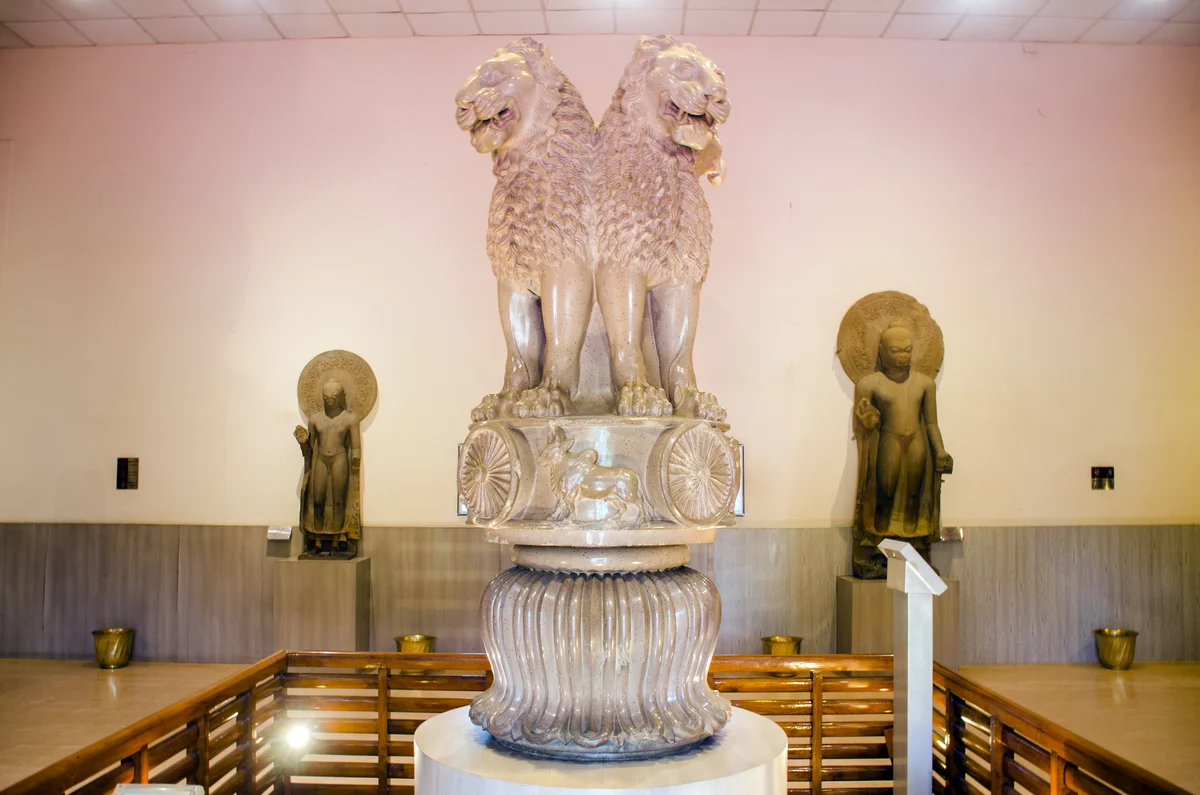
India’s national emblem is the State Emblem of India. The government adopted the design on 26 January 1950 from the Lion Capital of Ashoka at Sarnath. The emblem shows three of the original four lions and carries the Sanskrit motto सत्यमेव जयते, usually transliterated Satyameva Jayate and translated in the Act as “Truth alone triumphs.” The surviving sculpture can be seen at the Archaeological Museum in Sarnath.
The design brings an ancient sculpture, a Sanskrit motto and the authority of the modern state into one image. The lions and the carved band beneath them come from a Mauryan pillar capital. The words below the band come from the Mundaka Upanishad. The government’s adoption gave this arrangement its public role, while the schedule to the State Emblem of India Act, 2005, records the design in statutory form.
For a reader asking what the emblem stands for, the motto provides the clearest answer in words. The sculpture also grounds the emblem in a specific place and period. The government’s historical account connects the capital to Sarnath and Buddhist history. A claim that each lion stands for a particular virtue would call for an attributed interpretation. The statutory schedule describes what the lions and other elements look like and gives the meaning of the motto.
Use “Lion Capital of Ashoka” for the stone carving and “State Emblem of India” for the adopted design. The official government seal incorporates that emblem under separate rules. A label for the photograph above should identify the museum object. A description of a seal on a document should instead account for the office label or rim prescribed in the rules.
- India Code: State Emblem of India Act, 2005
- Government of India: National Emblem
- Embassy of India in Juba — official history of adoption and origin of the motto, April 2017
- Ministry of Home Affairs — State Emblem of India (Regulation of Use) Rules, 2007, and amendment
- Archaeological Survey of India — Sarnath Museum accession record 355 and Gallery 3
The four lions and the wheels at Sarnath
The Archaeological Survey of India catalogues the original as accession 355 in Gallery 3 of the Archaeological Museum, Sarnath. Carved from polished Chunar sandstone in the third century BCE, it once crowned Ashoka’s pillar in the deer park. Here, ‘capital’ means the sculpted top of a column. The museum accession identifies that particular object, a useful check when photographs of the Sarnath sculpture, its replicas and the separate Sanchi Lion Capital appear under similar captions.
The four lions face outwards with their backs together. Below them sits a round abacus, the supporting platform whose outer band carries an elephant, a galloping horse, a bull and a lion, with Dharma Chakras between the animals. Below the abacus is a bell-shaped element described as an inverted lotus. In a photograph taken from one side, the rear lion can disappear from view and only part of the platform’s circular band can be seen.
The Archaeological Survey’s account of the 1904–05 excavation credits F. O. Oertel and records the discovery of the capital near fragments of the pillar. The report also discusses a large wheel that originally crowned the lions. That upper wheel occupied a different position from the smaller wheels cut into the abacus. The wheel prominent in the state graphic comes from the band below the lions.
The ASI museum’s Gallery 3 narrative gives the capital a height of 2.31 metres. The accession page repeats that in its narrative and also shows a separate measurement field of 210 × 283 cm without the same explanation. Quote the height as the gallery’s figure if you need it. The capital was the top of a larger column, so give the measurement for the named object and keep the dimensions of the original pillar separate.
How to read the adopted design
Read the graphic from the viewer’s position. Three lion heads appear above a band with a full wheel at its centre. The galloping horse is on the viewer’s left and the bull is on the viewer’s right. Partial wheels mark the two outer edges. The arrangement takes a view of the circular carving and gives it a fixed front for reproduction. The graphic ends below the band with the Devanagari inscription सत्यमेव जयते. The inverted lotus stays with the sculptural original.
Satyameva Jayate is the transliteration of the Sanskrit motto. Devanagari is the script in which it appears on the emblem, and the Mundaka Upanishad is the source of the words. A translation in a caption helps readers understand the inscription. Within the statutory design itself, the Devanagari lettering forms part of the artwork in both appendices to the Act.
The Act provides a simplified rendering in Appendix I for small applications such as stationery, seals and die-printing. Appendix II gives a more detailed rendering for larger reproduction. Both specify the same emblem. If a small graphic is legible at the lion heads but loses the lettering underneath, compare it with Appendix I before describing it as a complete rendering. The simpler official artwork still carries the full motto, a point the Ministry of Home Affairs reiterated in its 16 June 2025 circular.
| Feature | Original at Sarnath | State Emblem and seal |
|---|---|---|
| Lions | Four lions back to back in the round. | Three visible lions in the adopted view. |
| Central wheel | Multiple wheels on the abacus. | One complete wheel in the centre and partial wheels at the outer edges. |
| Animals | Elephant, horse, bull and lion around the abacus. | Horse on viewer’s left and bull on viewer’s right. |
| Lotus base | Bell-shaped inverted lotus below the abacus. | The statutory adaptation omits the lotus. |
| Motto | The carving predates the modern design. | सत्यमेव जयते, Satyameva Jayate, appears below the design. |
| Seal rim | The archaeological object has no official seal rim. | Rule 3 gives round or oval official seals an identifying office rim. |
- India Code: State Emblem of India Act, 2005
- Government of India: National Emblem
- Ministry of Home Affairs — display of the State Emblem circular, 16 June 2025
- Archaeological Survey of India — Sarnath Museum accession record 355 and Gallery 3
- Embassy of India in Juba — official history of adoption and origin of the motto, April 2017
The 1947 stamp, Republic Day and the modern Act
The Department of Posts catalogue records a 1.5-anna Ashoka Lion Capital stamp issued on 15 December 1947. It offers a dated example of the motif in public use after independence and before the Republic adopted the State Emblem. The stamp entry establishes the issue date and subject. A claim about whether its drawing matches a later official rendering would require a comparison of the artwork itself.
For the adoption date, the official history published by the Embassy of India in Juba gives 26 January 1950. That is the date to use when explaining when the three-visible-lion design became the emblem of the Republic. The third-century BCE date belongs to the carving, and the 1947 date belongs to the postal issue. All three dates can appear in an account of how the image acquired new uses across time.
The modern statute adds two more dates. The State Emblem of India (Prohibition of Improper Use) Act, 2005, is Act No. 50 of 2005, dated 20 December 2005. It came into force on 12 September 2007 under notification S.O. 1526(E). In a label or timeline, ‘adopted’ belongs beside 1950 and ‘came into force’ belongs beside the commencement date. The Act’s schedule supplies a reference for the design, while the operative sections address its use.
Where you see the emblem today
The front of the Mahatma Gandhi (New) Series ₹500 banknote offers an everyday reference. The Reserve Bank of India design sheet identifies the Ashoka pillar emblem on the right of the note. Find the lions there if you are trying to match the familiar image to its name. The RBI’s own seal is a separate mark, so use the specific feature identified in the banknote design sheet when captioning the emblem’s position.
An official government seal has a further identifying feature. Rule 3 of the State Emblem of India (Regulation of Use) Rules, 2007, places the emblem inside a round or oval frame and puts the name of the office or ministry in the surrounding rim. The name tells the reader which office the seal belongs to. The frame and rim lettering are the seal treatment around the underlying emblem. They are useful clues when deciding whether an image caption should identify the emblem itself or the seal of a particular office.
The Rules address display on seals, stationery, vehicles and public buildings in Rules 5 through 8. These provisions identify prescribed users and settings. A photograph of an emblem on a vehicle records an instance of display. To establish who is entitled to use that display, consult the provision for vehicles and the applicable list of users. The same approach works for a building or letterhead, where a different provision may apply.
- India Code: State Emblem of India Act, 2005
- Ministry of Home Affairs — State Emblem of India (Regulation of Use) Rules, 2007, and amendment
- Ministry of Home Affairs — display of the State Emblem circular, 16 June 2025
- Department of Posts — commemorative postage catalogue
- Reserve Bank of India, design of the Mahatma Gandhi New Series ₹500 note
What the law says about displaying it
The question to start with is what the display would communicate in its setting. Section 3 of the Act deals with uses of the emblem or a colourable imitation that create an impression of a government connection or an official government document without prior permission. If a private association wants three lions at the head of a membership certificate, the certificate layout and the impression it gives matter alongside the drawing itself. A design that closely imitates the emblem can still raise the question covered by Section 3.
Section 4 addresses trade, business, professions and other listed uses, subject to prescribed conditions. Section 5 addresses registration of designs or trademarks bearing the emblem and patent titles containing it. The Rules add detail. Rule 10 sets restrictions for unauthorised users, and Rule 11 addresses business, professions and designs, with a prior-approval provision for specified government-connected events or publications. A use proposed for a business identity calls for checking those provisions as well as any issue of apparent official endorsement.
For a current display question, start with the Ministry of Home Affairs Acts and Rules archive and check the 2007 Rules alongside the amendments listed there. The 2010 amendment, G.S.R. 629(E), is dated 22 July 2010 and was published on 23 July. Check for later amendments and relevant circulars by date. The ministry’s 16 June 2025 circular reiterates correct and authorised use, including the motto in both appendix designs. The Act and the Rules as amended are the instruments to consult for the applicable provisions.
- India Code: State Emblem of India Act, 2005
- Ministry of Home Affairs — State Emblem of India (Regulation of Use) Rules, 2007, and amendment
- Ministry of Home Affairs — display of the State Emblem circular, 16 June 2025
- Ministry of Home Affairs, 2010 amendment to the State Emblem Rules
- Ministry of Home Affairs Acts and Rules archive
Illustrating an article about the emblem
Rule 9 refers readers to Schedule III for uses beyond the specific official categories. Paragraph (xv) addresses illustrations in the text of a chapter or section of a school textbook, a history, art or culture book, or a periodical that explains the origin, significance or adoption. Its proviso concerns front-page, title or cover placements that give the impression of a government publication. Read the paragraph and the Act’s other conditions together for the particular use.
For an online explainer, check whether the publication and the proposed placement fall within the current provision before reproducing the official artwork. The listed examples give a specific basis for educational or editorial illustration in those settings. A website masthead, a page preview image and an illustration embedded in the article each put the image in a different context. Check the terms of the particular image file as well as the rules governing the emblem’s use.
A documentary photograph of the museum capital can show the stone, the carved band and the lotus while illustrating the object that inspired the design. Rangan Datta Wiki’s April 2023 photograph of the original in the Sarnath museum is available under CC BY-SA 4.0. Verify the file credit and licence at the source, note any edits in the attribution and identify the subject in the caption as the original Lion Capital of Ashoka. The museum record supplies the accession and gallery details if the caption needs to distinguish the object from a replica.
- India Code: State Emblem of India Act, 2005
- Ministry of Home Affairs — State Emblem of India (Regulation of Use) Rules, 2007, and amendment
- Archaeological Survey of India — Sarnath Museum accession record 355 and Gallery 3
- Rangan Datta Wiki — original Lion Capital at Sarnath Museum
- Ministry of Home Affairs — display of the State Emblem circular, 16 June 2025
- Archaeological Museum, Sarnath, Gallery 3 narrative
- Ministry of Home Affairs, 2010 amendment to the State Emblem Rules
- Ministry of Home Affairs Acts and Rules archive
Sources
- India Code: State Emblem of India Act, 2005
- Government of India: National Emblem
- Ministry of Home Affairs — State Emblem of India (Regulation of Use) Rules, 2007, and amendment
- Ministry of Home Affairs — display of the State Emblem circular, 16 June 2025
- Embassy of India in Juba — official history of adoption and origin of the motto, April 2017
- Archaeological Survey of India — Sarnath Museum accession record 355 and Gallery 3
- Archaeological Survey of India — 1904–05 Annual Report, Sarnath excavation
- Department of Posts — commemorative postage catalogue
- Rangan Datta Wiki — original Lion Capital at Sarnath Museum
- Archaeological Museum, Sarnath, Gallery 3 narrative
- Reserve Bank of India, design of the Mahatma Gandhi New Series ₹500 note
- Ministry of Home Affairs, 2010 amendment to the State Emblem Rules
- Ministry of Home Affairs Acts and Rules archive
