Which bird is the national bird of India?
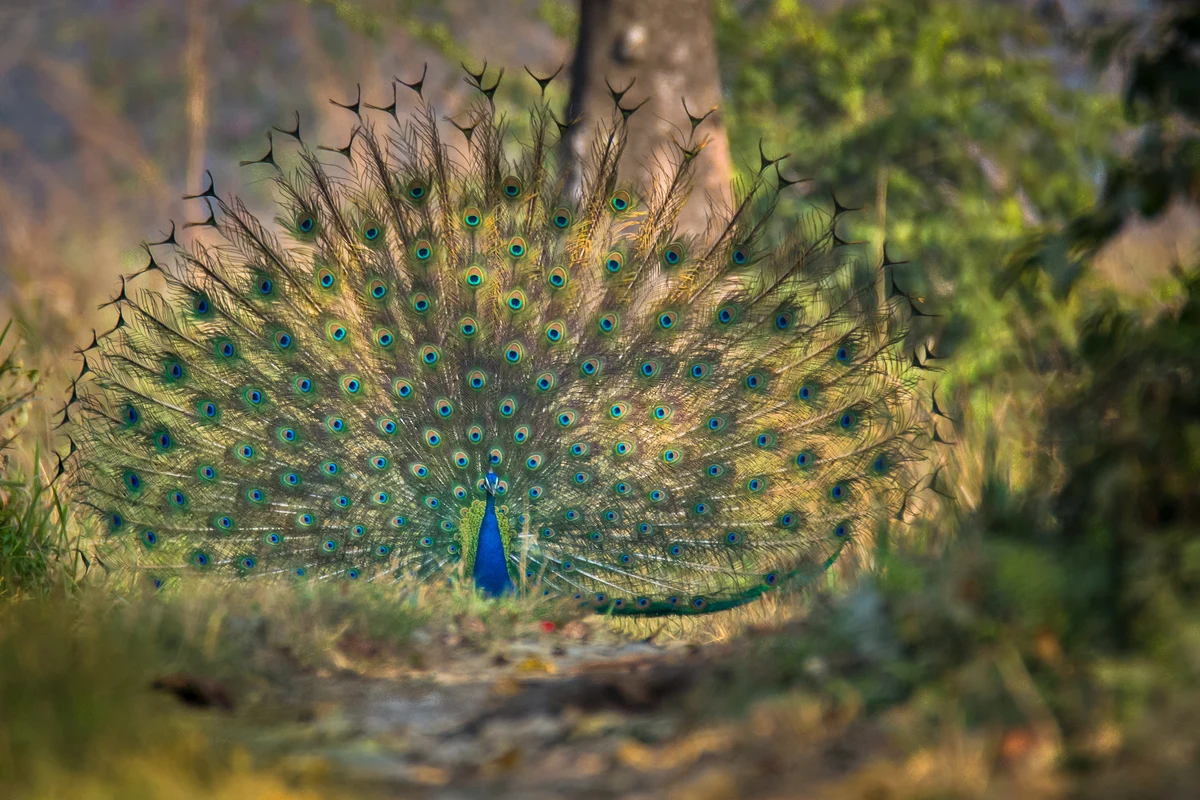
India’s national bird is the Indian peafowl, Pavo cristatus, also called the blue peafowl. Government documents commonly use peacock, the everyday word for the national symbol and the sex-specific name for the male. Peahen is the name for the female, and peafowl is a clear term for the species. The image at the top shows a male displaying at Manas National Park in Assam.
An official Ministry of External Affairs retrospective identifies 1963 as the year Indian peafowl was originally selected. A signed 30 May 2011 environment ministry notification re-notifies the peacock as the national bird. Those two records answer the date question at different levels. There is a supported historical year and a complete date for the later documentary action. The original dated notification was unavailable in the ministry’s records in 2011 and was not found in the reviewed public material.
In a field identification, look at the crest and neck before waiting for a full display. An adult male typically has an intensely blue neck and a fanlike crest. The female usually has brown body plumage and green around the neck. Both can identify the same species. A useful wildlife record includes the date, place and whether the bird was wild or being kept on the property.
The 1963 year and the signed 2011 notification
The March 2003 issue of India Perspectives, published by India’s Ministry of External Affairs, gives 1963 as the year Indian peafowl was named the national bird. Its account also recalls a discussion involving the ornithologist Salim Ali, making a comparison between the peafowl and the Great Indian Bustard as candidates. That passage is a later recollection and is most useful when attributed to the author, Samar Singh.
The most direct document currently available for the formal status is the Wildlife Division’s signed notification F. No. 25-1/2008-WL-I of 30 May 2011. It re-notifies peacock as national bird and tiger as national animal. The document states that earlier notifications could not be found in the ministry’s official records at the time. Read the signature, date and the wording about re-notification together.
A Lok Sabha answer dated 13 December 2019 confirms the re-notification and gives additional details about where peafowl occur and how they are protected. The Embassy of India’s information page names the species explicitly as Pavo cristatus. When citing a formal action, use the signed notice. When explaining which species is meant by peacock, include the scientific name from the government identity page or India Code.
If a question asks what year the peacock became India’s national bird, 1963 is the year supported by the official retrospective. If it asks when the published record was signed, the answer is 30 May 2011. The reviewed sources did not establish an original calendar day or provide a verified separate Gazette serial. Writing the record type beside each date is the easiest way to keep the chronology precise.
| Date | Record | What it establishes |
|---|---|---|
| 1963 | Ministry of External Affairs retrospective, published 2003 | Historical year of original designation. |
| 30 May 2011 | Signed Wildlife Division notification | Re-notifies the peacock as National Bird. |
| 13 December 2019 | Lok Sabha written answer | Confirms the 2011 re-notification and discusses protection and occurrence. |
| Current national symbols page | Embassy of India, Ashgabat | Identifies the national bird as Pavo cristatus. |
India’s national flower: sacred lotus and its official status
- Ministry of Environment and Forests, signed National Bird re-notification, 30 May 2011
- Ministry of External Affairs, India Perspectives, March 2003, Samar Singh
- Embassy of India, Ashgabat, national identity elements
- Ministry of Environment, Forest and Climate Change, Lok Sabha unstarred question 4254, 13 December 2019
Peacock, peahen and the feathers in the fan
The showiest Indian peafowl is usually a mature male. Cornell’s account describes the blue body and long train with its repeated eyespots. The display feathers are elongated upper-tail coverts. The shorter true tail helps support the extended fan. Knowing the name of the train helps when you are reading an exhibit label or trying to describe what a photograph shows.
A peahen has a crest and may show green on the neck, with much browner plumage overall and no long male train. When looking at a bird with a raised crest and no display, compare the colour of the whole neck and body to the rest of the group. A photograph that shows only the head may leave more uncertainty than a view of the whole bird.
The point of using these cues together is to preserve the common cases. A bird walking through a field with nothing raised can still be a male. A brown bird near it may be a female of the same species. The record improves if you have a clear view of crest shape, facial markings and the body. If a guidebook says peacock, check whether it is speaking about a male or using the common word for the national symbol.
| Bird | Head and neck | Body or display |
|---|---|---|
| Adult male Indian peafowl | Fanlike crest and bright blue head and neck. | A long eyespotted train often used in display. |
| Adult female Indian peafowl | Crest and often green neck. | Mainly brown body and no long male train. |
| Green peafowl | Compare crest and greener neck with coloured facial patches. | Males also have an eyespotted train. Distinct species Pavo muticus. |
How the green peafowl differs
The green peafowl is Pavo muticus. The Indian peafowl is Pavo cristatus. Both species can have a long train with eyespots. Comparative work on green peafowl describes a greener neck and distinct coloured facial features. A display photograph needs the bird’s head or other identification context if the train dominates the frame.
India Code lists both species by separate names in Schedule I of the Wild Life (Protection) Act. The official Indian identity information attaches the national bird label to Pavo cristatus. Giving the scientific name makes the distinction clear in a classroom worksheet, conservation article or image search.
A female Indian peafowl can show green plumage without belonging to the species called Green Peafowl. Compare the exact species name on a field guide, a zoological collection’s sign or a vetted sighting record. For photos of captive or introduced birds, also look for information from the institution or observer. Location may help narrow the identity, especially where one species is common, but it is only part of the evidence.
Where Indian peafowl live and what status labels mean
Indian peafowl are native to the Indian subcontinent and have been introduced in other regions. The 2019 parliamentary answer reports them in forests, agricultural areas and human habitations. It also says the ministry did not compile state and Union Territory totals at that time. Local occurrence can be well documented even when no complete census is available.
State of India’s Birds publishes monitoring information with separate geography views. The protected-area species page has the scope of protected areas and supplies links to broader views. Use the date and geography on a graph before quoting a change. Reports of a widespread or familiar bird give a different kind of information from a count of individuals across an entire country.
The same factsheet reports the global conservation category Least Concern and the species’ Schedule I listing in India. These are measures of different things. The broad global category relates to extinction risk. The legal schedule places the species within a domestic system of protection. Section 9 of the Wild Life (Protection) Act addresses the prohibition on hunting listed wild animals subject to the Act’s exceptions. Use the current India Code text for the legal wording.
Manas provides a documented location for the individual photographed here in February 2017. A historic photograph records a species, place and date, while the park’s own rules and local conditions determine a present visit. Look from the public route, retain enough distance for the bird to behave normally and follow ranger or site instructions if approaching would disturb it.
How to answer common questions about the national bird
For a simple answer, give Indian peafowl, also called the Indian peacock, and add Pavo cristatus when the assignment or audience benefits from a precise species name. For an answer about why the bird was chosen, attribute the historical recollection to India Perspectives. It points to distribution and long cultural associations, giving the author’s explanation rather than a verbatim record of the original decision.
For a wildlife article, give the sex only when the visible features or observer’s record support it. In the Manas photograph the blue neck and extended eyespotted train support the caption’s adult male identification. For a peahen, the crest and predominantly brown plumage will usually make a stronger caption than describing the colour of one feather.
For a fact sheet, put the year 1963 and the exact 2011 date next to the documents they describe. List the scientific name with a current government or ornithological source. Use the signed ministry notification for the statement that the symbol was re-notified. That evidence can be read alongside monitoring and field identification without confusing an administrative designation with an estimate of how many birds live in a given place.
Use a sighting, a park record and a map together
The UNESCO record places Manas Wildlife Sanctuary in Assam at the foot of the Himalayas. It describes a site around the Manas River with wooded hills, river-laid grasslands and tropical forest. The inscribed sanctuary covers 39,100 hectares and forms part of the core of the larger Manas Tiger Reserve. Preserve which geographic unit a map or official area figure describes. A park photograph is a useful reference for the named site and a particular bird.
When building your own observation, keep a count of distinct birds you actually saw and note how confident you were about each identification. Four photographs of the same displaying male represent one sighting of one bird. A female several metres away may be a separate bird, and your notes can record that without assuming whether the two were part of a larger group. Cancel a sighting or label it as uncertain if the field marks were incomplete.
For a comparison over time, use monitoring work with a defined geography and method. An isolated photograph from Manas can establish the scene the photographer captured in February 2017. A set of submitted bird observations can support a study if its sampling and coverage are clear. Neither the camera date nor the UNESCO area measurement tells you the park’s population of peafowl. This is also why the absence of a ministry-wide count in the 2019 parliamentary answer does not prevent useful observation-based work.
- Ministry of Environment, Forest and Climate Change, Lok Sabha unstarred question 4254, 13 December 2019
- Cornell Lab of Ornithology, Indian Peafowl, All About Birds
- State of India's Birds, Indian Peafowl primary monitoring factsheet
- Licensed photograph, display of a male Indian peafowl in Manas National Park
- UNESCO World Heritage Centre, Manas Wildlife Sanctuary
Sources
- Ministry of Environment and Forests, signed National Bird re-notification, 30 May 2011
- Ministry of External Affairs, India Perspectives, March 2003, Samar Singh
- Embassy of India, Ashgabat, national identity elements
- Ministry of Environment, Forest and Climate Change, Lok Sabha unstarred question 4254, 13 December 2019
- Cornell Lab of Ornithology, Indian Peafowl, All About Birds
- State of India's Birds, Indian Peafowl primary monitoring factsheet
- India Code, Wild Life (Protection) Act, 1972, updated Schedule I
- Peer-reviewed original Green Peafowl study, comparative identification
- Licensed photograph, display of a male Indian peafowl in Manas National Park
- UNESCO World Heritage Centre, Manas Wildlife Sanctuary
