What survives of medicine in ancient India
Medicine in ancient India survives in Sanskrit compilations such as the Suśrutasaṃhitā and Carakasaṃhitā, in Ashoka’s public proclamation about care for humans and animals, and in Buddhist monastic rules about tending the sick. These sources document medical knowledge, royal commitments and duties of care, while leaving the scale of everyday practice and the results of individual treatments largely open.
The dates attached to these sources follow different events. Ashoka’s date belongs to a group of inscriptions. The date of a Sanskrit manuscript belongs to a physical copy, which can preserve writing composed much earlier. A date on an English edition records an episode in the circulation of that work among a new readership. Putting those dates side by side helps explain why a history of medicine can begin in antiquity and still depend on objects produced many centuries later.
| Date | Evidence | What the date measures |
|---|---|---|
| Approximately 7,500–9,000 years ago | Drilled molars from Mehrgarh, present-day Pakistan | Archaeological dating of the burial evidence |
| Third century BCE | Ashoka’s major rock edicts at Girnar | Period of the royal inscriptions |
| Fourth to sixth centuries CE | Bower Manuscript | Broad institutional dating of the surviving object |
| Circa 878 CE | KL 699 Suśrutasaṃhitā manuscript | Copy date inferred from the colophon |
| 1883 | English Suśruta translation in Bibliotheca Indica | Publication in Calcutta |
| From 1888 | English Caraka-Saṃhitā series | Start of publication in Calcutta, with later fascicles |
- Wellcome Collection: Udoy Chánd Dutt Translation
- Coppa and colleagues — Early Neolithic tradition of dentistry, Nature, 6 April 2006
- National Museum, New Delhi — Ashoka Edict cast, Girnar; Hultzsch translation of Major Rock Edict II
- National Centre for Biological Sciences/TIFR — Bower Manuscript folio exhibition record
- Primary Sanskrit text edition and textual witnesses — University of Alberta Suśruta Project
- Theravāda Vinaya, Khandhaka chapter 8 — historical monastic care passage
What the drilled teeth at Mehrgarh show
At Mehrgarh in present-day Balochistan, Pakistan, Alfredo Coppa and colleagues reported eleven drilled molar crowns from nine adults. Their study, published in Nature in 2006, placed the finds approximately 7,500 to 9,000 years ago. The remains came from burials associated with a farming community. The authors interpreted the evidence as an early form of dentistry, giving the history of bodily intervention in South Asia a material record far older than the surviving manuscripts discussed here.
The count matters because it tells you what the researchers could examine. Eleven crowns do not represent eleven people, and the nine adults give a small sample from one site. The teeth preserve signs of intervention. They leave questions about what prompted each intervention, whether it brought relief and how frequently anyone performed it across the community. A finding can be persuasive about the presence of a practice and still provide very little information about the experience of those who underwent it.
The geographic description also matters. Mehrgarh belongs in a history of South Asian prehistory, and its location today is in Pakistan. Placing it beside the Sanskrit works shows the different kinds of evidence available for the region over time. Establishing a connection to a later medical school would require evidence that traces the practice across the intervening places and centuries. The burial findings give historians an earlier point of comparison on their own terms.
Ashoka’s proclamation about care for humans and animals
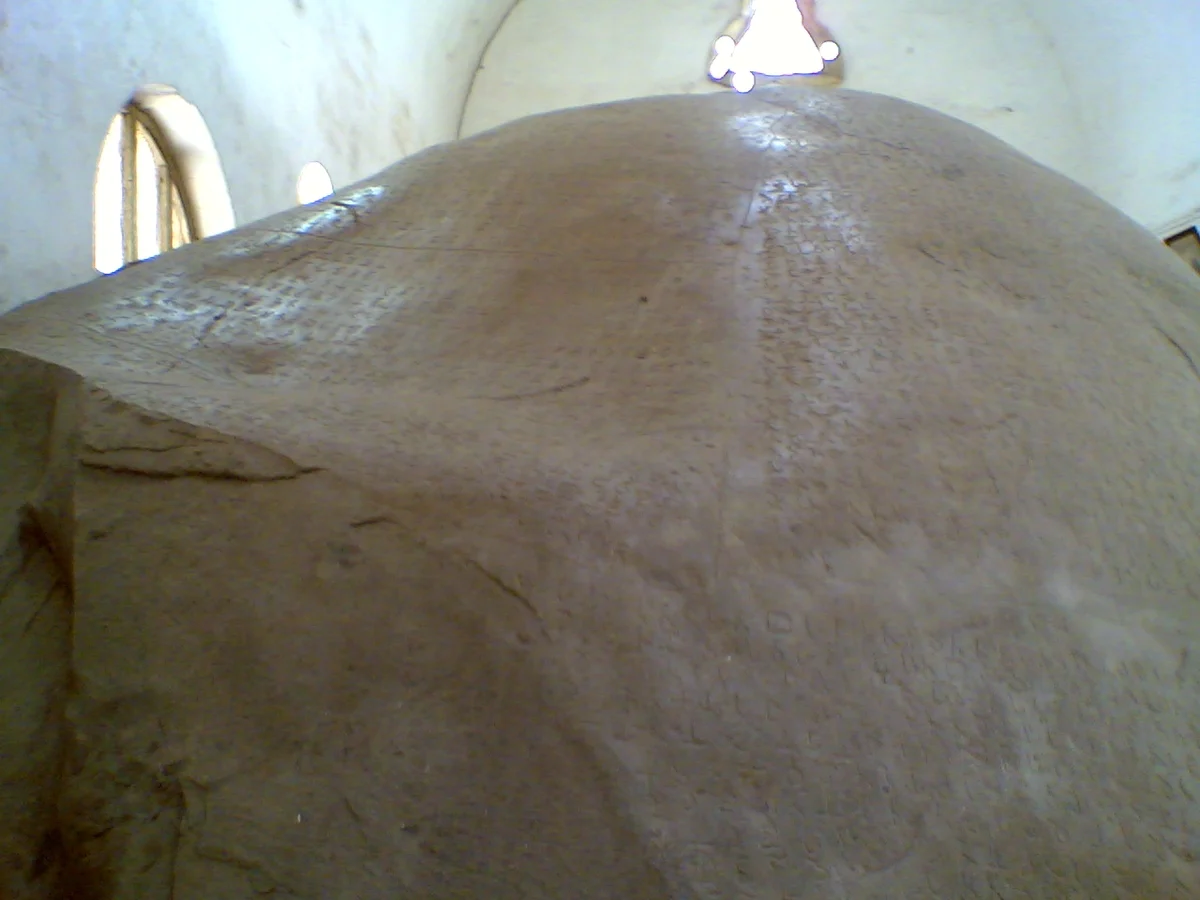
The National Museum in New Delhi holds a metal cast made from the inscribed rock at Girnar in present-day Gujarat. The museum dates the group of inscriptions to the third century BCE and identifies fourteen major rock edicts at the site. A photograph of the original rock at Junagadh and an image of the museum cast therefore document different objects. For the medical claim, the relevant passage is Major Rock Edict II in the Girnar version. The museum record establishes the context of the cast, and a scholarly translation provides the wording of the passage.
In his 1925 translation, E. Hultzsch renders the edict as a proclamation that Ashoka made provision for medical treatment for people and animals. The passage also describes planting and provisions relating to water. Reading these measures together puts the medical provision in the context of other ways the ruler presented his responsibilities. The inscription makes the provision for animals explicit, a detail that can disappear when the edict is compressed into a general statement about health care.
The rock establishes that the ruler publicly claimed these measures. A claim that Ashoka opened a hospital in a named town would require additional evidence for the building and its function. A claim about how many people received care would require evidence of use. To check an account of the edict, start with the place and number of the inscription, then compare the account with the relevant translation. Pay particular attention to whether a description of provision has been expanded into a claim about buildings, staff or coverage.
Suśruta’s teaching frame and surviving manuscripts
The Suśrutasaṃhitā presents medical instruction from Dhanvantari, identified as King of Kāśī, to Suśruta. Kāśī is Benares in the Wellcome catalogue description. The exchange gives the work a teaching setting and identifies the figures through whom it presents its knowledge. A historian can study that setting as part of the book’s account of how medicine should be taught. Establishing the date or location of an actual teaching institution, or a biography of either figure, would require independent evidence.
The University of Alberta Suśruta Project puts the compilation at roughly two millennia old. Its companion digital text provides a structured entry into six sections, including general principles, diagnosis and anatomy. Those categories show the range of topics the work brings together. A passage in the diagnosis section can show how the text classifies an illness or organizes observations. Questions about how common a diagnosis was among practitioners, or what happened to their patients, call for records of practice and outcomes.
One surviving copy, the palm-leaf manuscript KL 699 in Kathmandu, carries a colophon that the holding library’s UNESCO nomination interprets as corresponding to circa 878 CE. Some scholarship renders the date as 878 or 879 CE. The colophon dates the copying of this witness. The project compares KL 699 with two other Nepalese witnesses, NAK 1-1079 and NAK 5-333, and uses a 1938 printed edition for comparison. Follow the manuscript identifier when checking a passage, since an early copy can have gaps or incomplete sections. The project’s record of variant readings helps locate where the witnesses support different wording.
How commentaries and translations carry medical texts forward
A Sanskrit edition edited by Senagupta and catalogued by Wellcome includes the commentary of Ḍalhaṇa. Its publication date is 1859–60 śakābda, corresponding to 1937–38 CE. The catalogue places Ḍalhaṇa in the twelfth century. Those details identify separate contributions to what a reader sees on the page. The commentary belongs to a medieval reading of the work, and its inclusion in a twentieth-century edition shows how that reading continued to accompany the text in print.
English publication adds another layer. In 1883 the Asiatic Society published an English Suśruta translation associated with Udoy Chánd Dutt in Calcutta in the Bibliotheca Indica series. Wellcome’s notes distinguish the fascicles, or individually issued parts, and identify Aughorechunder Chattopadhya as the translator of fascicle three. If a passage comes from that part, citing Dutt alone would misattribute the translation. Checking the title page and the catalogue note for the part you are reading also helps explain why two references to the series may name different translators.
The Carakasaṃhitā has its own layered attribution. One Wellcome record for a Sanskrit edition gives the traditional attribution to Agniveśa, identifies revisions by Caraka and Dṛḍhabala, and names Cakrapāṇidatta as commentator. A separate record describes an English Caraka-Saṃhitā series printed in Calcutta from 1888, with further fascicles appearing later. These records allow a reader to identify the roles assigned within the tradition and to date particular publications. A precise year for the original composition or a definitive lifetime for a traditional author would require a separate historical argument.
The Bower Manuscript and the geography of transmission
A digital exhibition by the National Centre for Biological Sciences and TIFR identifies its image from the Bower Manuscript as leaf 9 obverse of Book II. It dates the birch-bark manuscript broadly to the fourth to sixth centuries CE and reports that it was discovered near a Buddhist stupa at Kuchar in Central Asia in the nineteenth century. India’s National Mission for Manuscripts identifies the Bodleian as the present holder. The leaf designation pinpoints the face displayed, while the date range refers to the surviving manuscript.
The Kuchar find gives Sanskrit manuscript transmission a concrete place outside present-day India. The findspot establishes where the object was recovered. Its origin, the route it followed and the people who read its medical contents are separate historical questions. Even the proximity of the stupa leaves room for several possible relationships between the manuscript and the site. An account identifying a particular group of readers would need evidence that connects those readers to the object.
The Bower and Kathmandu examples show why a date should travel with its object’s name. The earlier range belongs to the Bower Manuscript. Circa 878 CE belongs to the Kathmandu Suśruta witness KL 699. A claim about the oldest manuscript needs to specify what is being compared, such as surviving copies of a particular work or manuscripts containing Sanskrit medical material. For a caption or citation, use the holder’s identifier or the exhibition’s leaf designation and retain the date range given for that object.
Care in Buddhist monastic rules
Chapter 8 of the Khandhaka in the Theravāda Vinaya depicts an ill monk receiving inadequate care and treats the neglect as grounds for correction. The passage places looking after the sick within the responsibilities of the monastic community. Its story gives a reason for the rule as well as a picture of a problem the rule addresses. That combination makes it evidence for what the text expected of monks and what it regarded as a failure of collective responsibility.
A rule can illuminate how a community understood care even when records of its daily arrangements are scarce. The Vinaya passage leaves open who normally took on the work, how often care was needed and whether a given monastery had dedicated space. Historian Kenneth G. Zysk’s research examines relationships between monastic healing and medical knowledge traditions. Read the passage to see how the obligation is expressed, then use the scholarship to consider how such duties might have contributed to the circulation of medical knowledge.
What historical evidence can say about modern Ayurveda
The World Health Organization’s benchmarks for the practice of Ayurveda belong to a modern policy framework. They answer questions about how a living practice is described and organized today. A Sanskrit witness answers a historical question about what was written and transmitted. Clinical research addresses questions about safety and effects in particular circumstances. A single modern claim can involve all three, so it helps to identify the specific claim before choosing the evidence to check it.
Suppose a museum label says a remedy has been effective for centuries because it appears in a classical text. Its presence is a textual claim. A reader can check the work, passage, edition and translation to see what was recorded. Effectiveness is a separate claim that requires evidence about a defined intervention and outcome. The passage establishes an episode in the history of a medical idea. A modern practice benchmark gives context for present-day practice, while evidence for a particular treatment must address that treatment directly.
When checking a statement about current standards, look up the issuing organization’s publication record and check the edition or revision date. If the statement applies the benchmarks to a particular jurisdiction, check the relevant authority’s current documents as well. For a historical statement, record the work and passage, then identify the physical witness, edition or translation that supports the reading. That level of detail lets another reader verify the claim even when a catalogue entry moves or a digital edition is revised.
| Evidence type | Example | What the source supports |
|---|---|---|
| Material evidence | Neolithic Mehrgarh | An observed alteration in excavated remains |
| Royal proclamation | Ashoka’s Major Rock Edict II | What the court says it arranged for people and animals |
| Manuscript witness | Bower Manuscript or KL 699 | A surviving copy in a wider textual tradition |
| Prescriptive text | Monastic Vinaya | Rules and expectations for care within a documented community |
| Printed translation | Nineteenth-century Bibliotheca Indica | When a version reached print and a new audience |
History of India: a timeline from Harappan cities to the RepublicInventions and discoveries from India, from zero to UPIIndia’s healthcare system, Ayushman Bharat and spending
Sources
- Wellcome Collection: Suśrutasaṃhitā Catalogue Record
- Wellcome Collection: Udoy Chánd Dutt Translation
- World Health Organization: Benchmarks for the Practice of Ayurveda
- Coppa and colleagues — Early Neolithic tradition of dentistry, Nature, 6 April 2006
- National Museum, New Delhi — Ashoka Edict cast, Girnar; Hultzsch translation of Major Rock Edict II
- National Centre for Biological Sciences/TIFR — Bower Manuscript folio exhibition record
- Primary Sanskrit text edition and textual witnesses — University of Alberta Suśruta Project
- Wellcome Collection — Suśruta page and Dhanvantari–Suśruta teaching frame
- Theravāda Vinaya, Khandhaka chapter 8 — historical monastic care passage
- Wikimedia Commons — original photograph of Ashoka's inscribed rock, Junagadh
