A timeline of India’s major historical periods
India’s history stretches from Harappan urban settlements and Vedic traditions through early states, the Mauryan and Gupta eras, overlapping regional kingdoms and empires, and the rise of East India Company and British Crown rule. British India was partitioned at independence in August 1947, and India’s Constitution came into force on 26 January 1950.
Use the timeline to place a name, monument or date before reading about its period. Dholavira’s dates describe occupation at one archaeological site. The dates for Ashoka describe a reign, while those for the great Chola temples identify major phases of construction. The date of constitutional commencement comes from a written legal provision. Each kind of date answers a different question.
The geographic scale changes too. Khadir Island is in present-day Gujarat and Charaideo is in present-day Assam, so those names help locate the sites today. When reading about a kingdom or empire, look for evidence of its reach at the time. A monument securely places an activity at one location, while a regional chronology can show which powers or traditions overlapped.
| Date or period | Historical reference point | What the date describes |
|---|---|---|
| c. 3000–1500 BCE | Dholavira in present-day Gujarat | Approximate occupation span at one Harappan settlement |
| Around 1900 BCE | Changes across Harappan settlements | Changes in settlement patterns and material culture that varied by region |
| Sixth century BCE | Mahajanapadas, including Magadha | An era of emerging states, settlements, coin use and new religious traditions |
| c. 268–232 BCE | Ashoka | Approximate reign of the Mauryan ruler |
| Fourth century CE | Gupta power in northern South Asia | Rise of a dynasty within a wider regional chronology |
| Eleventh and twelfth centuries | Great Living Chola Temples | Major building phases at three southern sites |
| Late twelfth and thirteenth centuries | Qutb Minar and early Tai-Ahom Charaideo | Separate points of reference for Delhi and Assam |
| Fourteenth to sixteenth centuries | Hampi and Vijayanagara | Major settlement and monument phases at the capital |
| Later sixteenth century | Akbar’s Fatehpur Sikri | Construction of a city that served for a time as Mughal capital |
| Late seventeenth to early nineteenth century | Maratha fort properties | Construction, adaptation or expansion under Maratha rulers |
| 1757, 1764 and 1773 | East India Company | Milestones in the growth of Company power and British parliamentary oversight |
| 1858 | Government of India Act | Statutory transfer of Company governing powers to the Crown |
| 15 August 1947 | Independent dominions of India and Pakistan | Appointed day under the Indian Independence Act |
| 26 November 1949 and 26 January 1950 | Constitution of India | Adoption followed by commencement of most provisions |
- UNESCO World Heritage Centre: Dholavira
- UK Legislation: Indian Independence Act 1947 As Enacted
- IIT Kanpur SATHEE: NCERT on Early States and Economies, c. 600 BCE–600 CE
- India's UNESCO Tentative List Submission: Ashokan Edict Sites
- The Met: South Asia, 1–500 CE Chronology
- UNESCO: Great Living Chola Temples
- UNESCO: Moidams of the Ahom Dynasty
- UNESCO: Qutb Minar and Its Monuments, Delhi
- UNESCO: Group of Monuments at Hampi
- UNESCO: Fatehpur Sikri
- UNESCO: Maratha Historical Fort Properties
- UK Legislation: Government of India Act 1858 as Enacted
- Digital Sansad: Constitution and Parliamentary History
- Indira Gandhi National Open University: Vedic Period Teaching Unit
- UK Parliament: Parliament and the East India Company
Harappan cities and Vedic traditions
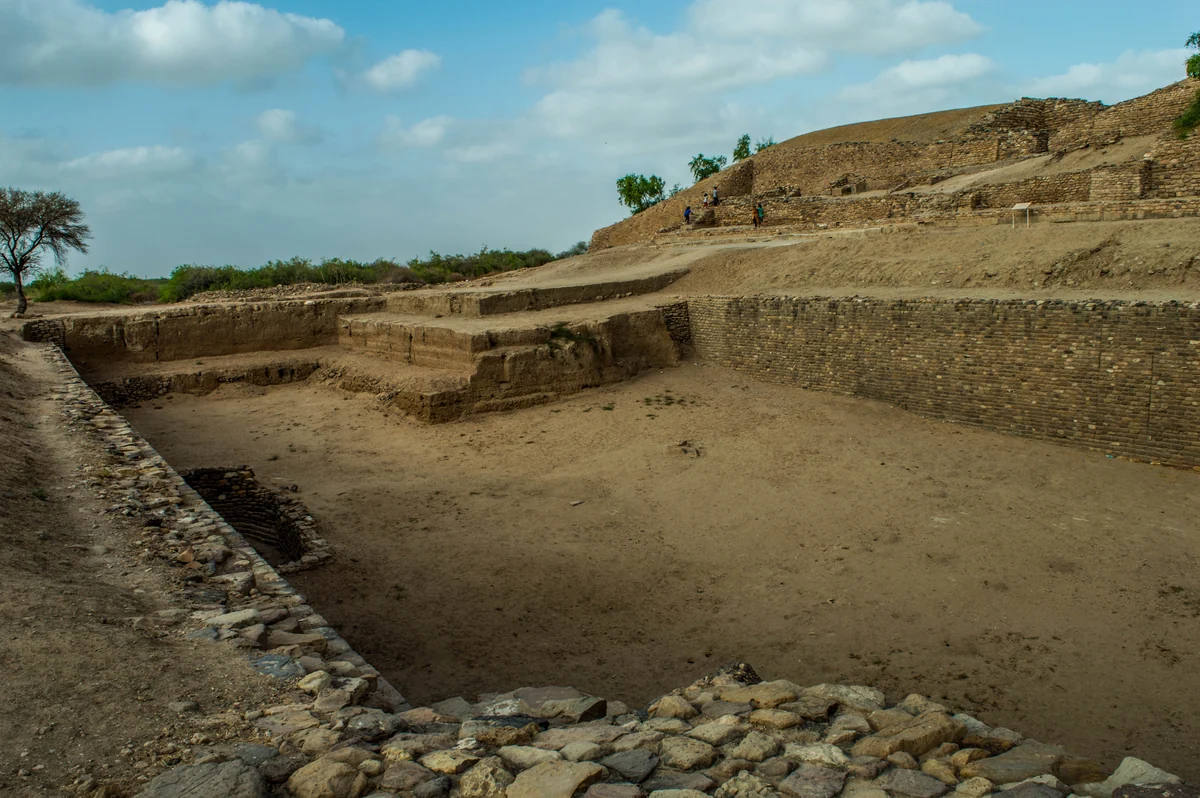
Dholavira gives the Harappan period a specific place and scale. The settlement occupied Khadir Island in what is now Gujarat from roughly 3000 to 1500 BCE. The protected site includes a walled settlement and a cemetery. Excavations identified bead-making workshops, and finds point to exchange involving Mesopotamia and the area of modern Oman. Together, those traces let you ask how people made goods, where those goods might have circulated and how the settlement organised space.
Water management offers a way to read the site. Two seasonal streams supplied water that reservoirs and drains helped the settlement manage. Those structures provide physical evidence of how the city dealt with an intermittent supply. The workshops answer a different question about activity inside the settlement. Evidence of long-distance exchange places that local activity within a wider economy, even where the journeys and people involved remain beyond what the supplied account can establish.
Around 1900 BCE, settlement patterns and material culture changed across Harappan regions. Some settlements in core Indus areas were abandoned, while communities elsewhere continued or established settlements. Keep Dholavira’s occupation range alongside that broader date. The two entries describe different scales of change and help explain why a chronology of urban practices across a region can look different from the history of one place.
The Vedic period brings a different source problem. Indira Gandhi National Open University explains how historians draw on Vedic texts and material evidence, with different emphases for early and later Vedic accounts. UNESCO’s account of Vedic chanting describes how formal patterns of tone and pronunciation carry texts across generations. If a timeline assigns a precise date to a Vedic phase, check which texts or material evidence it uses, which region it describes and how the date was estimated. The continuity of recitation establishes a method of transmission. Dating the societies described in the texts takes separate evidence.
Ancient India timeline: Harappan cities, Ashoka, Gupta and Nalanda
Early states, Ashoka and the rise of Gupta power
By the sixth century BCE, early states, settlements, coins and new religious traditions appear together in NCERT’s account. Buddhist and Jaina texts name major states known as mahajanapadas, often counted as sixteen. The lists vary, so check the source of a particular list before using it to label a map. Magadha emerged as a leading power among these states. Its rise belongs in a history of competing polities whose institutions could differ markedly.
Some mahajanapadas were monarchies. In others, known as ganas or sanghas, a group of rulers shared power. The evidence supports that description of how authority was distributed among rulers. A claim about who could participate in government would require closer evidence about membership and political rights. NCERT pairs texts, inscriptions, coins and archaeological evidence because each can address a different part of a question about early states and economies.
India’s UNESCO Tentative List submission dates the Mauryan ruler Ashoka’s reign to approximately 268–232 BCE and identifies surviving edicts on rocks and pillars across dispersed sites. A location on an edict map identifies surviving evidence of royal communication. To interpret a shaded political map, check how its author reconstructed the boundaries. The nomination also gives you a way to verify the heritage designation, since a Tentative List entry records a site proposed for consideration.
For the fourth century CE, the Metropolitan Museum of Art’s chronology places the rise of Gupta power in northern South Asia. Its wider survey groups art and sites by region and time, which makes it possible to see traditions that existed alongside Gupta power. When using an object to anchor a date, read its geographical entry as well as its date. An artwork’s place in the chronology establishes the context in which the museum presents it. Political attribution calls for evidence about that object or region.
Chola, Sultanate, Ahom, Vijayanagara, Mughal and Maratha landmarks
The Great Living Chola Temples at Thanjavur, Gangaikondacholapuram and Darasuram give the eleventh and twelfth centuries three southern points of reference. In Delhi, the Qutb Minar was begun in the late twelfth century, and its associated monuments document early Sultanate-era construction. Reading the entries together shows how different architectural and political histories belong in the same broad period. A construction date identifies a phase at a site. A dynasty’s territorial extent or lifespan requires a political chronology.
Charaideo adds a northeastern chronology. The Tai-Ahom selected it as an early capital and royal burial place after their arrival in the thirteenth century. The moidams preserve evidence of burial traditions through the nineteenth century. That span describes a practice documented at the site. The act of selecting a capital and the continued use of a royal necropolis are two separate developments that a single timeline entry could easily compress.
Hampi, on the Tungabhadra in present-day Karnataka, preserves the Vijayanagara capital, with major settlement and monument phases from the fourteenth to the sixteenth centuries. In the later sixteenth century, Akbar built Fatehpur Sikri and used it for a period as a Mughal capital. Its court and religious monuments give a reader two kinds of evidence to look for within one complex. If you encounter both cities under a sixteenth-century heading, check whether each date refers to a building phase, the occupation of a settlement or its use as a capital.
Maratha fort properties bring the chronology into the early nineteenth century. UNESCO’s serial property covers several locations, largely in present-day Maharashtra, where Maratha rulers built, adapted or expanded sites between the late seventeenth and early nineteenth centuries. When checking the age of an individual fort, look for the verb attached to the dated phase. An expansion under a Maratha ruler can sit within a longer building history, and the full range for the group tells you little about the age of one structure.
From East India Company power to British Crown rule
The East India Company acquired political and territorial power over time. The UK Parliament’s institutional history identifies 1757 and 1764 as milestones in that change from an organisation operating trading posts. In August 1765, Shah Alam II granted the diwani to Robert Clive. The British Library’s catalogue describes the grant as authority over revenue collection and civil justice in the relevant provinces. That description answers a more precise question than a general date for the rise of Company rule, since it identifies the powers the grant conveyed.
The catalogue also illustrates how to check a familiar historical image. The surviving work depicting the grant is a later copy of a commissioned painting. Its catalogue date and the date of the event belong in separate parts of a caption. The painting can help a reader examine how the ceremony was represented. The catalogue’s account of the grant is the relevant starting point for identifying the authority it conferred.
British parliamentary inquiries and legislation in 1773 brought Company finances and governance under increased scrutiny. The Government of India Act 1858 marks a later change in legal authority. It transferred the Company’s governing powers to the Crown and established a secretary of state assisted by a Council of India. If a source gives a different date for the end of Company rule, check the event named in the entry. The statutory transfer, the public proclamation and the later winding-up of the Company each have their own documentary record.
Quit India, independence and Partition
The Quit India archive lets readers follow a demand for independence through a specific document. The Nehru Archive reproduces drafts from 5 August 1942 and the final resolution adopted by the All India Congress Committee in Bombay on 8 August. The final text called for British withdrawal and a provisional government and described the proposed mass struggle as nonviolent. For a claim about what the committee adopted, use the final resolution. The drafts are evidence for how the wording developed.
The Indian Independence Act made 15 August 1947 the appointed day for the independent dominions of India and Pakistan. Sections 2 to 4 address territorial composition and the division of Bengal and Punjab. The Gazette of India Extraordinary published both boundary commission reports on 17 August. If two timeline entries seem to disagree by two days, compare their document headings. The statute gives the appointed day and the Gazette records the date of publication of the reports.
For a claim about an individual district or boundary segment, start with the original published award. Compare it with the period map in the National Archives collection and check the date and purpose of any later map. United Nations arbitral material on Bengal concerns subsequent disputes about interpretation. Its account belongs alongside the award when tracing a dispute and can help explain why a later treatment of a line may require its own date.
To follow the human consequences, read Nehru’s relief appeal of 25 November 1947 alongside the archival photograph documenting displacement. The appeal records contemporary relief needs. The photograph documents a scene whose identification depends on its archival caption. These sources give a reader ways to investigate what people faced in the aftermath and how relief needs were expressed at the time.
The Indian Independence Act names 15 August 1947 as the appointed day for both new dominions. Pakistan observes its Independence Day on 14 August, as its official holiday schedule shows. In a timeline, keep the date in the Act, the dates of particular ceremonies and the annual commemorations distinct. They describe different parts of the transfer of power and its remembrance.
The Quit India Movement of 1942India Independence Day on 15 August
- UK National Archives: Records of Partition
- UK Legislation: Indian Independence Act 1947 As Enacted
- Nehru Archive: Quit India Drafts and Final Resolution
- UK National Archives: Refugee Movements After Partition
- Nehru Archive: National Relief Fund, November 25, 1947
- United Nations: Bengal Boundary Interpretation Arbitration Record
- Gazette of India Facsimile: Bengal and Punjab Boundary Commission Reports
- Pakistan’s Ministry of Foreign Affairs holiday schedule
Constitutional adoption and the Republic
The Constituent Assembly adopted the Constitution on 26 November 1949. Most of its provisions came into force on 26 January 1950, the date that marks the start of the Republic. Article 394 gives that commencement date and identifies specified articles that took effect sooner. Use the parliamentary history for the dates of adoption and commencement, and consult the constitutional text when the effective date of a particular provision matters.
For a timeline entry on what changed between 1947 and 1950, give each event its own verb. The Independence Act established the independent dominions in August 1947. The Assembly adopted the Constitution in November 1949. Most constitutional provisions took effect in January 1950. This lets readers match the date to the question they are asking, whether it concerns independence, the Assembly’s decision or the operation of the constitutional text.
Sources
- UNESCO World Heritage Centre: Dholavira
- UK National Archives: Records of Partition
- UK Legislation: Indian Independence Act 1947 As Enacted
- IIT Kanpur SATHEE: NCERT on Early States and Economies, c. 600 BCE–600 CE
- UNESCO: Tradition of Vedic Chanting
- India's UNESCO Tentative List Submission: Ashokan Edict Sites
- The Met: South Asia, 1–500 CE Chronology
- UNESCO: Great Living Chola Temples
- UNESCO: Moidams of the Ahom Dynasty
- UNESCO: Qutb Minar and Its Monuments, Delhi
- UNESCO: Group of Monuments at Hampi
- UNESCO: Fatehpur Sikri
- UNESCO: Maratha Historical Fort Properties
- British Library: Benjamin West's Painting of the Diwani Grant
- UK Legislation: Government of India Act 1858 as Enacted
- Nehru Archive: Quit India Drafts and Final Resolution
- UK National Archives: Refugee Movements After Partition
- Nehru Archive: National Relief Fund, November 25, 1947
- United Nations: Bengal Boundary Interpretation Arbitration Record
- Digital Sansad: Constitution and Parliamentary History
- Parliament Digital Library: Constitution of India, Article 394
- Gazette of India Facsimile: Bengal and Punjab Boundary Commission Reports
- Indira Gandhi National Open University: Vedic Period Teaching Unit
- UK Parliament: Parliament and the East India Company
- Indira Gandhi National Open University: Harappan and Other Chalcolithic Cultures
- Pakistan’s Ministry of Foreign Affairs holiday schedule