A timeline of inventions, discoveries and rollouts
Documented innovations from India and the wider South Asian historical context include Brahmagupta’s rules for zero in 628 CE, the Indian chess ancestor chaturanga, Jagadis Chunder Bose’s crescograph, the Jaipur Foot, India’s satellite navigation system and the Unified Payments Interface. Bose’s instrument and the Jaipur Foot are inventions, the Raman effect is a scientific discovery, and the dates for satellite navigation and payments mark stages in building and launching services.
Read the date together with the event. The strongest year for the crescograph in this chronology comes from a research paper that describes an instrument. The Jaipur Foot entry uses the year its associated institution gives for development. UPI has a pilot date and a separate date for the start of bank apps. Each answers a different question about when an idea, object or service entered the record.
| Date | Milestone | What the evidence dates |
|---|---|---|
| 628 CE | Brahmagupta’s Brāhmasphuṭasiddhānta | A work recording arithmetic rules involving zero |
| 889–979 CE | Four sampled Bakhshali folios | A conditional combined radiocarbon interval for birch bark |
| 1920 | Bose’s crescograph | Publication of a description of the high-magnification instrument |
| 1928 and 1930 | Raman effect | The joint Raman–Krishnan paper and Raman’s subsequent Nobel Prize |
| 1968 and March 1975 | Jaipur Foot and BMVSS | Development of the design and formation of the later organisation |
| 1 July 2013 and 28 April 2016 | IRNSS-1A and IRNSS-1G | The first dedicated navigation satellite launch and a later constellation milestone |
| April and August 2016 | UPI | The pilot and the start of UPI-enabled bank apps |
| 21 February 2023 | PayNow–UPI linkage | Launch of a cross-border link for participating financial institutions |
Chaturanga fits alongside the early mathematical examples, with a date expressed at a different level of precision. The Science Museum traces chess to the Indian game around 1,500 years ago. An approximate period serves that evidence better than a spot between two precisely dated events. The Bakhshali interval also deserves its full range and a label identifying what the laboratory measured.
- University of Oxford: Radiocarbon Dating of the Bakhshali Manuscript
- Brahmagupta arithmetic in the Colebrooke Sanskrit translation archive
- C. V. Raman’s Nobel Lecture and the 1928 Raman–Krishnan paper
- Jagadis Chunder Bose original writings on the crescograph
- Jaipur Foot and BMVSS, original institutional history and attribution
- ISRO national satellite navigation mission archive
- RBI Bulletin, scoped chronology for NPCI's Unified Payments Interface
- Monetary Authority of Singapore and RBI, PayNow–UPI launch, 21 February 2023
- Science Museum and Met exhibition sources on chaturanga and later chess
- Original Raman and Krishnan Nature paper, 1928
- Bose’s Researches on Growth of Plants, Nature, 1920
Zero as a placeholder and as a number
The Bakhshali manuscript preserves a dot used as a placeholder in positional notation. In the modern decimal number 507, the zero keeps the hundreds and ones in their proper positions by marking an empty tens place. That illustrates the job of the manuscript’s dot. The arithmetic question of what happens when you add zero to a number concerns a separate use of zero and calls for evidence of a rule.
Brahmagupta’s Brāhmasphuṭasiddhānta, dated 628 CE, gives rules involving zero and positive and negative numbers. One familiar result is that a positive number plus zero remains the same positive number. The text also addresses division involving zero, where the historical treatment differs from modern arithmetic. Henry Thomas Colebrooke’s 1817 translation gives readers access to the rules. When citing them, attach 628 to Brahmagupta’s work and 1817 to the translation.
The date of the Bakhshali dot requires care. The Bodleian’s 2017 announcement included a range of 224–383 CE for the bark of folio 16. Repeat testing in 2018 showed that the early measurement was inaccurate. The 2024 laboratory report gives folio 16 a calibrated 95.4% interval of 901–1032 CE. The authors exclude folio 17 as an outlier and retain the original folio 33 measurement with updated calibration.
For folios 15, 23, 33 and 55, the report gives a conditional combined interval of 889–979 CE after consistency testing. The set of five did not pass that test. The researchers deliberately excluded ink from the samples, so even the combined interval dates the bark in that group. A specialist discussion of the manuscript considers uniform handwriting and text that continues from one leaf to another, evidence relevant to when the writing was copied.
For a date check, look at Table 1 of the 2024 report and match the printed claim to its folio number or to the four-folio group. Keep the find location separate from either date. The manuscript was found near Peshawar in 1881, in present-day Pakistan, and belongs in a history of mathematical traditions across South Asia.
| Sample | Earliest year CE | Latest year CE | Scope |
|---|---|---|---|
| Folio 15 | 773 | 986 | Calibrated 95.4% interval for bark |
| Folio 16 | 901 | 1032 | Calibrated 95.4% interval for bark |
| Folio 23 | 890 | 1014 | Calibrated 95.4% interval for bark |
| Folio 33 | 885 | 995 | Calibrated 95.4% interval for bark |
| Folio 55 | 774 | 991 | Calibrated 95.4% interval for bark |
| Combined folios 15, 23, 33 and 55 | 889 | 979 | Conditional combined interval after consistency testing |
In the Oxford report, repeat work found the original early folio 16 result inaccurate. The researchers identified folio 17 as an outlier and excluded it from their later grouping. They deliberately did not sample ink. A date range for birch bark is material evidence for the sampled folio. It cannot by itself establish the age of the inscription or the year in which an idea was developed.
How chaturanga belongs in the history of chess
The Science Museum traces chess back to chaturanga, an Indian strategy game played around 1,500 years ago. This is an attribution to a game tradition. The museum’s account supports a broad period and an origin in India. The development of later forms belongs to a longer history, which the Metropolitan Museum of Art follows through the spread and changing forms of the game.
A useful entry can therefore name chaturanga when it discusses ancestry and reserve the term modern chess for the later game with its familiar rules. A reader interested in when a particular move became standard would need a source on that move. An account tracing a game’s spread establishes a connection between traditions, while a history of the rules can tell you which features persisted and which changed.
When checking an exact year or a named inventor in a list of Indian inventions, ask what document or object the claim refers to. A surviving object can establish that a form of play was known in a particular time and place, if its identification and provenance are secure. The institutional accounts here support the broader line of descent, with the date given approximately and the credit attached to chaturanga.
Bose’s crescograph and the measurement of plant growth
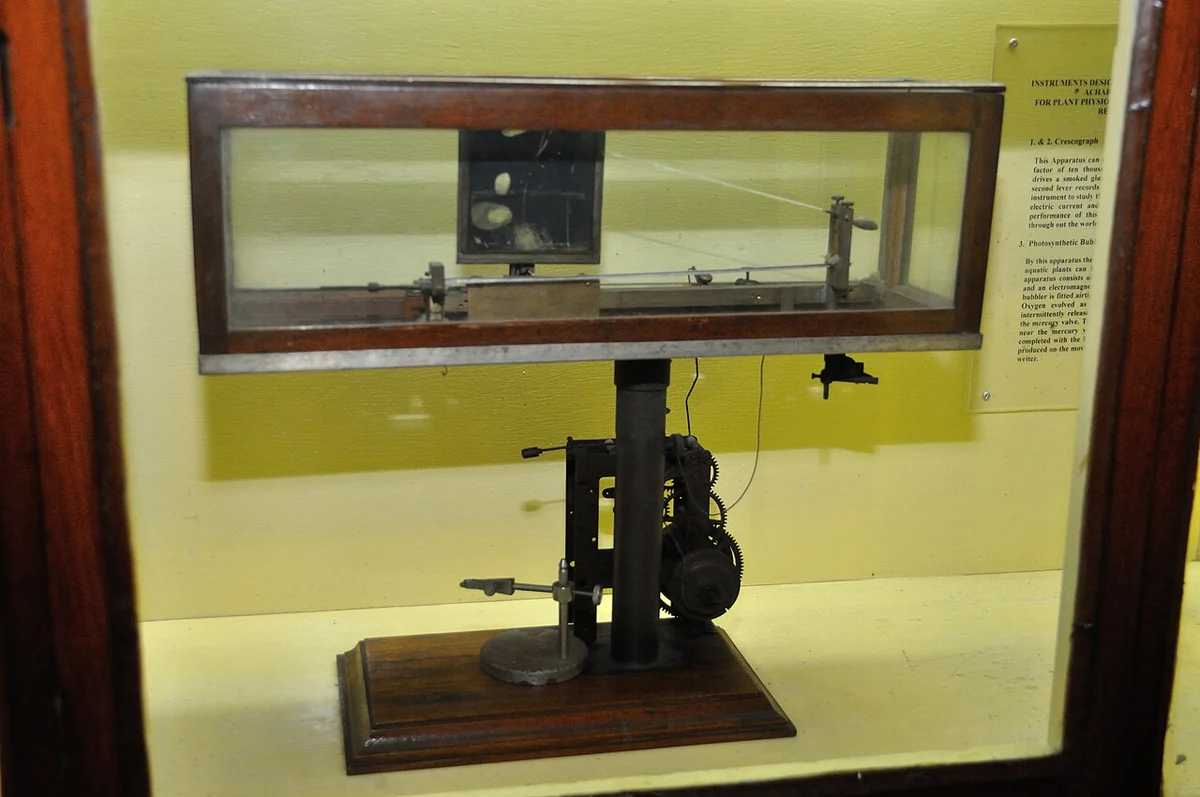
Jagadis Chunder Bose’s high-magnification crescograph made tiny plant growth movements observable and recordable. The instrument addressed a measurement problem. A plant can visibly grow over days, while changes over a short observation period can be too small to judge by eye. Magnifying the movement gives the experimenter a record to examine at the scale of those small changes.
Bose describes the high-magnification instrument in Researches on Growth of Plants, published in Nature in 1920. His Life Movements in Plants also documents the use of instruments in his experiments. Together these sources let a reader connect the device with what it recorded. If an entry needs a firm chronological marker, 1920 supports the statement that Bose published a description of this instrument by then. Establishing when he built an earlier prototype would require a dated record of that prototype.
A photograph offers a different kind of evidence. The image taken by Biswarup Ganguly at the Bose Institute’s museum in Kolkata on 26 July 2011 shows a displayed instrument with a wooden base under an acrylic cover. Its location and date belong to the photograph and the display. To identify the precise version of the instrument or date its manufacture, a reader would need an object record that connects the exhibit to Bose’s descriptions.
Credit for the Raman effect
In 1928, C. V. Raman and K. S. Krishnan published A New Type of Secondary Radiation in Nature. Their paper reported a phenomenon in which a small part of the light scattered by a material emerges at changed frequencies. Those shifts can carry information about the material. The observation belongs in a chronology of Indian science as a discovery and helps explain the principle behind later methods of analysing materials using scattered light.
The 1930 Nobel Prize in Physics is a separate event. The award names C. V. Raman for his work on light scattering and the effect that bears his name. Both dates are worth keeping because they answer common attribution questions. For who signed the 1928 report, check the author line of the Nature paper. For who received the prize and what the award recognised, check the Nobel record.
The same distinction matters when a timeline illustrates the discovery with a modern instrument. The 1928 paper supports a claim about the reported phenomenon. A date or inventor for a particular spectrometer would need a source about that instrument’s design. Raman’s Nobel lecture provides historical context about the research, while the joint paper provides the publication record for the finding.
Who developed the Jaipur Foot
The institutional history published by Bhagwan Mahaveer Viklang Sahayata Samiti, or BMVSS, dates development of the Jaipur Foot to 1968 in Jaipur. It places the earlier work at Sawai Man Singh Medical College and Hospital. The object of the attribution is a specific prosthetic foot design, which gives the entry a concrete subject and a place where the work took shape.
The institution’s development account identifies Ram Chandra Sharma, a craftsperson, and Pramod Karan Sethi, an orthopaedic surgeon. Sharma brought the skills needed to make the foot, while Sethi contributed orthopaedic expertise to the technical development. A short entry can retain both names and their roles. The making of the object is part of the development story, so reducing the entry to the clinician’s name would leave out work the institution explicitly credits.
March 1975 marks the formation of BMVSS. Its founder, D. R. Mehta, had a later organisational role in expanding access. That date is useful for a reader tracing how the design reached more people. When checking a claim about who developed the foot, use the institution’s account of the design work. When checking who established the organisation associated with its wider distribution, use the founding history.
UPI from pilot to cross-border payments
The National Payments Corporation of India developed the Unified Payments Interface as an interoperable payments platform. Interoperability is the practical feature to look for in its product description. Participating providers can use a shared system, so a payment can reach a recipient who uses a different participating bank or app. The attribution is to the development of UPI as a platform within the wider history of electronic payments.
The Reserve Bank of India Bulletin, citing NPCI, dates the UPI pilot to April 2016 and the start of UPI-enabled bank apps to August 2016. The pilot is the relevant date for a chronology of the platform’s introduction. August is the relevant date for the first bank apps in that chronology. For a claim about the availability of a specific bank’s app, check the bank’s own release or support record for that app.
On 21 February 2023, the Monetary Authority of Singapore and the Reserve Bank of India launched the PayNow–UPI linkage for participating financial institutions. The joint launch record establishes when the cross-border connection began. A reader checking whether they can make a transfer today should look up the current participating institutions and check support for the intended direction of the transfer with their provider. Participation at launch and eligibility for a specific transfer are separate facts, each with its own source.
India semiconductor projects, factory status and capacityIndia’s Moon missions, Chandrayaan dates and what they found
Sources
- University of Oxford: Dating the Bakhshali Manuscript
- University of Oxford: Radiocarbon Dating of the Bakhshali Manuscript
- National Payments Corporation of India: Institutional Milestones
- Brahmagupta arithmetic in the Colebrooke Sanskrit translation archive
- C. V. Raman’s Nobel Lecture and the 1928 Raman–Krishnan paper
- Jagadis Chunder Bose original writings on the crescograph
- Jaipur Foot and BMVSS, original institutional history and attribution
- ISRO national satellite navigation mission archive
- RBI Bulletin, scoped chronology for NPCI's Unified Payments Interface
- Monetary Authority of Singapore and RBI, PayNow–UPI launch, 21 February 2023
- Science Museum and Met exhibition sources on chaturanga and later chess
- Documentary photograph of the displayed crescograph at the Bose Institute
- Original Raman and Krishnan Nature paper, 1928
- Bose’s Researches on Growth of Plants, Nature, 1920
- ISRO official IRNSS-1G mission record
