Does India have universal healthcare?
India has a public primary-care programme designed for universal access and a nationwide public hospital scheme with defined eligibility. Universal health coverage remains a policy goal, and the national ₹5 lakh hospital benefit applies to eligible families and covered care.
The World Health Organization defines universal health coverage by whether everyone can obtain the quality services they need without financial hardship. That definition covers prevention, treatment, rehabilitation and palliative care. India’s National Health Policy 2017 sets universal access to good-quality care without financial hardship as a goal. The policy date tells you when that goal was set. Operational updates and expenditure accounts answer separate questions about implementation and financing.
The two components of Ayushman Bharat are useful starting points. Ayushman Arogya Mandir is the primary-care component, designed to provide free services at the point of use. Ayushman Bharat Pradhan Mantri Jan Arogya Yojana, abbreviated AB PM-JAY, finances specified secondary and tertiary hospital care for eligible people through participating hospitals. Someone looking for a regular outpatient visit and someone checking cover for a hospital admission therefore have different places to start.
Three questions help make sense of a coverage claim. Who qualifies, which service falls within the programme, and where can the person receive it? Nationwide adoption describes geographic participation. The age-based extension describes who qualifies under one route. The annual ceiling describes how much covered hospital care the entitlement can finance. Each answers one part of what a household needs to establish.
- WHO definition of universal health coverage
- Ministry of Health and Family Welfare, National Health Policy 2017
- Ministry of Health and Family Welfare, Ayushman Arogya Mandir programme
- Union Health Ministry, 4 August 2026 update on AB PM-JAY
- Union Cabinet approval for the AB PM-JAY age 70 and older expansion, 11 September 2024
- National Health Authority and West Bengal implementation memorandum, 8 June 2026
- National Health Accounts Estimates for India 2023–24, Table 1
What Ayushman Arogya Mandir offers
Ayushman Arogya Mandir expands the service model of former sub-centres and primary health centres. The Union health ministry lists pregnancy and childbirth care, newborn and childhood care, and general outpatient care among its service packages. It also lists chronic-disease screening and management, basic oral and eye care, mental health screening, and care for older people and people who need palliative services.
The national service list describes the programme’s intended scope. For a particular visit, the relevant detail is what the local facility offers and when. A service package can cover several activities, and a facility may provide some of them on site while directing patients elsewhere for others. Ask the facility which part of the service it provides, when it is available, and how referrals work if another facility handles the next step.
For example, someone arranging a routine follow-up for a chronic condition can ask the local Ayushman Arogya Mandir whether it provides ongoing management for that condition or offers screening and referral. That distinction helps the person decide whether the centre can handle the visit they are planning. The ministry’s listing of chronic-disease services gives them a specific service to ask about, while the facility can confirm what it is equipped to provide.
Who qualifies for PM-JAY hospital cover
The Union health ministry’s 4 August 2026 update puts the base PM-JAY target at 12 crore economically vulnerable families, representing approximately the bottom 40% of the population. A March 2024 extension covered approximately 37 lakh families of Accredited Social Health Activists, Anganwadi Workers and Anganwadi Helpers. The national figures describe the groups the programme aims to reach. Individual eligibility depends on the applicable programme record.
The standard national benefit is up to ₹5 lakh per eligible family per year for included secondary and tertiary hospital care at empanelled public and private hospitals. The family is the unit for the standard ceiling, so several family members can draw on the same annual cover for eligible care. The amount measures the maximum value of applicable hospital care financed through the entitlement. It has no cash payout or general outpatient reimbursement function.
For a planned admission, eligibility and treatment coverage are different checks. The patient needs to qualify, the hospital needs to participate, and the proposed care needs to fall within the applicable scope at that facility. This distinction matters even when a hospital is already familiar to the family. Past participation or treatment for another patient gives the family a place to inquire. The programme or provider can confirm the status of the planned admission.
Employment-based cover can involve a separate route. Employees’ State Insurance, for example, has medical benefits for covered workers and their families. A household comparing its options needs the terms of each scheme or insurance policy that applies to the patient. The PM-JAY ceiling describes one public hospital entitlement, while employment-based and private coverage have their own eligibility and terms.
The separate rules for people aged 70 and older
The Union Cabinet approved the age-70 extension on 11 September 2024, and Vay Vandana launched on 29 October 2024. The extension provides a national route to PM-JAY hospital cover for citizens aged 70 or older regardless of socioeconomic status, with a distinct card. The policy projected potential reach of approximately 6 crore people in 4.5 crore families.
For eligible seniors in a family already covered under the base scheme, the extension provides a separate additional top-up of up to ₹5 lakh a year reserved for members aged 70 or older. Other eligible families with members aged 70 or older receive cover under a ceiling that operates on a family basis. If two spouses aged 70 or older qualify through the extension and their family is outside the base scheme, the ceiling applies to their family rather than separately to each spouse.
The Cabinet release gives specific options for seniors who already belong to the Central Government Health Scheme, the Ex-Servicemen Contributory Health Scheme or Ayushman CAPF. It addresses private insurance and Employees’ State Insurance separately. Someone comparing overlapping arrangements should identify their existing scheme by name and confirm the terms that apply to it. Age establishes the route under the extension, while existing scheme membership can affect the choices available.
Where to check your eligibility and hospital
Start with the record that answers the question you have. For hospital cover, ask the applicable programme to confirm the patient’s eligibility or enrolment, including whether the record is under the base scheme or the senior extension. The National Health Authority’s public card dashboard shows aggregate card statistics by state and union territory. Its figures are useful for tracking issuance across jurisdictions. A personal eligibility check requires the patient’s programme record.
Use the National Health Authority’s PM-JAY hospital search to look for participating facilities. Then check with the hospital or programme about the proposed admission and treatment. Verify the exact facility, especially if a hospital group has multiple branches. PM-JAY provides portability, which makes a participating hospital in another state a possibility. For a planned admission away from home, confirm the patient’s entitlement and the destination facility’s coverage for the proposed care before making arrangements.
An Ayushman Bharat Health Account, or ABHA, is a digital health identifier. The Ayushman entitlement card relates to the hospital financing programme. If a record shows an ABHA number and the immediate question is who will finance an admission, ask for confirmation of PM-JAY eligibility and treatment scope. Knowing which record you have helps you direct the inquiry to the programme that can answer it.
| Question | Where to check | Detail to confirm |
|---|---|---|
| Can I get this primary-care service locally? | Local Ayushman Arogya Mandir | The service offered on site and its current availability |
| Does the patient qualify for PM-JAY? | Applicable PM-JAY programme | The patient’s eligibility or enrolment record |
| Does this hospital participate? | National Health Authority PM-JAY hospital search | The listing for the exact facility |
| Does the proposed admission fall within cover? | Participating hospital or applicable programme | The treatment scope and approval requirements for the patient and facility |
- Ministry of Health and Family Welfare, Ayushman Arogya Mandir programme
- Union Cabinet approval for the AB PM-JAY age 70 and older expansion, 11 September 2024
- Union Health Ministry, Arogya Manthan 2026 programme update
- Union Health Ministry official routing to NHA card data and search
- NHA programme hospital and treatment scope
What nationwide adoption and admission figures show
The National Health Authority and West Bengal signed an implementation memorandum on 8 June 2026. The Union ministry described West Bengal as the 36th state or union territory to adopt PM-JAY and the memorandum as completing nationwide adoption. West Bengal reported a state launch on 16 August 2026. The signing and the launch mark different stages of implementation, several weeks apart.
At the signing, the projected scope for West Bengal was approximately 1.43 crore families. At the Union ministry and state review on 5–6 November 2026, West Bengal reported 4.2 crore beneficiaries enrolled and 2.2 lakh people treated. The projection counts families. The later figures count beneficiaries and people treated. Comparing the enrolment figure directly with the projection would mix household and individual units.
Nationally, the ministry reported 12.69 crore hospital admissions worth ₹1.92 lakh crore authorised through 37,413 empanelled public and private hospitals as of 30 June 2026. At Arogya Manthan on 25 September 2026, it described more than 13 crore admissions and treatment worth more than ₹2 lakh crore. The June release gives figures with a specific cutoff, while the September event uses rounded milestones.
One patient can account for several authorised admissions. The same distinction applies to the Vay Vandana update, which reported 23.46 lakh authorised admissions worth ₹5,668.80 crore as of 20 October 2026. Dividing those admissions by the roughly 6 crore people the policy could reach would yield episodes per potential beneficiary. Measuring the proportion of eligible seniors who received care would require a count of unique patients and a matching eligible population.
| Reference date | Record | Published amount or status | Reporting unit |
|---|---|---|---|
| 8 June 2026 | West Bengal implementation memorandum | 36 | States and UTs in the Ministry’s nationwide adoption announcement |
| 30 June 2026 | Authorised national hospital admissions | 12.69 crore | Admissions through the cutoff, across 37,413 empanelled hospitals |
| 16 August 2026 | West Bengal programme launch | State launch | Operational date reported at the November state review |
| 25 September 2026 | Arogya Manthan national programme milestone | Over 13 crore | Admissions facilitated as reported at the event |
| 20 October 2026 | Vay Vandana admissions authorised | 23.46 lakh | Authorised senior programme admissions through the cutoff |
| 5–6 November 2026 | West Bengal health programme review | 4.2 crore | Beneficiaries enrolled in the state at the review |
| 5–6 November 2026 | West Bengal health programme review | 2.2 lakh | People treated in the state at the review |
- Union Health Ministry, 4 August 2026 update on AB PM-JAY
- Union Health Ministry, Vay Vandana two-year update on 29 October 2026
- National Health Authority and West Bengal implementation memorandum, 8 June 2026
- Union Health Ministry and West Bengal review, 5–6 November 2026
- Union Health Ministry, Arogya Manthan 2026 programme update
- Union Health Ministry official routing to NHA card data and search
What households pay out of pocket
The National Health Accounts for fiscal year 2023–24, released on 15 November 2026, put household out-of-pocket expenditure at 42.7% of India’s total health expenditure. That share was 64.2% in 2013–14, a decline of 21.5 percentage points over the period. The recent figures show an uneven path. The share reached 39.4% in 2021–22, rose to 43.4% in 2022–23, and then fell to 42.7% in 2023–24.
Combined central and state government health expenditure rose from 28.6% of total health expenditure in 2013–14 to 43.5% in 2023–24. In nominal rupees the ministry reports an increase from ₹1,29,778 crore to ₹4,14,196 crore. The shares use the same denominator, total health expenditure, which includes other sources of spending. The nominal amounts describe spending in the rupees of each year.
The out-of-pocket share describes where spending came from across the health system. Measuring whether care causes financial hardship requires evidence about what households pay in relation to their resources. Measuring access also requires evidence about people who needed care and were unable to obtain it. The expenditure series by itself cannot isolate how much of the change came from any one scheme.
For a newer comparison, use Table 1 of the latest National Health Accounts and check the fiscal year on each figure. Keep the data year separate from the publication year, and compare shares that use total health expenditure as the denominator. For the cost of a specific admission, the relevant figures come from the patient’s entitlement and the provider’s confirmation of what the proposed care includes.
- 2013–14
- 64.2 percent
- 2014–15
- 62.6 percent
- 2015–16
- 60.6 percent
- 2016–17
- 58.7 percent
- 2017–18
- 48.8 percent
- 2018–19
- 48.2 percent
- 2019–20
- 47.1 percent
- 2020–21
- 44.4 percent
- 2021–22
- 39.4 percent
- 2022–23
- 43.4 percent
- 2023–24
- 42.7 percent
| Fiscal year | Household out-of-pocket share (%) | Government health expenditure share (%) |
|---|---|---|
| 2013–14 | 64.2 | 28.6 |
| 2014–15 | 62.6 | 29.0 |
| 2015–16 | 60.6 | 30.6 |
| 2016–17 | 58.7 | 32.4 |
| 2017–18 | 48.8 | 40.8 |
| 2018–19 | 48.2 | 40.6 |
| 2019–20 | 47.1 | 41.4 |
| 2020–21 | 44.4 | 42.8 |
| 2021–22 | 39.4 | 48.0 |
| 2022–23 | 43.4 | 43.7 |
| 2023–24 | 42.7 | 43.5 |
Two columns in the table use the same national total for the denominator. Other financing sources also contribute to that total. Between 2013–14 and 2023–24 the out-of-pocket share was 21.5 percentage points lower, with a rise from 39.4% to 43.4% between 2021–22 and 2022–23. For a question about whether a household could afford a particular treatment, look for household-level survey evidence with a definition of financial hardship. This accounting series measures the composition of total spending.
Sources
- WHO definition of universal health coverage
- Ministry of Health and Family Welfare, National Health Policy 2017
- Ministry of Health and Family Welfare, Ayushman Arogya Mandir programme
- Union Health Ministry, 4 August 2026 update on AB PM-JAY
- Union Cabinet approval for the AB PM-JAY age 70 and older expansion, 11 September 2024
- Union Health Ministry, Vay Vandana two-year update on 29 October 2026
- National Health Authority and West Bengal implementation memorandum, 8 June 2026
- Union Health Ministry and West Bengal review, 5–6 November 2026
- Union Health Ministry, Arogya Manthan 2026 programme update
- National Health Accounts Estimates for India 2023–24, Table 1
- Union Ministry release of 2023–24 National Health Accounts, 15 November 2026
- Union Health Ministry official routing to NHA card data and search
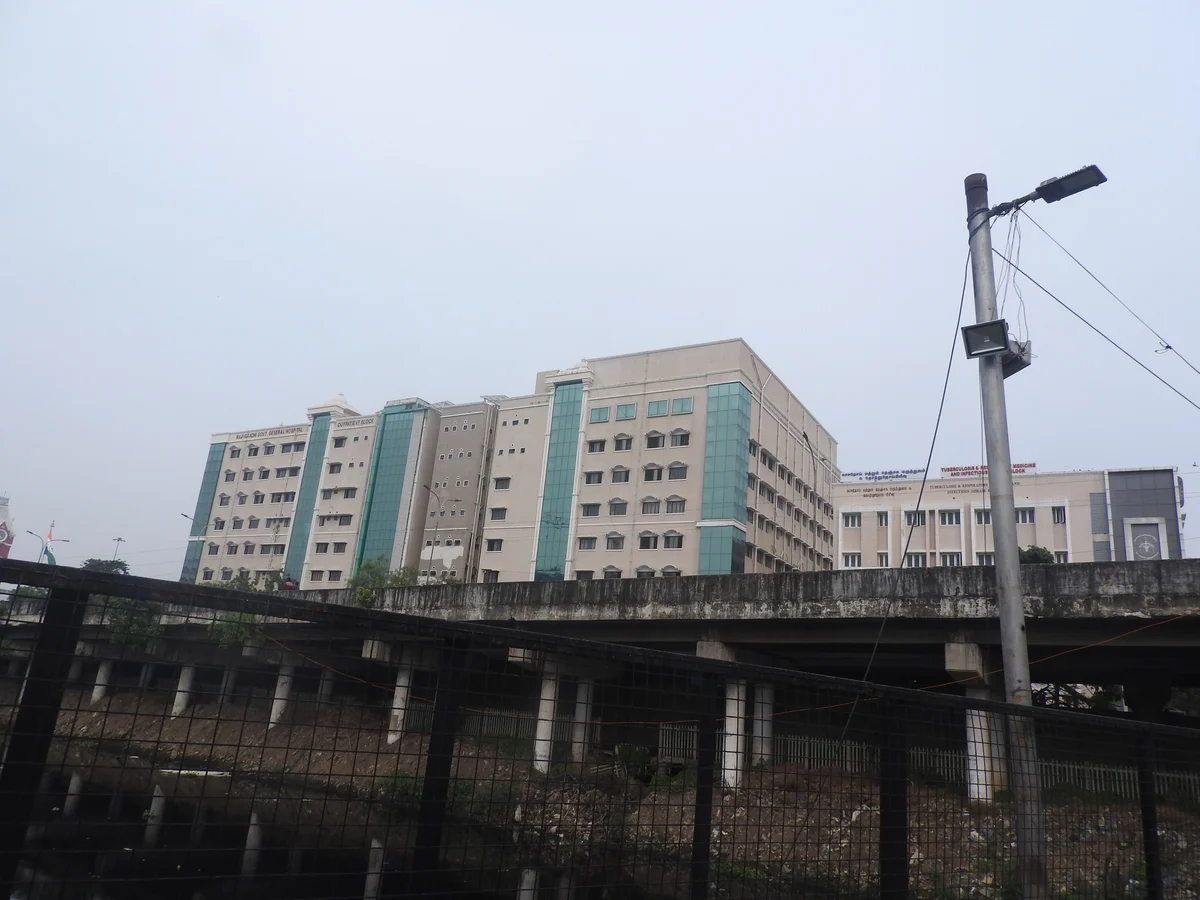
- Rajiv Gandhi Government General Hospital, Chennai, licensed site image
- National Health Authority PM-JAY operations manual
- NHA programme hospital and treatment scope
- Employees’ State Insurance Corporation benefit overview
