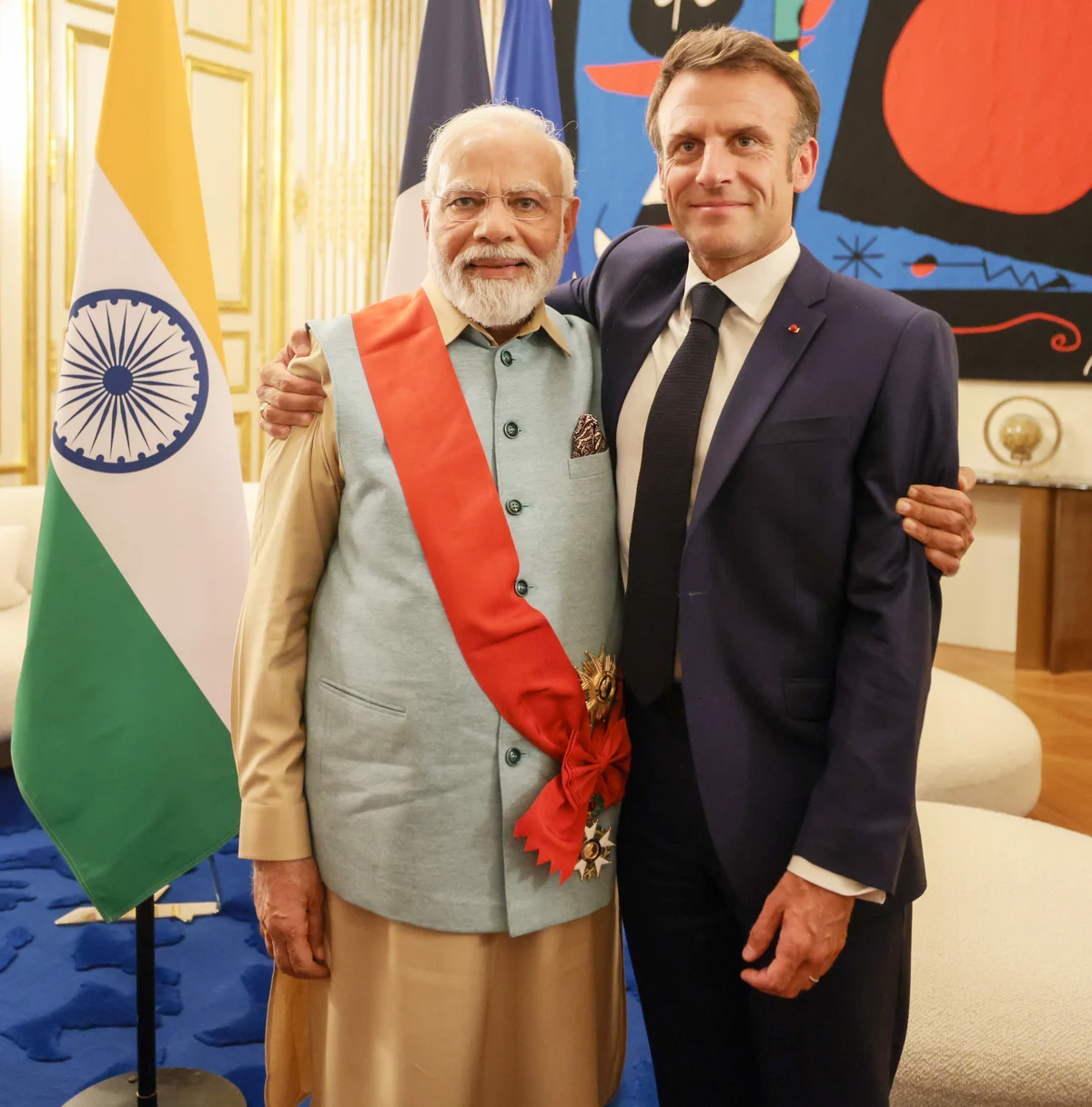
What changed in February 2026?
India and France elevated their relationship to a Special Global Strategic Partnership in February 2026 during French President Emmanuel Macron’s 17–19 February visit to India. The upgrade builds on the strategic partnership established in 1998 and follows Horizon 2047, the roadmap the two countries set out in 2023.
The joint statement is the record of the change in diplomatic status. It also describes cooperation in areas including civil nuclear energy, research, education and trade. Each area has a different kind of evidence for progress. The inauguration of the India–France Year of Innovation in Mumbai on 17 February was an event with a date and place. Progress on a research project or a civil nuclear initiative calls for its own record identifying what happened and who was involved.
The wording also locates the upgrade within an existing policy. Horizon 2047 covers bilateral, regional and global cooperation. The countries can work together through their own institutions, pursue a shared objective in a wider forum or participate in the same event in different capacities. The February statement distinguishes the bilateral relationship from participation in the AI Impact Summit. France’s June 2026 G7 archive gives another example by identifying India as a partner country associated with the French presidency.
For a dated account of the relationship, the February statement supports the formal upgrade and the Mumbai inauguration. To establish what followed in any specific field, look for a subsequent release that names the responsible ministry, agency or institution. Its date belongs to that particular development, even when the release traces the work back to February.
From the 1998 partnership to Horizon 2047
The French foreign ministry dates the original strategic partnership to 1998. When Indian Prime Minister Narendra Modi made an official visit to France on 13–14 July 2023, the two governments marked its 25th anniversary and adopted Horizon 2047. That July visit supplies the adoption date for the roadmap. The year in its title supplies the planning horizon.
Use the French foreign ministry country brief for the institutional background to the partnership. It distinguishes partnership policy, economic cooperation and multilateral relations. That division helps place a development in context. A policy commitment in a leaders’ statement belongs to the diplomatic relationship. A customs release measures trade flows over a specified period. A summit archive establishes the role a country held at a particular meeting.
The dates also show how joint work can develop across visits. In February 2025, Modi travelled to France for a visit that included the Paris AI Action Summit and a joint Economic Forum. By February 2026, during Macron’s visit to India, the countries had inaugurated their Year of Innovation. The two visits provide fixed points for following the agenda, alongside the separate June summit hosted by France.
| Date | Track | Milestone | What the official record establishes |
|---|---|---|---|
| 1998 | Bilateral partnership | Strategic partnership | Starting date of the original partnership. |
| 13–14 July 2023 | Bilateral partnership | Horizon 2047 | Long-term roadmap adopted in Paris on the 25th anniversary of the partnership. |
| 10–11 February 2025 | Innovation | Paris AI Action Summit | India and France co-chaired the summit. |
| 27 January 2026 | European Union trade | EU–India free trade agreement negotiations | The European Union and India announced conclusion of negotiations. |
| 17 February 2026 | Innovation | India–France Year of Innovation | The leaders launched the programme in Mumbai. |
| 17–19 February 2026 | Bilateral partnership | Special Global Strategic Partnership | Upgraded status announced during the presidential visit to India. |
| 15–17 June 2026 | Multilateral diplomacy | Évian G7 summit | The host included India as a partner country. |
| 2027, scheduled | Space | TRISHNA Earth observation mission | Current CNES project summary reports the mission in development. |
- Prime Minister of India: Horizon 2047 Roadmap
- French foreign ministry political and economic relations brief
- Indian Ministry of External Affairs historical bilateral brief
- Élysée joint declaration on Modi’s February 2025 visit
- Élysée February 2026 bilateral joint statement
- Élysée official archive of the June 2026 Évian G7 summit
AI cooperation and the Year of Innovation
India and France co-chaired the Paris AI Action Summit on 10–11 February 2025. That gives both countries a documented role in a particular international meeting. The joint declaration issued around Modi’s visit also records the Economic Forum on 11 February. These are distinct events within the same visit, and the declaration provides a starting point for tracing the innovation agenda that followed.
The February 2026 joint statement places the launch of the India–France Year of Innovation in Mumbai on 17 February. For someone following research cooperation, the inauguration answers when the initiative publicly began. A relevant later record would identify a specific institution or activity, such as a published research call or an agreement that names the organisations responsible for carrying out the work. An announcement of that kind can establish its own scope and timetable.
Suppose a university team wants to know whether it can apply to a joint research opportunity. The visit declaration can establish the policy background, and the inauguration can place the opportunity within the wider initiative if its organisers make that connection. For the application decision, the team needs a call issued by the participating institution or funding body with eligibility, an application window and submission requirements. A report that dates the opportunity should use that call’s publication date.
The event titles also matter for reporting on AI. The Paris AI Action Summit is the 2025 meeting with documented Indian and French co-chairing. The 2026 bilateral statement discusses participation in the AI Impact Summit in its separate multilateral context. Attribute each role to the named event and year so a reader can retrieve the corresponding official record.
What the 2025 goods trade figures show
The French Treasury reports €15.8 billion in goods trade between France and India in calendar year 2025, down 7.3% from 2024. From France’s perspective, exports to India were €6.6 billion, down 14.3%, and imports from India were €9.2 billion, down 1.4%. The declines in both flows came alongside a wider French goods deficit, reported at €2.5 billion for 2025 after €1.6 billion in 2024.
The figures describe different features of the same trade relationship. The total measures both directions combined. The export and import changes show which of those flows fell faster in percentage terms. The balance captures the gap from the French reporting perspective. With French exports falling faster in percentage terms than imports, the Treasury reports a wider deficit even as total trade fell.
The published amounts also illustrate why a balance needs its own source value. Subtracting the displayed €6.6 billion from €9.2 billion gives €2.6 billion. The Treasury reports €2.5 billion because it rounds the displayed flows independently. If you quote the balance in a chart or a briefing, carry over the published €2.5 billion and label it as the French goods deficit.
India’s Ministry of External Affairs gives a separate bilateral trade figure of USD 15.11 billion for FY 2023–24. The reporting period and currency differ from those of the French calendar-year release. To assess year-over-year change, use consecutive observations from one series with the same coverage and reporting period. Check the release for revisions when replacing a number, and check whether a new release describes merchandise alone or includes other flows before updating a chart label.
| Measure | 2025 value in € billion | 2025 versus 2024 | Scope |
|---|---|---|---|
| Total goods trade | 15.8 | −7.3% | French exports plus French imports |
| French exports | 6.6 | −14.3% | France to India |
| French imports | 9.2 | −1.4% | India to France |
| French goods deficit | 2.5 | 2024 deficit €1.6 billion | Published deficit, separately rounded |
Suppose you are assembling a trade chart across European partners. Label France’s €15.8 billion row as calendar-year merchandise turnover from the French customs series. For an Indian financial-year row, retain April to March and the source currency so the series can be interpreted on its own. A reader deciding whether a figure includes tourism receipts or technology services would need a separately sourced services series.
India–U.S. relations and the latest trade developmentsIndia–Japan relations, investment and the November 2026 talks
How the EU–India trade agreement fits in
On 27 January 2026, the EU and India announced that they had concluded negotiations on a free trade agreement. The announcement came before the February India–France statement and belongs to the EU–India relationship. The French Treasury’s figures measure France’s own goods flows with India. The EU summit record establishes the negotiating milestone for an agreement at EU level.
For tariff questions, the date of the negotiation announcement establishes when the parties reported reaching that stage. Establishing the effective treatment of a product requires a current legal record. Check the EU’s official agreement status and any published entry-into-force or application notice, then consult the applicable tariff schedule. Keep the date of that legal milestone with any claim about when a rate applies.
Suppose a French exporter is pricing an order for an Indian buyer and wants to know whether to include a preferential duty rate. The January announcement provides the background for checking. The exporter would need evidence that the relevant provision applies on the shipment date, plus the tariff classification and any origin conditions for that product. The bilateral goods totals can help describe the market relationship, while the applicable customs documents govern the rate used for the shipment.
On 26 November the European Commission’s public text still stated that its publication was for information and could change through legal revision. It says the text becomes final on signature and the agreement becomes binding after the required internal procedures. If you are checking a consignment, use the tariff and origin rules in force on the date of entry, then verify the tariff code and documentary requirements for that product.
The 2030 student target and International Classes
Paragraph 48 of the February 2026 joint statement sets a target of welcoming 30,000 Indian students in France by 2030. The statement gives an approximate baseline of 10,000 students and identifies International Classes as a way to support access. On the figures in that document, the target is about three times the stated baseline. The baseline belongs to the joint statement, and any subsequent count should come with its own reference period.
To track progress, find a dated update that explains who is included in the count and what period it covers. A figure for new arrivals in one academic year answers a different question from a figure for students enrolled across all years. A comparable update would use a consistent definition and identify the academic year or other reference period alongside the total.
For an individual considering study in France, the education target sets the policy context. The practical decision starts with a specific institution and intake. Check the institution’s current course and admissions information for any International Classes option, including the language requirements and how the class relates to the intended degree. Scholarship eligibility comes from the relevant funding call, and visa requirements come from the official visa instructions for the applicant’s circumstances. Each can have its own deadline.
TRISHNA and India’s role at the Évian G7
TRISHNA is a civilian Earth observation mission under joint development by France’s CNES and India’s ISRO. The project aims to observe land and coastal surface temperatures using thermal infrared measurements. That remit identifies both what the mission would measure and the surfaces it would observe. It also gives a more specific example of bilateral cooperation than the general research language in a leaders’ statement.
The CNES project page lists a planned launch in 2027. Earlier CNES material mentioned 2026. Use the date on the current project page when describing the schedule, and keep the word ‘planned’ with the year. For a future update, look for a new schedule from the agencies, followed by an official launch report once the event has taken place. A dated report establishes when the launch occurred, whereas a project schedule records the agencies’ expectations at publication.
France hosted the G7 summit in Évian on 15–17 June 2026. The Élysée archive identifies India as a partner country associated with the French presidency. ‘Partner country’ describes India’s participation in that summit. For claims about a particular commitment made at Évian, check the summit record for the participants and the text of the outcome. A separate India–France announcement from the event would need its own bilateral record and date.
Older presentations and a 2024 workshop programme cite 2026. The current CNES project summary and its current Earth-observation recruitment material cite 2027, so this reference uses 2027 as the schedule and keeps the project status as in development. CNES lists a three-day equatorial revisit, roughly 60-metre products and a five-year design lifetime. Those are mission parameters published during development.
Sources
- Prime Minister of India: Horizon 2047 Roadmap
- Prime Minister of India: 2026 India–France Joint Statement
- French foreign ministry political and economic relations brief
- Indian Ministry of External Affairs historical bilateral brief
- Élysée joint declaration on Modi’s February 2025 visit
- Élysée February 2026 bilateral joint statement
- French Treasury customs comparison of 2025 goods trade with India
- Conseil de l’Union européenne, EU–India summit 27 January 2026
- CNES and ISRO civilian Earth observation mission TRISHNA
- Élysée official archive of the June 2026 Évian G7 summit
- PMO photo of July 2023 ceremony in Paris
- European Commission text and legal status of the EU–India Free Trade Agreement
- CNES Earth observation data centre description of the TRISHNA preparation timetable
