Why Jaipur is called the Pink City
Jaipur, the capital of Rajasthan, is India’s Pink City, a name India’s Ministry of Tourism traces to Maharaja Ram Singh having the city painted pink in 1876 ahead of a visit by the Prince of Wales. For a first walk, start with Hawa Mahal’s street façade, continue through the historic streets toward City Palace, and make Jantar Mantar your final stop if its admission hours fit.
Two dates explain why the architecture and the nickname tell different parts of Jaipur’s story. Sawai Jai Singh II founded the walled city in 1727. Its planners laid out a grid on the plains with room for bazaars and trade. The painting associated with the royal visit came nearly a century and a half later. The streets and markets you encounter on a walk grew out of that earlier plan.
UNESCO inscribed the walled city in 2019. Its description takes in historic market fronts, nine gates, main squares, craft streets and monuments. That scope gives you a reason to look up between the ticketed stops. The relationship between a row of shops, the street it faces and the square it opens onto is part of what the designation recognises. The nickname gives you one feature to watch for, while the layout gives you a way to read the streets as you go.
Put the three stops in walking order
Use Hawa Mahal, City Palace and Jantar Mantar as the three anchors for your walk. Rajasthan Tourism’s heritage walk places Hawa Mahal in a streetscape connected with markets, temples and the palace. Use that relationship to shape the first leg. Pull up directions from your actual arrival point to the façade, then build the rest of the walk using the public visitor entrances of the sites you plan to enter.
If you are arriving by metro, the City Palace Museum lists Badi Chaupar on the Pink Line as its closest station. Start with the façade beside the main shopping street. For the Hawa Mahal interior, the Rajasthan National Informatics Centre identifies the visitor approach on the City Palace side. Confirm the street-to-gate directions before setting off with anyone who needs a short or step-free approach.
A monument pin is useful for finding the building on a map. For walking directions, look for a separately marked entrance or a visitor map that shows where admission takes place. Check the route at street level, especially where it crosses a main road or appears to pass through a palace compound. Leave time between entries for finding the gate and getting through admission. If getting around comfortably depends on the condition of the route, check crossings and footway access locally before you commit to walking the whole sequence.
If you have time for a single interior, choose it before setting out. Start at the Hawa Mahal façade and pick City Palace if you want to see the textiles or Jantar Mantar if you want to understand the astronomical instruments. Check the admission window for your chosen site first. You can then decide how much of the market streets to see on the way, with your one entry as the fixed point of the visit.
| Stop | Reason to allow time | Detail to check |
|---|---|---|
| Hawa Mahal | See the screened façade from the street or add an interior visit | Public entrance, last admission and access to upper levels |
| City Palace | See the courtyards and open galleries | Which galleries are open and what your ticket covers |
| Jantar Mantar | Spend time reading the instruments and their explanations | Last admission and availability of interpretation |
| Market streets | See the street fronts and squares as part of the walk | Open pedestrian connections and usable crossings |
Read Hawa Mahal from street level
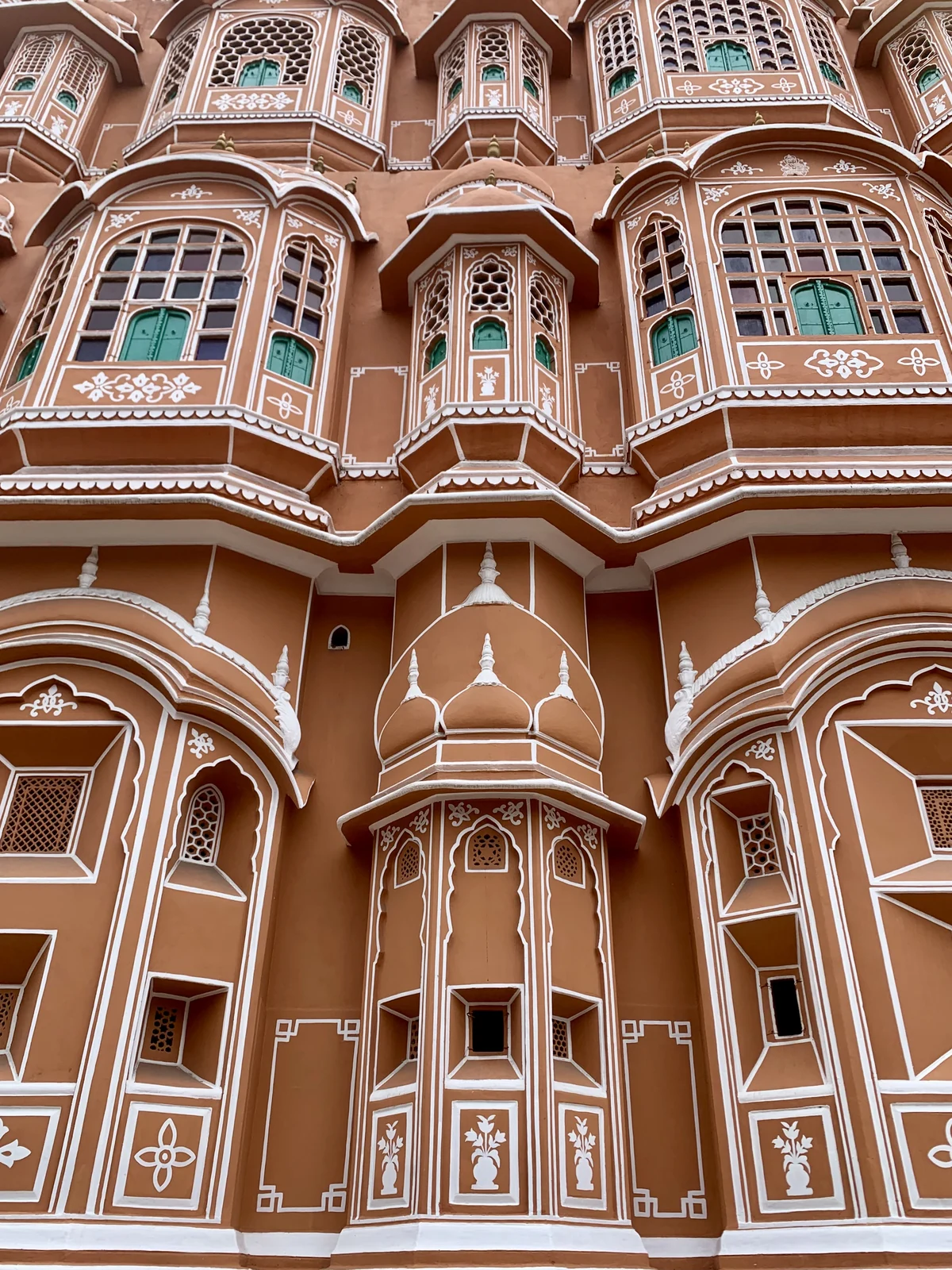
Sawai Pratap Singh commissioned Hawa Mahal in 1799. Rajasthan Tourism describes five floors with stone screens, small domes and latticed balconies. Start by looking at how those features repeat across the front. Then look for the differences between the levels, including where balconies project and where a screen sits within the line of the wall. The Ministry of Tourism counts 953 windows. The number gives a sense of how densely the openings are arranged.
The screens also explain why the building faces the street the way it does. They allowed royal women inside to watch festivities below. From a public spot where you can pause comfortably, follow a row of screened openings with your eyes and think about the view down from that level. Looking at the façade in relation to the street makes the screens’ purpose easier to understand, even on a day when you only have time for an exterior stop.
Treat the street view and an interior visit as two planning choices. If you want to go inside, confirm where visitors enter and which levels are open before allowing time for the stop. For anyone who needs to avoid stairs, check access to the specific level or viewing area they are interested in. The building’s five floors describe the architecture, and a current visitor notice or staff member can tell you which areas your group can reach.
Choose what to see at City Palace
Sawai Jai Singh II, Jaipur’s founder, conceived and built the City Palace complex within the walled city. Walking toward it after Hawa Mahal brings the palace into the same frame as the markets and temples described in the heritage walk. At the palace, decide what you want admission to cover. If you came for the museum’s historic clothing, use Mubarak Mahal as the specific building to ask about when checking the ticket.
Rajasthan Tourism identifies shawls, silk saris and embroidered textiles among the museum’s holdings in Mubarak Mahal. The City Palace Museum announced the temporary closure of the Textile Gallery for restoration from 27 March 2026. When checked for this guide, the operator still carried the notice. Ask the museum what is open for your date if the textiles are the main reason for your visit.
The museum’s visitor page lists wheelchair access at major entrances and accessible restrooms. Ask where ramps are available on the specific route you intend to use and whether your group can exit to a mutually convenient meeting point. If some people are staying outside, pick a public landmark everyone can identify without passing through the ticket counter.
Make sense of Jantar Mantar’s instruments
Jantar Mantar is an early eighteenth-century astronomical observatory. India’s Ministry of Tourism dates its instruments to 1728–1734, and UNESCO describes roughly 20 principal instruments. The masonry structures enabled observers to make astronomical measurements without telescopes. Their scale is one of the first things you notice. Spend some of your visit looking for the surfaces, edges and markings that made a structure useful for measurement.
A way to start is to read the panel for one instrument, identify the part the text refers to and look back at the structure before moving to the next one. If a panel explains a scale or sight line, try to locate it from the permitted visitor area. Give yourself time to do that with a few instruments. If clouds limit what you can see of any shadow-based feature, use the diagrams and the visible geometry to follow the explanation.
UNESCO lists the observatory separately from the walled city. If you find visitor information under ‘Jaipur City’ while checking your walk, search specifically for ‘Jantar Mantar, Jaipur’ to find information about entering the observatory. For a visit focused on how the instruments work, check what interpretation is available on your day and in the language you want. That detail can matter more to your experience than planning to stop at every instrument.
Check hours, admission and access for your date
| Stop | Published information | What to confirm before you go |
|---|---|---|
| Hawa Mahal | Rajasthan Department of Archaeology and Museums provides government ticketing | Select the monument and confirm opening and last entry for your date |
| City Palace Museum | Museum tour 9:30 am to 6:30 pm, with tickets sold until 6 pm | Gallery closures, ticket type and seasonal changes |
| Jantar Mantar | Rajasthan Tourism lists 9 am to 7 pm with the last ticket at 6:30 pm | Date-specific closures and whether the same ticket window applies |
The City Palace operator posts a Dhulandi closure and a separate temporary suspension of its night museum program. Read the hours for the particular visit you want. City Palace day tickets and Rajasthan’s government ticketing for monuments are different channels. In the government portal, select the named monument and date before relying on an advertised booking window.
Check opening and last admission separately for each interior stop. Start with the attraction’s official visitor information or the operator’s ticketing page and look for a notice that covers your date. If the posted hours lack a date or two official notices disagree, contact the operator or ask at the ticket counter before basing the rest of the walk on that entry. For a same-day visit, check again before heading over if you have seen a closure notice or a change to normal hours.
If you are planning from the US or elsewhere abroad, read the admission window against the calendar date in Jaipur. Put that local date on any booking you make and check whether the time given refers to a slot, the closing of the ticket counter or the closing of the grounds. Leave enough time for the visit you want after entering. Getting through the gate just before last admission could still leave little time to see a museum display or read the observatory panels.
If Jantar Mantar’s last entry on your date would leave very little time after the palace museum, use the observatory admission window to set your order. You could visit it first, then continue to the palace if that museum’s own schedule works, and see Hawa Mahal from the street when you reach it. Check each entrance again when reversing the route. The way a map sends you out of a site can depend on which gate you used to come in.
If you are travelling with someone who needs step-free access, ask about the approach from the street, the ticket counter and the specific gallery or viewing area in the same enquiry. A usable entrance answers only one part of that trip. If photography is a priority, check the rules for the particular space you will enter and the equipment you intend to bring, especially if you are planning to publish the images.
Decide whether to add Amber Fort
Make Amber Fort a separate outing when planning from this walk. Amber is one of six components of UNESCO’s Hill Forts of Rajasthan listing. UNESCO uses the group to illustrate how Rajput states used terrain and substantial fortifications, with settlements and significant community buildings within some of the enclosures. At Amber, that framing gives you a reason to look at how the fort sits in the landscape. In the walled city, the features to look for are the grid, the market streets and the squares that organise movement through the centre.
If you are choosing between adding Amber and spending longer in central Jaipur, decide what you would give up in the centre. An extra stretch of bazaar gives you more time to see how the street fronts work, while a longer observatory visit gives you time to read the instruments. To judge whether Amber fits as well, check transport and admission for that outing on their own terms, including the time needed to get from your drop-off point to the visitor entrance.
Sources
- Incredible India | Jaipur
- UNESCO World Heritage Centre | Jaipur City, Rajasthan
- Rajasthan Tourism | Jaipur Heritage Walk
- Rajasthan Tourism | City Palace, Jaipur
- UNESCO World Heritage Centre | Jantar Mantar, Jaipur
- UNESCO World Heritage Centre | Hill Forts of Rajasthan
- City Palace Museum | Opening hours, tickets and access
- Rajasthan Tourism | Jantar Mantar opening hours
- Rajasthan Department of Archaeology and Museums | Monument tickets
- National Informatics Centre Rajasthan | Hawa Mahal visitor entrance