Three Chandrayaan missions, three outcomes
India’s first Moon mission, Chandrayaan-1, recorded surface signatures of hydroxyl and water, and Chandrayaan-2 returned orbital science data after its landing attempt failed. Chandrayaan-3 made India’s first lunar soft landing on 23 August 2023, and its rover detected sulphur locally and gathered measurements that researchers interpreted as evidence of ancient lunar crust.
The three missions carry the same name because they belong to India’s lunar exploration programme, but their scientific records come from different vantage points. An orbiter can survey terrain from above, while a rover can measure the chemistry of material where it stops. The first approach gives scientists geographic context. The second ties a measurement to a particular patch of ground. Even an element detected with confidence at one stop may be unevenly distributed elsewhere.
Dates matter because launch, arrival at the surface, collection of measurements and publication each answer a different question. Chandrayaan-3’s August 2023 landing marks the engineering milestone. The 2024 paper based on rover measurements marks the publication of a geological interpretation. When a headline gives a date for a discovery, check whether it refers to the measurement, a preliminary announcement or the paper that explains the finding.
| Mission | Key dates | Science record |
|---|---|---|
| Chandrayaan-1 | Launched 22 October 2008. Communications lost 29 August 2009. | Moon Mineralogy Mapper spectra showed hydroxyl and water signatures. Mini-SAR investigated radar signatures consistent with ice. |
| Chandrayaan-2 | Launched 22 July 2019. Landing attempt targeted 7 September 2019. | The soft landing was unsuccessful. The orbiter carried eight experiments and later released science data. |
| Chandrayaan-3 | Launched 14 July 2023. Soft-landed 23 August 2023. | Pragyan detected sulphur locally and measured elemental abundances used to infer the composition of nearby highland material. |
- ISRO Chandrayaan-1 science and measurements
- ISRO Chandrayaan-2 science and orbiter records
- ISRO Chandrayaan-3 mission timeline
- ISRO initial rover spectroscopy record
- PRL and ISRO APXS Nature paper 2024
- ISRO spacecraft mission register
- ISRO report on future Venus and lunar mission approval
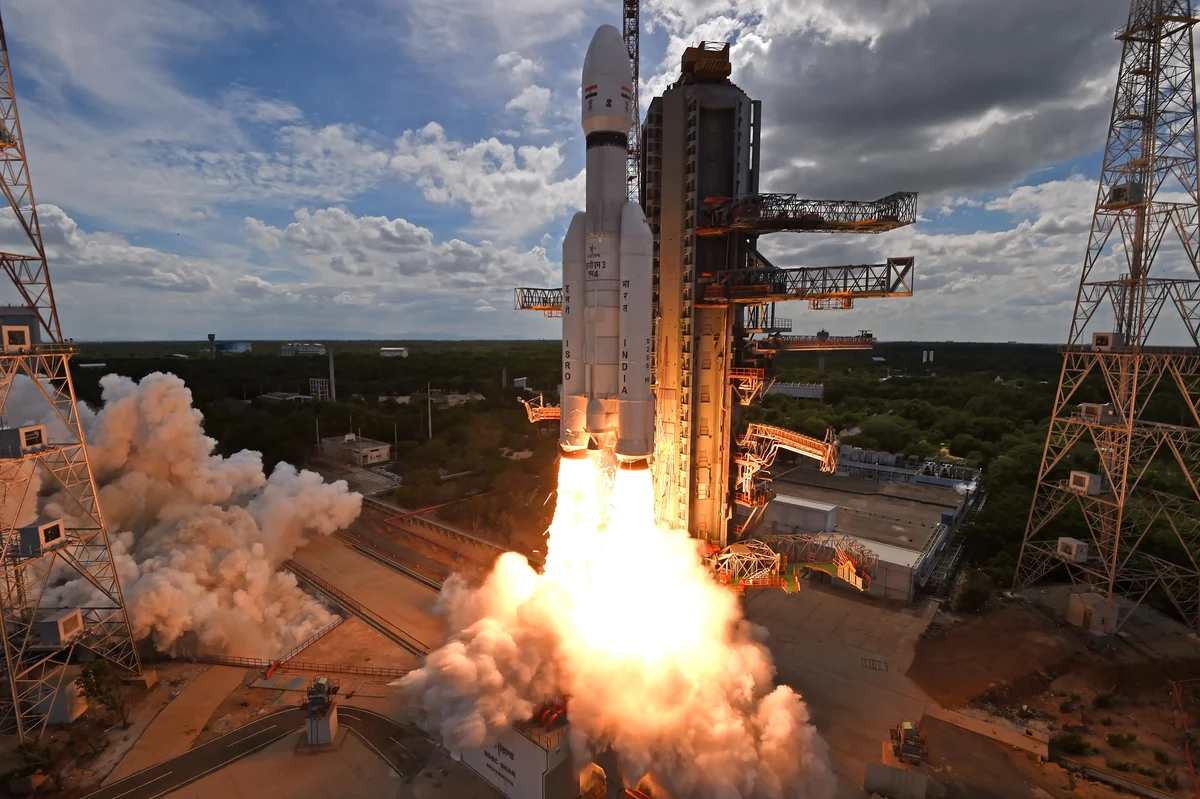
- ISRO documentary photograph of the Chandrayaan-3 launch
Chandrayaan-1 and the evidence for lunar water
Chandrayaan-1 launched on 22 October 2008 with the Moon Mineralogy Mapper, a NASA instrument also called M3. It measured reflected light at different wavelengths. Certain molecules and chemical bonds absorb light in characteristic parts of a spectrum, leaving features that researchers can identify. M3 recorded surface spectral signatures of water and hydroxyl. Hydroxyl consists of oxygen bonded to hydrogen, so the two names describe related forms of chemistry with distinct meanings.
The spectral result tells scientists something about the material interacting with light at the lunar surface. Its scope is the chemical signature. The observation supplies no measurement of a liquid reservoir, and there was no laboratory analysis of a sample brought to Earth. The instrument name is useful when a headline simply says that India found water. Looking up M3 takes you to the evidence behind the wording and helps you see why scientists describe it in terms of surface chemistry.
Another Chandrayaan-1 instrument, Mini-SAR, investigated permanently shadowed craters with radar. Radar sends out its own signal and measures the return, so it can examine terrain that receives no direct sunlight. The instrument looked for patterns consistent with ice. The phrase “consistent with” matters because a radar return is an indirect clue and its interpretation depends on how the terrain scatters the signal. A radar result from a shadowed crater answers a different question from a molecular signature in reflected light. To read either claim accurately, keep the instrument, the terrain and the observed signal together.
Chandrayaan-2’s orbiter and landing attempt
Chandrayaan-2 launched on 22 July 2019 and targeted 7 September for its landing attempt. The attempt failed to achieve a soft landing. The orbiter had its own flight and science objectives, and its eight experiments went on to produce a science record. ISRO subsequently released orbital data. Describing the outcome by component preserves both facts and makes it clear which part of the spacecraft collected later observations.
A mission register and a science archive serve different purposes here. ISRO’s spacecraft mission register is the place to check the launch entry and the status it lists for the orbiter. The Chandrayaan-2 science material and initial data archive are the places to establish what observations were released. A release documents the availability of a body of data at that point. It gives limited information about which instruments are operating today or whether a newer set of observations has become available.
If a later article describes a Chandrayaan-2 measurement, the practical question is which instrument supplied it. Start with the mission’s science material and look for the named experiment in the archive. Then check the observation date separately from the release date where the record provides both. That sequence lets a reader establish whether the article is reporting newly acquired observations or drawing a fresh conclusion from existing measurements. Both can produce news years after launch, even when the landing attempt remains the date most people remember.
Where Chandrayaan-3 landed
Chandrayaan-3 launched on 14 July 2023. Its three components were a propulsion module, the Vikram lander and the Pragyan rover. Vikram made a soft landing on 23 August at a site in the Moon’s southern high latitudes. India became the fourth country to achieve a lunar soft landing, after the Soviet Union, the United States and China. The propulsion module, lander and rover have distinct roles in the mission record, so names matter when assigning a result to a spacecraft or instrument.
NASA places the landing site approximately 600 kilometres from the geographic lunar south pole. The geographic pole is a specific point, while southern high latitudes describe a wider area. That distance gives useful context to a map or headline that says the landing was near the pole. It also helps explain why a result obtained beside Vikram applies to that landing area. Claims about ice in a particular permanently shadowed crater require evidence tied to that crater.
NASA’s Lunar Reconnaissance Orbiter imaged the site four days after landing. The image shows a central lander shadow and a halo of disturbed regolith, the loose material covering the surface. Its value is geographic and visual. It helps readers locate the spacecraft and see a change in the ground around it. A question about what elements are present calls for the rover’s spectroscopy records, since variations in brightness in the orbital photograph do not identify the chemistry of the material.
What Pragyan measured at the surface
In August 2023, ISRO reported that Pragyan’s Laser-Induced Breakdown Spectroscope, or LIBS, identified sulphur and other elements in material at the landing area. The instrument uses a laser to excite a small amount of material and reads the light emitted. Characteristic wavelengths reveal which elements are present. This was an initial report about local chemistry. Sulphur is a finding in its own right, and its detection alone does not establish the presence of water ice.
A separate study published in Nature in 2024 used the rover’s Alpha Particle X-ray Spectrometer, or APXS. It drew on 23 readings taken directly on the Moon along Pragyan’s local traverse. The researchers inferred a broadly uniform composition dominated by ferroan anorthosite, a rock type associated with the lunar highlands. They also discussed magnesium-rich material. The number 23 describes the set of readings in the paper, and the traverse defines the area over which the researchers could compare them.
The ferroan anorthosite result supports an interpretation in which early in the Moon’s history a large body of molten rock cooled and separated into materials of different composition. Relatively light minerals could rise and help form the early crust. Finding broadly similar highland material along the rover’s route is consistent with that account. A local traverse leaves room for variation beyond the landing area, and the researchers based their inference on readings made on the surface. A returned specimen would allow laboratory methods that this instrument record cannot provide.
| Record | Instrument or archive | What the observation supplies |
|---|---|---|
| Chandrayaan-1 spectra | Moon Mineralogy Mapper (M3) | Spectral signatures of hydroxyl and water at the surface |
| Chandrayaan-1 shallow ice evidence | Mini-SAR | Radar signals consistent with ice in permanently shadowed crater areas |
| Chandrayaan-3 local sulphur | Pragyan LIBS | In situ elemental observations reported in August 2023 |
| Chandrayaan-3 local highland composition | Pragyan APXS | 23 in situ elemental readings reported by researchers in 2024 |
How to verify a finding in the science archive
ISRO released Chandrayaan-3 science data on 23 August 2024, one year after landing. The release directs readers to the Indian Space Science Data Centre, or ISSDC, where the data are shared in the Planetary Data System version 4 format, known as PDS4. Start with the release for the route to the archive, then identify the instrument behind the claim. The date on the release establishes when this archive release took place. Consult the archive itself for the products it currently lists.
Imagine a report says that the rover found the ancient material from which the Moon’s crust formed. Start with the Nature paper and check what APXS recorded, how many locations were represented and how the authors got from elemental abundances to a rock type. The measurement supports an inference about anorthosite, which in turn supports a model for how the crust formed. Reading those steps in order preserves the distinction between the strength of the measurements and the broader interpretation they support.
For a claim about the first report of sulphur, start instead with ISRO’s August 2023 LIBS announcement. Its wording gives you the preliminary finding and the instrument that produced it. When you compare a release, an archive product and a paper, record their dates and what each one establishes. That makes it possible to update a reference if the archive expands or a later study revises a geological inference while keeping the original observation and its date intact.
What Chandrayaan-4 and LUPEX are meant to do
ISRO’s 2025–26 annual report describes Chandrayaan-4 as a forthcoming Indian lunar sample-return mission approved in September 2024. Its objective is to bring lunar material to Earth. A returned sample would let researchers apply laboratory techniques and revisit the material as analytical methods improve. Government approval, launch, collection and successful return are distinct milestones. The approval establishes the programme and its objective. Any claim that material has been recovered would require a separate mission record.
Chandrayaan-5, also called LUPEX, is a partnership with the Japan Aerospace Exploration Agency, or JAXA, to study lunar polar volatiles. ISRO’s annual report records financial sanction on 10 March 2025. Volatiles include substances such as water that can change phase as conditions change. Investigating how they occur in polar terrain addresses a different scientific question from bringing a specimen back to Earth. The partnership and its science objective are useful identifiers when update notices use LUPEX and Chandrayaan-5 in different places.
To check a new milestone, look for a dated mission update from ISRO and, for LUPEX, the corresponding JAXA account. Match the verb to what the agencies actually report. An approval or funding decision establishes a commitment, while a launch announcement or completed mission event supplies a different kind of record. The annual report supports the programme milestones above and supplies no launch date for either mission.
Inventions and discoveries from India, from zero to UPIIndia semiconductor projects, factory status and capacity
Sources
- ISRO Chandrayaan-1 science and measurements
- ISRO Chandrayaan-2 science and orbiter records
- ISRO Chandrayaan-3 mission timeline
- NASA LRO landing site dated image report
- ISRO initial rover spectroscopy record
- PRL and ISRO APXS Nature paper 2024
- ISRO public Chandrayaan-3 scientific data archive release
- ISRO 2025–26 progress report on Chandrayaan-4 and LUPEX
- ISRO Chandrayaan-1 official mission page
- ISRO spacecraft mission register
- ISRO report on future Venus and lunar mission approval
- ISRO documentary photograph of the Chandrayaan-3 launch
