Obama’s two presidential visits to India
Barack Obama visited India twice as U.S. president, travelling to Mumbai and New Delhi on 6–9 November 2010 and to New Delhi on 24–27 January 2015. During the first trip he backed India for permanent membership in a reformed U.N. Security Council, and during the second he became the first U.S. president to serve as India’s Republic Day chief guest.
Obama was also the first sitting U.S. president to visit India twice. That distinction concerns presidential travel, so the State Department’s Office of the Historian is the starting point for the count. Its register gives cities and itinerary ranges, while the White House’s event records let you identify the day of a particular speech or appearance. Dates here use local time.
For the second trip, the official travel range begins on 24 January and the dated public events in New Delhi begin on 25 January. Those dates answer different questions. Use 24–27 January when referring to the itinerary as a whole, and use the local event date when identifying a statement, a photograph or a public appearance.
The itinerary also provides a geographical check on the timeline. Mumbai belongs to the first presidential trip. New Delhi appears in both, so a caption or speech excerpt that identifies only the capital still needs a venue or a year. The June 2016 Obama–Modi meeting belongs to the wider policy chronology and took place in Washington.
| Date | Place | Event | First record to open |
|---|---|---|---|
| 6 November 2010 | Mumbai | Memorial at Taj Mahal Palace Hotel | White House memorial video |
| 7 November 2010 | Mumbai | Student and youth town hall with Barack and Michelle Obama | White House town hall transcript |
| 8 November 2010 | New Delhi | Joint session of Parliament | Parliament speech transcript |
| 8 November 2010 | New Delhi | Meeting and statement with Manmohan Singh | Obama–Singh joint statement |
| 30 September 2014 | Washington, DC | Modi’s U.S. visit | Obama–Modi joint statement |
| 25 January 2015 | New Delhi | Hyderabad House talks and Asia-Pacific and Indian Ocean vision | Joint press remarks and separate joint vision |
| 26 January 2015 | New Delhi | Republic Day parade and business events | Pete Souza photograph and Business Council transcript |
| 27 January 2015 | New Delhi | Siri Fort public address and Mann Ki Baat broadcast | Two separately published White House transcripts |
| 7 June 2016 | Washington, DC | Record of progress following the earlier roadmaps | 2016 joint statement |
6–7 November 2010 in Mumbai
On 6 November 2010, Barack and Michelle Obama were at the Taj Mahal Palace Hotel in Mumbai, where the president remembered the victims of the 2008 Mumbai attacks and spoke about ties between the United States and India. The White House preserved a dated video of the memorial remarks. The two years matter in captions and references because 2008 dates the attacks and 2010 dates the presidential commemoration.
The full venue name resolves an ambiguity in references to Obama at the Taj. The Mumbai record names the Taj Mahal Palace Hotel. The Taj Mahal mausoleum is in Agra, while the Taj Palace Hotel in New Delhi appears in the separate record of Obama’s January 2015 business summit. For a photograph or quotation with an abbreviated venue, check the city alongside the date before assigning it to the itinerary.
On 7 November, both Barack and Michelle Obama spoke at a Mumbai town hall with students and young people. At that gathering the president referred back to their visit to Gandhi’s Mani Bhavan and to his conversation with survivors of the attacks. The town hall transcript is therefore a source for what he said about those experiences, as well as a record of the youth event itself.
The two Mumbai records serve different purposes. Use the memorial video for a reference to Obama’s remembrance at the hotel. Use the town hall transcript to attribute remarks from the youth gathering, especially if the speaker was Michelle Obama. A reference to Mani Bhavan inside the transcript gives context for the remarks and leaves the town hall as the event at which the words were spoken.
8 November 2010 in New Delhi
Obama addressed a joint session of India’s Parliament on 8 November. His statement on the U.N. Security Council expressed U.S. support for India as a permanent member in a reformed council. The qualification about reform belongs in any accurate account of the position. The address established what the president publicly supported, and the speech itself conferred no seat.
Prime Minister Manmohan Singh and Obama also issued a joint statement dated 8 November. It set out a strategic partnership spanning security, clean energy and science, among other areas. On nuclear policy, the statement referred to cooperation that already existed and addressed future implementation. It provides a record of the two governments’ commitments at the time, with implementation as a separate question.
The White House partnership fact sheets add detail in fields including the economy, technology, agriculture, education and clean energy. Their value is in showing where the broad partnership had specific announced areas of work. For a question about agriculture, for instance, the 2010 fact sheets give a more direct starting point than the parliamentary address. A question about delivery requires records from the period after the announcement.
The same date can thus appear with several titles in an archive. Use the Parliament transcript for the Security Council position, the Obama–Singh statement for the jointly expressed policy and the fact sheets for the scope of the announced commitments. Matching the claim to the right record preserves the distinction between a U.S. presidential position and a commitment recorded by both governments.
For a specific clean energy claim, the 8 November fact sheets identify the Partnership to Advance Clean Energy by name and describe the work on energy access, research and deployment. This is a more precise reference than citing every announcement to the parliamentary speech. The same visit produced both a public diplomatic address and documents about named programmes.
September 2014 and January 2015 policy talks
The next milestone in this account came on 30 September 2014, when Obama and Prime Minister Narendra Modi issued a joint statement during Modi’s visit to Washington. Its treatment of energy cooperation and its commitment to fully implement the civil nuclear agreement provide a dated bridge between the two presidential trips. The location explains why this Obama–Modi meeting appears in the policy timeline while the India travel count stays at two.
In New Delhi on 25 January 2015, Obama and Modi spoke at Hyderabad House. Modi described a recently reached understanding on civil nuclear issues. The sequence of documents gives that development its context. The 2010 Obama–Singh statement recognised existing nuclear cooperation, the September 2014 statement called for full implementation, and the January 2015 remarks recorded an understanding on implementation. Each is evidence of a distinct stage in the same policy area.
The January joint statement covered a wider agenda than the remarks on nuclear cooperation. It introduced a strategic and commercial dialogue and set out cooperation in areas including trade, clean energy and education. The joint statement is the appropriate source for the bilateral agenda. The Hyderabad House remarks are useful when attributing the description of the nuclear understanding to Modi.
A separate joint strategic vision issued on 25 January addressed the Asia-Pacific and Indian Ocean. It dealt with regional cooperation, navigation and prosperity. Its geographic focus distinguishes it from the broader bilateral statement issued that day. Use the vision for what the governments said about the region and consult the text of any specific agreement before assigning legal or treaty obligations to that language.
Republic Day and the public events of 26–27 January 2015
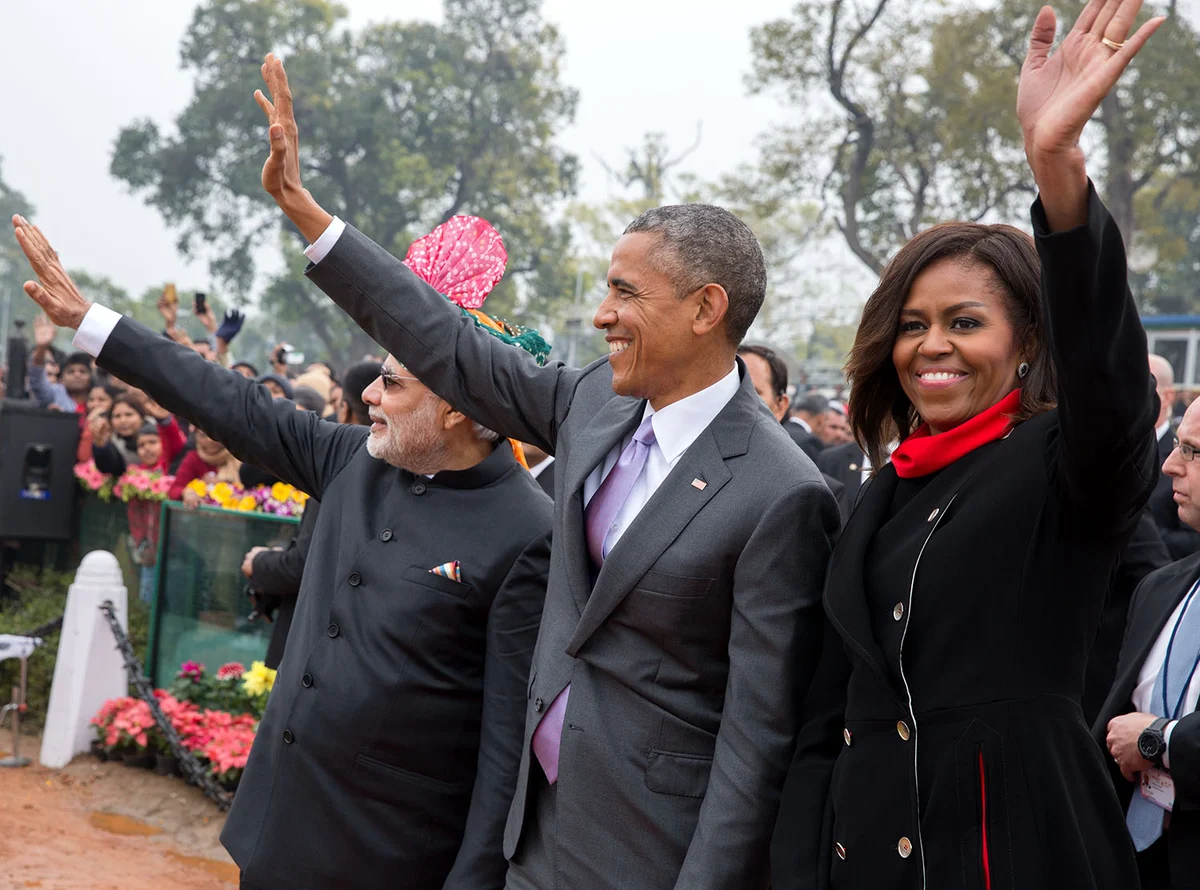
Obama attended India’s Republic Day in New Delhi as chief guest on 26 January. The official photograph taken by White House photographer Pete Souza identifies Barack Obama, Michelle Obama and Narendra Modi waving following the Republic Day parade. For that image, the relevant caption date is 26 January and the setting is the parade. The earlier Hyderabad House talks have their own records dated 25 January.
The daytime celebrations shared a date with business events. Obama gave evening remarks at the U.S.–India Business Council summit at the Taj Palace Hotel in New Delhi. The White House also recorded a CEO roundtable that day as a separate event. An account citing the summit speech should identify the summit by name, since a reference to a meeting with business leaders on 26 January could point to either record.
On 27 January, Obama addressed the people of India at Siri Fort Auditorium in New Delhi. The full venue identifies this as the public address from the second trip. The parliamentary address associated with his Security Council statement took place on the first trip, in November 2010. Both have New Delhi datelines, which makes the venue or full date valuable when identifying a clip.
Obama and Modi also participated in a joint Mann Ki Baat radio programme that aired on 27 January. For the radio appearance, use the programme name and the public airing date. For the address at Siri Fort, use the auditorium and the date. The format and participants resolve a reference that gives only the day, when both records might otherwise fit.
India Republic Day on 26 JanuaryThings to do in Delhi: one, two and three-day itineraries
- 25 January 2015 joint statements at Hyderabad House
- Business Council Summit, New Delhi, 26 January 2015
- Public address to people of India, 27 January 2015
- Joint radio address, 27 January 2015
- Pete Souza White House photograph, Republic Day, 26 January 2015
- Official White House recap of January 2015 travel
- Obama and Modi at the CEO Roundtable, 26 January 2015
June 2016 follow-up and how to verify policy progress
Obama and Modi met again in Washington, where their joint statement of 7 June 2016 described progress on the agenda developed in Washington in 2014 and New Delhi in 2015. It gives the timeline a later checkpoint from the same presidency. The statement records the governments’ account of progress as of that meeting, so attribute any reported development to the dated statement and its specific policy area.
For a claim that the civil nuclear agreement had been fully implemented by January 2015, start with Modi’s Hyderabad House remarks and check the wording about the understanding. Then compare the specific issue with the June 2016 statement. If the claim concerns a particular project becoming operational, look for a dated record that identifies the project and milestone, such as a publication from the responsible agency or the organisations involved. An understanding, an agency action and an operating project each require their own evidence.
Apply the same date discipline to the Security Council reference. The Parliament transcript is the source for the position Obama expressed in 2010. If the question is who holds permanent seats today, check the U.N.’s current Security Council membership and the relevant Charter provisions. To report a subsequent change, identify the official record and effective date before connecting it to earlier diplomatic support.
For the historical itinerary, the strongest cross-check is a dated event transcript or photograph read alongside the official travel register. For a policy claim, match the verb in the account to what the document establishes. A report that leaders discussed an issue, announced a commitment or recorded progress refers to a different milestone each time. Keep the location with the date so Washington follow-ups retain their place without being mistaken for events in India.
India–U.S. relations and the latest trade developments
- Obama White House Archive: November 2010 Partnership Fact Sheets
- Obama White House Archive: January 2015 Joint Statement
- Office of the Historian, Barack Obama travels as president
- White House archive, address to joint session of Parliament, 8 November 2010
- Joint Obama–Singh statement, 8 November 2010
- Joint Obama–Modi statement in Washington, 30 September 2014
- 25 January 2015 joint statements at Hyderabad House
- Joint strategic vision for Asia-Pacific and Indian Ocean, 25 January 2015
- Public address to people of India, 27 January 2015
- Joint radio address, 27 January 2015
- 7 June 2016 Obama–Modi statement in Washington
- Pete Souza White House photograph, Republic Day, 26 January 2015
Sources
- Obama White House Archive: November 2010 Partnership Fact Sheets
- Obama White House Archive: January 2015 Joint Statement
- Office of the Historian, Barack Obama travels as president
- White House archive, Mumbai memorial, 6 November 2010
- White House archive, Mumbai student town hall, 7 November 2010
- White House archive, address to joint session of Parliament, 8 November 2010
- Joint Obama–Singh statement, 8 November 2010
- Joint Obama–Modi statement in Washington, 30 September 2014
- 25 January 2015 joint statements at Hyderabad House
- Joint strategic vision for Asia-Pacific and Indian Ocean, 25 January 2015
- Business Council Summit, New Delhi, 26 January 2015
- Public address to people of India, 27 January 2015
- Joint radio address, 27 January 2015
- 7 June 2016 Obama–Modi statement in Washington
- Pete Souza White House photograph, Republic Day, 26 January 2015
- Official White House recap of January 2015 travel
- Obama and Modi at the CEO Roundtable, 26 January 2015
