India current affairs for 22–26 November 2026
India’s confirmed developments for 22–26 November 2026 include the launch of the Ayodhya–Janakpur rail link during Nepal Prime Minister Balendra Shah’s visit, five Cabinet and CCEA decisions totalling ₹19,934 crore on the government’s briefing slide, the November RBI Bulletin and the scheduled 26 November Constitution Day observance. The official records reviewed did not verify a late-November Union Cabinet reshuffle, and the PMO portfolio reference is dated 25 July 2026.
Start with the date that answers your question. For the Nepal visit, the 23 November joint release describes events across two days. For the Cabinet items, 25 November is the decision date linked to the approvals. For Constitution Day, the ministry notice appeared on 25 November and named 26 November as the observance date. These distinctions let you put a story in sequence even when several records appear on the same day.
| Date | Development | What the record establishes |
|---|---|---|
| 22–23 November 2026 | Balendra Shah’s state visit to India | First visit to India in office |
| 23 November 2026 | India–Nepal joint release | Records the leaders’ talks and the inaugural Sarayu-Kamala Express flag-off |
| 25 November 2026 | Cabinet and CCEA briefing | Lists five decisions with a combined slide subtotal of ₹19,934 crore |
| 25 November 2026 | November RBI Bulletin | Publication of the monthly bulletin, including four research articles |
| 26 November 2026 | Samvidhan Diwas | Observance date named in the Parliamentary Affairs ministry’s 25 November notice |
The timeline gives you the national developments covered by this briefing. Use the more specific record when the question turns on what happened next. The joint release establishes the first flag-off, while a future journey has its own date and availability. The Cabinet briefing establishes a decision and gives the figures used that day. Its figures are most useful alongside the individual releases, where terms such as estimated cost, proposed outlay and capacity after completion explain what each number measures.
How to check whether India’s Cabinet was reshuffled
The 25 November briefing records decisions issued by the Union Cabinet and the Cabinet Committee on Economic Affairs, or CCEA. A reshuffle question concerns who holds a ministerial post or which portfolio a minister is assigned. To confirm that change, look for a dated official announcement that identifies the minister and the assignment, or an official portfolio record that shows the relevant change. The briefing’s five entries concern manufacturing, a port terminal, an airport and two postal items.
Use the PMO portfolio page as a dated baseline. It says “As on 25 July 2026,” which is the date to give if you use it to describe a minister’s assignment. Finding that page in a search in November says when you found it. Its own date tells you the period it describes. If you locate a subsequent official notice, check whether it names the same person, ministry and role that the headline refers to. A notice about one assignment supports a claim about that assignment. Describing a wider reshuffle requires evidence for its wider scope.
Suppose a forwarded headline says a reshuffle happened on 25 November and points to the Cabinet slide. Open the slide and look for the named minister or portfolio. If the attachment only shows the five approvals, it substantiates the decisions in the briefing. Record the reshuffle claim as unverified in the material reviewed and look for a separate portfolio notice. If an announcement gives an effective date, retain that date alongside the publication date.
What the ₹19,934 crore Cabinet subtotal covers
Page 2 of the 25 November briefing lists ₹11,000 crore for CIE manufacturing, ₹4,288 crore for the second Kamarajar Port container terminal, ₹2,014 crore for the Doloo airport project, ₹1,141 crore for Postal Operations and ₹1,491 crore for postal Estates Management. Those five amounts add up to ₹19,934 crore as displayed. The manufacturing entry is the largest single line and accounts for more than half of the subtotal. Keep the subtotal tied to those five entries and the date of the briefing.
The port release gives an estimated ₹4,288.26 crore including GST, while the briefing rounds the entry to ₹4,288 crore. Use the briefing’s figures when reproducing its subtotal, and use the detailed figure when describing the port project on its own. The Postal Operations release describes its ₹1,141 crore as a proposed outlay covering several financial years. Putting every figure in crore makes the lines easy to add. The wording in each release still matters for understanding the type and timing of the amount.
Postal Operations is a continuation decision for FY2026–27 through FY2030–31. Its stated scope includes parcels and mail, rural connectivity, international mail and digital services. A sender who needs to price a parcel or find a delivery estimate should check the applicable postal service information for the parcel and destination. The scheme announcement supplies the programme period and scope. For postal Estates Management and CIE manufacturing, the figures in the briefing are the details established here. Project-level claims about either item require the corresponding decision text.
What was approved at Doloo and Kamarajar Port
The CCEA approved Airports Authority of India development of a greenfield airport at Doloo in Assam’s Cachar district on 25 November. The estimated cost is ₹2,014 crore. The project is intended to address constraints at the existing Silchar airport. Plans call for a terminal of 12,351 square metres designed for 800 passengers at peak hour. That figure describes the proposed terminal’s design throughput. The approval gives neither an opening date nor a new flight route, so a reader arranging travel should check flights serving the existing airport on the date needed.
In Tamil Nadu, the CCEA approved a second container terminal at Kamarajar Port. The design-build-finance-operate-transfer public-private partnership combines responsibility for designing, building, financing and operating the terminal before transfer. The plan covers two phases and aims for annual capacity of 2 million twenty-foot-equivalent units after completion. A twenty-foot-equivalent unit, or TEU, expresses container capacity in units equivalent to a twenty-foot container. Keep the words “after completion” with the figure. The approval describes what the project aims to provide once built.
The two capacity figures answer different questions. Doloo’s measures how many passengers the proposed terminal is designed to handle during a peak hour. Kamarajar’s measures annual container-handling capacity in a standard freight unit. If a later report gives actual traffic, check that it identifies the same facility and specifies the period measured. A count for the existing airport or for the whole port would describe a different facility or scope from the figures in these approvals.
What happened during Nepal’s state visit
Balendra Shah made his first visit to India as Nepal’s prime minister on 22–23 November. The joint release records talks with Narendra Modi and the inaugural flag-off of the Sarayu-Kamala Express. The official flag-off album identifies the stations as Ayodhya Cantt and Janakpur Dham and describes a weekly service at launch. Use those station names when looking up the train, since the cities in the headline describe the connection more broadly.
The visit also produced outcomes at different stages. The foundation stone for the Lower Arun hydroelectric project marks a construction milestone. The state visit outcome release names Kandla and Paradip as additional ports for Nepal transit cargo and records an announced ₹15,000 crore development cooperation package. A description of the visit can report all three alongside the rail launch by keeping the relevant verb with each item. Electricity generation, the handling of a particular shipment and amounts disbursed under the package would each require a later record specific to that activity.
Consider a reader planning to travel from Ayodhya Cantt to Janakpur Dham the following month. The launch record gives the service name and stated weekly frequency. To choose a departure, look for an operator listing for the exact date, then check whether the train is bookable and whether seats are available. Consult the operator’s current guidance for travel-document questions before committing to the journey. The inauguration establishes that the first flag-off occurred, while the later checks establish whether the intended trip can be made.
India–Nepal relations, treaties, trade and the 2026 state visitMark Carney and India, visits, trade talks and verified milestones
How to read the November RBI Bulletin
The Reserve Bank of India released its November bulletin on 25 November. It includes four research articles covering the state of the economy, the drivers of imported inflation, a review of the non-bank finance sector at end-March 2026 and an event study of US monetary policy. The bulletin date tells you when the collection appeared. The end-March date in the sector review tells you the point in time that article examines. Keep both when describing the review in a briefing.
Choose the article that matches the question. Imported inflation is the place to start for analysis of how price pressures originating abroad can feed into domestic prices. The non-bank finance review is relevant for a sector snapshot at the stated cut-off. An event study examines what happens around identified events. Its inclusion gives readers research on US monetary policy, alongside the bulletin’s other analysis.
If a headline turns the bulletin into a claim that the RBI changed its policy rate on 25 November, look for the relevant Monetary Policy Committee decision. To report a change, verify the rate named, the level the decision sets and the date it applies. To report how members voted, use the record of that committee decision and its vote. The November bulletin release supports the publication date and research topics, so a briefing based on that release can describe those directly.
Constitution Day dates and anniversary counts
The Ministry of Parliamentary Affairs issued its notice on 25 November for the following day’s Samvidhan Diwas observance. Constitution Day marks the Constituent Assembly’s adoption of India’s Constitution on 26 November 1949. The Constitution’s ordinary commencement followed on 26 January 1950, the date commemorated by Republic Day. For a dated current affairs note, pair “adoption” with November and “commencement” with January. This also explains why the Constitution appears in two different annual observances.
Two counts apply to 26 November 2026. Subtracting 1949 from 2026 gives the 77th anniversary of adoption. The government magazine calls it the 12th Constitution Day observance, counting the annual observances from 2015 inclusive. A quiz asking for the anniversary of the adoption takes the first count. A question asking which annual Samvidhan Diwas the government marked in 2026 takes the second.
The notice also describes a MyGov preamble initiative in 23 languages, comprising English and 22 Scheduled Languages. The figure describes the languages offered by that initiative. If you are using the notice to prepare for an event or check how to participate, look for the current event or initiative listing. For an account of what took place on 26 November, look for a subsequent record of the observance. The notice establishes what the ministry announced ahead of the day.
Where to verify a changing current affairs detail
The Press Information Bureau’s ministry release archive groups dated releases by issuing government context. Search around the date of the claim and check the issuing ministry when several entries concern the same subject. Read far enough to find the operative wording. A release can be published on one day, describe a decision made on another and specify a later start. Keep whichever dates determine the meaning of the claim you are checking.
Digital Sansad’s Lok Sabha Questions and Answers archive is useful when you need to know what the government told Parliament. Find the question and the full reply, then identify the reply date and any separate reporting period in the text. If the answer gives a figure as of a particular date, carry that date with the figure when you cite it. For proceedings, use Lok Sabha Business to identify what was scheduled and look for a subsequent record of what the House did.
Suppose a headline says a bill became law and cites the day’s business papers. The papers can establish that the item was scheduled. Look for the later decision to establish what happened in the House and the enacted text before calling it law. If the reader’s question is when a provision begins to apply, check the applicable commencement wording as well. This sequence lets you update a briefing as each step is documented, with a date and a source appropriate to the status you report.
| Claim type | Source to open | What the document can establish |
|---|---|---|
| Cabinet decision list | 25 November government briefing | Subject, amount if specified and intended next step |
| Cabinet portfolio list | Prime Minister’s Office dated portfolio publication | The minister and assigned portfolio as of the document’s date |
| India–Nepal rail announcement | 2 governments and PMO visit statement | Inaugural flag-off and separately published service information |
| Central bank bulletin | Reserve Bank of India November bulletin | Publication date, article coverage and time series sources |
| Constitution Day observance | Ministry of Parliamentary Affairs notice | Date, organiser instruction and public context |
Sources
- Press Information Bureau: Ministry Release Archive
- Digital Sansad: Lok Sabha Questions and Answers
- Digital Sansad: Lok Sabha Business
- PMO joint release, Nepal prime minister's state visit
- PMO India–Nepal state visit outcomes
- Government of India 25 November signed-date Cabinet briefing
- India Prime Minister’s Office dated ministerial portfolio reference
- CCEA Doloo, Silchar greenfield airport approval
- CCEA Kamarajar Port second container terminal approval
- Cabinet continuation of the Postal Operations Scheme
- RBI Bulletin, November 2026
- Ministry of Parliamentary Affairs, Constitution Day
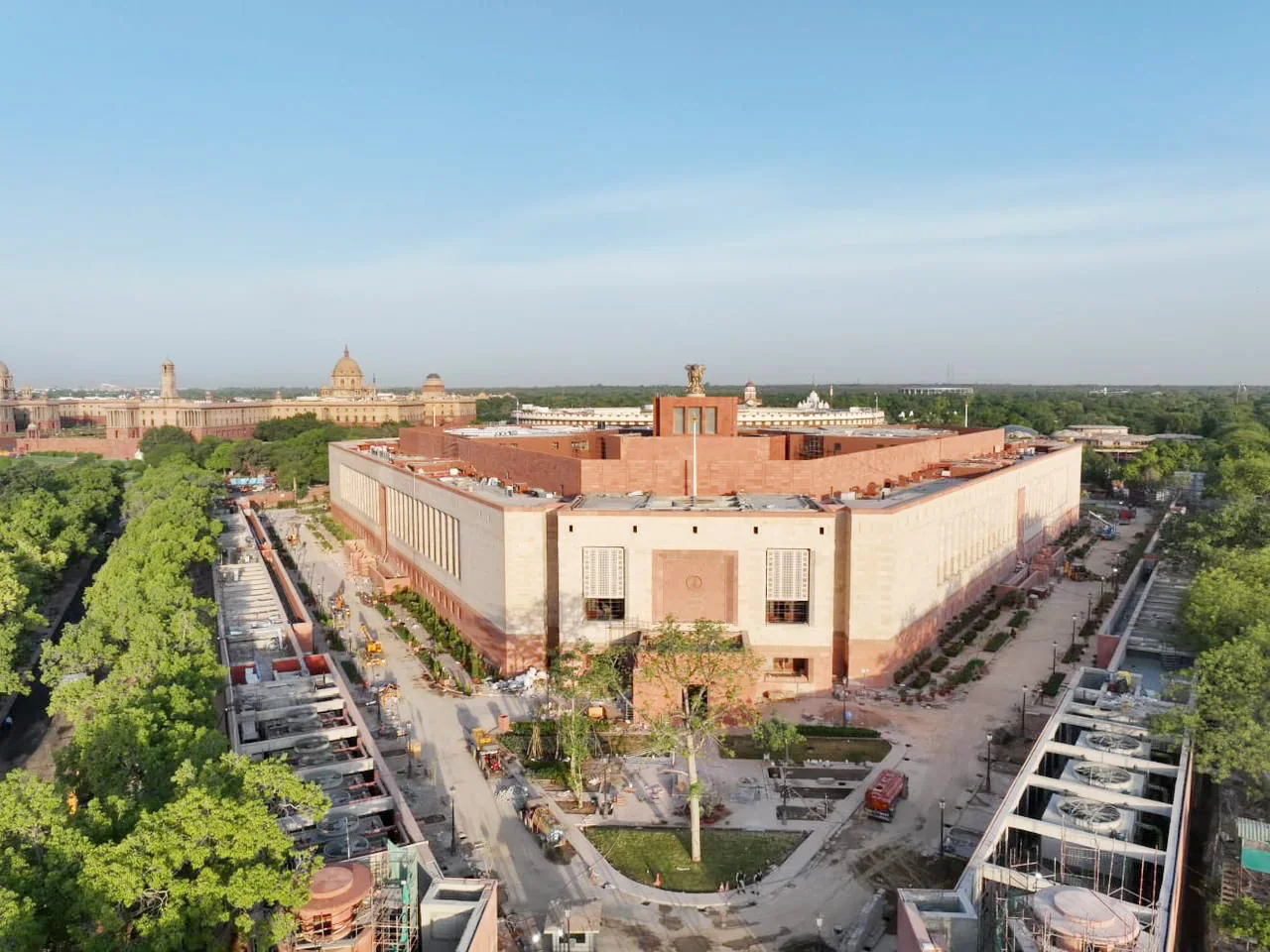
- Existing credited new Parliament building context image
