Where wolves live in India
Yes, India has wild grey wolves. They include the Indian wolf of semi-arid plains and other open landscapes and the Himalayan wolf of high-altitude country, which the Zoological Survey of India lists as the Tibetan grey wolf.
For the Indian wolf, Madhya Pradesh, Rajasthan, Gujarat and Maharashtra are useful starting points for understanding the range. A 2022 study identified substantial populations in these states. Within them, the relevant habitats include grassland, scrub, open forest and some landscapes used for farming and livestock grazing. The study gives a broad geographic picture, and the mix of suitable habitats varies within each state.
The Himalayan wolf belongs to a high-altitude Central Asian lineage whose range extends across national borders. A map focused on India shows only its Indian portion. Elevation and landscape provide more context for interpreting the two wolves’ distribution than state outlines alone, especially when the underlying sources cover different areas and were produced for different purposes.
If you associate wolves with the forests of North America or Europe, pay particular attention to India’s open country. Grassland and scrub are central to the peninsular wolf’s habitat description. Farms and grazing land can also form part of landscapes that wolves use, so a map of forest or protected areas alone gives an incomplete picture of where the Indian wolf occurs.
Indian wolf, Himalayan wolf, jackal and dhole
The Zoological Survey of India’s 2025 mammal checklist records the Indian wolf as Canis lupus pallipes and the Tibetan grey wolf as Canis lupus chanco. The shared first two words place both under the grey wolf species, Canis lupus, in that checklist. The third word identifies the subspecies. If a source uses Himalayan wolf, check for chanco to see whether it is referring to the same wolf covered by the checklist’s Tibetan grey wolf entry.
The names also reflect real evolutionary differences. A continent-wide study by Hennelly and colleagues, published online in December 2025, found that the Tibetan and Indian lineages showed the most pronounced divergences among the Asian grey wolves studied, alongside a broader Holarctic lineage. Genomic studies investigate evolutionary relationships. A checklist records the taxonomic ranks its authors adopt. Those two purposes explain how a study can describe distinct lineages while a national checklist places them under one species.
Suppose a wildlife caption from central India describes an animal as a wild dog. Begin by checking whether it gives a scientific name, since Indian wildlife writing can use wild dog for the dhole, Cuon alpinus. The golden jackal, Canis aureus, is also a separate species in the national checklist. A broad place name or the phrase wild dog alone leaves the animal’s identity unresolved.
| Name | Scientific name used in the reference | Where the guide uses it |
|---|---|---|
| Indian wolf | Canis lupus pallipes | Mainly open country in peninsular studies |
| Tibetan grey wolf | Canis lupus chanco | ZSI checklist name for the high-altitude form discussed here |
| Golden jackal | Canis aureus | Separate species listed in the ZSI checklist |
| Dhole | Cuon alpinus | Separate wild canid with a different genus |
How to read a wolf habitat map
Read the legend before interpreting a shaded area or a point. A documented occurrence records evidence in an area during the period covered by the source. Modelled habitat shows the result of applying a study’s criteria to a landscape. A breeding record answers a narrower question, showing that breeding was documented. The Wildlife Institute of India’s distribution report identifies known breeding populations and field study sites, so the meaning of a symbol matters as much as its position.
The 2022 peninsular study drew on camera trapping across 20 states in 2018–2019. The camera-trap component covered 121,337 square kilometres of forested habitat. The researchers also incorporated records from outside the sampled forests and other documented presence data. That extra coverage matters for an animal associated with open country because forest survey effort alone would give an uneven view of its habitat.
Suppose a historical map shows records in one part of Rajasthan and leaves another broad area blank. Check the source’s survey period and methods before treating the blank as evidence of absence. The result depends on which landscapes were surveyed and how much effort went into them. A later source with different coverage may fill a gap simply because researchers looked in places the earlier work covered less thoroughly.
Movement studies add detail at a different scale. The Wildlife Institute of India’s work on Indian grey wolf ecology examines how tracked animals move, use space and feed in landscapes shared with people. Its tracks describe a particular research sample. Use that work to understand how wolves can use a mixed landscape and consult distribution studies for the broader range. For Himalayan wolves, check whether the map covers India or the lineage’s wider assessment area.
How many wolves are there in India?
The clearest India-wide figure in the peninsular research is an estimated 3,170 Indian wolves, with a reported standard-error range of 2,568 to 3,847. Jhala and colleagues published the estimate in March 2022. It applies to the peninsular wolf within India and excludes Himalayan wolves. When you quote the figure, include the wolf group and publication year so the number retains its geographic and historical scope.
The researchers used evidence about occupied and breeding habitat along with pack size, territory size and densities to model abundance. The camera-trap observations helped establish where wolves occurred, and the model translated habitat and pack information into an estimate of how many animals the landscape might support under its assumptions. The reported range expresses uncertainty around the estimate. Keep the study’s term standard-error range if you report both endpoints.
The Himalayan wolf assessment addresses a different population. The assessment team reports an estimated 2,275 to 3,792 mature wild individuals and a decreasing trend across its cross-border assessment area. Adding that figure to the peninsular estimate would bring in Himalayan wolves outside India and combine a mature-individual estimate with a different population measure. An India-wide total for both wolves would require an India-only Himalayan estimate and compatible methods and population definitions.
Dates matter when comparing numbers from different publications. The peninsular model’s main camera-trap inputs are from 2018–2019, and its publication followed in 2022. Treat an older or newer estimate as a separate result until you know that it covers the same area, animals and survey methods. A changed headline figure can reflect a change in coverage or estimation method, so a time series requires comparable inputs.
| Source and date | Area and animals covered | Measure |
|---|---|---|
| Jhala and colleagues, 2022, with main camera-trap inputs from 2018–2019 | Peninsular Indian wolves within India | Modelled 3,170 wolves, with a reported standard-error range of 2,568–3,847 |
| Himalayan wolf assessment, first published in 2023 and amended in 2024 | Himalayan wolves across the cross-border assessment range | Estimated 2,275–3,792 mature wild individuals, with a decreasing trend |
| National Studbook of Indian Wolf, second edition, 2018 | Managed Indian wolf breeding population | Historical institutional breeding records |
What Vulnerable means for each wolf
The IUCN Red List’s 2025 Indian wolf assessment lists Canis lupus pallipes as Vulnerable. The assessment date is 24 March 2025 and the native-country entries are India and Pakistan. That geographic scope is wider than the Indian territory covered by the peninsular abundance study. When reading the Red List entry, use the subspecies name to match its category to the population being assessed.
The Himalayan wolf also has a Vulnerable assessment. The first assessment was published in 2023, with an amended Red List record in 2024. Look for Canis lupus chanco when checking that record. Since both entries carry the same category, a bare statement that wolves are Vulnerable leaves the reader guessing which assessment applies. Giving the common and scientific names makes the statement precise.
You may also find a global Red List entry for Canis lupus. It covers the species across a different range and uses a different category. To check a claim, compare the scientific name and taxonomic rank on the page with the animal named in the claim. Then check the assessment date and geography. A species account can be relevant to the broader conservation picture while a subspecies account answers a more specific question.
A Red List category describes extinction risk for the assessed taxon. Local status requires evidence at a finer scale. For a question about whether wolves still occur in a particular landscape, look for dated occurrence or monitoring records covering that area. For a question about how many live there, look for a population study that explains its sampling and uncertainty. The national mammal checklist is the better starting point when the question is which name an Indian authority uses.
How to check whether you can see a wolf
A state on a distribution map can help answer whether wolves occur there. A visit requires information at a different scale. Historical field records and broad state-level estimates provide no schedule or current public viewing information. If your aim is to see a wolf, check with a regulated zoo through its official visitor channels and confirm whether the animal is currently on public display.
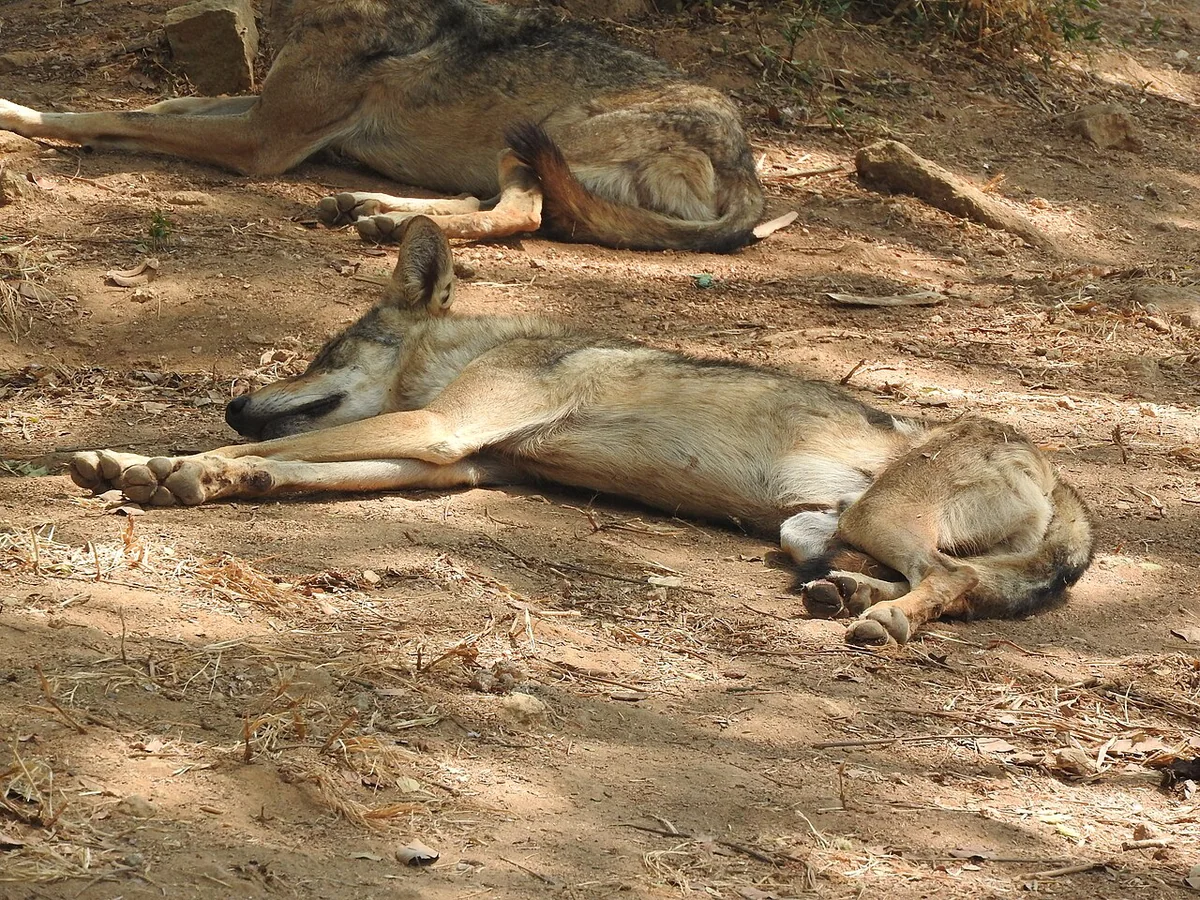
Bannerghatta Zoo provides a concrete example of how to read a dated record. A photograph taken there on 23 February 2024 shows captive Indian wolves resting. If that photograph prompts you to consider a visit, confirm the current display with the operator and check the visitor information for your intended date. The photograph establishes what was present when it was taken. A current operator update is the relevant source for planning a visit.
The Central Zoo Authority and Wildlife Institute of India published the second edition of the National Studbook of Indian Wolf in August 2018. It documents a managed breeding population and helps explain the role of institutions in the species’ care and conservation. Read its institutional entries with the edition date in mind. For a visitor, the practical distinction is between a historical record of animals under care and confirmation that a zoo has wolves on public display.
When you contact a zoo, use the name Indian wolf or Canis lupus pallipes and ask specifically about public display. An animal can be held by an institution at a time when visitors cannot see it. Check the normal entry rules and opening information for the date you are considering. If the operator gives a general animal list with no display dates, treat it as background until you have a current answer.
Bears in India, four wild species and where they liveNational parks of India: find all 106 in the WII inventory
- Wildlife Institute of India | Indian wolf ecology and conservation
- Jhala and colleagues — Distribution, Status, and Conservation of the Indian Peninsular Wolf, 2022
- Central Zoo Authority and Wildlife Institute of India — National Studbook of Indian Wolf, second edition
- Wikimedia Commons — Indian Grey Wolf at Bannerghatta Zoo, own work by Yercaud-elango
Sources
- IUCN Red List | Indian wolf assessment
- Wildlife Institute of India | Indian grey wolf ecology study
- Wildlife Institute of India | Indian wolf ecology and conservation
- Zoological Survey of India — Fauna of India, Mammalia checklist, 2025 Version 2.0
- Jhala and colleagues — Distribution, Status, and Conservation of the Indian Peninsular Wolf, 2022
- Hennelly and colleagues — Continent-wide view of genomic diversity and divergence in the wolves of Asia
- Oxford WildCRU assessment team — Himalayan wolf Red List assessment
- Central Zoo Authority and Wildlife Institute of India — National Studbook of Indian Wolf, second edition
- Wikimedia Commons — Indian Grey Wolf at Bannerghatta Zoo, own work by Yercaud-elango
