India’s environment ministry reported 106 national parks in its 16 March 2026 release about India’s Seventh National Report to the Convention on Biological Diversity. The finder lists the 106 rows in the Wildlife Institute of India’s separately dated February 2025 inventory. Search by park, state or WII zone and download the underlying reference. Check the relevant operator for current gate access and any visit permit.
The directory has 30 state and union territory names. Its zone labels are WII’s broad groupings, so a filter for East includes the northeastern states in that publication. Among the entries are 11 parks in Madhya Pradesh, seven in Assam and six in the Andaman and Nicobar Islands. These counts describe the source edition. A later state publication can use a different reference date or handle pending designations differently.
The inventory includes a year and area for each row. The year is shown as WII lists it, which sometimes reflects an earlier notification rather than the latest legal milestone. Use the stated area for the exact park and edition. Search either Simlipal or Similipal to find the Odisha entry. The names Pench and other similar names can appear in different states, so read the state cell before comparing figures.
National parks by WII zone, February 2025 inventory
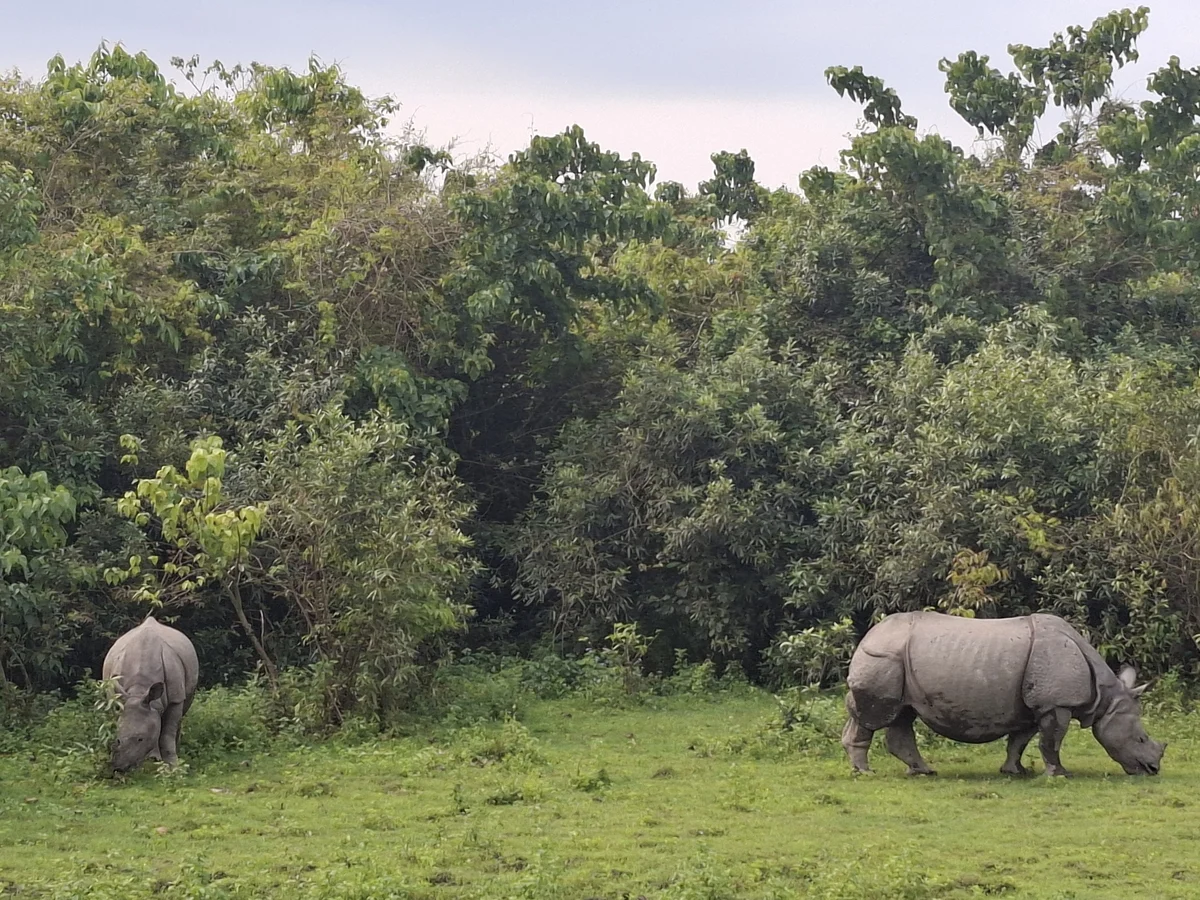
If you are searching for jungles in India, start by deciding what kind of landscape you want to see. Kaziranga in Assam is a northeastern floodplain whose conservation history includes the recovery of the Indian one-horned rhinoceros from near extinction in the early twentieth century. The Ministry of Culture also records tigers, elephants, wild buffalo and sloth bears there. Those records establish which animals the park supports. A particular outing can only offer the opportunity to see them.
Rajasthan’s Desert National Park gives a different reason to visit, with dunes, rocky ground and dry salt-lake beds. Rajasthan Tourism lists it alongside destinations across several protected-area categories. If you are choosing between Rajasthan sites, use the tourism listing for habitat and destination research, then look up the specific place and activity. A state wildlife directory can group sites together even when the conditions for entering them are set separately.
Think about the activity as well as the terrain. Gujarat’s forest department describes the Gir Jungle Safari, the Gir Interpretation Zone at Devaliya and the Ambardi Interpretation Zone near Dhari as separate offers. Corbett’s administration distinguishes safari, canter and night-stay reservations. If your travel party wants to spend the night in Corbett, compare the dates offered under night stays before building the rest of the visit around a day safari. The separate reservation categories matter even when you are looking at the same destination.
Treat seasonal access as a property of the visit you want to book. A park name and a month can get you to a shortlist, but the useful details are the visitor product, zone or route, and exact date. Under the Wild Life (Protection) Act, tourism is among the purposes for which a permit may be granted subject to conditions. Use the operator’s current notice and reservation information to establish what is open to visitors.
Gir illustrates how to read an annual closure statement. The Gujarat portal gives a 16 June to 15 October closure note for the sanctuary. It separately lists Gir Jungle Safari, GIZ Devaliya, Ambardi Safari Park and Girnar Nature Safari, and specifies the booked time and route on e-permits. If you are considering a July visit and can choose an interpretation zone, look up that product’s availability directly. The dates in the sanctuary note establish the scope of that closure, while the individual booking information determines your options.
Corbett illustrates a different date pattern. Its official update history includes a window for separate day-visit reservations at Dhela, Jhirna and Garjiya from 15 to 27 October 2026. The dates belong to that particular update. To assess your own trip, read the latest notice covering the intended zone and check the corresponding reservation category. If a date has no displayed slots and the reason is unclear, the available information leaves that visit unconfirmed.
Book the right product and confirm where to arrive
Use the authority that manages visitor permits for the product you choose. For Gir, the Gujarat Forest Department directs visitors to its online permit system. For Corbett, use the Corbett Tiger Reserve Administration’s visitor portal for its zone, booking and eligibility updates. A national inventory can confirm a park’s identity, while the official operator can tell you which reservation category to use and what conditions apply to it.
Before arranging transport, match the booked product and reporting point with the operator’s current instructions. A map result for a park can represent a large protected area. A driver needs the meeting point for the specific booking, and you need enough time to reach it from where you will be staying. Around Gir, for instance, identifying Ambardi as the offer near Dhari is a more useful starting point for travel planning than searching only for Gir. Confirm the precise arrival point against your booking.
Read the eligibility and check-in terms for everyone in the group before finalising plans. Whether you are travelling within India or arriving from the United States, look for the operator’s instructions on accepted identification, reservation details and the documents to carry on the visit. For any mobility or vehicle requirements, confirm what the specific product can accommodate. Where the available instructions leave an important detail open, use the contact channel published by the operator before relying on that booking.
Distinguish park boundaries from reserve boundaries
National parks, wildlife sanctuaries and tiger reserves are separate designations. A tiger reserve can include core or critical tiger habitat and a buffer or peripheral area. Its boundary can overlap a national park or sanctuary and extend beyond it. That affects the numbers you see in directories and the names you see when booking. An official visitor portal may use the reserve name even when your search began with a national park.
Kaziranga illustrates what happens when several area figures circulate for one place. Assam’s original 1974 national park notification covered 430 km². WII’s February 2025 national park entry is 889.51 km². NTCA gives 1,173.58 km² for the tiger reserve, including 625.58 km² of core and 548.00 km² of buffer. Keep the area and its designation together when identifying a boundary or thinking about visitor access.
Gir’s chronology makes the distinction practical. The Gujarat Forest Department records a sanctuary designation in 1965 and a national park declaration for the core in 1975. The national inventory measures that park entry at 258.71 km². If you encounter a sanctuary notice while researching a Gir booking, read which area and activity the notice covers. A shared destination name can refer to the sanctuary, the national park or a particular bookable outing.
Read a notification year in the context of the record it comes from. Section 35 of the Wild Life (Protection) Act distinguishes a notification of intent from a final declaration specifying the limits and effective date. Other dates can record expansions or recognition under a separate designation. For Khangchendzonga, UNESCO records establishment in 1977, expansion in 1997 and World Heritage inscription in 2016. The WII inventory records 1997 and 1,784 km². For a timeline of the park, each date answers a different question.
WII lists Simlipal at 845.70 km² under 1980. Odisha issued its final Similipal notification on 24 April 2025 under section 35(4), referring to earlier notifications in 1980 and 1986. Its announcement called Similipal India’s 107th national park. WII had already listed the same site and area. Give the state’s ordinal its source and date, and avoid adding the same named park to the older inventory a second time.
Assam’s 5 March 2025 Sikhna Jwhwlao notification declares intent under section 35(1) and (2) in its 316.29 km² area. The Assam Economic Survey 2025–26 counts it in the state table. A separate final section 35(4) notice had not been verified as of 26 November 2026. These differing documents describe different stages of public reporting. They do not establish a replacement national total by themselves.
The WII download index was updated on 1 May 2026, and its linked park inventory states a February 2025 data cutoff. Use the cutoff when describing the park-by-park figures. The ministry’s separate 16 March 2026 release supplies the more recent dated headline count of 106, alongside 574 wildlife sanctuaries and 58 tiger reserves. Because designations can overlap, adding those figures would give a sum of designation counts rather than a count of distinct places.
The 106 transcribed February rows add to 44,853.0904 km², which rounds to the 44,853.09 km² stated in that inventory. The legacy WII summary also reports 106 parks but gives 44,402.95 km², a difference of 450.14 km². The publications reviewed do not establish why those totals differ. Quote the area with its edition and avoid using the later date of the WII index as a date for the area measurements.
When checking for an update, open the publication linked under national parks in the WII index and inspect the cutoff inside the document. A newer index date can accompany the same inventory. India’s open data catalogue also offers downloadable historical state totals, including a snapshot from 14 August 2015. Those files can answer a historical question about state counts and areas. For individual park names and rows, use the named WII inventory edition and consult the relevant state record for a later change.
For an updated count, open the downloadable inventory and record the data date inside it. The national ministry’s March 2026 release also reports 574 wildlife sanctuaries and 58 tiger reserves. Those are separate designations and can overlap on the ground. Adding all three counts would combine administrative labels, while the 106-row finder is a reference for the national park entries in one edition.