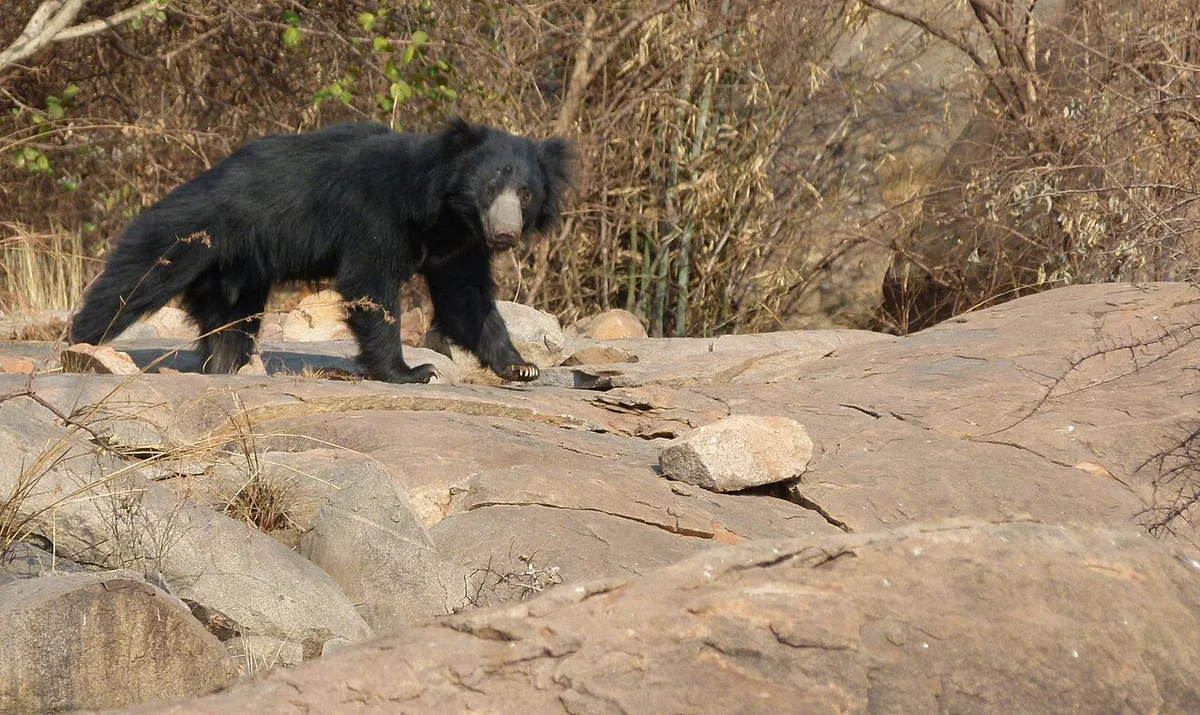
The four wild bear species in India
Yes, India has four native wild bear species: the sloth bear, Asiatic black bear, brown bear and sun bear. Sloth bears are widespread in suitable lower-elevation habitat, Asiatic black bears occur in the Himalaya and Northeast, brown bears occupy high Himalayan country, and sun bears have a localized northeastern distribution.
The Zoological Survey of India’s 2025 mammal checklist gives each species its own row. Himalayan brown bear is the common name for the regional form of the brown bear, Ursus arctos. A list that includes both names is using two levels of naming for the same species. Likewise, Malayan sun bear and sun bear refer to Helarctos malayanus, so the longer name in an older research report can be matched directly to the Indian checklist.
India’s forest and mountain regions provide a better starting point than a countrywide label. The lower-elevation range of the sloth bear spans suitable habitat in more than one part of India, while the ranges of the other three are associated with the Himalaya, the Northeast or both. Those broad regions answer where each species occurs at a national scale. A particular district, valley or protected area requires evidence at that scale.
The four-species list also appears in the government’s National Bear Conservation and Welfare Action Plan launch announcement of 27 November 2012. The announcement and the 2025 checklist use compatible broad geography. Use the checklist for the species names and listed distributions, and read the launch announcement in the context of the conservation concerns the ministry identified in 2012.
| Species | Scientific name | Broad Indian distribution |
|---|---|---|
| Sloth bear | Melursus ursinus | Widespread in suitable lower-elevation habitats |
| Asiatic black bear | Ursus thibetanus | Himalayan and northeastern regions |
| Brown bear | Ursus arctos | High Himalayan country, with listings for Ladakh, Jammu and Kashmir, Himachal Pradesh and Uttarakhand |
| Sun bear | Helarctos malayanus | Localized records in the Northeast |
Sloth bears in lower-elevation habitats
The sloth bear is the species to look up first when a question concerns bears in suitable lower-elevation habitat in India. The national checklist describes a broad distribution, and Daroji Sloth Bear Sanctuary near Hampi in Karnataka gives that distribution a concrete southern reference. At the scale of a national map, a broad sloth bear region describes a collection of suitable habitats. Within that region, a named town and a protected area can tell very different stories about the evidence available.
In a clear archival photograph, look for a shaggy black coat, a long pale muzzle and long curved claws. The claws help the bear reach ants and termites. A pale chest mark often appears too, and its value increases when the photograph also shows the muzzle and coat. A dark bear with a pale chest in a cropped photograph could fit more than one Indian species, especially when the location has been stripped from the caption.
Suppose you are identifying a photograph credited only to the Hampi area. A visible long pale muzzle and shaggy coat would point toward sloth bear, and the nearby sanctuary would make that interpretation geographically plausible. To label the photograph confidently, check the original photographer’s caption for the species and location. That extra step matters because a caption can distinguish a photograph taken at Daroji from one used simply to illustrate a story about the area.
Brown bears and Asiatic black bears in the Himalaya
Both the brown bear and the Asiatic black bear occur in the Himalayan region. The brown bear is associated with high Himalayan country, and the 2025 mammal checklist lists it in Ladakh, Jammu and Kashmir, Himachal Pradesh and Uttarakhand. Asiatic black bear distribution includes Himalayan and northeastern regions. The 2012 action plan announcement describes the Himalayan and sub-Himalayan context for the two bears, giving a broader geographical frame than a list of jurisdictions.
For map reading, treat a state listing as a record at the scale of that jurisdiction. In Himachal Pradesh, for instance, the presence of Himalayan brown bears somewhere within the state gives you a state-level answer. A question about a particular valley or elevation band calls for a source that actually names or surveys it. The evidence here supports the broad high-mountain association without placing a precise lower elevation limit on the range.
In a well-captioned image, the Asiatic black bear’s often visible pale chest crescent can help with orientation. Check the overall appearance and the caption together, because pale chest markings also occur in other bears. Scientific names are especially useful when comparing captions written for different audiences. Ursus thibetanus identifies the Asiatic black bear, while Ursus arctos connects an image captioned Himalayan brown bear to the species listed in the national checklist.
What the Northeast records show about sun bears
The sun bear is part of India’s wild fauna, with records in the Northeast. A Wildlife Institute of India project reported in its 2007–08 annual report provides historical evidence from Mizoram. The project began in April 2007, and early work used interviews and signs to support presence in the state. The researchers said those early data could establish only part of the picture. The report supports a dated record of presence in Mizoram and leaves abundance unresolved.
The same project also included Arunachal Pradesh and Nagaland in its study goals. When reading a report like this, look for which places appear in the findings and which appear in the proposed coverage. A study can name a state because its authors intended to investigate it. A state-level occurrence claim needs a stated result. A 2025 Wildlife Institute of India repository record supplies more recent evidence at the regional scale, reporting both sun bear and Asiatic black bear in a selected Eastern Himalayan study landscape.
The Northeast chapter of the 2022 tiger, co-predator and prey assessment adds a different kind of evidence. It pooled signs of sloth bears, Asiatic black bears and sun bears in the Northeast Hills and Brahmaputra floodplains because the species behind individual signs were uncertain. If you come across a shaded cell from that assessment and want to know whether it establishes sun bear presence, start with the legend and methods. A cell based on pooled data supports bear occurrence at the resolution and grouping used by the survey. Identifying the species requires a separate record.
- Zoological Survey of India | Mammal checklist
- Wildlife Institute of India — Annual Report 2007–08, Malayan sun bear research
- Wildlife Institute of India — Eastern Himalayan mammal assemblage research, 2025 institutional record
- Wildlife Institute of India and NTCA — Status of Tigers, Co-predators and Prey in India 2022, Northeast chapter
How to read a bear habitat map
A map is useful once you know whether it shows broad distribution, a particular study’s coverage or records from a survey. A national checklist gives a starting geography for each species. A study can offer stronger evidence for a smaller area through its reported findings. Read the legend for the unit of evidence and the accompanying text for the survey footprint. The colour on a map may cover a whole state, a broad region or sampled forest, depending on what the mapmaker had available.
Keep occupancy, abundance and encounter probability distinct when reading the labels. Occupancy concerns use or presence across the places being assessed. Abundance concerns how many animals there are. The chance of seeing a bear during a visit would need evidence specific to that kind of visit. The 2022 northeastern assessment pooled uncertain bear signs and sampled forest. Its bear results have that survey’s geographic and taxonomic scope, which limits how far they can be carried into questions about individual species or visitor sightings.
Human–bear interaction records answer another question. The Wildlife Institute of India compilation treats interactions as specific to species and geography. If you find a district in that material, check the period covered and the kind of interaction documented before drawing a conclusion. The record can help establish what was reported there during that period. Estimating the district’s bear population or the likelihood of an encounter would take separate evidence.
Wolves in India, habitat, numbers and how to identify themNational parks of India: find all 106 in the WII inventory
- Zoological Survey of India | Mammal checklist
- Wildlife Institute of India | Human–bear interactions
- Wildlife Institute of India — Eastern Himalayan mammal assemblage research, 2025 institutional record
- Wildlife Institute of India and NTCA — Status of Tigers, Co-predators and Prey in India 2022, Northeast chapter
Reading conservation status for Indian bears
The 2025 Zoological Survey of India mammal table reports global species-level categories of Vulnerable for the sloth bear, Asiatic black bear and sun bear, and Least Concern for the brown bear. Pay attention to the geographic scale in that sentence. The brown bear entry covers Ursus arctos globally. A status or trend for Himalayan brown bears in India would require an assessment that identifies the regional population and sets out the evidence used to evaluate it.
The same table separately shows all four Indian bear entries under Schedule I of the 2022 amendment. Read that column as an Indian legal listing and the conservation category as a global species assessment. If a later checklist gives a different version, check the date printed on the mammal table and confirm that you have the bear rows in front of you. ZSI announced a whole-fauna Version 3.0 on 30 June 2026, while the detailed bear entries verified here carry the 2025 version designation.
Habitat loss and increasing human interaction were among the issues identified at the 2012 launch of the National Bear Conservation and Welfare Action Plan. The plan also addressed welfare and state-level management. Its launch announcement helps explain why Indian bear conservation includes both free-ranging populations and the care of individual animals. To check for a current population trend, use a later assessment with a stated area, survey period and method.
Daroji sanctuary visits and managed bear care in Agra
Daroji Sloth Bear Sanctuary near Hampi is a starting point for a regulated visit to wild sloth bear habitat. The sanctuary was established in 1994, and the Ministry of Tourism describes designated visitor infrastructure. Check Karnataka Tourism and the responsible local visitor authority for access on the date you plan to go. Confirm whether public viewing is operating, where visitors should report and which arrangements apply. Use designated visitor areas and follow instructions from staff. The sanctuary listing establishes that there is visitor infrastructure, while a sighting depends on what free-ranging animals do on the day.
The Agra Bear Rescue Facility serves a different purpose. Its operator identifies the Uttar Pradesh Forest Department as the administrator and Wildlife SOS as the technical and operational care partner. The facility provides a setting for learning about rescued bears and managed care. For a visit enquiry, use the operator’s current visitor contact and confirm how it handles requests. A description or photograph from the facility should identify the managed setting so readers can interpret what they are seeing.
If you are choosing a stop around an existing Hampi itinerary and want to understand the landscape where sloth bears live, check Daroji’s public access first. If your itinerary takes you through Agra and your interest is rescue and welfare, enquire with the facility about its education visits. The first choice gives you a reason to learn about habitat and regulated wildlife viewing. The second gives you a way to learn how rescued animals are cared for in a managed setting.
| Place | What it documents | Who to contact before making plans |
|---|---|---|
| Daroji Sloth Bear Sanctuary, Karnataka | Wild sloth bear habitat near Hampi | Sanctuary authority for current access and permitted viewing |
| Agra Bear Rescue Facility, Uttar Pradesh | Managed long-term care for rescued bears | Wildlife SOS for visitor access to its programme |
Sources
- Zoological Survey of India | Mammal checklist
- Wildlife Institute of India | Human–bear interactions
- MoEF and WII — National Bear Conservation and Welfare Action Plan launch, 27 November 2012
- Wildlife Institute of India — Annual Report 2007–08, Malayan sun bear research
- Wildlife Institute of India — Eastern Himalayan mammal assemblage research, 2025 institutional record
- Wildlife Institute of India and NTCA — Status of Tigers, Co-predators and Prey in India 2022, Northeast chapter
- Smithsonian National Zoo — Sloth bear profile
- Wildlife SOS — Bear conservation and Indian species profiles
- Ministry of Tourism — Daroji Sloth Bear Sanctuary visitor reference
- Wildlife SOS — Agra Bear Rescue Facility
- Wikimedia Commons — Young male sloth bear, own work by L. Shyamal
