What to see and how long to allow
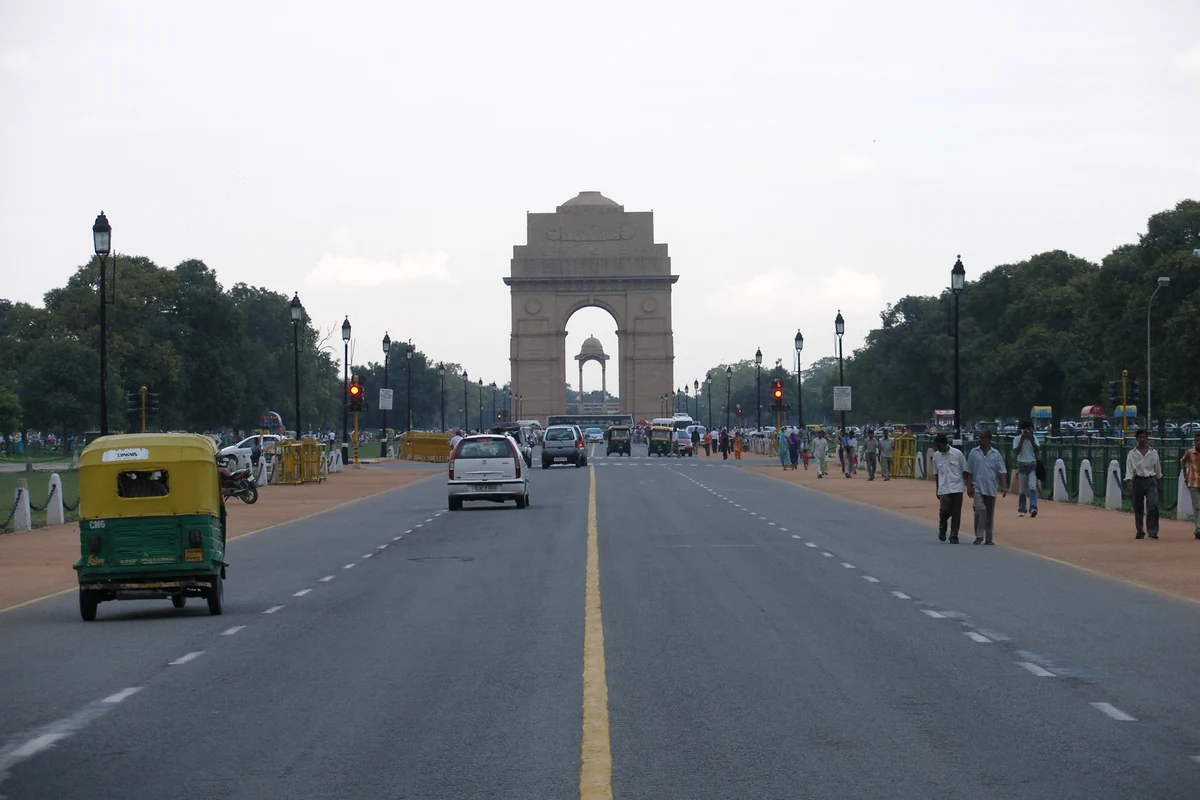
India Gate is a 42-metre memorial arch at the eastern end of Kartavya Path in New Delhi. Delhi Tourism lists free access to the public area. You can visit the arch and central avenue as one outing, then continue to the adjoining National War Memorial if it is open. The latter is a separate, free memorial with its own access hours, last admission and visitor rules.
For an easy first visit, start on the Kartavya Path side of the arch, look through the axis toward the canopy and take time for the different views of the stonework. Visitors going into the National War Memorial should make its admission window the fixed point of the itinerary. The memorial’s visitor guide estimates 45 minutes to an hour inside, so a combined outing needs more time than a quick photo stop.
On a weekday morning you can see the stone details in daylight and visit the National War Memorial after 09:00. If you prefer the evening, go inside the memorial before its published last admission and use the public side for a later walk where permitted. Arriving at the arch does not start or extend the admission window of the memorial nearby.
| Place or season | Normal public schedule | Entry and timing |
|---|---|---|
| India Gate public area | Delhi Tourism describes daily access with some areas restricted after dark. | Free viewing. Follow current posted closures. |
| Kartavya Path public avenue | Delhi Tourism lists daily access. | Public walkway and lawns. Timed events can affect the route. |
| National War Memorial, November–March | 09:00–19:30. | Free. Last admission 19:00. |
| National War Memorial, April–October | 09:00–20:30. | Free. Last admission 20:00. |
| Canopy and Netaji statue | Outdoor view subject to public access at the time. | Separate landmark near the arch. |
| National War Memorial retreat | Official site describes a routine before sunset. | Confirm the day’s arrangement and access with the memorial. |
Choose your arrival according to the place you want
Metro approaches work best when you specify your first stop. Delhi Tourism lists Central Secretariat for Kartavya Path and India Gate, while the National War Memorial lists Mandi House about 1.5 km from its entrance area and Central Secretariat about 2.5 km away. These estimates use the memorial’s own reference point. The arch, the lawns and the enclosed memorial need separate walking directions.
Central Secretariat is on the Yellow and Violet lines and suits a walk along the western portion of Kartavya Path toward the arch. Mandi House is a Blue and Violet line interchange. The National War Memorial also lists Khan Market and Janpath on the Violet Line, both around 2 km by its reckoning, and Baroda House as a bus stop around 0.8 km away. Choose the station and route best matched to the length and direction of walk you want.
If travelling by taxi or in a group, agree an actual destination and collection point. For a National War Memorial visit use the memorial’s stated drop-off instructions and public entrance. Its published address is C Hexagon, India Gate, New Delhi 110001. If visiting the arch first, share your intended Kartavya Path meeting point. Allow for the walk to the memorial and its last-admission time.
- Delhi Tourism, India Gate visitor area and general hours
- Delhi Tourism, Kartavya Path public avenue
- National War Memorial, ticket rules, admission and suggested Metro approaches
- Ministry of Housing and Urban Affairs, 8 September 2022 Kartavya Path inauguration
- Delhi Metro Rail Corporation, interchange lines
The arch and the names it commemorates
Edwin Lutyens designed India Gate as a memorial arch in the layout of New Delhi. Delhi Tourism’s historical entry places the foundation in 1921 and the dedication ten years later. The National War Memorial’s historical account also identifies 1931 for the arch and connects it with the First World War and Third Anglo-Afghan War. Keep the chronology of the 1931 arch separate from the later additions under and near it.
Notice how the building rises from its low base. Delhi Tourism identifies red Bharatpur stone below the arch and calls out the imperial suns and the Roman-numeral dates around the word INDIA. MCMXIV reads 1914 and MCMXIX reads 1919. These are dates in the inscription, while the dedication came later. Looking along the full avenue and then studying the visible parts of the arch gives two different perspectives on the same landmark.
Published figures can refer to different groups of people. For a particular First World War name, use the Commonwealth War Graves Commission’s guide to researching someone from undivided India. It explains the casualty database and practical alternatives for full names and initials. For the post-independence memorial’s tablets, use the National War Memorial roll. The two searches serve different commemorative contexts.
How Amar Jawan Jyoti and the later memorial fit
The National War Memorial’s official history dates the old Amar Jawan Jyoti installation under the arch to January 1972, after the 1971 war. Photographs from different years can therefore show an added memorial and flame under the older arch. Keep a date with a photograph and distinguish the sandstone structure from any commemorative addition visible in the scene.
The National War Memorial was dedicated on 25 February 2019. The Ministry of Defence documents the ceremony on 21 January 2022 that merged the old Amar Jawan Jyoti flame with the eternal flame at the National War Memorial. For the current flame location, follow the National War Memorial entry directions and look for the obelisk in Amar Chakra. The date helps reconcile older visitor descriptions with current signage.
Kartavya Path and the canopy also have their own 2022 change. The Ministry of Housing and Urban Affairs records the inauguration of the redeveloped avenue and the unveiling of the statue of Netaji Subhas Chandra Bose on 8 September 2022. The Ministry of Culture describes the statue beneath the canopy as 28 feet high. Treat the canopy, arch, avenue and enclosed memorial as separate landmarks when looking at a map or describing what a photo shows.
The 2022 redevelopment also added or refreshed facilities that shape a visitor’s walk. The works announcement describes pedestrian underpasses, updated signage, amenity blocks, new lighting and refurbished canals. Look for the pedestrian route serving the part of the avenue you want. The redevelopment notice gives the date and scope of the work, while public signs and current event notices describe access on the day.
Visiting the memorial respectfully and finding a name
The National War Memorial describes four thematic circles. Amar Chakra holds the obelisk and eternal flame. Veerta Chakra includes six bronze murals. The memorial describes Tyag Chakra as the walls of honour with granite tablets and Raksha Chakra as the outer protective circle. The site is designed as a walk through different parts of a memorial. Use the signs and keep to the designated pedestrian route.
The on-site guidance asks visitors to leave food, bags and suitcases outside, keep phones silent and avoid touching the murals and honour walls. Visitor photography is allowed when it does not disturb others, and tripods or professional stands are excluded by the published rules. If visiting between longer journeys, make an arrangement for luggage at the place you are leaving or staying before coming to the memorial.
The memorial publishes marked paths, ramps, railings and facilities for visitors with disabilities. It says to ask its help desk about a wheelchair. Make an advance check for the length and surface of your intended route if you need assistance. The monument’s visitor section also distinguishes assigned pickup and drop-off points from parking in the surrounding roads.
For a visit focused on a name, open the public National War Memorial website and use its Roll of Honours search, where fields include the person’s name, unit, service number and year. Confirm any similar names before you set out. Ask the help desk how to identify the tablet if you need directions, or use the site’s published contact channel if a detail appears to need correction.
The memorial’s visitor FAQ distinguishes a formal wreath ceremony from ordinary visitors’ tribute. It directs visitors who want to leave a flower to the base of the Tyag Chakra walls. It also says that the memorial offers lighting and routine ceremonial activity rather than a laser or sound-and-light show. Keep those details separate when confirming an evening visit with family or a group.
One-hour and two-hour examples
With about an hour and no scheduled activity, treat the arch, canopy views and a stretch of Kartavya Path as the outing. If the memorial is the main reason for travel, use that hour inside and count the transport and queue separately. On an evening trip with less time, check the published last-admission time and decide which experience is feasible before walking from the metro station.
With about two hours on a winter evening, aim to reach the National War Memorial well before 19:00, leave time to walk its circles, and use the remaining time for the arch or an accessible section of the avenue. Between April and October the published last admission is 20:00, with closing at 20:30. At either time of year a memorial ceremony or crowding can change admission, so use the current instructions.
For a morning when the avenue is your focus, begin at the Metro approach that suits your journey and use the axis as orientation. Near the arch, decide whether the canopy or the memorial will be your next stop. If another traveller comes straight to the memorial, meet at its public entrance instead of sending them to a general India Gate pin. Two points with similar postal descriptions can be a substantial walk apart.
What to confirm for the day you are in Delhi
Follow event-specific public instructions around large civic observances. The standard operating hours describe ordinary access and the National War Memorial explicitly allows temporary restrictions. If you need the retreat, ask what is planned and how admission works that day. The memorial’s website describes the retreat as taking place before sunset rather than publishing a single year-round time.
An outdoor walk and an enclosed memorial visit place different demands on a short trip. Check the weather, leave time for transport both ways, and bring only what the intended venue allows. The easiest itinerary to follow has an exact first point, a time for the only fixed activity, and a second point you can leave optional if walking takes longer than expected.
Sources
- Delhi Tourism, India Gate visitor area and general hours
- Delhi Tourism, India Gate admission and arch inscription
- Delhi Tourism, Kartavya Path public avenue
- National War Memorial, ticket rules, admission and suggested Metro approaches
- National War Memorial, history, circles and ceremonial activities
- Ministry of Defence, 21 January 2022 flame ceremony
- Ministry of Housing and Urban Affairs, 8 September 2022 Kartavya Path inauguration
- Ministry of Culture, canopy statue record
- Delhi Metro Rail Corporation, interchange lines
- National War Memorial, Search Roll of Honours
- Commonwealth War Graves Commission, First World War research guide