Where to look by region and season
For flowers in India, look to Srinagar for planted tulips in spring, Uttarakhand’s Valley of Flowers for alpine wildflowers typically most abundant from July to September, and the Munnar area for occasional mass flowering of neelakurinji. For a visit, use the season to choose a destination and check the current opening notice and recent flowering reports before fixing your dates.
If you’re trying to name a flower you’ve seen, start with its setting and visible features. A large bloom in a pond calls for a different comparison from a purple cluster on a Himalayan woody plant. The garden and meadow entries below help narrow the possibilities when you know where a photograph was taken. The lotus and marigold entries are better starting points when the plant is familiar but its name is uncertain.
| Region or setting | Flower or display | Timing supported by the record | Check before relying on it |
|---|---|---|---|
| Srinagar, Kashmir | Planted tulips and other bulbs | Spring display. The 2026 show opened on 16 March. | Current show dates and flowering stage |
| New Delhi | Amrit Udyan seasonal displays | 3 February–31 March and 16 August–15 September for the two named 2026 programmes | Latest programme, public admission days and booking rules |
| Chamoli, Uttarakhand | Alpine meadow flowers, including primulas, poppies and anemones | Typically greatest floral abundance in July–September | Forest Department access and recent meadow conditions |
| Sikkim and the eastern Himalayan context | Rhododendron niveum | April full bloom in the Botanical Survey of India species profile | Local occurrence, flowering stage and site access |
| Munnar area, Kerala | Mass flowering of neelakurinji | August–October in the documented 2018 season | Current flowering at the specific viewing site and public access |
| Freshwater ponds and lakes | Sacred lotus | Habitat reference. The evidence gives no local flowering dates. | Whether the plant is present and flowering at the pond |
Read each date at the scale it describes. Srinagar’s opening was an event on a particular day. Uttarakhand’s July–September window describes abundance across a meadow with many species. April in the Sikkim entry pertains to a single species, and the Munnar months refer to a documented mass-flowering season. This distinction matters if you’re choosing between a display you can visit on several possible days and a particular flower you hope to photograph.
- Uttarakhand Tourism | Valley of Flowers
- Srinagar district | Tulip Garden
- Rashtrapati Bhavan | Amrit Udyan 2026 seasonal booking instructions
- Akashvani — 16 March 2026 Srinagar Tulip Show opening archive
- President of India — Amrit Udyan Summer Annuals release, 4 August 2026
- Akashvani — Valley of Flowers 2026 access announcement with Forest Department attribution
- Botanical Survey of India — Rhododendron niveum, Sikkim state tree profile
- Kerala Tourism — Official 2018 Neelakurinji season booklet
- Botanical Survey of India — Flora of India, volumes 1 and 13
Srinagar’s spring tulip terraces
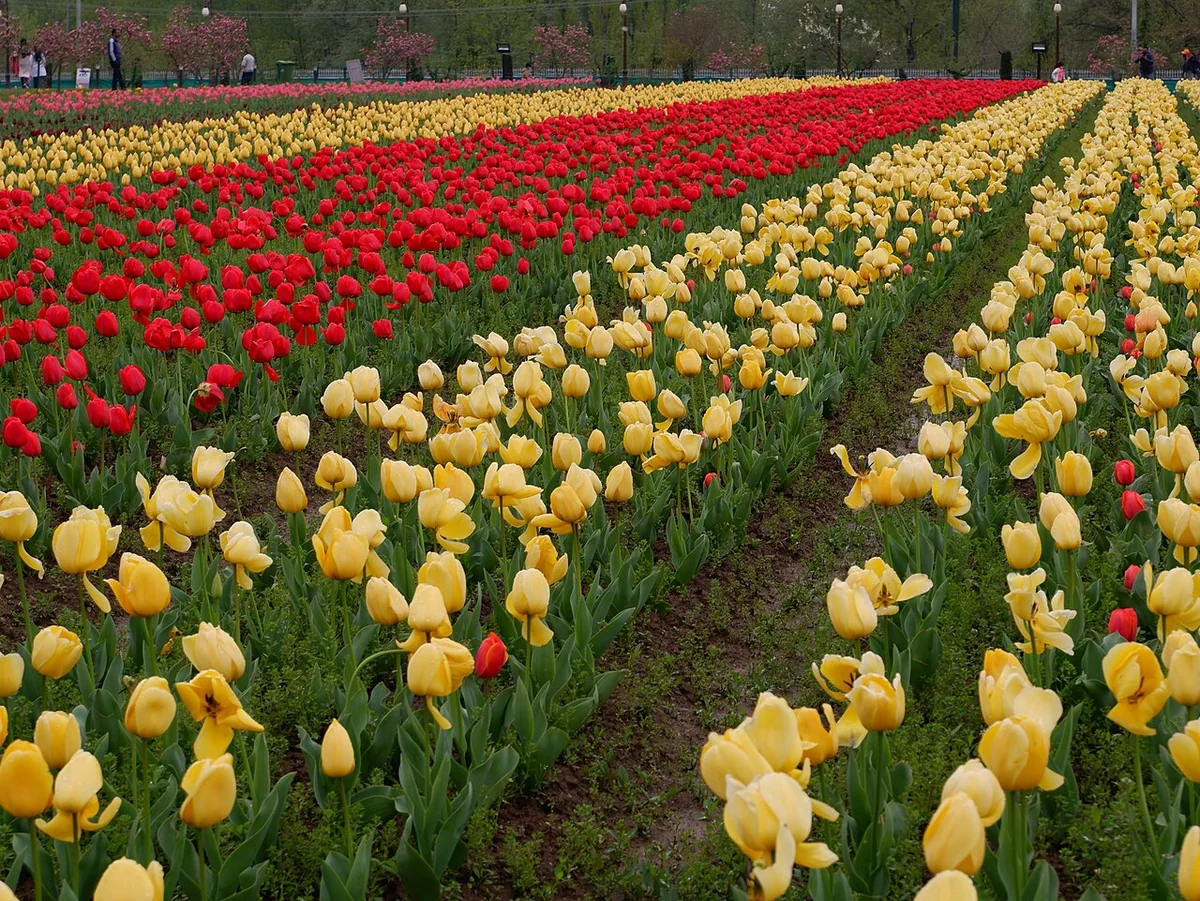
Srinagar’s tulip garden sits at the foot of the Zabarwan Range overlooking Dal Lake. District Srinagar describes a managed garden of about 30 hectares arranged across seven terraces. It opened in 2007, and the wider plantings include hyacinths, daffodils and ranunculus. The terraces make this a place to see planted blocks of colour in a landscape setting, with individual beds and flower forms to look at closer up.
Akashvani’s 17 March bulletin recorded the opening of the 2026 show on 16 March. It reported roughly 18 lakh tulips, or 1.8 million, in more than 70 varieties, along with about one lakh other planted bulbs. Those totals describe the scale of planting for that edition. To judge whether several beds are likely to be colourful on the same visit, look for a recent view across multiple terraces. A close-up of a flowering bed gives you information about that bed alone.
If you have a choice between opening day and a later day within the announced run, decide whether the opening itself matters to you. For a photograph of broad bands of colour, recent views of the beds are the more relevant evidence. An archive photograph taken at the garden on 16 April 2021 shows red and yellow rows. Its date tells you when that photograph was made and gives no basis for assuming mid-April access in another year.
Check District Srinagar and Jammu and Kashmir Floriculture announcements for the edition you plan to attend. Look for the year, the public opening and any stated closing date, then check the date on the bloom report you’re using. A current opening notice can settle whether your proposed day falls inside the run even when the stage of flowering is still uncertain.
New Delhi’s Amrit Udyan seasonal openings
At Rashtrapati Bhavan in New Delhi, Amrit Udyan has published separate seasonal programmes. The 2026 Winter Annuals opening ran from 3 February to 31 March. The Summer Annuals programme that year ran from 16 August to 15 September and included the Plumeria Garden, Bonsai Garden, Central Lawn, Long Garden and Circular Garden on its visitor route. A programme name identifies a particular opening and offers a much better starting point for checking access than a generic search for Delhi’s flower season.
Both 2026 editions normally listed hours of 10 a.m. to 6 p.m., with Monday maintenance closures. Last admission was 5:15 p.m. for Winter Annuals and 5 p.m. for Summer Annuals. Winter Annuals also closed on 4 March for Holi. During the summer run, 29 August was reserved for sportspersons and 5 September for teachers. A mid-programme date could therefore still be unavailable for general admission.
If you’re fitting a visit around an afternoon appointment, use last admission as the cut-off when comparing dates. The 2026 summer notice also required advance online booking and directed visitors to Gate 35. Entry was free for that edition. For another edition, open the President of India’s garden visits information and read the notice for the exact programme. Its booking instructions, eligible dates and entrance details will tell you whether the visit fits the time you have.
| Place or programme | 2026 record | What it establishes |
|---|---|---|
| Srinagar Tulip Show | 16 March | Documented opening of the 2026 show |
| Amrit Udyan Winter Annuals | 3 February to 31 March | Scheduled garden programme |
| Amrit Udyan Summer Annuals | 16 August to 15 September | Separate seasonal garden programme |
| Valley of Flowers National Park | Open by 2 June through 31 October | Announced park access for 2026, subject to conditions |
Uttarakhand’s Valley of Flowers alpine meadows
The Valley of Flowers National Park lies in Chamoli district and forms one core zone of the Nanda Devi Biosphere Reserve. It protects a western Himalayan alpine meadow ecosystem. The Valley of Flowers was added to the UNESCO World Heritage property in 2005, following the original inscription of Nanda Devi in 1988. The World Heritage property includes both national parks, so search using the Valley of Flowers name when you need visitor information for the meadow.
Uttarakhand Tourism names primulas, poppies and anemones among the alpine flowers and describes July to September as the period of greatest floral abundance. That window makes sense as a starting point for someone who wants to see a variety of meadow flowers. Individual species and local weather shape what is open on any given day. If your interest is a particular primula or poppy, a dated observation of that plant in the park will tell you more than the overall flowering window.
The access record covers a wider period. On 2 June 2026, Akashvani reported that the park had already opened and quoted Forest Range Officer Chetna Kandpal giving 31 October as the last scheduled date. The 2025 opening notice gave 1 June as opening day and mentioned online and offline permits. Those records establish what was announced for each year. Check the Forest Department’s information for the year you intend to go, including current permit arrangements and any gate closures.
If your choice is between early June and August and flowers are the main reason for going, August falls within the state tourism guide’s typical abundance window. Early June falls near the start of access in the documented seasons. The choice still depends on current conditions. Match the latest access update to your proposed date, and check how recently any photographs or flowering observations were made in the meadow itself.
Hiking in India, from short forest walks to alpine treksNational parks of India: find all 106 in the WII inventory
Sikkim rhododendrons and the scope of an April bloom
The Botanical Survey of India’s Himalayan Regional Centre describes Sikkim’s state tree, Rhododendron niveum, as native to Northeast India, Bhutan and southern Tibet. Its profile places full bloom in April and describes smoky blue to mauve-purple, bell-shaped flowers arranged in rounded clusters. For a photograph, the shape of the individual bells and their arrangement within the cluster give you two features to inspect alongside colour.
April is a reference for this species. The profile gives you a month to investigate, while the location of an accessible plant and the flowering stage at a particular site need separate evidence. Look for a botanical or site record with the scientific name and locality, followed by a dated observation from that locality. A general report of rhododendrons flowering in Sikkim leaves the species and exact place unresolved.
Munnar’s neelakurinji mass flowering
Kerala Tourism documented August to October as the 2018 mass-flowering tourism period in the Munnar region. The plant associated with that display is Strobilanthes kunthiana, the accepted name given by Kew. Kerala Tourism describes an approximately twelve-year mass-flowering cycle in its Eravikulam context. Use the species name when comparing notices or photographs, since the common name kurinji is used for multiple plants.
The dates from 2018 give a historical example of when the flowers drew visitors. For future planning, treat the cycle as a reason to look for field reports from a named population. A notice that specifies the site, observation date and extent of flowering helps you distinguish a report of some plants in bloom from a broad hillside display. The site manager’s visitor information answers the separate question of whether that area is open to the public.
If a photograph prompts you to plan a detour from Munnar, look for its capture date and identifiable location before choosing where to go. A photograph labelled only with the region could show an earlier season or a different population. A recent report from the same viewing area, paired with a current access notice, gives you grounds to decide whether the detour is worthwhile.
Lotus and marigolds in a plant identification guide
Sacred lotus, Nelumbo nucifera, grows in freshwater ponds and lakes and is also cultivated ornamentally. The Botanical Survey of India describes broad, roughly circular leaves and a conspicuous receptacle, the central structure that bears the developing fruits. If your photo shows a pink flower above a pond, enlarge the centre and look for nearby leaves before assigning a name. Water lilies belong to a separate family, Nymphaeaceae, and a photo showing only petals may leave the identification uncertain.
For marigolds, the Flora of India distinguishes the commonly cultivated French marigold, Tagetes patula, from the generally larger-headed Tagetes erecta. Compare flower heads when your images give you a sense of scale, and keep the genus name if the photograph lacks enough detail for a species identification. Kew places the native range of Tagetes erecta from Mexico to Guatemala. In a guide to flowers seen in India, it belongs as a cultivated example, with its native range recorded separately.
Sources
- Uttarakhand Tourism | Valley of Flowers
- Srinagar district | Tulip Garden
- Rashtrapati Bhavan | Amrit Udyan 2026 seasonal booking instructions
- Akashvani — 16 March 2026 Srinagar Tulip Show opening archive
- President of India — Amrit Udyan winter opening release, 21 January 2026
- President of India — Amrit Udyan Summer Annuals release, 4 August 2026
- UNESCO — Nanda Devi and Valley of Flowers National Parks World Heritage record
- Akashvani — Valley of Flowers 2026 access announcement with Forest Department attribution
- Botanical Survey of India — Rhododendron niveum, Sikkim state tree profile
- Kerala Tourism — Official 2018 Neelakurinji season booklet
- Botanical Survey of India — Flora of India, volumes 1 and 13
- Wikimedia Commons — Indira Gandhi Memorial Tulip Garden, Srinagar, own work by JyotiPN
