Six crafts and their registered regions
Start with six registered handicrafts across five states: Channapatna Toys & Dolls and Bidriware in Karnataka, Kondapalli Bommallu in Andhra Pradesh, Blue Pottery of Jaipur in Rajasthan, Orissa Pattachitra in Odisha, and Kutch Embroidery in Gujarat. Use the registered name to check the geographical indication (GI), then ask who made the individual piece, where it was made and which technique the maker used.
The region column gives the geographical area shown in the registry. Read it alongside the full product name. Blue Pottery of Jaipur carries a city name within an entry listed under Rajasthan, and Kutch Embroidery carries a regional name within an entry listed under Gujarat. The state field alone cannot tell you how broadly the registered craft is defined. For that question, open the product record and consult the journal material associated with the application.
| Registered craft name | Registry area | Material or technique to ask about | Application |
|---|---|---|---|
| Channapatna Toys & Dolls | Karnataka | Lathe-turned wood with a lacquer finish | 23 |
| Bidriware | Karnataka | Metalware with inlaid decoration | 20 |
| Kondapalli Bommallu | Andhra Pradesh | Painted wooden figures | 44 |
| Blue Pottery of Jaipur | Rajasthan | Quartz-based body with a glaze | 66 |
| Orissa Pattachitra | Odisha | Painting on a prepared ground, with painted cloth as a documented example | 88 |
| Kutch Embroidery | Gujarat | Embroidery on a textile ground | 103 |
Keep the application number with any notes you take from a catalogue, shop or exhibition. It gives you a precise way to recover the entry when a label shortens the name or a search turns up a separately registered logo. The technique column serves a different purpose. It gives you vocabulary for discussing an object with a maker or seller. The records establish the names and registered areas of these crafts. Establishing a connection between an individual object and that area calls for information about the object itself.
| Registered name | Registry geographical area | Material or technique | Filed | Application and certificate |
|---|---|---|---|---|
| Channapatna Toys & Dolls | Karnataka | Turned wood with lacquer | 7 February 2005 | Application 23, certificate 22 |
| Bidriware | Karnataka | Inlaid metalware | 24 January 2005 | Application 20, certificate 21 |
| Kondapalli Bommallu | Andhra Pradesh | Carved and painted wood figures | 10 November 2005 | Application 44, certificate 30 |
| Blue Pottery of Jaipur | Rajasthan | Glazed pottery | 14 August 2006 | Application 66, certificate 74 |
| Orissa Pattachitra | Odisha | Painting on prepared cloth in the documented example | 9 April 2007 | Application 88, certificate 70 |
| Kutch Embroidery | Gujarat | Embroidery on fabric | 11 July 2007 | Application 103, certificate 82 |
The filing date identifies the application. The certificate number identifies the registration evidence on the portal. The accompanying document index and the lead certificate date field can show different dates. The Jaipur record, for example, shows a certificate-date field of 10 July 2008 with an associated certificate document indexed in October 2007. Specify the field if you need to cite either date.
Indian painting traditions, six examples and how to compare themJaipur, the Pink City
- Intellectual Property India: Registered Geographical Indications
- GI Registry — Channapatna Toys & Dolls, application 23
- GI Registry — Bidriware, application 20
- GI Registry — Kondapalli Bommallu, application 44
- GI Registry — Blue Pottery of Jaipur, application 66
- GI Registry — Orissa Pattachitra, application 88
- GI Registry — Kutch Embroidery, application 103
- Development Commissioner (Handicrafts) — Government of India GI craft compendium
- D'Source, IIT Bombay design resource — Channapatna making process
- D'Source — named master craftsperson account from Channapatna Toy II
Karnataka and Andhra Pradesh wooden toys and figures
Channapatna Toys & Dolls and Kondapalli Bommallu both include coloured wooden objects, so a material label such as ‘painted wood’ gives you little to work with. D’Source documents Channapatna makers shaping wood on a lathe and applying colour and lacquer. Start by looking at the shape of the individual parts. A rounded section that keeps the same profile as you turn it is consistent with lathe work. Ask how the work was shaped and how the finish was applied. A photograph can show the profile and surface sheen, while the maker’s account can explain the process.
For Kondapalli Bommallu, the government craft compendium documents painted wooden figures. A useful catalogue entry describes the subject of the figure or group as well as the material. Ask for a view that shows the entire object and a detail that shows where the paint defines features. This gives you a way to match the object to a maker’s photograph or an order description. Even when a subject or finish looks familiar, ask the seller to identify the workshop and production location.
Suppose you are choosing between a stack of rounded wooden pieces and a painted group of figures, both advertised as South Indian wooden toys. For the stack, ask which parts were turned and whether the workshop applied lacquer. For the group, ask what the figures depict and where the group was made and painted. Those answers let you compare two specific objects and decide which work you want to credit. If you are buying for a child, ask separately about the intended age and any product-specific safety information. The making-process account does not establish safety for a particular toy.
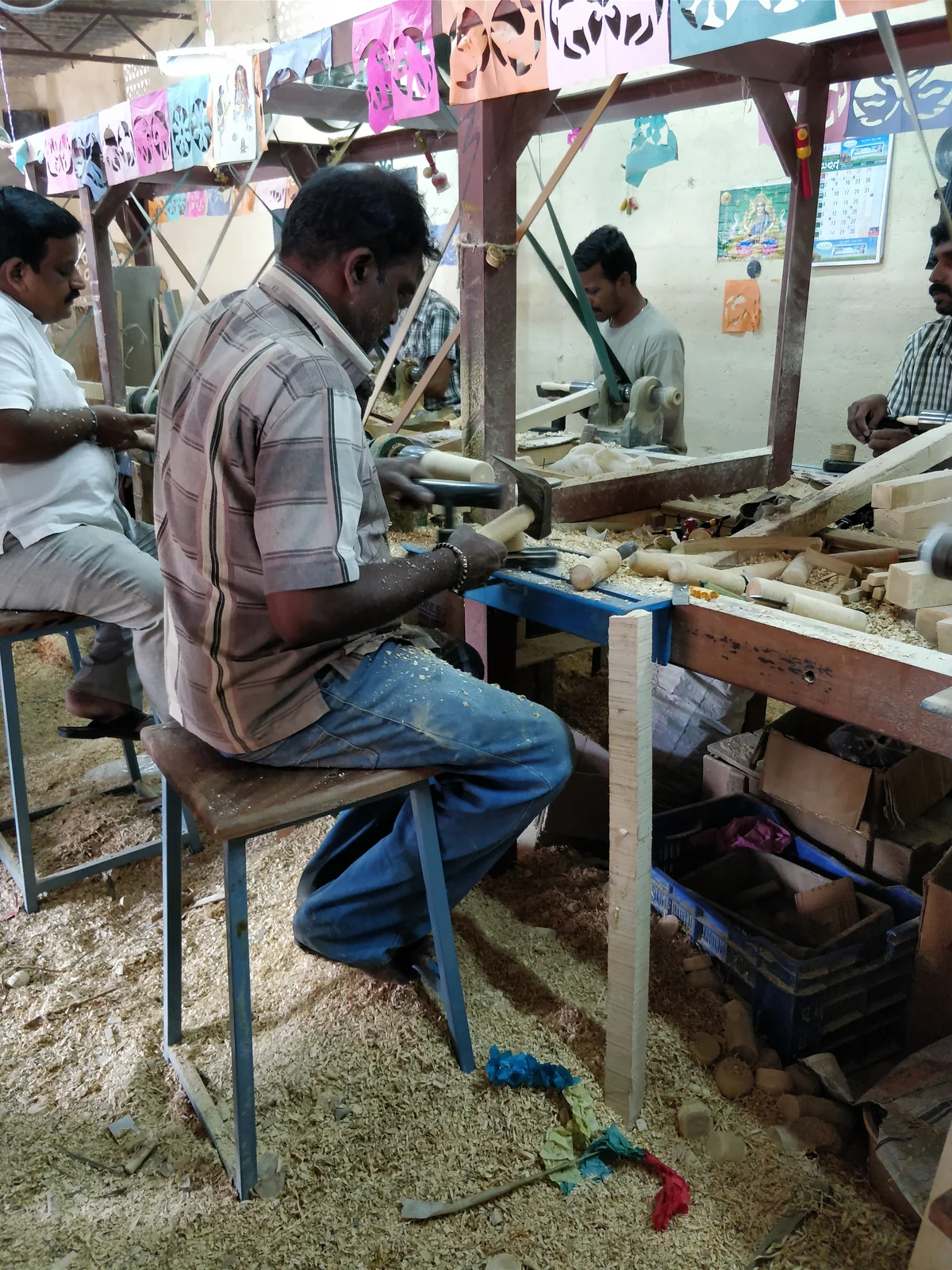
The D’Source field account profiles Channapatna master craftsperson Kenchayya and his son Chandru as two generations practising toy making. The photograph on this page documents Channapatna artisans in a separate workshop record. For the history of a particular object, use the maker’s own details together with the listed technique and the registered geographical area.
Bidriware from Karnataka and blue pottery from Rajasthan
Bidriware is associated with Bidar and documented as metalware with inlaid decoration. Blue Pottery of Jaipur is documented with a quartz-based body and a glaze. In listings for bowls, vessels or other decorative pieces, begin with the material beneath the finished surface. For Bidriware, ask what the body is made of and how the decoration was inlaid. For Jaipur blue pottery, ask what the body is made of and how the surface was glazed. The replies help you identify which description in the craft compendium is relevant.
If you are comparing two listings from photographs, a close view of the decoration and a view of the rim or underside will give you more information than another front-facing image. A metallic-looking line in a photograph leaves the decoration method uncertain. A blue glazed surface leaves the composition of the body uncertain. Ask the seller for a material and technique description tied to the actual piece. For a catalogue, use ‘inlaid’ or ‘quartz-based’ when the documentation supports that wording. Until then, describe the visible decoration and retain the seller’s material description as an attributed claim.
The shape of an object can also prompt a question about use. A vessel offered as a display piece may come with a description of its finish and very little information about how it handles washing or contact with food. If those properties matter to your purchase, request care and intended-use information for that item. Keep it with the item description so that anyone using the piece later has the same information. The registry entry supplies the product name and geographical field, while the compendium describes the craft process.
Odisha painting and Gujarat embroidery
Orissa Pattachitra is the registered product name, with Odisha in the geographical-area field. Use both when recording a source so readers can recognise the state name and find the registry entry. The craft compendium documents painted cloth as an example. When documenting a particular painting, ask what surface it was made on and describe that surface only as specifically as the evidence allows. A broad listing title such as ‘Pattachitra painting’ leaves the regional tradition open. Record the place and maker given for the work before attaching the Odisha registry name to the description.
Kutch Embroidery is registered under Gujarat. The name and the journal material define the relevant scope more precisely than the state field can on its own. For an individual textile, ask who did the embroidery and where that work took place. A finished bag, garment or furnishing can involve different contributors. If a seller gives you a brand or a shop name, ask how that organisation relates to the embroidery. Credit the embroiderer or producing group when they can be identified, and record any other documented roles separately.
If two textiles are offered as Kutch Embroidery and only one has a label naming a producing group and its location, use the label as a starting point for a follow-up. Ask whether the group carried out the embroidery on the textile in front of you and whether the seller has an item label or order record connecting the two. This matters when a shop carries pieces from several sources under one display title. A useful directory entry lets a reader see which attribution applies to the particular textile.
Maker credits and workshop evidence
D’Source profiles Channapatna master craftsperson Kenchayya and his son Chandru as successive generations of toy makers. Their names belong with the documented workshop account. To credit either person for a particular toy, look for an item-level record that makes the connection. KartikMistry’s workshop photograph shows artisans making toys in Channapatna, and the photograph’s source leaves the subjects unnamed. A caption can credit the photographer and identify the activity and place. The profiles of Kenchayya and Chandru should be credited separately to D’Source.
For a purchase or directory entry, start with the name under which the person or group wants to be credited, then establish the relationship to the object. A maker may have shaped, painted or embroidered it. A workshop may have coordinated the work, and a retailer may have supplied it. Ask for the production location in addition to the address where the object was sold. If the seller can provide a maker card, invoice or catalogue entry, retain the description or reference that ties it to the actual piece.
When a registry record supplies authorized-user details, as the Channapatna and Kutch records do, look up the name the seller gives you and establish whose name the record concerns. A seller may identify an upstream producer whose name appears there. In that case, ask how the seller obtained the piece and what record connects it to that producer. Keep the registry finding and the account of the supply chain as two entries in your notes. That preserves the strongest attribution you have even if the individual artisan remains unnamed.
How to check a GI record when details change
Open the Intellectual Property India registered GI list and use the full product name and application number to locate the individual record. Check the status and geographical-area fields, and note the certificate number if you need a stable reference in your own records. Separate logo entries can appear in the results. For example, Blue Pottery of Jaipur is application 66, and Blue Pottery of Jaipur (Logo) is application 540. Orissa Pattachitra and Kutch Embroidery also have separate logo records. Confirm which entry you have open before copying any fields.
Copy dates with their field names when those dates are relevant. The main record for Kondapalli Bommallu gives a filing date of 10 November 2005 and a certificate date of 12 January 2006 for Certificate 30. It separately lists journal availability on 18 September 2006. The Blue Pottery of Jaipur record gives a filing date of 14 August 2006 and identifies Certificate 74. Its main certificate-date field shows 10 July 2008, while the accompanying document list has a certificate entry dated 27 October 2007. Use the filing date and certificate number for a compact reference, and preserve the field labels if reporting both dates.
For an entry intended to stay current, revisit the product record before publication and check any authorized-user information you plan to rely on. If a detail has changed, keep a note of the field you read and the date you checked it. For a claim about when a craft began, look for a historical source that addresses the practice itself. Filing, certificate and journal fields describe the registry record. A historical account may concern a particular workshop, community or technique, so check that its subject matches the claim you want to make.
- Intellectual Property India: Registered Geographical Indications
- GI Registry — Channapatna Toys & Dolls, application 23
- GI Registry — Bidriware, application 20
- GI Registry — Kondapalli Bommallu, application 44
- GI Registry — Blue Pottery of Jaipur, application 66
- GI Registry — Orissa Pattachitra, application 88
- GI Registry — Kutch Embroidery, application 103
Sources
- Intellectual Property India: Registered Geographical Indications
- GI Registry — Channapatna Toys & Dolls, application 23
- GI Registry — Bidriware, application 20
- GI Registry — Kondapalli Bommallu, application 44
- GI Registry — Blue Pottery of Jaipur, application 66
- GI Registry — Orissa Pattachitra, application 88
- GI Registry — Kutch Embroidery, application 103
- Development Commissioner (Handicrafts) — Government of India GI craft compendium
- D'Source, IIT Bombay design resource — Channapatna making process
- D'Source — named master craftsperson account from Channapatna Toy II
- Wikimedia Commons — Channapatna artists making toys, KartikMistry
