How to identify the tradition a painting belongs to
Identify a painting from India by checking its original setting, physical format, place of production and date, then reading its subject alongside those details. Ajanta’s Buddhist cave murals, a Mughal court album folio and a nineteenth-century Kalighat album leaf belong to distinct painting contexts that a broad label such as “Indian art” leaves unspecified.
Start by asking what the catalogue is describing. A cave entry covers architecture and paintings across a site. A folio entry describes a leaf that may have two worked faces. An album entry can bring several elements together, each with its own date or attribution. A museum photograph might show just one face or one part of the object. Establishing the unit gives you a way to judge which details in the caption apply to what you see.
Keep place, subject and material in separate fields when comparing objects. Marwar is the regional attribution of a particular Ragamala page. The series identification tells you about its musical theme, while ink and opaque watercolor identify the materials listed for that leaf. The Hyderabad manuscript examples also use opaque watercolor on paper. That shared medium gives you a basis for comparing the handling of colour on paper, while the place and manuscript records supply the evidence for identifying each work.
| Work or context | Place or school | Date in source | Medium or viewing setting | Collection or record |
|---|---|---|---|---|
| Ajanta painted cave interiors | Ajanta, Maharashtra | Early caves second–first centuries BCE, major decorated later phase fifth–sixth centuries CE | Cave painting and rock-cut architecture | UNESCO 242 |
| Shah Jahan and Dara Shikoh | Mughal court album | About 1620 for the painted verso | Album folio on paper, reverse side has a separate date | Met 55.121.10.36 |
| Ladies in a Pavilion | Marwar, Rajasthan | About 1640–50 | Ink and opaque watercolour on paper, dispersed Ragamala page | Met 55.121.28 |
| Manaku’s painting practice at Guler | Guler, Pahari workshop context | Artist active around 1725–1760 | Drawings and paintings document stages of making | Met research on Manaku |
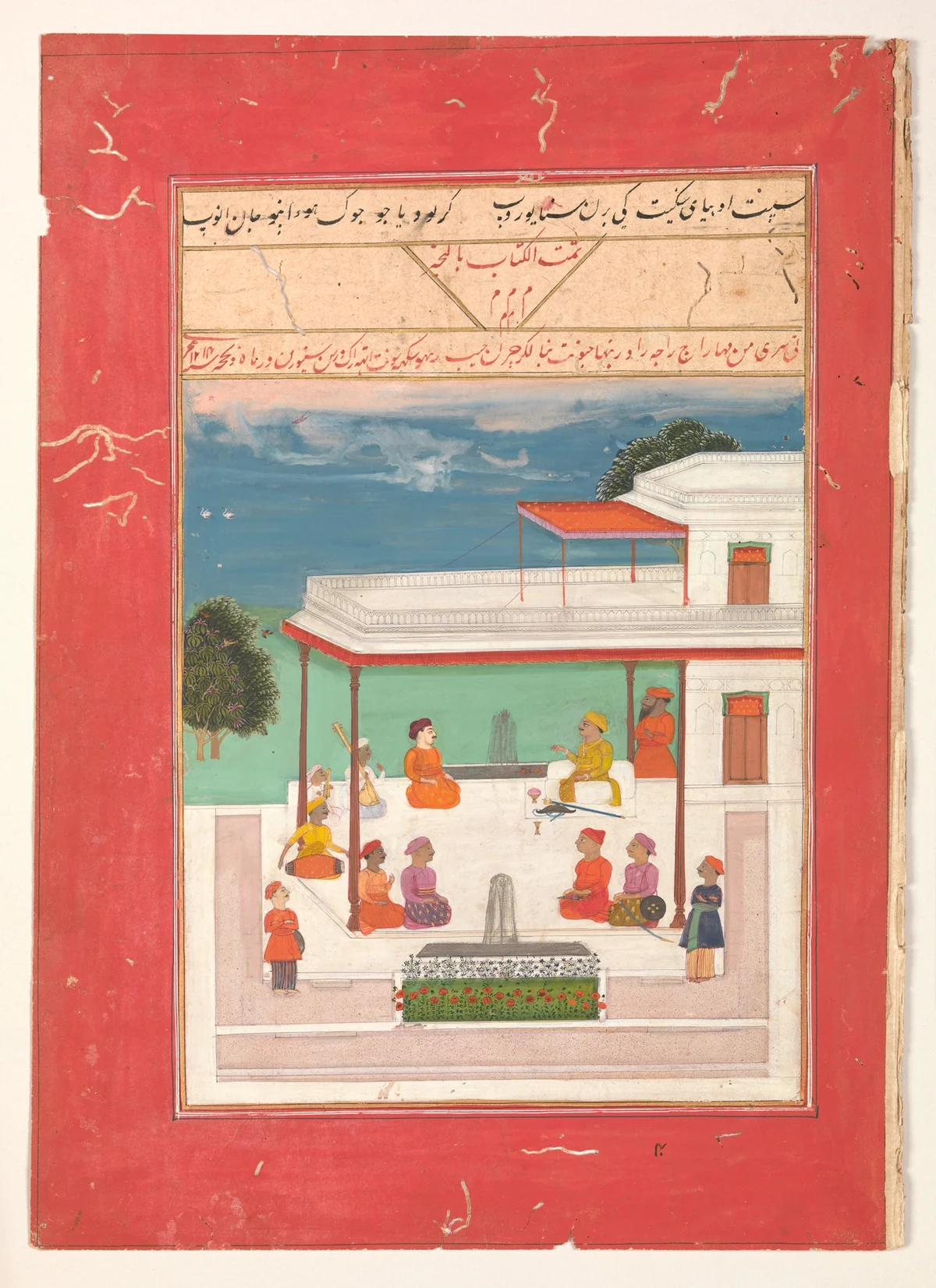
| A Raja and a Guest Listening to Musicians | Hyderabad | 1799–1800 CE | Opaque watercolour on paper, manuscript folio | Met 2007.35 |
| Two Aspects of Kali | Kalighat, Kolkata | About 1890 | Gum tempera, graphite and ink on paper | Cleveland Museum 1980.216 |
- Metropolitan Museum of Art: Folio from the Raga Darshan of Anup
- Metropolitan Museum of Art: Ladies in a Pavilion
- UNESCO World Heritage Centre: Ajanta Caves
- Metropolitan Museum of Art — Shah Jahan Album folio, accession 55.121.10.36
- Metropolitan Museum of Art — Guler painting and workshop stages
- Metropolitan Museum of Art — A Raja and a Guest Seated on a Terrace Listening to Musicians Perform, accession 2007.35
- Cleveland Museum of Art — Two Aspects of Kali, accession 1980.216
Ajanta murals and the space around them
At Ajanta, painting is physically integrated into Buddhist rock-cut architecture. The earliest Buddhist cave monuments belong to the second and first centuries BCE. Richly decorated caves were added in the fifth and sixth centuries CE. Those periods describe phases of the site. If you encounter a close photograph of a painted figure, you need the cave or scene identification before you can attach a more specific date to the image. The site chronology alone gives you the range of building and decoration contexts.
Read an architectural view alongside a detail when both are available. First locate the painted area in the cave interior and register how much of that surface the photograph includes. Then use the detail to look at the figure or group. A crop lets you inspect gestures and outlines. The wider view supplies the position and scale that the crop can hide. It may also show how adjacent painted areas guide your eye from one group to another.
This changes what you record in a comparison with a painting on paper. For a folio, dimensions help you recover the scale of a leaf that might have been enlarged on your screen. For a mural detail, identifying its position within the cave is an equally important first step. A useful caption preserves that connection to the room so a reader can place the detail even when the accompanying image fills the page.
Ancient Indian art and symbols at Ajanta, Sanchi and beyondIndian architecture, six buildings and what to look for
Mughal album painting and the dates on either side
A Shah Jahan Album folio at the Metropolitan Museum of Art shows why album paintings need face-specific captions. On accession 55.121.10.36, the museum attributes the painted scene of Shah Jahan and Dara Shikoh on the verso to Nanha and dates it to about 1620. It catalogues the recto, the other face of the same leaf, around 1530–50. The two dates make sense once you know which face each entry describes.
Think of a court album page as an assembled object. Painting, calligraphy and margins can have distinct histories, and their later assembly adds another stage. When examining a reproduction, work from the pictured area outward. See where the central field ends and where the surrounding material begins. Then match the image label to the catalogue description. You can describe what you observe in the margins while keeping the attribution to Nanha attached specifically to the painted scene.
If a caption needs to identify the image of Shah Jahan and Dara Shikoh, the scene, verso designation and date of about 1620 are the relevant details. An entry about the physical leaf can give both dates with their respective sides. This distinction matters when thumbnails circulate independently of the museum entry. The museum’s accession number takes you to the leaf, and the face label takes you to the particular work reproduced.
Marwar Ragamala and the difference between subject and place
The Met catalogues Ladies in a Pavilion as a page from a dispersed Ragamala series, attributes it to Marwar in Rajasthan and dates it to circa 1640–50. Its materials are ink and opaque watercolor on paper. Ragamala is a subject category associated with music that appears across regional styles. The Marwar attribution belongs to this object. Keeping both terms in an identification lets the reader search for related musical paintings or for other works attributed to the same region.
The word “dispersed” is also part of the identification. It tells you that the leaf is catalogued as part of a series whose pages have become separated. To look for related leaves, start with the catalogue’s series description and compare the attribution on each candidate record. A pavilion or a similar grouping of figures may give you something to compare visually. The recorded series association gives you firmer ground for presenting two pages as related.
Put this page beside the Met’s Hyderabad image of a raja and a guest listening to musicians. The Marwar title identifies ladies in a pavilion, with the musical connection supplied by the series identification. In the Hyderabad record, musical performance is part of the described action. That makes the pair useful for seeing how a subject can be established at different levels, from what a scene depicts to the larger work in which the leaf belongs.
What Guler workshop studies reveal about making a painting
The Met’s study of Manaku, who was active at the Guler court around 1725–1760, uses unfinished and completed Pahari works to examine stages from drawing to colour. Begin with the unfinished work. Follow the lines that establish a figure or divide the pictorial space, then move to the completed work and see how colour articulates those areas. Starting with the drawing makes it easier to notice compositional decisions that may recede once the surface is filled.
A line in an unfinished work can give you a specific question to carry into the comparison. Look at where the outline sets the edge of a figure and how the adjacent space is shaped around it. In a completed work the same kind of boundary may be visible through a meeting of colours. You can then describe how drawing and colour work together, using features you can actually find in the images.
Keep the scope of that comparison tied to the museum’s examples. The dates describe Manaku’s activity at Guler. They are useful context for the study and should sit alongside individual dates where the museum supplies them. Likewise, Guler gives the reader a specific court to associate with the case. The broader Pahari designation helps locate the works in a regional discussion whose other courts and painters need evidence of their own.
The Met’s Manaku study uses unfinished Guler works to follow how a drawing developed into colour. The Cleveland Museum’s Kalighat leaf illustrates a different technical combination, including graphite and ink as well as gum tempera. This kind of comparison helps explain local craft choices without assigning one technique to every painting from a region.
Two Hyderabad folios with the same manuscript title
The Met records two distinct Hyderabad folios from the Raga Darshan of Anup dated 1214 AH, or 1799–1800 CE, both in opaque watercolor on paper. Accession 2007.35 shows a raja and a guest listening to musicians on a terrace. That scene is the one documented in the supplied Open Access photograph. Its catalogue title gives you a precise way to identify the image and to use it as an example of musical performance pictured in a manuscript.
The other folio, accession 2007.36a, b, measures 36.4 × 25.6 centimetres. It has paintings on opposite faces that accompany verses by Mah Laqa Bai Chanda. The museum identifies Holi in the lower scene on the face it discusses. Attach the Holi identification to that specific scene and use the museum’s image label to establish which face you are viewing. The dimensions and the connection with the verses belong to this record.
When you find a reproduction under the manuscript title alone, check the scene against the museum’s accession record. A terrace performance points you to 2007.35. A reference to Holi or to paintings on opposite faces sends you to the companion record for closer inspection. The repeated title, date and medium establish what the leaves share. The accession and scene details resolve which one a caption or discussion is about.
The lead image shows the raja and guest with musicians, accession 2007.35. The separate folio catalogued as 2007.36a, b includes a Holi-related scene in the museum’s description. In an essay or exhibit label, keep the accession number paired with the photograph and keep the catalogue’s indicated side when a folio carries paintings on both faces.
Indian handicrafts, six registered crafts and how to check provenance
Kalighat materials, image labels and current catalogue checks
The Cleveland Museum of Art dates Two Aspects of Kali, accession 1980.216, to circa 1890 and lists gum tempera, graphite and ink on paper. Its record provides separate links for the two paintings. Begin with the museum’s label for the individual image before describing its subject. The title and materials describe this album leaf, and the two image entries help you specify which depiction you are discussing.
For a material comparison, place Cleveland’s medium field next to the Met’s description of a Hyderabad folio. Both identify paper as the support. The Kalighat record lists tempera, graphite and ink, while the Hyderabad record lists opaque watercolor. If you can see an outline in an enlarged image, describe its shape and weight. Assigning that particular mark to graphite or ink takes more evidence than a medium field that lists both materials for the object as a whole.
To verify a detail that can change, search the holding institution’s collection by accession and open the current object entry. Compare the specific image label with the object title, then check the display field if you are planning to see it in person. For reuse, check the rights statement attached to the exact image file. The CC0 dedication supplied for the Met’s terrace photograph covers that reproduction. A different folio or photograph calls for its own record and rights statement.
- Metropolitan Museum of Art: Folio from the Raga Darshan of Anup
- Metropolitan Museum of Art — Shah Jahan Album folio, accession 55.121.10.36
- Metropolitan Museum of Art — A Raja and a Guest Seated on a Terrace Listening to Musicians Perform, accession 2007.35
- Cleveland Museum of Art — Two Aspects of Kali, accession 1980.216
- Metropolitan Museum of Art via Wikimedia Commons — open photograph of the Hyderabad folio
Sources
- Metropolitan Museum of Art: Folio from the Raga Darshan of Anup
- Metropolitan Museum of Art: Ladies in a Pavilion
- UNESCO World Heritage Centre: Ajanta Caves
- Metropolitan Museum of Art — Shah Jahan Album folio, accession 55.121.10.36
- Metropolitan Museum of Art — Guler painting and workshop stages
- Metropolitan Museum of Art — A Raja and a Guest Seated on a Terrace Listening to Musicians Perform, accession 2007.35
- Cleveland Museum of Art — Two Aspects of Kali, accession 1980.216
- Metropolitan Museum of Art via Wikimedia Commons — open photograph of the Hyderabad folio
