Check a payment in one coin denomination
Compare the face value of genuine circulation coins with the Coinage Act’s single-transaction limit for that denomination.
Twenty 50-paise coins total ₹10 and reach the legal-tender payment limit.
Illustrated guide
Check which rupee and paise coins are valid, compare payment limits and coin designs, and trace India’s change from annas to decimal coinage.
Compare the face value of genuine circulation coins with the Coinage Act’s single-transaction limit for that denomination.
Twenty 50-paise coins total ₹10 and reach the legal-tender payment limit.
India’s legal-tender circulation coins are 50 paise, ₹1, ₹2, ₹5, ₹10 and ₹20, including genuine issues in different valid designs. Coins of 25 paise and below ceased to be legal tender on 30 June 2011.
The Indian rupee has the currency code INR and the symbol ₹. One rupee equals 100 paise, so the 50-paise coin is worth half a rupee and two make ₹1. When reading a coin, check the unit as well as the numeral. A coin marked 50 paise belongs to the smallest denomination on the current RBI list.
The Government of India designs and mints coins, and the Reserve Bank of India puts them into circulation. The government also issues the one-rupee paper note, which the Coinage Act includes in its definition of a coin. A catalogue can still describe the note and the metal ₹1 coin separately because they are physically different objects.
| Coins | Legal-tender payment limit per transaction | Number of identical coins at the limit |
|---|---|---|
| 50 paise | ₹10 | 20 |
| ₹1 | ₹1,000 | 1,000 |
| ₹2 | ₹1,000 | 500 |
| ₹5 | ₹1,000 | 200 |
| ₹10 | ₹1,000 | 100 |
| ₹20 | ₹1,000 | 50 |
For a coin you recognise by denomination, its legal status is the first check. For an unfamiliar piece, identify the issue as well. The RBI’s list covers valid circulation designs across different sizes and themes. That matters when coins of the same value have different inscriptions or pictures, or when a coin carries a design you have only seen once.
Section 6 of the Coinage Act sets a legal-tender payment limit of ₹10 for half-rupee coins and ₹1,000 for coins of ₹1 or more. The RBI explains these as limits for a single transaction. The ₹1,000 figure applies to the group of denominations from ₹1 upwards. The counts in the table show how that limit works when every coin in the payment has the same value.
Suppose you have ₹1,020 in ₹20 coins. Fifty coins total ₹1,000, so a payment with all 51 coins would exceed the legal-tender limit for a single transaction. For a customer depositing the same coins into a bank account, the RBI FAQ says the RBI prescribes no limit on customer coin deposits. The purpose of the transaction determines which rule to consult.
The RBI’s exchange direction tells bank branches to accept coins for transactions or exchange and to make exchange available on working days to customers and non-customers. Use that direction to check what service a branch provides when you want to exchange valid change. Use the Act and currency FAQ to check the legal-tender amount for a payment, including one made outside a bank.
Section 6 also qualifies tender for coins that are defaced or have lost weight. A denomination you can still read may leave a question about the individual coin’s condition. If that is the issue, ask a bank branch about the piece itself and consult the current RBI exchange direction for the applicable guidance.
The calculator tests a payment made entirely in the selected denomination. It multiplies the number of coins by the face value and compares the total with the applicable limit. A mixed bag of change includes different denominations, and the bank exchange process is a separate use of coins. Check the statutory wording and RBI instrument for the type of transaction you have.
Start with the face value, then compare the shape, edge and arrangement of the metals with the specifications for the issue. An older genuine ₹10 coin can lack the rupee symbol and remain valid. When comparing it with a photograph, look for an image of the same issue. A single picture of a newer ₹10 coin shows only one of the designs you can encounter.
On 7 March 2019, the government unveiled a series covering ₹1, ₹2, ₹5, ₹10 and a new ₹20 denomination. The ₹20 was 12-sided with a smooth edge, while the other four were round. Increasing size and weight formed part of the series’ accessibility design. These features describe the series unveiled that day. The date of the launch tells you when it was presented, and individual banks could receive the coins at different times.
The Gazette rules dated 8 November 2021 describe a separate series marking the 75th year of Independence. Its ₹10 is round and bimetallic, with a brass-coloured outer ring and a lighter centre. Its ₹20 has 12 sides and a smooth edge, with the brass colour in the centre and the lighter metal around it. Shape and colour together help distinguish the two when their numerals are hard to read.
Both coins belong to a series that also includes ₹1, ₹2 and ₹5. The rules put the Ashoka Lion Capital and motto on the obverse and the campaign logo, denomination and mint year on the reverse. For a close comparison, check both faces against the Gazette schedule. The RBI’s exchange direction is the reference for whether a genuine circulation design remains valid.
| Coin | Shape | Colour layout |
|---|---|---|
| ₹10 | Round | Brass-coloured outer ring, lighter centre |
| ₹20 | 12 sides, smooth edge | Lighter outer ring, brass-coloured centre |
The RBI’s 2025–26 annual report records 1,432,889 lakh coins in circulation at the end of March 2026, with a combined value of ₹40,814 crore. The ₹1, ₹2 and ₹5 denominations together accounted for 80.7% of the pieces and 60.2% of the value. The first percentage counts every coin once. The second adds the rupee value each coin represents, so higher denominations carry more weight.
The ₹1 was the largest denomination by piece count, with 549,855 lakh coins, followed by ₹2 at 375,287 lakh and ₹5 at 231,658 lakh. The RBI recorded 101,542 lakh ₹10 coins and 26,667 lakh ₹20 coins. Those national totals describe the stock in circulation on the reporting date. How often each denomination comes back as change at a particular shop is a separate question.
The 50-paise coin illustrates the difference between circulation stock and mint supply. The report records 147,880 lakh half-rupee coins in circulation at the end of March 2026, the same published quantity for each of the three March dates shown. The table of supply from mints for 2025–26 has rows for ₹1 through ₹20 and no 50-paise row. The RBI’s exchange direction still lists 50 paise as legal tender.
To check a newer figure, find the Currency Management chapter of the latest RBI annual report. Look for the date attached to the circulation table and distinguish the number of pieces from their total rupee value. For a claim that a coin has been withdrawn, check the latest exchange direction and any withdrawal notice. A change in supply or stock serves a different purpose.
| Denomination | Volume, lakh pieces |
|---|---|
| 50 paise | 147,880 |
| ₹1 | 549,855 |
| ₹2 | 375,287 |
| ₹5 | 231,658 |
| ₹10 | 101,542 |
| ₹20 | 26,667 |
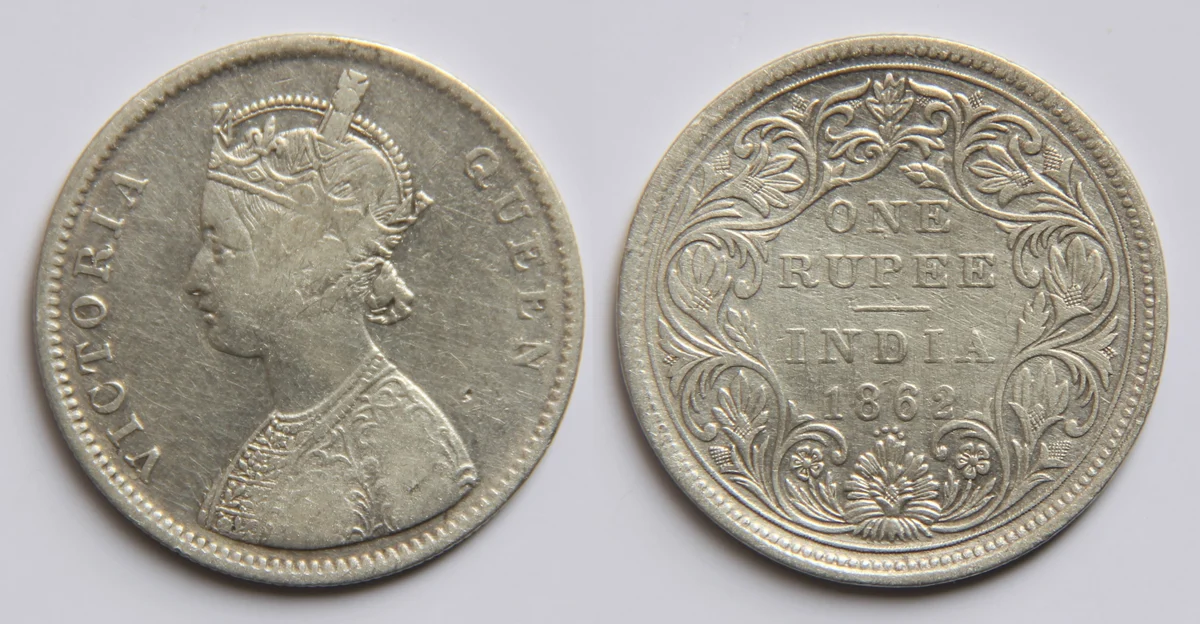
The RBI Currency Museum traces uniform colonial issues to the Coinage Act of 1835 and dates the first issues under the British Crown to 1862, after the East India Company period. An 1862 silver rupee with Queen Victoria’s bust belongs to that Crown coinage. Its reverse places the denomination and date within a wreath. Together those details identify a particular historic issue that shares its denomination name with the modern ₹1.
Independent India went through a transition before the Republic’s first Anna Series appeared on 15 August 1950. The Lion Capital replaced the monarch’s portrait, and the ₹1 reverse showed sheaves of grain. The series retained the existing system of 16 annas to a rupee, four pice to an anna and three pies to a pice. The designs and the units therefore tell different parts of the chronology.
For a tray label reading ‘four annas’, divide four by 16 to get a quarter of a rupee in that system. The corresponding fraction in today’s units is 25 paise. That arithmetic explains the historical face value. Keep the original unit on the label so a reader can distinguish an anna coin from a later decimal coin with the same fraction of a rupee.
Decimalisation took effect on 1 April 1957, dividing the rupee into 100 paise. The term naya paisa distinguished the new unit from the earlier one, and the qualifier naya was dropped on 1 June 1964. Use the date and wording together when placing a coin in this transition. The museum’s views of both faces give you features to compare when a date or inscription is partly worn.
The Gazette notification dated 20 December 2010 withdrew coins of 25 paise and below from legal tender for payments and on account with effect from 30 June 2011. The RBI’s April 2011 circular reproduces the notification, and its current exchange direction repeats the effective date. The RBI’s public notice gave 29 June 2011 as the deadline for the exchange arrangement offered at the time.
If a drawer contains a 25-paise coin and a 50-paise coin, sort them by denomination before considering what to do with them. The 25-paise piece falls under the withdrawal. The 50-paise piece remains in the RBI’s legal-tender list and, subject to the applicable condition and payment limit, can still be tendered. The age of the two coins may look similar while their status differs.
The old exchange deadline explains what holders could do during the withdrawal. For a coin found today, check the latest RBI direction before assuming any face-value exchange is available. When cataloguing a withdrawn coin, record its face value and its withdrawal status separately. A coin can retain a legible denomination long after that denomination has ceased to function as money.
An anniversary design can appear on ordinary change. A ₹20 with the 75th year of Independence design has a face value of ₹20 and belongs to the series specified in the 2021 rules. Special commemorative issues also exist at face values such as ₹125. If you come across an unfamiliar denomination, identify the issue before deciding where it fits.
The Coinage Act authorises denominations up to ₹1,000 and includes appropriately issued commemorative coins in its definition of coin. It also defines issuing as putting a coin into circulation. To interpret a special piece, check the rules for its denomination and design and look for official information about its issue. The statutory ceiling describes the government’s minting authority. The RBI’s circulation list answers which denominations belong to ordinary change.
For a collector’s description, record the visible denomination, date, inscriptions and physical features, with views of both faces. Keep any assessment of collector value separate from the face value. The 1862 silver rupee photograph, for instance, supports identification through the portrait, wreath and date. An assessment of an individual specimen’s authenticity, condition or market value requires evidence about that particular piece.
