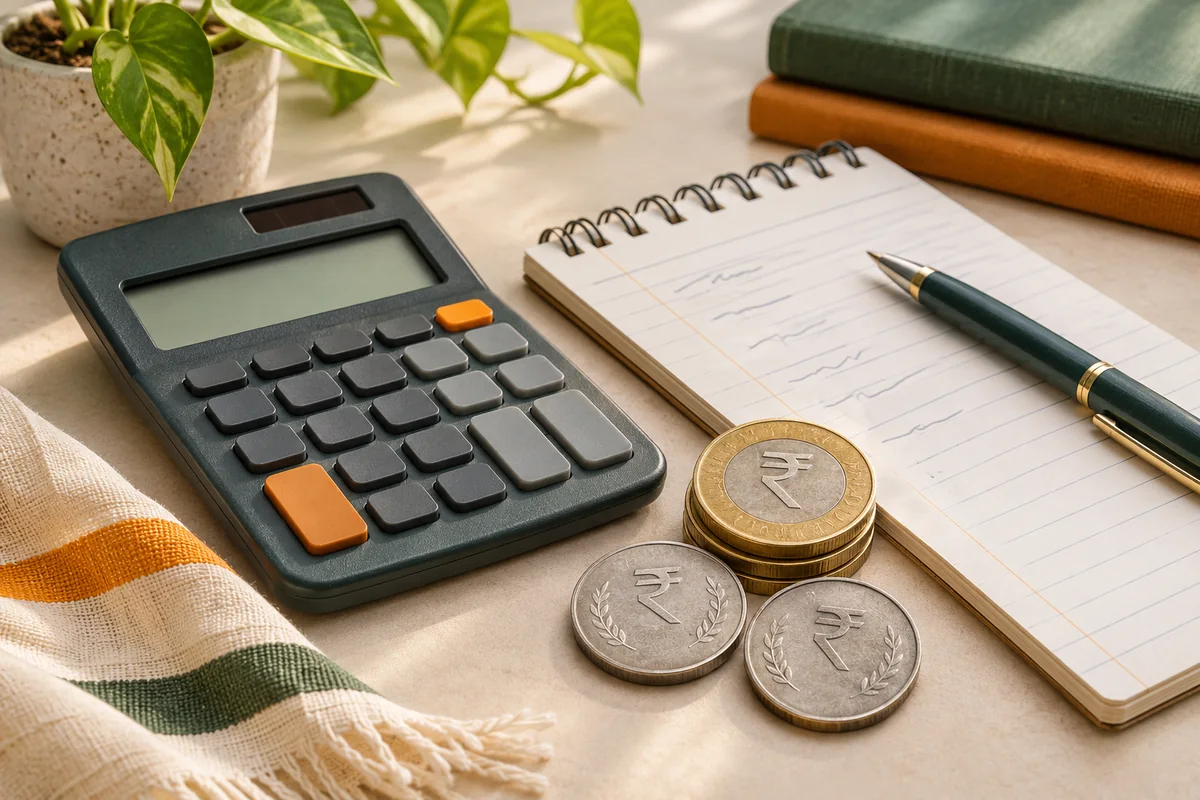
India’s currency name, code and symbol
India uses the Indian rupee, written with the symbol ₹ and the currency code INR. One rupee equals 100 paise, so ₹1.50 means one rupee and 50 paise.
You can read ₹ and INR as two ways of identifying the same currency. On a price label, ₹ tells you what the number is measured in. On a booking screen or a form with a currency selector, INR does that job. If a document puts INR in a column heading, it can apply to every amount in that column, even when each row displays only a number.
A booking page shows ₹1,200 and the downloadable receipt shows INR 1,200. Both amounts are 1,200 Indian rupees. If the receipt also lists an amount in another currency, read the headings and line labels before comparing the figures. One line might show the merchant’s price while another displays the equivalent amount in the currency selected for payment.
If a screen spells out only “rupees,” look for the currency code somewhere on the same quote or payment screen. INR identifies the Indian rupee even when the seller uses a short label. For a form with separate amount and currency fields, put the number in the amount field and select INR in the currency field.
| Example display | Read it as | Detail to check |
|---|---|---|
| ₹84 | 84 Indian rupees | The ₹ sign identifies the currency. |
| INR 84.50 | 84 Indian rupees and 50 paise | The decimal part represents paise. |
| ₹0.50 | 50 paise | The amount is half a rupee. |
| 84.50 under an INR heading | 84 Indian rupees and 50 paise | The heading supplies the currency for the amount. |
Reading paise, decimals and digit grouping
The digits after the decimal point express a fraction of a rupee. With two decimal places, they give the number of paise directly. A trailing zero can matter when reading aloud or copying a figure. For example, ₹36.05 is 36 rupees and five paise, while ₹36.50 is 36 rupees and 50 paise. ₹36.00 is exactly 36 rupees.
Commas can also change position across displays. Indian digit grouping puts a comma before the final three whole-number digits and then groups earlier digits in pairs. For example, ₹1,25,000 and INR 125,000 both represent 125,000 rupees. In Indian numbering, that amount is one lakh twenty-five thousand rupees. The comma positions affect how the number is written, and the decimal point still separates whole rupees from the fractional part.
When copying a quote into a calculator, check the digits on each side of the decimal point against the original. For an invoice total of ₹1,25,000.50, the amount field may accept 125000.50 and the currency field can carry INR. Check the calculator’s interpretation if it accepts pasted numbers with commas. The figure it parses should still contain 125,000 whole rupees and 50 paise.
A receipt can use paise to show the exact result of a calculation. The decimal places give you the amount to reconcile against the payment record. If you are settling in cash, the denominations available at the counter determine which amounts can be assembled. If the seller quotes a different cash total, ask them to identify the payable amount and explain the difference before you hand over money.
Who issues Indian notes and coins
The Reserve Bank of India issues Indian banknotes. The Government of India issues coins and the one-rupee note. The one-rupee note is the exception to the usual banknote issuer, which matters when you read issuer information on a piece of cash or in a reference guide. Both issuers’ cash is denominated in the same currency.
A denomination is the face value of a particular note or coin. It answers how much that individual piece represents. The amount you owe can be made up from several pieces. Example. A cash bill of ₹180 can be settled with ₹180 in combined face value if both sides can make the total with the cash on hand. If you tender ₹200 against that bill, the difference is ₹20.
Treat the printed face value and the status of the denomination as two separate facts to look up. The face value lets you identify the item for an official search. The current guidance tells you how to treat it. The issuer distinction can help you identify what you have, but an issuer name alone cannot establish an individual note’s authenticity or whether a particular notice covers it.
Checking a note’s validity and circulation
The RBI distinguishes whether a denomination is valid from whether it circulates. Validity concerns its status as money under the applicable official notice. Circulation concerns its presence in use and distribution. A banknote can be unfamiliar or seldom seen and still require a separate check of its validity. The fact that a denomination is mentioned in an older guide gives you a starting point for that check.
Start with the RBI currency FAQ for the terminology, then search the RBI’s updates for the face value and any series or design details identified in the guidance. Read the newest directly applicable notice and look for later updates that change it. Check the date the notice took effect, the items it covers and whether it describes validity, circulation, or a particular procedure for handling notes. Each detail can have a different practical consequence.
The RBI’s June 2026 consolidated notice gives a direct example. It says ₹2,000 notes were withdrawn from circulation and continue to be legal tender. It also directs readers to arrangements at RBI Issue Offices. Check the notice and subsequent RBI updates for the latest procedures if you have one of these notes. A withdrawal policy and the legal status of a banknote are separate facts.
If you are checking what cash to carry for an immediate purchase, availability is a separate question. An RBI notice can establish the official status of a denomination. A merchant can tell you what payment methods they take and whether they have change at that moment. A refusal at one counter gives you information about that payment and is insufficient to establish the denomination’s official status.
Making a cash payment and checking change
For a small cash purchase, check the total and pick the combination closest to it from the cash you carry. The larger the gap between the total and the amount you tender, the more change the seller needs to make. If your only available note is much larger than the bill, ask whether the counter can make change or whether it offers another way to pay.
A counter quotes ₹135 and you tender ₹200. The expected change is ₹65. If the counter asks whether you have another ₹35, hand it over only after checking the revised arithmetic. Tendering ₹235 against ₹135 makes the change ₹100. This can simplify the return if the cashier has a way to make ₹100 and is short of the smaller amounts needed to make ₹65.
If a displayed total has paise and you receive a rounded cash quote, establish which figure will appear as paid. For example, a receipt displays ₹242.50 and the cashier asks for ₹243 in cash. The difference is 50 paise. Ask the cashier to confirm the amount they will record. For a foreign-currency payment, also keep the receipt or confirmation that states the amount and currency actually charged.
Understanding a rupee currency conversion
A currency conversion needs an amount, a source currency, a destination currency and a rate in a stated direction. A rate given as INR per USD tells you how many rupees correspond to one US dollar. Multiply a US dollar amount by that rate to estimate its value in rupees. Divide a rupee amount by that same rate to estimate its value in US dollars.
The European Central Bank publishes euro reference rates, including rates for INR, USD, GBP and CAD. Because each expresses how much of the named currency corresponds to one euro, you can calculate a reference rate between two of those currencies using the same dated observation. For INR per USD, divide INR per EUR by USD per EUR. The euro units cancel and leave rupees per US dollar.
Example using hypothetical rates. Suppose a single dated observation gives 90 INR per EUR and 1.20 USD per EUR. Dividing 90 by 1.20 gives 75 INR per USD. At that hypothetical rate, USD 40 corresponds to ₹3,000, and ₹3,000 corresponds to USD 40. The figures illustrate the calculation. For a GBP or CAD estimate, use the same operation with the corresponding rate per euro from the same observation.
Keep the rate units beside the result when comparing two quotes. Example. One screen describes a rate in INR per USD and another describes it in USD per INR. To compare them, take the reciprocal of one rate and label the resulting units before looking at the figures. Keep the available precision through the calculation and round the displayed result at the end.
The separate India IRL currency converter shows a dated reference table alongside the amount controls. It reports INR and the selected alternative currency using the same observation date. Match the source and destination currency before reading the result. Rates are displayed with a date so you can compare them with the figure on your own quote.
Verifying a rate date and comparing a payment quote
For a reference estimate, look up the observation date on the European Central Bank’s rate table and match both currency values to that date. The ECB generally publishes rates on working days around 16:00 Central European time, except TARGET closing days. Check the date shown on the data even if you are looking it up today. The latest published observation may be from an earlier working day.
The observation date tells you when the rate applies. A last checked time tells you when someone retrieved or verified it. If a calculator shows both, use the observation date to reproduce the conversion. If a required rate is missing for that observation, find the latest dated observation that contains both currencies and label the estimate with that date.
The ECB discourages using its reference rates for transactions. To compare a reference estimate with a payment quote, put both amounts in the same currency and check what the quote includes. For a purchase priced in INR, look for the final amount in the currency that will actually be charged and any separately stated fee. For an exchange quote, check how many rupees you will receive for the total amount you will pay.
A reference calculation estimates that a ₹3,000 purchase equals USD 40. A payment screen quotes USD 42 for the same purchase. Check whether USD 42 is the total charge and whether the quote includes any separately listed fee. If USD 42 is the full charge, it is USD 2 above the example reference estimate. The amount alone cannot show which part of the difference comes from the applied exchange rate.
Indian rupee currency converter and exchange ratesSend money from the USA to India, rates, fees and payout