What Ajanta and Sanchi can tell us
Start with Ajanta’s Buddhist murals and Sanchi’s Buddhist stupas and sculpture to see how ancient Indian art used painted surfaces, carved forms and entire monuments. To identify a symbol or date an image, work from the particular painting, carving or structure and its documented setting.
A reader looking for ancient Indian drawings may be picturing a line image that can be copied into a notebook. At Ajanta, the documented category is mural painting. A line illustration made from a mural can help you follow a contour, but it adds a step between you and the painted surface. It may omit colour or leave out adjacent figures. If an illustration gives the impression of a complete design, check how much of that design appears in the underlying photograph.
Sanchi offers a different scale of comparison. Here the stupa is a kind of Buddhist monument, and the site also preserves monasteries and other Buddhist structures. You can identify the type of subject in a site overview before investigating what a particular sculpted detail depicts. That distinction matters when a close crop makes a carving look like a freestanding object. A broader view can show the relationship between the visible detail and the structure that carries it.
These sites give the comparison a defined scope. Both preserve Buddhist material, and their records establish broad periods of work. The date and interpretation of an individual image still depend on more specific evidence. If your immediate question is what a shape represents, the visible form, its architectural setting and the institution’s identification are three different pieces of information. Keep track of which of those you actually have.
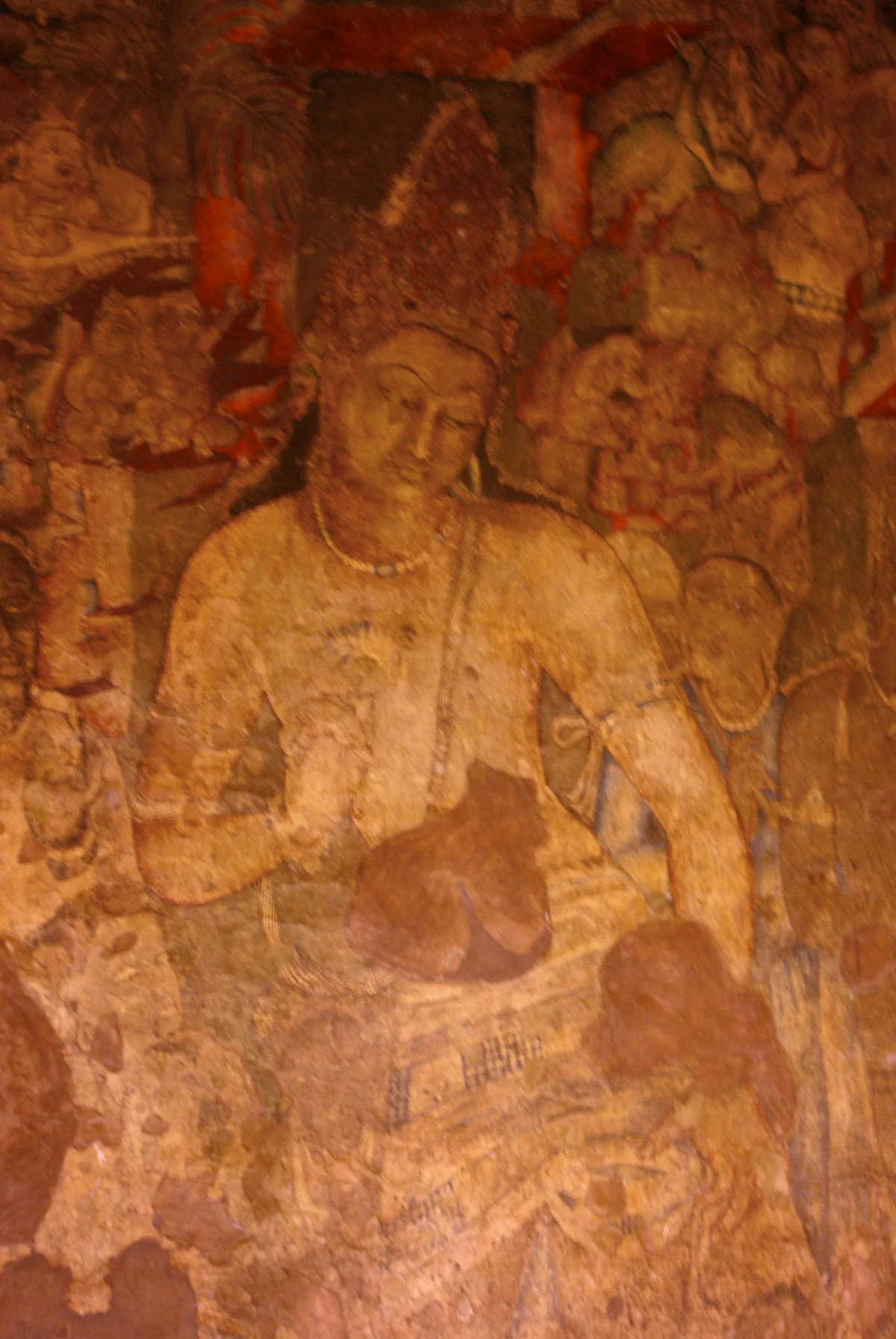
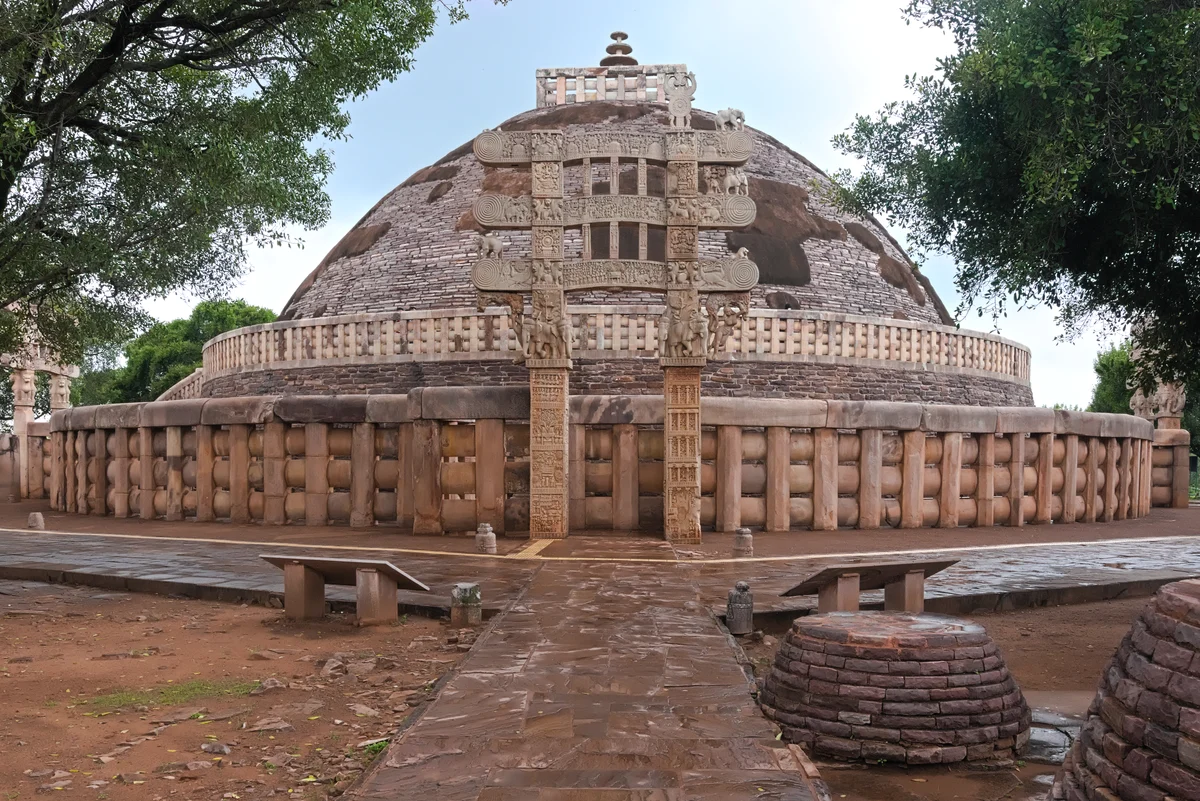
Three documented examples anchor the comparison. In Ajanta Cave 1 a painted bodhisattva holds a lotus. At Sanchi an eastern stone gateway marks a way into the enclosure around the Great Stupa. In the Indian Museum collection, a seated Buddha uses the teaching gesture and the lotus is part of a throne. The visual elements and the records for each object lead to different historical questions.
Dating a mural or sculpture at Ajanta
Ajanta’s Buddhist caves are cut into rock and include murals and sculpture. UNESCO dates the earlier monuments to the first and second centuries BCE and the later work to the fifth and sixth centuries CE. Those ranges describe two broad phases at the site. In a caption, make the subject of the date explicit. A date attached to the name Ajanta describes part of the site’s history, while a date attached directly to a photograph’s subject reads as a claim about that particular work.
For a particular mural, look for the cave identifier and a location within the cave. A wall, ceiling or other specified position can help you match a cropped photograph to its record. Then read the wording around any date. An entry may discuss the cave, a decorated surface or the image in question. Even when those subjects appear together in a single paragraph, the date may apply to only one of them.
Worked example. Suppose a photograph is described as an Ajanta mural and the accompanying text gives the full span of the UNESCO site description. If you can confirm the photograph’s identification as a mural at Ajanta, you can label it at that level and place the two phase ranges in a separate sentence about the caves. To attach a phase to the image, look for a record that identifies and dates that painting. A cave number would make the search more precise, and a matching surface description would give you a way to check that the record and the photograph concern the same subject.
The National Institute of Open Schooling identifies Padmapani Bodhisattva in Cave 1, dates the mural to the late fifth century and describes its medium as tempera on a wall. Look for the bent head and the blue lotus identified in its description. That object-specific date is much narrower than UNESCO’s ranges for construction across the caves. The fresco-like appearance of a wall painting is also insufficient to identify its method.
Dating structures and decoration at Sanchi
Sanchi, near Bhopal, preserves stupas, monasteries and other Buddhist monuments. Its earliest major structures date to the Mauryan period, and architecture and sculpture accumulated at the site over many centuries. This makes the word ‘Mauryan’ useful when describing the beginnings of major construction at Sanchi. When the subject is a particular photograph, identify the structure or carved surface before deciding whether the period belongs in the caption.
An exterior view and a close view answer different questions. The exterior may show which structure a record is describing. In a close view, you may be able to see what figures or forms appear together, yet lose the clues that place the carving within the monument. When you can match the two views, carry the name of the structure into your notes along with any more specific location. That gives you something searchable even when the decorative subject is uncertain.
Worked example. Suppose a close-up from Sanchi carries a period label in a gallery, with the site history as its only reference. Start by checking whether the gallery names the structure or gives an image identifier. Look for that identifier or a matching wider view in an institutional record. If you can establish the location but the record gives a date only for the structure as a whole, keep that date tied to the structure in your notes. Describe the photographed subject at the level you have confirmed, such as a sculpted detail, and leave its individual date open.
In the photograph below, start with the two uprights and horizontal carved beams of the eastern gateway. They stand in front of the circular railing and rounded mass of Stupa 1. Stupa 1 is the Great Stupa. Call the gateway a torana if the word helps identify the part in a catalogue. A wide view lets you locate the architectural feature before relying on a cropped panel to explain what was carved into it.

Describing a motif and checking its meaning
A motif is a recognisable visual element. Calling an element a symbol makes a further claim about what it signifies in a particular setting. The Buddhist context of Ajanta and Sanchi gives you a place to begin looking for interpretations. To use one in a caption, check whether it applies to the specific image, the larger scene or a motif discussed elsewhere. An interpretation of the scene may depend on the relationship between several figures or objects, including details outside the crop.
Start with observations you can point to in the image. Record the position of the form, whether it appears more than once and which other features touch or surround it. If part of the surface is difficult to read, keep that uncertainty in your description. Then compare your notes with the record’s wording. Terms such as ‘identified as’ and ‘possibly’ carry different levels of certainty. Preserve the distinction when you paraphrase, and keep the institution’s identification separate from observations you made from the photograph.
Worked example. Suppose a line drawing shows a circular outline with marks radiating from its centre. Record those visible features and look for the original image and a wider view of the scene. The crop could have removed the figure or structure that would let you match the detail to a description. If you find an institutional entry for the same image, check exactly what the entry identifies. If your only match is a similarly shaped feature in a different work, use the resemblance to guide your search and retain a description of the visible form in your notes.
Compare the lotus in Cave 1 with the one listed in the Indian Museum’s record 9440/A24784. The Ajanta record describes a lotus held by Padmapani. The museum catalogues a Buddha seated on a lotus throne supported by lions, with a deer and wheel motif on the pedestal. The teaching gesture, called dharmachakra mudra in the record, supplies another clue to subject. A photographed lotus by itself will rarely distinguish these two uses.
Tracing an image back to its subject
Provenance questions depend on what you are tracing. For a mural or a carved detail documented in place, start with the site, structure and position. If a record describes a detached object, look for a findspot where one is recorded and for the collection or custody history. The location where an object is held today and the location associated with its discovery answer different questions. A partial record can still support a precise caption if you state which location you can establish.
A photograph has its own history. The institution that describes the artwork, the person who took the photograph and the website displaying that photograph can be different parties. A credit to the institution may tell you where the description came from while leaving the photographer unidentified. Record the artwork and image details separately when you encounter them. A catalogue number for the artwork can help with identification, while a file title or photograph identifier helps you find the same reproduction again.
Worked example. Suppose a drawing credits a photograph, and the photograph’s caption names a site without specifying a structure. Follow the drawing’s credit to find the photograph it used. Compare the visible damage, edges and nearby forms if you find a potential match in a site record. If the match establishes the structure, you can credit the drawing as a drawing and identify its subject more precisely. Keep the drawing’s creator and the source photograph in your notes, since each contributes to the image a reader will see.
Choosing two images for a fair comparison
For a comparison of media, pair a documented Ajanta mural with a documented Sanchi sculpted detail and explain what each view lets the reader observe. A photograph of a painting can preserve the arrangement of colour and the placement of forms. A photograph of sculpture can show the surface and how a shape projects from it, with shadows that depend on the light in that particular shot. If you want to compare architectural settings, choose views that show how the work sits in the cave or on the structure.
Worked example. Suppose you can choose between a tightly cropped photograph with a broad site credit and a wider photograph whose record identifies the surface and its position. Use the wider image when the reader’s task is to locate the detail. If fine features are hard to see at that scale, a clearly labelled inset can direct attention to the relevant area, provided the image terms allow it. If the reader’s task is to compare dates, choose subjects with individually documented dates or ranges and use the site histories to put those dates in context.
| Work or structure | Medium and location | Feature to compare |
|---|---|---|
| Padmapani Bodhisattva | Wall painting, Cave 1, Ajanta | Tilted head and blue lotus held in the right hand |
| Eastern torana of the Great Stupa | Carved stone structure at Sanchi | Uprights and three tiers of carved beams in front of Stupa 1 |
| Buddha in dharmachakra mudra | Indian Museum, Kolkata, 9440/A24784 | Teaching gesture, lotus throne and deer-and-wheel motif |
Verifying credits and reuse before publication
Check reuse terms against the exact photograph, reproduction or drawing you plan to publish. The age of the ancient subject answers a historical question, while the terms on a modern image record address use of that image. Start with the individual listing, then follow any policy it refers to. Check whether the stated terms cover your intended publication, whether they allow changes such as cropping, and what attribution they require. If the record leaves the terms unclear, look for another image with clear terms or obtain permission for the proposed use.
Keep the image identifier, the rights statement you relied on and the wording of the required credit. Reopen the listing close to publication and verify that those details still resolve to the same image. If the listing has moved or the rights wording has changed, use the identifier to find the current record and check how it applies to the file you selected. Apply the same check to a replacement image, even if it depicts the same surface. A different photograph can carry a different credit and different terms.
Worked example. Suppose the selected photograph has a stated credit and the proposed layout places an enlarged detail beside the full view. Verify whether the terms cover that crop and how the credit should appear in the layout. If you can use the full photograph and the crop terms remain unclear, consider whether the full view answers the reader’s question at publication size. Where the fine detail is essential, an image with clear terms for the intended presentation lets you deliver the comparison and give the creator the appropriate credit.