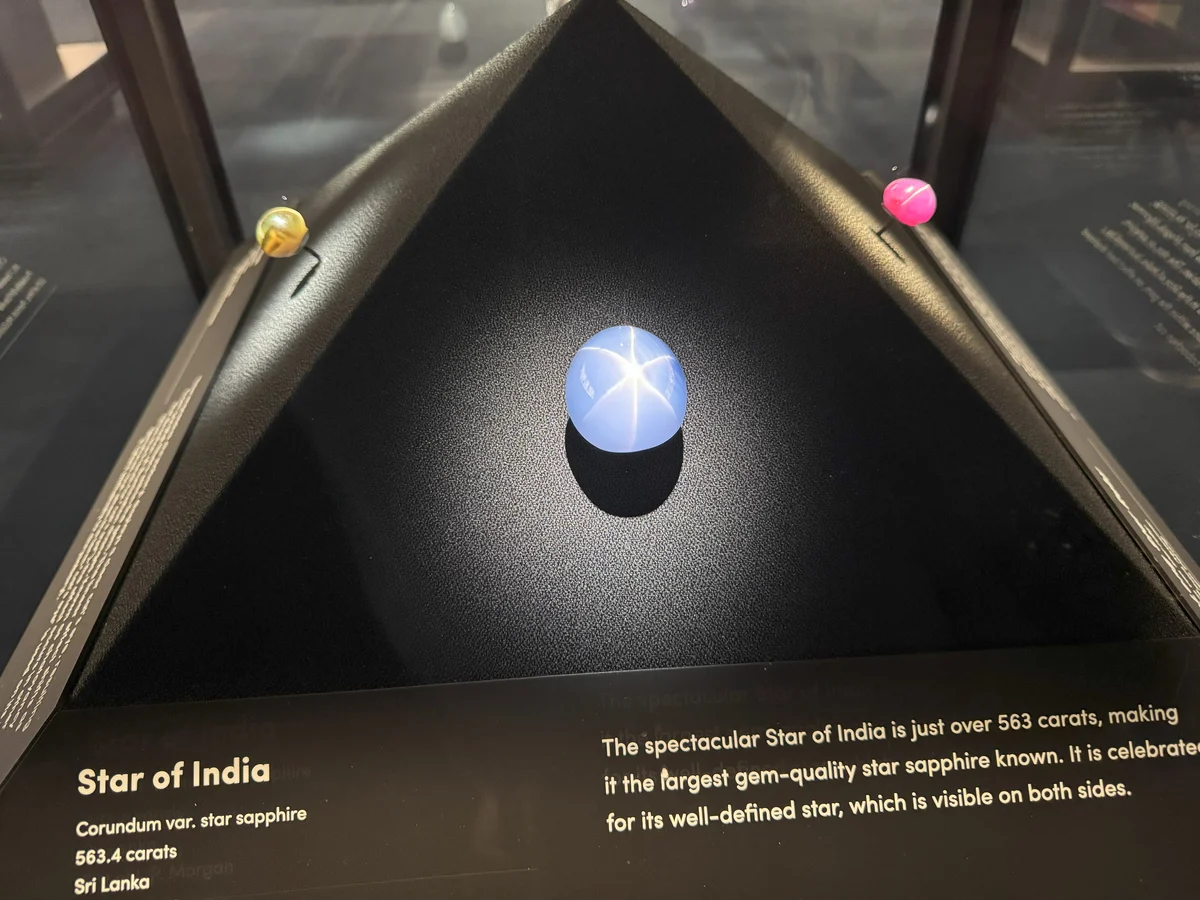
Which gem is the Star of India?
The Star of India is a 563.35-carat star sapphire mined in Sri Lanka and displayed at the American Museum of Natural History in New York City. It shows a six-rayed star on each face. The Black Star of Queensland is a separate, 733-carat black star sapphire found near Anakie, Australia.
The New York museum’s exhibition page rounds the Star of India’s weight to 563 carats. Its Research Library object record gives 563.35 metric carats, equivalent to 112.67 grams. Those figures describe the same sapphire at different levels of precision. The catalog figure is the better choice for a caption or comparison where weight helps identify the object, especially if the other stone also has “Star” in its name.
The Sri Lankan origin and the name “Star of India” belong in separate fields when describing the gem. The catalog gives the country where the stone was mined, while the museum displays it under its established name. The available object record leaves the origin of that name open. It also leaves the precise mine, discovery date and cutter unspecified. Each of those details would require evidence tied to this particular sapphire.
The museum estimates that the sapphire formed about two billion years ago. That estimate belongs to the geology of the crystal. Mining, cutting and entry into a museum collection are later events in the object’s history, and the estimate gives no date for any of them. For a dated account of how the stone came to public attention, the museum’s collection history provides a firmer place to start.
How the star appears on both sides
Sapphire is a variety of corundum. In the Star of India, the museum attributes the star to minute rutile inclusions within the sapphire. The inclusions are needle-shaped, and their orientation matters. Groups of needles aligned in different directions reflect light into narrow bands. Where three bands cross, each extends out from the intersection in two directions, producing six visible rays. Gemologists call the resulting effect asterism.
A cabochon presents a smooth, domed surface on which those bands can be seen together. As the positions of the light, the stone and the viewer change relative to one another, the bright intersection appears to move across the surface. A photograph captures that relationship at a single moment. The position of the star in the frame depends in part on the lighting and viewpoint used to make the image.
The Star of India’s nearly spherical cut gives it a feature worth looking for in the museum’s object description. A star is visible on each side. A photograph showing one face can illustrate the shape of the rays and how they meet, while the Research Library record supports the claim about the second face. If an illustration shows only one side, its caption can describe what is visible and leave the two-sided effect to the text.
Asterism helps explain why these gems attract attention, but its value for identifying an individual stone is limited. The Gemological Institute of America describes asterism as an optical effect. A visible star alone leaves a specimen’s identity, geographic origin and natural status unresolved. To connect a photograph to the New York sapphire, look for an object record or a documented exhibit image that ties the pictured stone to the museum and its collection.
George Kunz, J. Pierpont Morgan and the 1900 gift
The American Museum of Natural History traces part of its gem collection to two groups of stones assembled by George F. Kunz, a Tiffany gemologist, with financing from J. Pierpont Morgan. Kunz assembled the first group for the 1889 Paris Exposition. Morgan commissioned a second collection in 1900. The museum’s account supplies the connection between the two men and explains why both years appear in histories of the collection.
Geoscience Australia dates Morgan’s presentation of the Star of India to the American Museum of Natural History to 1900. That is the date to use for the gift of the sapphire. The 1889 date belongs to the earlier exposition collection. An account can include both events, provided the object-specific claim about the Star of India stays attached to the documented presentation in 1900.
The two institutional accounts answer different questions. The museum’s collection history identifies Kunz’s role in assembling collections financed by Morgan. Geoscience Australia identifies Morgan as the donor of this specific sapphire. The Research Library catalog adds the stone’s physical description and place of origin. Taken together, they support an account of how a Sri Lankan gem entered a New York museum, with the stone’s earlier passage from mine to collection still undocumented in these records.
The same distinction matters when reading dates on images. The Research Library catalogs a transparency of the Star of India made by E. and H. Van Pelt in 1990, under the identifier ptc-4759. That year dates the transparency. Its record can help match a reproduction to the museum’s photograph, while the date of the gift comes from the institutional history of the gem.
The 1964 theft and the 1965 recovery
The American Museum of Natural History dates the theft of the Star of India and other stones to 29 October 1964. A separate dated chronology from former FBI Special Agent William F. Beane records the sapphire’s recovery in Miami on 8 January 1965. Those two entries establish the dates and places of the events without relying on a retelling of the theft.
For the recovery date, the relevant part of Beane’s material is the dated entry that lists the Star of India among the recovered objects. That level of detail matters because a document about the wider case can also carry dates in a heading or in surrounding narrative. Use the date attached to the entry for the stone when tracing its movements, and keep the museum’s institutional date attached to the theft.
The recovery entry places the sapphire in Miami on that January date. It leaves the date of its subsequent return to the museum and the date it went back on public display open. The October entry also covers other stones, so a timeline for a second object would need to identify that object explicitly at each stage. An event recorded for the Star of India supplies evidence about the sapphire itself, even when other gems appear in the wider account.
| Date | Event | Documentary scope |
|---|---|---|
| 1900 | Gift associated with J. Pierpont Morgan | Museum collection record |
| 29 October 1964 | Museum theft | AMNH chronology |
| 8 January 1965 | Recovery in Miami | Lead investigator William F. Beane’s account |
How to tell the similarly named gems apart
The Star of Bombay is a separate Sri Lankan gem. The Smithsonian National Museum of Natural History identifies it as specimen NMNH G8845-00, a 182-carat oval cabochon of medium-dark blue corundum. The shared country of origin makes Sri Lanka a poor way to choose between the two names. The Smithsonian specimen number and 182-carat weight, or the American Museum of Natural History record and 563.35-carat weight, give a clearer match.
The Black Star of Queensland introduces a different distinction. Geoscience Australia records it as a 733-carat black star sapphire found near Anakie, Queensland. The same source describes the Star of India as a blue star sapphire. Since the Queensland stone weighs more, a broad claim that the Star of India is the largest star sapphire by weight would conflict with the two documented masses. If quoting the New York museum’s size claim, keep its gem-quality qualification and attribute the description to the museum.
| Name | Recorded weight | Recorded origin or identifying detail | Source institution or seller |
|---|---|---|---|
| Star of India | 563.35 carats | Sri Lanka | American Museum of Natural History |
| Star of Bombay | 182 carats | Sri Lanka, specimen NMNH G8845-00 | Smithsonian National Museum of Natural History |
| Black Star of Queensland | 733 carats | Near Anakie, Queensland | Geoscience Australia |
| DeLong Star Ruby | 100.3 carats | Myanmar, gift dated 1938 | American Museum of Natural History |
The DeLong Star Ruby shows why even a shared museum and a shared optical effect can leave room for confusion. The American Museum of Natural History catalogs the DeLong as a 100.3-carat ruby from Myanmar and dates its gift to 1938. Asterism can occur in ruby as well as sapphire. In a caption or collection search, the full object name and gem variety resolve the ambiguity more quickly than a description of the rays.
Kaufman Auctions used “Black Star of India” for a one-carat lot and explicitly described its accompanying certificate as unverified. This establishes that a seller used the phrase. A search result using those words can therefore refer to an actual listing while leaving the lot’s stated identity unconfirmed. The listing supplies no documented connection to either the New York sapphire or the Queensland stone. Its usefulness here is to explain how the wording can appear in a gem search.
- American Museum of Natural History: Star of India
- AMNH Research Library: Star of India Object Record
- Sapphire — Geoscience Australia
- Star of Bombay — Smithsonian National Museum of Natural History
- DeLong Star Ruby transparency — AMNH Research Library Digital Collections
- Example of auction-label use of Black Star of India — Kaufman Auctions
How to verify a photo, caption or museum visit
If you are deciding whether a picture labeled “Star of India” shows the New York sapphire, start with the image’s own record. Look for the named collection and an identifying detail such as the weight or catalog reference. A picture filed under Smithsonian specimen NMNH G8845-00 belongs to the Star of Bombay record, even if a repost supplies a different caption. Colour can be a weaker clue in a photograph because lighting and reproduction affect how the stone appears.
One documented exhibit photograph by Vicpeters, held on Wikimedia Commons, shows one face of the American Museum of Natural History gem. The photographer dates it to 14 May 2025. That date identifies the photograph, while the museum catalog supports the stone’s weight, origin and two-sided star. If the image is reproduced, credit Vicpeters and Wikimedia Commons, identify the CC BY 4.0 licence and indicate any crop or other change. The caption can then focus on identifying the gem and museum.
For a visit, the museum identifies the Mignone Halls of Gems and Minerals as the Star of India’s display location. Check the museum’s current exhibition and visitor information close to your trip for hall access, hours and any temporary closures. If seeing the sapphire is the main reason for the visit and the current information only confirms that the hall is open, ask the museum whether the specific stone is on view. The collection record can confirm the object’s identity, while the museum’s current visitor information is the place to confirm access.
Sources
- American Museum of Natural History: Star of India
- AMNH Research Library: Star of India Object Record
- Minerals and Gems Collections — American Museum of Natural History
- Star of India recovery — case chronology of former FBI Special Agent William F. Beane
- Sapphire — Geoscience Australia
- Star of Bombay — Smithsonian National Museum of Natural History
- DeLong Star Ruby transparency — AMNH Research Library Digital Collections
- A summary guide to phenomenal gems — Gemological Institute of America
- Example of auction-label use of Black Star of India — Kaufman Auctions
- Star Of India Gem2 — original exhibit photograph by Vicpeters
