Was the East India Trading Company real?
The East India Trading Company in Pirates of the Caribbean is Disney’s fictional version of the real English East India Company. Lord Cutler Beckett’s pursuit of Davy Jones is invented, while a surviving 1758 royal commission concerning the seizure of pirates documents a real connection between anti-piracy authority and East India Company records.
The names can cause confusion because Disney itself uses both forms. Its D23 entry for Dead Man’s Chest calls Beckett’s organisation the East India Trading Company. The separate entry for At World’s End shortens it to East India Company while describing the same Beckett. A reader looking up the shorter name may therefore find accurate film material alongside historical documents. The context of the result tells you which company the source is discussing.
For a film caption, East India Trading Company is supported by Disney’s Dead Man’s Chest synopsis. In historical prose, East India Company is a practical short name. For a transcription or a claim about a particular legal act, use the corporate name in the relevant charter or agreement. The full names matter because the historical record includes a rival company and a later United Company. A single label across the entire chronology can conceal which body existed or acted at the time.
- Disney D23 official film synopsis for Dead Man's Chest
- Disney D23 official film synopsis for At World's End
- British Library item IOR/A/1/2, copy of the original incorporation charter
- British Library item IOR/A/1/60, Queen Anne's tripartite indenture and the United Company
- British Library item IOR/A/1/82, actual Royal George anti-piracy commission
What Beckett controls in the films
Disney credits Tom Hollander as Lord Cutler Beckett in Dead Man’s Chest. The D23 synopsis describes a pirate hunter who wants the chest because it offers control over Davy Jones. That motive explains why the Company belongs in the plot. Beckett pursues a supernatural means of extending his power at sea, and the chest gives the competing characters something concrete to fight over. Disney dates the release to 7 July 2006 after a Disneyland premiere on 24 June.
In At World’s End, Disney’s synopsis describes Beckett exercising control over Jones and the ghost ship Flying Dutchman. It also identifies the Brethren Court and a Singapore sequence involving Sao Feng. The second synopsis thus shows what Beckett gains from the pursuit in the earlier film. Both entries are studio accounts of story events. They can support a plot explanation or a cast credit, while a quotation of spoken dialogue requires checking the scene itself.
The dates serve a different purpose. D23 gives 25 May 2007 as the principal release date for At World’s End and records 23 May releases in France and Belgium. Those entries place the film in the franchise’s release chronology and explain why reliable references can list different May dates. A chronology of the events inside the story would require evidence from the film or another source explicitly addressing when the story takes place.
What the game and novel add to Jack Sparrow’s story
The licensed At World’s End game shares its title with the third film, but the introduction to the North American PlayStation 2 manual describes a story spanning Dead Man’s Chest and At World’s End. It names the East India Trading Company under Beckett. The manual is useful primary evidence for how the game presented the Company, even though the surviving scan is hosted by a third party. Check the platform and edition when using it to identify the text.
The game’s dates illustrate how easily a search result can attach the wrong event to the right title. Xbox’s 15 May 2007 announcement concerns the demo. Nintendo’s April lineup schedules the Disney game for 22 May in its North American listing. The first is an announcement about a demo and the second records a planned date for the game. Disney’s film synopsis supplies the separate principal theatrical release date of 25 May.
For Jack Sparrow’s early employment, the relevant source is Disney Book Group’s listing for A.C. Crispin’s The Price of Freedom, dated 17 May 2011. It describes Jack at 25 working as a merchant first mate for the East India Trading Company, with Beckett part of the prequel’s context. If you are checking the claim that Jack once worked for the Company, attribute that version of his backstory to Crispin’s novel. The publisher description establishes the premise. A claim about exactly what happens in a particular scene requires the relevant passage or film sequence.
What the real Company’s charters say
Elizabeth I’s letters patent incorporated the Governor and Company of Merchants of London, trading into the East-Indies. The British Library’s copy records Thomas Smith as the first governor and names the Earl of Cumberland and 215 others among the addressees. The charter granted a fifteen-year trading monopoly within the geography it specified. That term describes the privilege granted by this instrument. The later corporate history runs through renewals and reorganisation well beyond the first grant.
Use 31 December 1600 for the charter date. The British Library’s item-level entry, IOR/A/1/2, gives that date, as does the first charter in the 1817 printed collection. The background text on the library’s parent record gives 30 December. Follow the item reference when verifying the day, and describe the archival document accurately as a surviving copy of the lost original. The catalogue is useful at both levels, with the item identifying the specific document and the parent record giving the wider institutional history.
That wider history explains why a later record can carry a different legal name. A rival English company dates to 1698. Queen Anne’s tripartite indenture of 22 July 1702 joined the Crown and two companies in a scheme to combine them. The archive traces Godolphin’s role in 1708 and the old company’s surrender of its charter in 1709. The resulting United Company of Merchants of England trading to the East Indies drew its incorporation from the rival company’s charter. These steps give the union several dates worth distinguishing.
Several East India Company names appear across the charter series because the corporate arrangement changed. The British Library item for the 1600 charter copy gives one name, and the Queen Anne indenture records a later effort to combine two companies. Quote the name from the record for the year in question, and retain the library shelfmark when someone needs to identify the exact item.
What real piracy records establish
The contemporary published account of William Kidd’s trial records hearings at the Old Bailey Admiralty sessions on 8 and 9 May 1701. The Library of Congress digitisation includes a section on the Quedagh Merchant and reproduces two commissions. It places a real piracy case involving the East Indies in a court where allegations, documents and findings had different roles. A reference to a ship in the proceedings establishes that it figured in the case. A statement about its ownership needs evidence that identifies the owner.
The British Library records a different kind of document under IOR/A/1/82. Dated 16 October 1758, it is George II’s commission concerning the seizure of pirates by the ship Royal George. Its place in the India Office parchment records ties the document to the Company archive, and its wording identifies the Crown as the source of the authority recorded there. A commission answers a question about authority. To answer whether the ship seized anyone on a particular voyage, look for records of the voyage or subsequent proceedings.
The dates help limit the comparison with Disney. Kidd’s hearing took place before the 1702 agreement to combine the two English companies. The Royal George commission came more than half a century after the hearing. These records show piracy appearing in two different settings, as a matter before the Admiralty sessions and as the subject of a royal commission. Neither supplies a historical prototype for Beckett or identifies a campaign corresponding to his command of the Flying Dutchman.
How the Company gained power in India
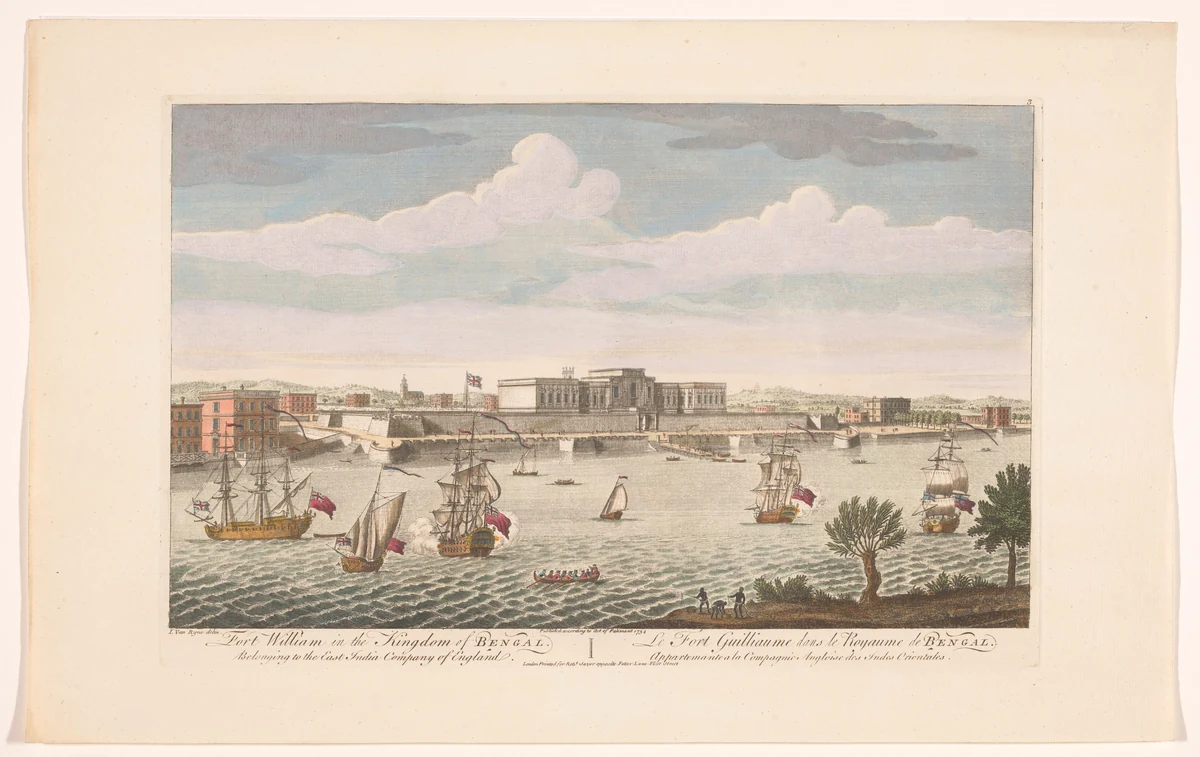
For a view of the Company’s presence in Bengal before the battles that changed its standing, look to the Rijksmuseum’s 1754 print of Fort William in Calcutta, now Kolkata. Its plate title identifies the site with the English East India Company. Robert Sayer published the hand-coloured print in London, and the museum records an anonymous printmaker working after Jan van Ryne. The object’s date and title help place the depicted fort in Company history. Its composition is an eighteenth-century representation of the site.
UK Parliament’s history traces the Company’s shift toward territorial power through Plassey in 1757 and Buxar in 1764 and the resulting control of revenue in Bengal, Bihar and Orissa. Revenue control changed the nature of the institution. The monopoly in the 1600 charter governed trading privileges within a designated geography. The later ability to collect territorial revenue put the Company in a governing role, and the two battles belong to that later phase of its history.
Parliamentary oversight followed in 1773, and the renewals in 1793, 1813, 1833 and 1853 progressively restricted the Company’s privileges. The legal endpoints are especially easy to confuse. The Government of India Act of 2 August 1858 transferred Company government to the Crown and provided for a Secretary of State. The corporation survived that transfer. Section 36 of the East India Stock Dividend Redemption Act 1873 set its dissolution for 1 June 1874. Which date belongs in a caption depends on whether the caption concerns government in India or the life of the corporation.
Mughal India from Babur to Bahadur Shah II
- British Library item IOR/A/1/2, copy of the original incorporation charter
- UK Parliament institutional record of the Company's India transition
- Original 1858 transfer statute and 1873 Act setting the separate dissolution date
- Public-domain 1754 Fort William historical print from the Rijksmuseum, RP-P-1932-440
What the Singapore scene can tell you about the timeline
Disney’s At World’s End synopsis places Sao Feng in a fictional Singapore sequence. A historical date often associated with the Company in Singapore is 6 February 1819, when Stamford Raffles represented the British East India Company in a treaty with Sultan Hussein and Temenggong Abdul Rahman. Singapore’s National Heritage Board identifies the document as part of the Straits Settlements Records and relates it to the establishment of a British trading settlement. The names of the Malay signatories matter because the treaty records an agreement between parties.
Suppose a film guide assigns the Sao Feng scene to 1819 because it links Singapore with the East India Company. Check what the proposed source actually dates. The treaty identifies a transaction and its participants, while the studio synopsis supplies the setting and fictional character. To put a year on the scene, the guide would need evidence that dates the events of the story. It can use the treaty as a historical comparison by naming what happened on that day and attributing the scene separately to the film.
A timeline is most useful when each date travels with the event it identifies. If an archive or studio reorganises its catalogue, search by document title, shelfmark or the name of the film and check the field that supplies the date. The date of a trial hearing, the date an agreement was signed and the date a film opened answer different questions. Keeping the event in the same row as the date also makes it easier to spot a claim that has moved from one chronology into the other.
| Date | Context | Event | Source record |
|---|---|---|---|
| 31 December 1600 | Historical record | Date on the British Library’s item-level copy of the original charter | IOR/A/1/2 |
| 8–9 May 1701 | Historical record | William Kidd’s Old Bailey Admiralty trial sessions | Library of Congress trial publication |
| 22 July 1702 | Historical record | Indenture setting out a scheme to join the two English companies | IOR/A/1/60 |
| 16 October 1758 | Historical record | Crown anti-piracy commission to Royal George | IOR/A/1/82 |
| 1773 | Historical record | Parliamentary regulation of Company government | UK Parliament historical account |
| 6 February 1819 | Historical record | Singapore settlement treaty signed by Raffles, Sultan Hussein and Temenggong Abdul Rahman | Singapore National Heritage Board |
| 2 August 1858 | Historical record | Government of India Act transfers Company government to the Crown | 1858 statute |
| 1 June 1874 | Historical record | Dissolution date provided by the 1873 Act | East India Stock Dividend Redemption Act, section 36 |
| 7 July 2006 | Disney production | U.S. theatrical release of Dead Man’s Chest | Disney D23 film reference |
| 15 May 2007 | Disney production | Xbox announcement of the game demo | Xbox Wire archive |
| 25 May 2007 | Disney production | U.S. theatrical release date listed for At World’s End | Disney D23 film reference |
| 17 May 2011 | Disney production | Publisher date for A. C. Crispin’s The Price of Freedom | Disney Book Group listing |
- Disney D23 official film synopsis for At World's End
- British Library item IOR/A/1/60, Queen Anne's tripartite indenture and the United Company
- Library of Congress digitization of the 1701 William Kidd trial publication
- Singapore National Heritage Board source record for the 6 February 1819 treaty
- UK Parliament institutional record of the Company's India transition
- Original 1858 transfer statute and 1873 Act setting the separate dissolution date
Sources
- Disney: Pirates of the Caribbean: At World's End
- British Library: Historical East India Company Charters
- Disney D23 official film synopsis for Dead Man's Chest
- Disney D23 official film synopsis for At World's End
- Disney Interactive Studios' At World's End licensed game and original manual
- Disney Book Group publisher description for A.C. Crispin's The Price of Freedom
- British Library item IOR/A/1/2, copy of the original incorporation charter
- British Library item IOR/A/1/60, Queen Anne's tripartite indenture and the United Company
- British Library item IOR/A/1/82, actual Royal George anti-piracy commission
- Library of Congress digitization of the 1701 William Kidd trial publication
- Singapore National Heritage Board source record for the 6 February 1819 treaty
- UK Parliament institutional record of the Company's India transition
- Original 1858 transfer statute and 1873 Act setting the separate dissolution date
- Public-domain 1754 Fort William historical print from the Rijksmuseum, RP-P-1932-440