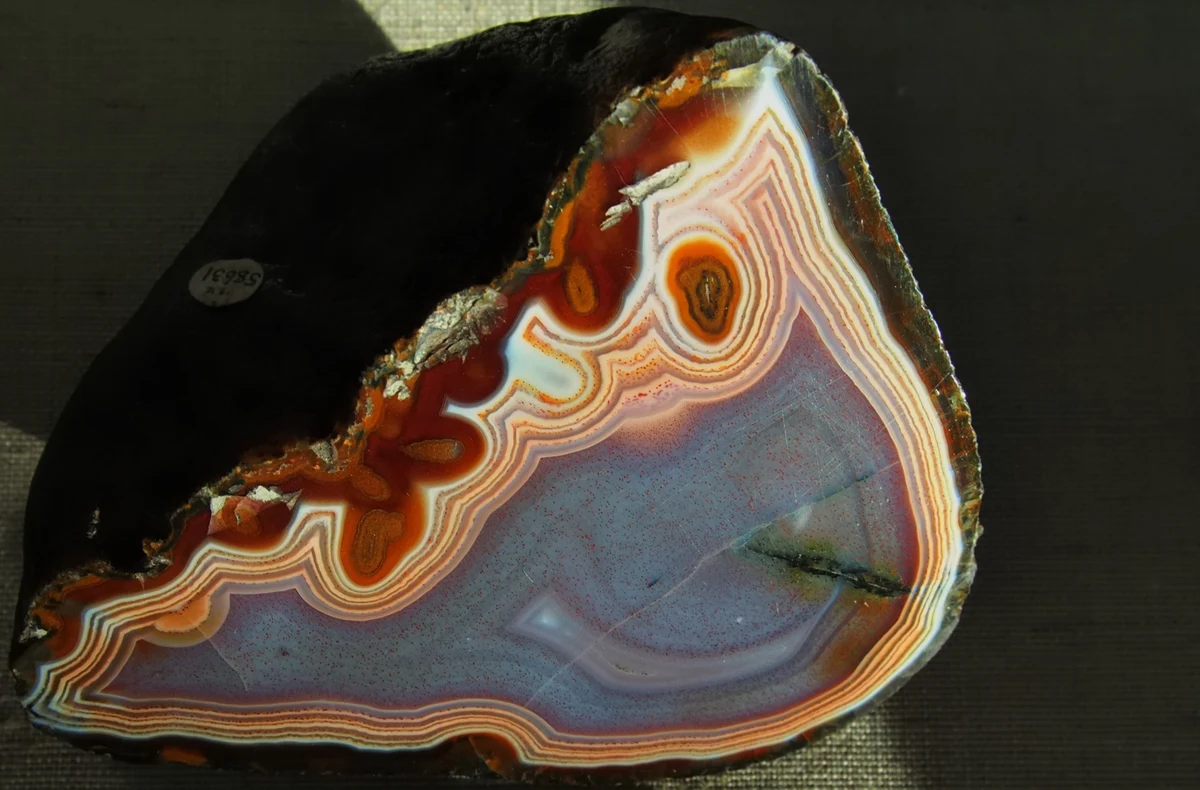
What Indian agate describes
Agate is a form of chalcedony commonly recognised by bands. Indian agate can describe a stone represented as coming from India, or an object cut, polished or sold there. Agates of Cambay is a registered geographical indication (GI) associated with the craft in Khambhat, Gujarat. A listing needs its own evidence for the finished piece, rough-stone origin, colour treatment and any use of the registered name.
Agate is a form of chalcedony, commonly with banding. In a listing, the name may appear in the material field, in the title of a finished object or in the shop category that groups several kinds of stonework. Where the word appears matters. A material field is a direct seller claim about the object. A category tells you where the retailer filed it. When the title and the material field disagree, the seller needs to clarify the description for the exact item.
Indian can describe a place of extraction, a place of manufacture or the location of the seller. Khambhat, also called Cambay, is in Gujarat’s Anand district. The Press Information Bureau describes a local craft cluster that cuts and polishes stone and produces objects including beads and decorative and functional pieces. A documented connection to that workmanship can be a reason to choose the piece. To establish where the rough was extracted, look for a separate statement and ask what records support it.
Let the reason you want the piece determine which unanswered questions matter. For earrings chosen to match an outfit, colour, size, closure and the seller’s care advice may settle the choice. A purchase made for the provenance calls for a named maker and a documented connection to the item. Decide which description you would expect to see on the invoice before comparing prices. That gives you a concrete way to assess whether the seller has answered the question that affects your choice.
Read colour, pattern and treatment separately
Use photographs to examine the pattern and visible condition. For a piece advertised as banded agate, look for the bands in the photographs of the actual item or ask which images show it. For a pair of earrings, compare the two faces if matching matters to you. Photos can help you choose a pattern and judge how much variation you are willing to accept. Appearance alone leaves the stone’s identity, colour treatment and geographic origin unresolved.
The Gemological Institute of America describes chalcedony that can be naturally coloured or dyed. Ask the seller to record the treatment status in plain language. A statement that the material is natural agate addresses the claimed identity of the stone. It leaves open whether someone altered the colour. If the seller says the piece is untreated, ask what that statement is based on and whether it applies to the particular piece you would receive.
If the seller discloses dye, ask for cleaning and care instructions for that object. GIA discusses treatment in connection with durability and care, so the information has a practical use beyond deciding whether you like the colour. If the seller says the treatment is unknown, factor that uncertainty into your decision. It may be acceptable for an ornament bought for its appearance. A buyer who specifically wants untreated colour needs a firmer declaration before choosing the item on that basis.
Where stone identity matters enough to request independent testing, ask the laboratory what it can establish for the submitted object. An identification or treatment finding has its own scope. GIA’s general discussion of geographic origin offers no assurance that a laboratory can determine the extraction country of agate. If the seller already offers a report, check which property it covers and whether its description or identifying details connect it to the item you would receive.
IP India lists Agates of Cambay as application 101, Class 14, handicraft, filed 5 July 2007. Certificate 80 is dated 10 July 2008. The register showed validity through 4 July 2027 when checked on 26 November 2026. It lists Agates of Cambay Logo separately under application 508. For a named seller’s claim, pull up the correct entry and compare any supplied authorised-user detail with the register, then ask how the seller connects the particular piece to that maker.
Check an Agates of Cambay claim
IP India lists Agates of Cambay as application 101, a Gujarat handicraft in Class 14. The application was filed on 5 July 2007, and certificate 80 is dated 10 July 2008. The entry lists validity through 4 July 2027, which you can recheck on the register when you buy. Agates of Cambay Logo has its own entry, 508. If a listing uses a logo as part of its claim, establish which entry and which maker the seller is referring to.
Search the authorised-user entries by published business name and compare the identifier. Examples in the register include Super Agate, AU / 1406 / GI /101 / 17, A.K. Agate, AU / 1414 / GI /101 / 25, and Heeral Export, AU / 1420 / GI /101 / 31. Each entry documents an authorised-user designation. If a shop name looks similar, use the identifier and the name on the seller’s paperwork to resolve the match. A familiar trade name by itself leaves the relationship uncertain.
A marketplace storefront can list products from several makers. If a reseller attributes a particular bowl to a registered business, ask for a document that connects that maker to the bowl or its batch. Compare the product code or description against the listing and ask whether the maker will be identified on the invoice. A register search establishes the designation of the business you looked up. The link from that business to the goods on offer depends on the item documentation.
A listing that says only Khambhat craft makes a narrower claim. Ask who made or finished the object and where that work took place. The answer may be sufficient if your aim is to buy work from the local cluster. Check the GI register when the seller specifically claims the registered designation. If your interest is the geology of the stone, ask for extraction provenance in either case.
| Indiahandmade catalogue item | Displayed amount | Stock when checked | Coverage |
|---|---|---|---|
| Agate Gemstone Earring Set | ₹500 | Out of stock | Blue one-size set. Treatment unverified. |
| Agate Pendant Oval Pendant with Metal Chain | ₹999 | Out of stock | Seller catalogue amount for the item. Chain composition unverified. |
| Agate Round Shape Bowl | ₹4,000 | Out of stock | Seller catalogue amount. Rough origin unverified. |
The entries are account-free observations from one producer’s Indiahandmade catalogue. Their prices are snapshots attached to different objects. The collection listed the three entries as out of stock, so the figures are neither purchasable offers nor a market range for material of one grade and size. For a product advertised under the isolated search phrase Sandal Jewels, establish the exact maker and invoicing seller first. The public source records cited here establish no relationship between that phrase and the Khambhat producer or the registered GI.
- IP India — Agates of Cambay registration 101 and authorized users
- Press Information Bureau — Gujarat, Cambay stone craft
- Indiahandmade — Jan Jyoti Stone Jewellery producer collection
- Indiahandmade — direct Agate Gemstone Earring Set catalogue item 7563
- Garvi Gurjari — Khambhat craft and moss agate necklace/earring set
- Garvi Gurjari — mixed-label natural stone bowl
Compare jewellery by the details you can use
Indiahandmade identifies JANJYOTISTONES as a Khambhat producer company. Its Agate Gemstone Earring Set, item 7563, is described as one-size, blue and made of agate stone, with Gujarat in the state-of-origin field. The page displayed ₹500 and marked it out of stock. It supplied no visible written finding on dye or stone authentication. Use the Gujarat field as the marketplace’s stated origin for the product. A buyer interested in where the rough was extracted would still need to ask.
Garvi Gurjari’s GGCASNS02 gives a different kind of detail. The retailer calls the stone green moss agate and lists a necklace at 10 × 0.5 inches, earrings at 1.5 × 0.5 inches and a fish-hook closure. This helps you decide whether to pursue the set for its proportions and fastening. If fit matters, ask what the necklace measurement includes. The available listing evidence leaves the current price and availability unresolved and supplies no independent finding on the stone.
For a complete piece of jewellery, record what the seller says about the stone, the mounting and the fastenings as separate parts of the description. Indiahandmade’s oval agate pendant is listed with a metal chain, which identifies the included component in broad terms. If the chain composition affects your choice, ask for the material and any claimed purity or plating in writing. Evidence about the agate would cover the stone. A precise claim about the chain needs documentation that addresses the chain itself.
Resolve mixed material labels before comparing bowls
Garvi Gurjari’s bowl, product 210503, shows how a category can complicate a search for agate. The title combines rose quartz with agate, the description says rose quartz and a field says agate gemstone. The retailer places it under Agate Showpiece and lists a diameter of 6 inches and a height of 3 inches. Those measurements let you assess fit on a shelf or table. The competing descriptions leave the stone identity unresolved.
If you want the bowl specifically in agate, give the seller the product number and ask for one material description that applies to the physical bowl and will appear on the invoice. If the seller identifies more than one material, ask which parts each name describes. Request supporting documentation if that identification determines whether you would buy. A stock reply that repeats the entire mixed title would leave the original ambiguity in place.
The product page also showed a combination-not-available message, and the figures on the homepage and the item page conflicted. Exclude the bowl from a live agate price comparison until both the material and a purchasable price for the selected item can be confirmed. If you are choosing a bowl primarily for display, you can still use its listed dimensions to judge whether it suits the space. Ask about intended use separately if you want it for serving.
Record what each listing establishes
Build a comparison around the exact object and quantity on offer. JANJYOTISTONES displayed ₹500 for the earring set, ₹999 for the oval pendant with metal chain and ₹4,000 for the round bowl, all out of stock. Those amounts describe three catalogue entries. The objects differ in form and included components, and the stock status means those entries provide no current ordering price. Use them to see how the producer describes its range, then compare offers for equivalent items you can actually order.
| Field | What to record | Where to verify |
|---|---|---|
| Exact offer | Product code, selected variant, dimensions and what one unit includes | Item page and seller confirmation for the selected variant |
| Seller and maker | Storefront name, invoicing seller and named maker if different | Producer profile, written seller response and invoice |
| Stone and treatment | Claimed identity, colour and disclosed treatment in separate fields | Item description, treatment statement or relevant report |
| Craft and extraction | Where the piece was worked and where the rough was extracted, if known | Maker statement and any records that support the extraction claim |
| GI claim | Registered name, authorised-user ID and document linking that user to the piece | IP India register and item or batch documentation |
| Jewellery fittings | Closure type, chain or mounting material and any stated purity | Specifications and supporting paperwork for the metal claim |
| Terms of sale | Available quantity, total with taxes and delivery, and return or exchange eligibility | Current item page, checkout and order terms |
When an item becomes available, open the exact variant and check whether it can be ordered for your delivery location. Compare the total at checkout, including any delivery charge and applicable tax, using the same quantity for each offer. If a collection page and a product page show different amounts, resolve which applies to the chosen variant before using either figure. If availability is still unclear, keep the price in your notes as a catalogue figure.
Item 7563 displayed a seven-day return term and no exchange. If it comes back into stock, check the current wording for the actual order, including when the return period begins and whether the chosen item qualifies. For jewellery bought to match a particular photograph, it also matters whether that photograph shows the pair being sold. Ask for confirmation before ordering when the listing leaves it unclear. Keep a copy of the seller’s answer and the item description with the order details so you can refer to the exact offer if a question arises.
India gold rate by purity and weight: IBJA and price calculator
- IP India — Agates of Cambay registration 101 and authorized users
- Gemological Institute of America — agate/chalcedony identification and treatments
- Indiahandmade — Jan Jyoti Stone Jewellery producer collection
- Indiahandmade — direct Agate Gemstone Earring Set catalogue item 7563
- Garvi Gurjari — Khambhat craft and moss agate necklace/earring set
- Garvi Gurjari — mixed-label natural stone bowl
- Gemological Institute of America: Gem Treatments
Sources
- IP India — Agates of Cambay registration 101 and authorized users
- Press Information Bureau — Gujarat, Cambay stone craft
- Gemological Institute of America — agate/chalcedony identification and treatments
- Indiahandmade — Jan Jyoti Stone Jewellery producer collection
- Indiahandmade — direct Agate Gemstone Earring Set catalogue item 7563
- Garvi Gurjari — Khambhat craft and moss agate necklace/earring set
- Garvi Gurjari — mixed-label natural stone bowl
- edk7 — documented Indian agate at London's Natural History Museum
- Gemological Institute of America: Gem Treatments
