Where to watch Made in India A Titan Story
Made in India – A Titan Story is a six-episode 2026 drama with Jim Sarbh as Xerxes Desai and Naseeruddin Shah as J.R.D. Tata. Amazon announced it in India through Amazon MX Player, and the official Prime Video page lists all six parts. For the Indian free-with-ads offer, look for Amazon’s Free to Me section and check the playback offer displayed for the episode and location.
Search using the full title, including A Titan Story. The words Made in India alone can surface unrelated material. If you land on an article, a trailer or a short clip, look for a programme page with an episode list and playback controls. A promotional page can identify the series accurately while leaving the practical question of whether you can watch it unanswered.
Use the cast to confirm a result if the search display shortens the title. Jim Sarbh plays Xerxes Desai and Naseeruddin Shah plays JRD Tata. Those two credits together give you a stronger identity check than the word Titan on a thumbnail. Once you have a match, use the episode list to find the first part.
The public listing identifies the opening episode as The Watch Project and the finale as Twenty Two. Amazon’s Indian announcement describes free streaming through Amazon MX Player. The public series page can also surface a Prime trial or subscription prompt. That display belongs to the storefront view and region the reader opened. Use the India catalogue and the terms on the player for the session you intend to use.
| Episode | Official title | Spoiler-light premise |
|---|---|---|
| 1 | The Watch Project | Desai takes on a Tata Press assignment and sees a different future in watches. |
| 2 | Demonstration | A watch team pursues backing and looks for a partner. |
| 3 | Flying Saucer | The watch moves from an ambition toward a physical prototype. |
| 4 | The Real Value | The team responds to setbacks and tries to understand its buyers. |
| 5 | Universal Language | Pricing and advertising move to the foreground. |
| 6 | Twenty Two | Another design challenge tests Desai and the company. |
How to check playback and territory
A streaming announcement can establish a service without establishing the full territory list or the terms every viewer will encounter. For a viewer in India, the practical check is to open the official listing from their usual device and location, inspect the episode menu and see what happens when they select an episode. Read any access prompt before drawing a conclusion about the whole series.
Amazon announced the unification of its two streaming services in May 2026 and updated the rollout details on 16 July. It described Free to Me as the section for free ad-supported content in Prime Video and renamed the MX Player Android app MX Player by Prime Video. It planned redirects from MX Player on web, televisions and iOS. Those changes explain why an older MX Player reference and a newer Prime Video listing can both point to the same programme.
A viewer travelling outside India sees a location message when opening the series. The wording on that screen can establish the restriction the viewer encountered. A current platform statement would be needed to turn that observation into a claim about which countries carry the series, and a separate current listing would be needed to confirm an alternative licensed service.
The Prime Video listing checked for this guide showed six episode entries. It displayed 3 June 2026 on the first and 26 May 2026 on several later entries. These are public listing metadata. The mixed labels do not establish when each episode first became playable in India, so the table follows the sequence in the heading above each episode. Use that order to watch the story.
Cast, creative credits and the source book
The announcement identifies Naseeruddin Shah as JRD Tata and Jim Sarbh as Xerxes Desai. Robbie Grewal directs, and Karan Vyas wrote the series. Amazon credits Vinay Kamath’s non-fiction account of Titan as the basis for the adaptation. If you are looking for the book after seeing a cast interview or promotional feature, the author’s name and Titan together are useful catalogue search terms.
For viewers coming to the subject through the actors, the distinction between the credits matters. Shah and Sarbh give performances as named historical figures. Vyas’s credit identifies the writer responsible for the television work, while Kamath’s identifies the author of the underlying account. To check who said something, first identify whether the words came from the programme, the book or a source quoted by the book.
A viewer remembers a line spoken by Shah’s character and wants to quote JRD Tata in an article. The viewer can record the episode and identify the line as dialogue delivered by the character. Attributing those words directly to Tata requires a historical source for the quotation, such as a documented interview, speech or letter that can be checked in context.
The same care helps when looking up a scene discussed online. Search for the character and the actor as well as the series title. An interview with an actor can explain how a performance was developed. A source that documents the real person’s actions or words serves a different purpose.
The company history behind the premise
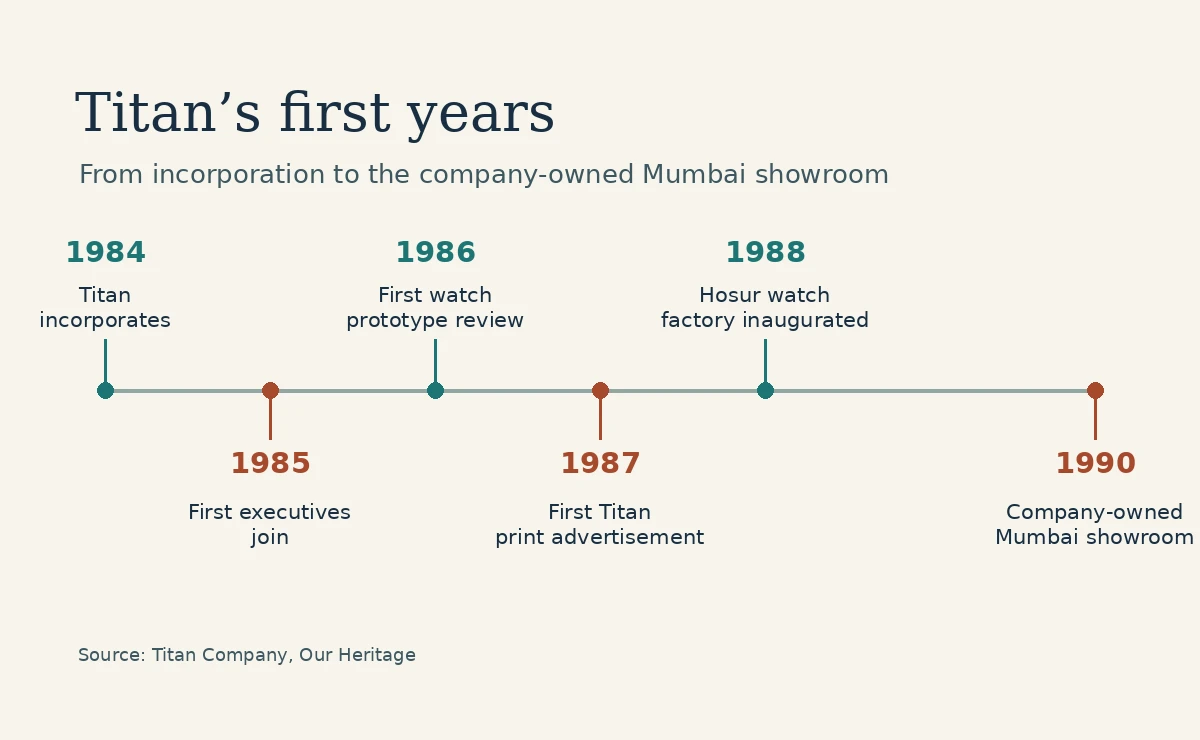
Titan dates its incorporation as a Tata Group and Tamil Nadu Industrial Development Corporation joint venture to 1984. The company records its first executives in 1985, a prototype review in 1986, its first print advertisement in 1987 and inauguration of the Hosur factory in 1988. Its first company-owned Mumbai showroom appears in 1990. These dates cover the formation, early product development and retail phases of the business.
The venture’s origins and the actions of particular people are separate historical questions. A company timeline can establish how Titan describes the venture. A claim about who first proposed an idea, approved a decision or secured an agreement needs evidence that identifies the decision and the person’s role. The amount of screen time a character receives tells you how the drama presents the subject.
The official watch timeline names Desai, Anil Gore and Anil Manchanda at the 1986 prototype review. It names J.R.D. Tata, Desai and TIDCO chairman A.L. Mudaliar in the account of the 1990 Mumbai showroom inauguration. Looking up a particular picture, prototype or shop visit by its own date gives you a firmer fact than a single founding story about who made every decision.
For a disagreement about a milestone, look for a contemporary report or a dated record that names the event and the organisations involved. Compare that wording with Titan’s timeline. The company page is first-party evidence of how Titan records its own history, which is useful context when interpreting any differences.
| Year | What Titan documents |
|---|---|
| 1984 | Titan incorporates |
| 1985 | First executives join |
| 1986 | Watch prototypes reviewed |
| 1987 | First print advertisement |
| 1988 | Hosur factory inaugurated |
| 1990 | Company-owned Mumbai showroom opens |
Which source answers which question
A useful fact check starts with a claim narrow enough to verify. Asking whether the series is accurate bundles together the venture’s existence, the identities of its participants, the order of events and private dialogue. Asking whether a specific development took place before another gives you two events to identify and a clear reason to examine the dates attached to them.
| Question | Evidence to use | What it establishes |
|---|---|---|
| Where did Amazon announce the series? | Amazon’s series announcement | The named streaming service and the announced six-part format |
| Can I play full episodes now? | The official player’s listing and playback controls | Access in the location and session checked |
| Who plays Xerxes Desai? | Amazon’s cast credits | Jim Sarbh’s role in the drama |
| Which organisations formed the joint venture? | Titan’s heritage timeline | Titan’s account of its origins |
| Did a historical figure say a line shown on screen? | A reliable record of the original words | Whether the quotation can be attributed to that person |
When the question concerns sequence, write down the two events in plain language before opening a timeline. Check whether the entries refer to the same events the scene appears to depict. A date attached to a public announcement answers a different question from a date attached to an agreement. If the evidence gives only a year, keep that level of precision.
A viewer wants to check whether an agreement portrayed in one scene preceded a public announcement portrayed in the next. They can note the apparent order and look for a record of each event. If they find a dated announcement and an undated reference to an agreement, they can establish the announcement date and leave the order unresolved.
Look at what each account cites when two sources appear to agree. A later article that repeats the company timeline can help you find the relevant entry. It gives you one chain of evidence for the claim. A contemporary account or a separately sourced record offers a way to check that chain.
How to read the source book alongside the series
Amazon describes the series as a drama inspired by Titan’s history and adapted from Kamath’s non-fiction account. That makes the book a sensible place to investigate a scene that leaves you with a question about people, sequence or motivation. Look for the passage that addresses the specific question and note whether it presents a documented event, an individual’s recollection or the author’s interpretation.
If a book passage and a scene describe the same event, compare the scope of the two accounts. Identify what the scene shows directly, then see which details the passage supplies. Pay particular attention to dates, the people present and whether the account attributes a recollection to someone. Those details help you see how much of a scene you can connect to the historical account.
Suppose a conversation on screen makes a decision look immediate. The relevant passage might describe discussions over a longer period or might give only a participant’s recollection of the outcome. In the first case, you can cite the passage for the longer sequence it describes. In the second, retain the attribution to the participant and leave the precise timing open.
For a reading note, record the chapter or page from your edition and the episode in which the scene appears. Keep a short description of what each source says. That makes the comparison easy to revisit if another account gives a different sequence or if you later need to check which source supplied a particular detail.
Kamath’s name is the most reliable catalogue search term because the subtitle varies by edition. Titan’s announcement uses the subtitle Inside India’s Most Successful Consumer Brand. Hachette India’s published book entry titles its ISBN 9789388322522 edition The Story of India’s Most Successful Consumer Company. Compare the author and edition before using a page number from another reader’s copy.
How to assess a scene’s historical claims
The programme’s status as a drama matters most when a scene appears to resolve an ambiguous question. A scene can show a character making a choice and immediately show its consequences. To use that sequence in a historical account, check each link separately. Establish that the choice occurred, who was involved, and whether a source connects it to the outcome.
Imagine that the drama places a discussion about the venture directly before a meeting. The two scenes may invite the viewer to infer that the discussion triggered the meeting. A dated record might establish that the meeting occurred. An account of who called it and why would be needed to support the causal link.
Credits and publicity can support straightforward statements about the production, including its cast, writer, director and adaptation source. When discussing an individual scene, use language that identifies the claim as a depiction. Phrases such as the series portrays or the character argues keep the account anchored to what the viewer saw. Reserve statements about what the historical person did or believed for the evidence that supports them.
A timeline may omit an exchange while still confirming the larger milestone around it. Its silence leaves the exchange unverified. If the detail matters to your article or discussion, look for a record suited to that claim. Meeting records may establish attendance or decisions. A contemporaneous interview may establish what a participant publicly said. Private motives often remain difficult to establish.
What to recheck when the listing changes
Use the latest official programme listing for claims about current access. Record the date you checked, the country from which you checked and what the listing showed. If you checked playback, distinguish opening the episode page from playing the full episode. Those details give any later reader a concrete observation to compare with their own experience.
A reader can find the programme on an official service page but sees no episode controls. A useful note would record that the programme page was visible and that no episode controls appeared in that session. It would take further evidence to work out whether the difference arose from location, account state, device support or a catalogue change.
If a different service claims to carry the series, look for a full programme listing on that service and a current statement that covers your territory. Platform announcements and suggested search results can refer to different markets. Where the evidence is incomplete, describe the service and the territory you actually verified and keep broader rights claims open.
If an official listing is temporarily hard to find, check the exact wording of the title against Amazon’s announcement and try the full title again in the service’s own search. Cast credits can help identify a result when the interface shortens the name. A missing result is an observation worth recording with the search terms and location, especially if you plan to check again later.
Sources
- Amazon MX Player series announcement
- Titan Company’s official historical timeline
- Prime Video’s six-episode series listing and credits
- Amazon India’s Prime Video and MX Player transition, July 2026 update
- Titan Company’s announcement of the drama and its source book
- Hachette India’s edition of Vinay Kamath’s Titan book