A timeline of major developments
Ancient India’s major developments included Harappan urban engineering, the rise of early states and coin use, Mauryan royal inscriptions, Gupta-era art and coinage, and the growth of monastic learning at Nalanda. Start with Dholavira’s occupation around 3000–1500 BCE, then follow the early states visible by the sixth century BCE, Ashoka’s reign around 268–232 BCE, the Gupta rise in the fourth century CE, and Nalanda’s flourishing from the fifth century CE.
| Date or period | Development | What the date refers to |
|---|---|---|
| c. 3000–1500 BCE | Occupation at Dholavira | The archaeological span for one settlement on Khadir Island |
| Around 1900 BCE | Changes in Harappan settlements and material culture | A regional shift that affected settlements in different ways |
| Sixth century BCE | Early states, settlements, coins and new religious traditions become visible | A period identified in NCERT’s account of early states and economies |
| c. 268–232 BCE | Ashoka’s Mauryan reign | The reign dates used in India’s UNESCO Tentative List submission |
| Fourth century CE | Gupta power rises | The emergence of a major power in northern South Asia |
| Fifth–thirteenth centuries CE | Nalanda flourishes as a monastic and scholastic institution | The institution’s flourishing, following earlier remains at the site |
The dates measure different things. Dholavira’s range describes occupation at a particular settlement. The sixth-century BCE entry describes changes visible across a wider area. Ashoka’s dates belong to a reign, while Nalanda’s range describes the flourishing of an institution. These distinctions matter when comparing achievements. A wall, a coin and an inscription can all survive, but each comes with a different route from the object to a historical date.
Modern place names help locate the evidence. Dholavira lies in Gujarat, while the Met places the rise of Gupta power within northern South Asia. A timeline that gives each entry a location as well as a date can accommodate overlapping histories. At its later end, Nalanda carries the story of ancient institutions forward into subsequent centuries. Its long life is a reason to follow the institution across period boundaries.
History of India: a timeline from Harappan cities to the Republic
- UNESCO World Heritage Centre: Dholavira
- IIT Kanpur SATHEE: NCERT on Early States and Economies, c. 600 BCE–600 CE
- India's UNESCO Tentative List Submission: Ashokan Edict Sites
- The Met: South Asia, 1–500 CE Chronology
- UNESCO: Nalanda Mahavihara Archaeological Site
- Indira Gandhi National Open University: Harappan and Other Chalcolithic Cultures
Harappan cities, water and trade
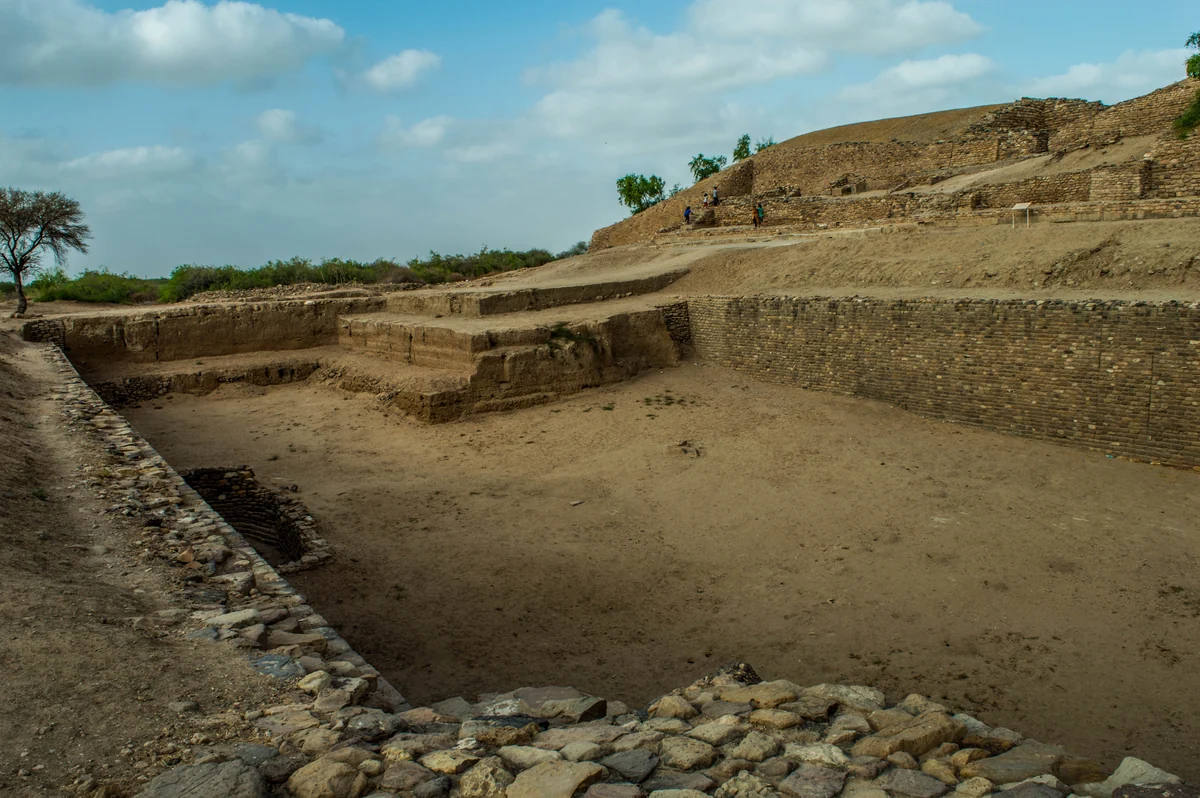
At Dholavira, the practical problem was how to manage water from two seasonal streams. Reservoirs gave the settlement a way to store water and drains helped direct its flow. The surviving works show how inhabitants adapted the built environment to local conditions. The walled settlement and cemetery are also part of the protected site, and excavated bead-making workshops add evidence of specialised production. Together they reveal several kinds of activity at one place, from managing water to making goods and burying the dead.
Archaeologists found evidence of trade involving Mesopotamia and the area of modern Oman. That puts Dholavira in a wider network of exchange. The workshops show that people made beads at the settlement, while evidence for overseas connections answers a separate question about how far exchange reached. To link a particular object to a workshop or assign it an itinerary would require evidence about that object. Harappa Archaeological Research Project’s archive offers a way to follow this distinction through field reports, artefact studies and broader reconstructions.
Around 1900 BCE, some settlements in the Indus core were abandoned. Other places continued or saw new settlement, and material culture changed. Dholavira’s occupation span extends several centuries beyond that turning point. Read the two dates together and the regional transition becomes easier to understand. Changes in settlement patterns can be substantial even when occupation continues at a particular site. Claims about when a city was abandoned need the chronology for that city.
The photograph shows a stepped reservoir at the archaeological site in Gujarat. Its stone sides and steps make the scale of storage visible. Archaeologists use the structure with evidence from the wider settlement and the seasonal streams to understand how water was managed. The form of one reservoir does not by itself tell us who had access to it or how water was distributed.
Vedic texts and the practice of oral transmission
Vedic chanting preserves texts through formal recitation, including systematic patterns of tone and pronunciation. The practice makes preservation a cultural achievement in its own right. Exactness concerns how sounds are produced as well as which words are spoken. UNESCO’s account describes a living tradition that helps explain how a body of material can pass between generations through trained performance. It supports a claim about the methods of transmission.
A chronology of Vedic societies requires a different kind of inquiry. Indira Gandhi National Open University’s teaching unit reconstructs the period using Vedic texts alongside material evidence. Its treatment of early and later Vedic accounts calls for attention to the sources used for each phase and how they are dated. A text can supply evidence about the practices or social arrangements it describes. To use a passage as evidence for a particular place and century, a historian also needs to explain why it belongs there.
When consulting a chart that divides the Vedic period into two phases, check what each boundary measures and where the author applies it. A proposed date for a layer of text and a date inferred from excavated material can be useful even when they answer different questions. Approximate ranges allow room for overlap and local variation. The continued practice of chanting tells a story about preservation, while a chronology of early and later Vedic society depends on the evidence used to reconstruct each phase.
Ashoka’s edicts as evidence of Mauryan government
India’s UNESCO Tentative List submission places the Mauryan ruler Ashoka’s reign at approximately 268–232 BCE. The surviving inscriptions appear at geographically dispersed sites on rocks and pillars. They provide evidence of royal communication that can be studied in the places where the inscriptions survive. For a reader comparing early states with the Mauryan period, the edicts make a different kind of source available. Lists of states in religious texts supply names and political groupings, while inscriptions preserve messages issued under royal authority.
A map of the edicts shows where surviving messages can be located. The dots can support a discussion of the reach of royal communication. Drawing a perimeter around them would add a claim about territory that needs other evidence. A study of administration would ask which officials, institutions or practices can be documented in particular places. An inscription that communicates a royal position also leaves open how that message was received and whether local practice followed it.
To verify the dates or the current heritage designation, look up the Ashokan Edict Sites entry at the UNESCO World Heritage Centre and check how UNESCO classifies the record. The supplied entry is a Tentative List submission. Its historical date range refers to Ashoka’s reign. An individual inscription may require a site-specific record to check its dating, location or reading, especially if a map or caption names the monument.
India’s national symbols, from the tiger to the Ashoka Chakra
Nirvana and Buddhist learning at Nalanda
In Bhikkhu Sujato’s translation of the Pali first discourse, extinguishment belongs to an account of the middle way and the cessation of suffering. Begin with the problem the discourse addresses. Cessation gives extinguishment its context, and the middle way gives the discussion a practical direction. That makes it possible to give a plain-language explanation of nirvana anchored in a particular Buddhist text. Other traditions or later uses of the word need their own context, especially when a single English rendering could make distinct accounts sound interchangeable.
Nalanda answers a question about institutions. UNESCO distinguishes archaeological remains that go back to around the third century BCE from the large monastic and scholastic institution that flourished from the fifth to the thirteenth century CE. The earlier evidence establishes antiquity at the site. The later range situates the institution for which the site is known. A date for the earliest surviving activity at a place can precede the development of the institution a visitor associates with its name.
If a timeline has room for just one entry about Nalanda as a centre of monastic learning, the fifth century CE is the relevant starting point for its period of flourishing. An entry about archaeology can also include the third-century BCE remains. A two-line caption can carry both dates by giving each its own subject and verb. That small editorial choice keeps a date for material remains from becoming an unsupported date for the foundation of a school.
Gupta art, coins and the Golden Age label
Gupta power rose in northern South Asia in the fourth century CE. The Met uses Golden Age as a label sometimes applied to the northern Indian Gupta period of the fourth to sixth centuries while discussing Buddhist images. With that scope, the phrase introduces a specific art historical discussion. A claim about prosperity across the same centuries would need evidence about the communities and economic conditions being described. The Met’s regional chronology helps readers see which powers and artistic traditions overlapped in time.
Coins attributed to Samudragupta give readers a second kind of Gupta-era object. The National Museum identifies illustrated examples through their figures and emblems. Those details help ask how a ruler was represented in a medium made to circulate. They also provide evidence of material production. To assess the wealth of a region from coinage would require a broader record, including how the examples relate to the volume and distribution of surviving coins.
For an artwork captioned classical Indian, look up the catalogue’s date range, place and attribution before assigning it to a dynasty. The Met’s chronology covers more than one region within the same centuries. An artwork can fit the date range associated with the Guptas while belonging to a different regional tradition. A caption grounded in the object’s location and attribution lets readers compare artistic developments across regions without treating a period label as a political map.
What the Bakhshali manuscript shows about zero
The Bakhshali manuscript preserves a dot that Oxford identifies as a placeholder. In positional notation, a placeholder marks an empty position so the other digits keep their intended values. In modern notation, the zero in 205 holds the tens place and distinguishes the number from 25. The comparison explains the job a placeholder performs. A claim about zero as a number in its own right asks for evidence of how mathematical texts treated it in calculations. A claim about who first invented it also calls for comparison with other securely dated evidence.
Radiocarbon analysis of Bakhshali sampled birch bark from particular leaves and produced different age ranges. The analysis dates the sampled material. Dating the composition of the underlying mathematics is a separate problem because ideas and wording can be copied onto a later writing surface. A single date attached to the whole manuscript can hide both the differences between the sampled leaves and the gap between a physical object and the text it carries.
When a headline gives a year or century for the invention of zero, check the linked study or catalogue for the subject of that date. Look for the particular leaf or sample and the range reported for it, then check what the source says about the mark itself. A well-supported account can name the dot’s role, specify what researchers dated and leave mathematical priority open where the evidence stops.
Sources
- UNESCO World Heritage Centre: Dholavira
- Harappa Archaeological Research Project
- IIT Kanpur SATHEE: NCERT on Early States and Economies, c. 600 BCE–600 CE
- UNESCO: Tradition of Vedic Chanting
- India's UNESCO Tentative List Submission: Ashokan Edict Sites
- The Met: South Asia, 1–500 CE Chronology
- National Museum: Early Coinage and Punch-Marked Coins
- National Museum: Samudragupta's Coin Types
- UNESCO: Nalanda Mahavihara Archaeological Site
- The Met: Buddhist Art and the North Indian Gupta Period
- SuttaCentral: First Discourse, Translated by Bhikkhu Sujato
- Oxford Research Archive: Radiocarbon Dating of the Bakhshali Manuscript
- University of Oxford: Zero Placeholder in the Bakhshali Manuscript
- Indira Gandhi National Open University: Vedic Period Teaching Unit
- Indira Gandhi National Open University: Harappan and Other Chalcolithic Cultures