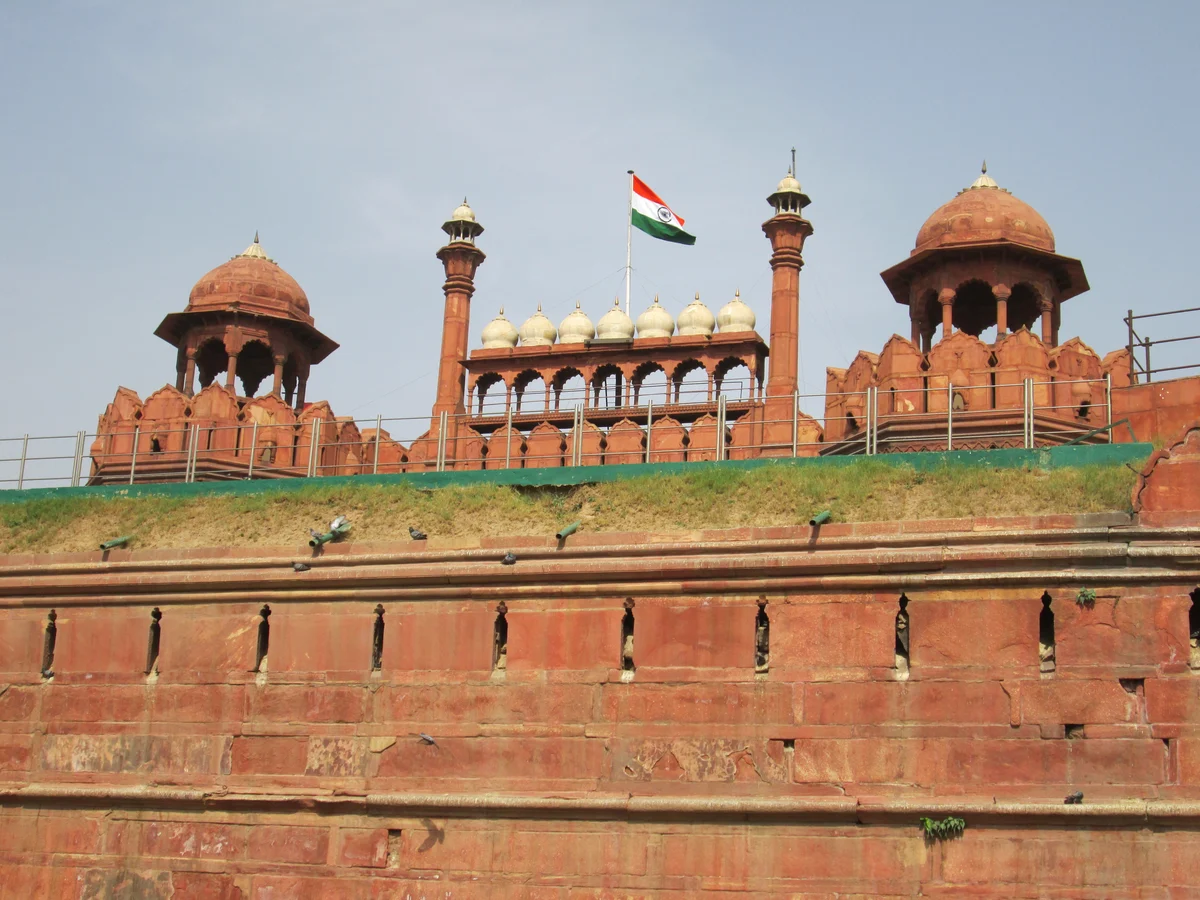
What the Indian flag looks like
India’s national flag has three equal horizontal bands. India saffron is at the top, white is in the middle and India green is at the bottom. The white band contains a navy-blue Ashoka Chakra with 24 equally spaced spokes. The Flag Code requires the wheel to be visible on both sides. The length is three units for every two units of height.
The three bands occupy the same vertical height. If a horizontal flag is 90 centimetres long, it is 60 centimetres tall and each band is 20 centimetres high. Use the top edge to orient the design before hanging or reproducing it. In an official description, a reference to width may mean the hoist or short dimension. Comparing the actual dimensions resolves the difference between 2:3 width to length and 3:2 length to height.
The Chakra is the wheel at the centre of the adopted flag. Its design draws on the wheel on the abacus of the Lion Capital of Ashoka at Sarnath. The national flag and the State Emblem use related historical imagery, with different official designs. Consult the flag specification for the placement of the wheel and the emblem rules for the emblem’s use.
India’s national anthem: words, 52-second version and occasions
Meaning of saffron, white, green and the wheel
The 22 July 1947 Assembly debate records more than the colours and geometry. S. Radhakrishnan explained saffron in terms of renunciation and freedom from self-interest. He associated white with light and truth, green with India’s soil and plant life, and the wheel with dharma and movement. Those descriptions belong to a speech on the adoption of the flag. Attribute the interpretation to the speaker when using it.
A later Press Information Bureau publication describes saffron as strength and courage, white as peace and truth and green as fertility and growth. Public explanations sometimes select different parts of the same symbolism. On a school or museum label, distinguish an attributed historical interpretation from the actual design requirement, which specifies the bands, colours, wheel and proportions.
To understand the reference to movement, read Radhakrishnan’s explanation of the wheel alongside the Assembly’s adoption debate. It puts the wheel within a discussion of what the independent country should do and how its leaders should act. For an illustration or purchase, use the Flag Code’s 24-spoke design. The interpretation adds history to the object without changing what must appear on the flag.
From movement flags to adoption on 22 July 1947
Jawaharlal Nehru moved the flag resolution in the Constituent Assembly on 22 July 1947, and the Assembly adopted the design that day. India became independent on 15 August. Those are two different milestones with their own records. The Assembly debate connects the wheel in the centre of the adopted design to the Sarnath capital. Use that record for the adopted wording and date.
The Ministry of Culture’s historical overview identifies an early flag flown in Calcutta in 1906, a Home Rule flag in 1917 and a design associated with Pingali Venkayya presented in 1921. It follows the spinning wheel through designs from the independence movement and includes a 1931 saffron, white and green flag. Date and identify those objects before comparing their colours or symbols with the official flag used today.
The wheel is one useful way to distinguish archival photographs of movement flags from the tricolour adopted in 1947. A spinning wheel or charkha belongs to an earlier design in the ministry’s sequence. The Ashoka Chakra identifies the current national design when the rest of the prescribed arrangement is present. Details may be hard to see in black-and-white or wind-blown photographs, so check the archive’s caption and date as well.
Choose dimensions and a suitable flag
Start by measuring the available space horizontally and vertically. If the length is fixed, multiply it by two-thirds to find the height. If height is fixed, multiply it by three-halves to find the length. Keep the same measurement unit throughout. Use the table for standard sizes listed in the Code. The Ministry’s public FAQ also says the public may use other dimensions as long as they retain the prescribed ratio.
| Length, mm | Height, mm | Application noted in the Code |
|---|---|---|
| 6300 | 4200 | Standard size |
| 3600 | 2400 | Standard size |
| 2700 | 1800 | Standard size |
| 1800 | 1200 | Standard size |
| 1350 | 900 | Standard size |
| 900 | 600 | Standard size |
| 450 | 300 | VVIP aircraft |
| 225 | 150 | Official motor-car size |
| 150 | 100 | Table flag |
The Flag Code lists fabric categories in its amended material provision. The 30 December 2021 order permits hand-spun and handwoven or machine-made cotton, polyester, wool, silk or khadi bunting as described in the consolidated document. Read the seller’s full description if the production method or material affects your choice. The code addresses the flag’s construction, while a product listing describes the object on sale.
The 150 by 100 millimetre standard is for a table flag. The Code also lists 450 by 300 and 225 by 150 millimetres for particular official aircraft and motor-car uses respectively. The separate official entitlement and protocol sections govern those uses. A size printed in a table describes the physical flag. For a ceremony or official vehicle, use the applicable section before arranging display.
A centimetre label and a millimetre label can describe the same flag. The 900 by 600 millimetre standard is 90 by 60 centimetres. A design listing with two bare numbers requires the unit and the order of dimensions. For an outdoor pole, consider the space the full length of the fabric needs when it extends in the wind. The length on the label is measured across the full flag, including all three bands together.
Home, wall and public-building display
The 20 July 2022 amendment permits day and night display when the flag is flown in the open or on the house of a member of the public, under Part II. The Ministry’s August 2026 compliance circular reaffirms following the Code with its 2021 and 2022 amendments. For the date of the change to open or home display, use the signed July 2022 amendment.
Part III gives a separate protocol for public buildings where the flag is customarily flown. Paragraph 3.6 sets sunrise to sunset, including Sundays and holidays, with night display on very special occasions. For a government building, ceremony or other official venue, read the applicable provisions and any current order for that venue. For home display, use the member-of-the-public provision above.
When the flag is laid flat on a wall horizontally, place saffron at the top. When displayed vertically, the advisory places saffron on the flag’s right, which is on the viewer’s left. Keep the flag in a position of honour and free of contact with the floor, ground or water. The advisory calls for a properly maintained flag and for the respectful private disposal of paper flags used at public events.
Two documents address different aspects of public display. The Flag Code contains the display and placement instructions. Section 2 of the Prevention of Insults to National Honour Act addresses specified acts of disrespect or contempt in a public place or within public view and includes certain visual representations. Read the current wording for a ceremony, production or event that raises a particular question. The Ministry keeps the current documents together.
For a lectern or stage, the ordinary placement instructions give two choices. Put the flag to the speaker’s right as they face the audience, or display it flat above and behind the speaker. The speaker’s right is the audience’s left. A site plan can specify those points before the event, especially if two teams are arranging the same stage from different sides of the room. Preserve the horizontal or vertical orientation rules for the applicable placement.
The public-display instructions also cover a flag on a mast and the use of decorations. Reserve its masthead for the national flag and keep other flags or bunting from occupying the prohibited positions around it. Decorations or garlands belong away from the mast. An official event involving foreign national flags has additional protocol guidance in the Code. Check the correct arrangement before applying an ordinary public-display illustration to a diplomatic ceremony.
- Ministry of Home Affairs – Flag Code of India, 2002, consolidated through the 2021 amendment
- Ministry of Home Affairs – signed Flag Code amendment order of 20 July 2022
- Ministry of Home Affairs – English advisory with salient Flag Code provisions
- Press Information Bureau – Ministry of Home Affairs Flag Code FAQ
- Ministry of Home Affairs – Flag Code compliance circular dated 10 August 2026
- Consulate General of India, Ho Chi Minh City – Flag Code Part III reproduction
- India Code – Prevention of Insults to National Honour Act, 1971, Section 2
- Official Flag Code provisions on public and educational display
Digital flags, the emoji and references for publication
The flag emoji 🇮🇳 is formed from two Unicode regional indicators. A device, browser or font supplies its visible drawing. On unsupported systems it can show paired letters. Use the India flag emoji guide for the exact copy-and-paste sequence and troubleshooting. Use the Flag Code and an image suitable for your publication if the reader needs the correct geometry and every spoke to be visible.
For meaning, keep the source of the explanation with the wording. For historical images, record the date, purpose and institution or archive responsible for the image. For a design reference, preserve the ratio and show the front orientation. Codes or colours chosen by a digital graphics package describe that graphic. Use the official physical specification if the colour standard matters to a flag order.
For questions about Independence Day and Republic Day, start with the two events’ own dates and programmes. In July 2026 the Ministry issued revised anthem and national-song instructions and separately reported the parliamentary passage of the measure extending the relevant protection to the national song. The national flag still has its own Code and amendments. The linked anthem guide records the applicable ceremony rules for that different national symbol.
Keep the distinctions when sharing a screenshot, handout or reference card. A photograph of a flag over the Red Fort can illustrate public use in a particular setting and year. The code supplies the dimensions and arrangement. The Constituent Assembly record supplies the adoption decision and historical discussion. These three records together let another reader verify both the object and the claims made about it.
A practical caption can give the photographed site and date separately from the official design. For example, a Delhi photograph taken in 2016 can illustrate a flag flown at the Red Fort. An explanation of when day-and-night display was permitted needs the July 2022 order. The two dates refer to their respective evidence and can appear together in the same reference without implying that the photograph documents the later rule.
India flag emoji 🇮🇳 to copy and pasteIndia’s national anthem: words, 52-second version and occasions
Sources
- Ministry of Home Affairs – Flag Code of India, 2002, consolidated through the 2021 amendment
- Ministry of Home Affairs – signed Flag Code amendment order of 20 July 2022
- Ministry of Home Affairs – English advisory with salient Flag Code provisions
- Press Information Bureau – Ministry of Home Affairs Flag Code FAQ
- Ministry of Home Affairs – Flag Code compliance circular dated 10 August 2026
- Parliament of India – Constituent Assembly debates, 22 July 1947
- Unicode Consortium – Emoji 16.0 sequence data
- Consulate General of India, Ho Chi Minh City – Flag Code Part III reproduction
- Press Information Bureau – New India Samachar explainer on tricolour meanings
- Ministry of Culture via Press Information Bureau – evolution of the national flag
- India Code – Prevention of Insults to National Honour Act, 1971, Section 2
- Ministry of Home Affairs – July 2026 monthly record
- Ministry of Home Affairs signed amendment of 30 December 2021
- Official Flag Code provisions on public and educational display