How society was organised
In ancient India, varna was a fourfold Brahmanical model of social rank and duty, while jati could refer to a more specific, named group linked to birth. Kinship, occupation, guild membership and political power also organised people's lives, and surviving texts and inscriptions show that these relationships could cut across the fourfold model.
The period from about 600 BCE to 600 CE gives this account a working frame. NCERT uses it to study kinship, caste and class in early societies. The Rigveda supplies literary background, while the inscriptions below document particular communities and transactions within the working period. Nasik and Mandsaur offer evidence from specific places, so their records support conclusions at a different scale from a text that sets out a general hierarchy.
The word caste can cover several questions that call for different evidence. A royal genealogy can show which family ties a ruler publicly claimed. An occupational name can identify the work for which a group was known. A birth-linked group raises further questions about descent, marriage and recognition by others. Even where several of these features appear together, each needs its own textual or inscriptional support.
- NCERT Themes in Indian History I: Kinship, Caste and Class, via IIT Kanpur SATHEE
- Epigraphia Indica VIII: Émile Senart, Nasik Cave Inscriptions, no. 12
- Pramāṇa: Nasik Cave 10 inscription of Īśvarasena's ninth regnal year, Senart edition no. 15
- DHARMA and Siddham: Mandsaur Stone Inscription of the Silk Weavers
- IGNOU: India from 200 BCE to 300 CE, University Unit
- Swayam Panda, IGNOU MHI-06: Changing Social Pattern, Varna and Jati, §11.3
Varna in the Rigveda and Manu
In the Purusha Sukta, Rigveda 10.90.12 names Brāhmaṇa, Rājanya, Vaiśya and Śūdra. The creation hymn associates them with the mouth, arms, thighs and feet of a cosmic being. The arrangement places the categories inside a story about the formation of the world. Its genre matters because a ritual account can give a classification symbolic authority while leaving the everyday organisation of communities outside its subject.
Rājanya is the Sanskrit word in this verse. A translation or explanation may give a term associated with Kshatriya, which is familiar from later accounts of varna. To verify a quotation or resolve an apparent discrepancy, compare verse 12 in the Vedic Heritage Portal's Sanskrit text with the same verse in R. T. H. Griffith's English translation. The verse number identifies the passage even where spellings and category names differ. The hymn's initial composition cannot be assigned a secure exact year.
The Mānava-Dharmaśāstra, often called the Manusmriti, makes the hierarchy explicit through prescriptions. Verses 1.87–91 assign different duties and occupations within its fourfold scheme. Verse 10.4 calls three groups twice-born and the fourth once-born, drawing a distinction in ritual standing within the text's classification. These passages reveal how the work's authors organised rank and duty. The number four describes the categories of that scheme and supplies no population count of birth-linked communities.
Editions also place different layers of interpretation on the same page. Ganganatha Jha presents verse 10.4 alongside the later commentary of Medhātithi and explanatory notes. Check where the verse ends before attributing a commentator's interpretation to Manu. Patrick Olivelle's critical edition and translation can help check the ancient passage. Its Oxford Academic publication date, 9 December 2004, dates the modern edition. The ancient text's date remains debated.
- NCERT Themes in Indian History I: Kinship, Caste and Class, via IIT Kanpur SATHEE
- Indira Gandhi National Centre for the Arts Vedic Heritage Portal: Rigveda 10.90, Purusha Sukta
- R. T. H. Griffith historical English translation: Rigveda Hymn 10.90
- Oxford University Press: Patrick Olivelle, Manu's Code of Law, critical edition and translation
- Ganganatha Jha translation of Manusmriti with Medhatithi: verse 10.4 and index
- Swayam Panda, IGNOU MHI-06: Changing Social Pattern, Varna and Jati, §11.3
Jati, kinship and arguments about birth
Jati can describe a named group whose membership was linked to birth. The word's sense varies by text, so the surrounding passage matters when deciding what it denotes. NCERT discusses numerous jatis and groups that fell outside the fourfold model. This makes it difficult to turn the four varnas into an exhaustive list of the groups through which people identified themselves or were classified by others.
Kinship is especially visible in royal genealogies, where recording a relationship can help explain a claim to succession or standing. Such records tell us whose descent a court considered worth making public. NCERT also discusses rulers who sit uneasily with Brahmanical prescriptions. A discrepancy between a ruler's recorded position and a prescribed order is evidence worth keeping in view when asking how political office and inherited status interacted.
Ancient authors also disputed what birth entitled someone to claim. In the Vāseṭṭha Sutta, preserved as Majjhima Nikāya 98, two brahmin students disagree over birth and conduct. The Buddha argues in the dialogue that deeds determine who merits the title brahmin. The exchange establishes that a Buddhist literary tradition preserved a reasoned challenge to inherited standing. Its form gives historians an argument to analyse and offers little basis for measuring how widely communities acted on it.
Texts that describe social exclusion raise a related problem. They can show the boundaries an author wanted to draw or the treatment an author represented as acceptable. To judge where a restriction applied and whom it affected, look for evidence tied to a particular place, group or institution. The mobility of a documented guild or the prominence of an individual donor supplies evidence about those people. It leaves the experience of excluded groups a separate question.
What the Nasik guild records reveal
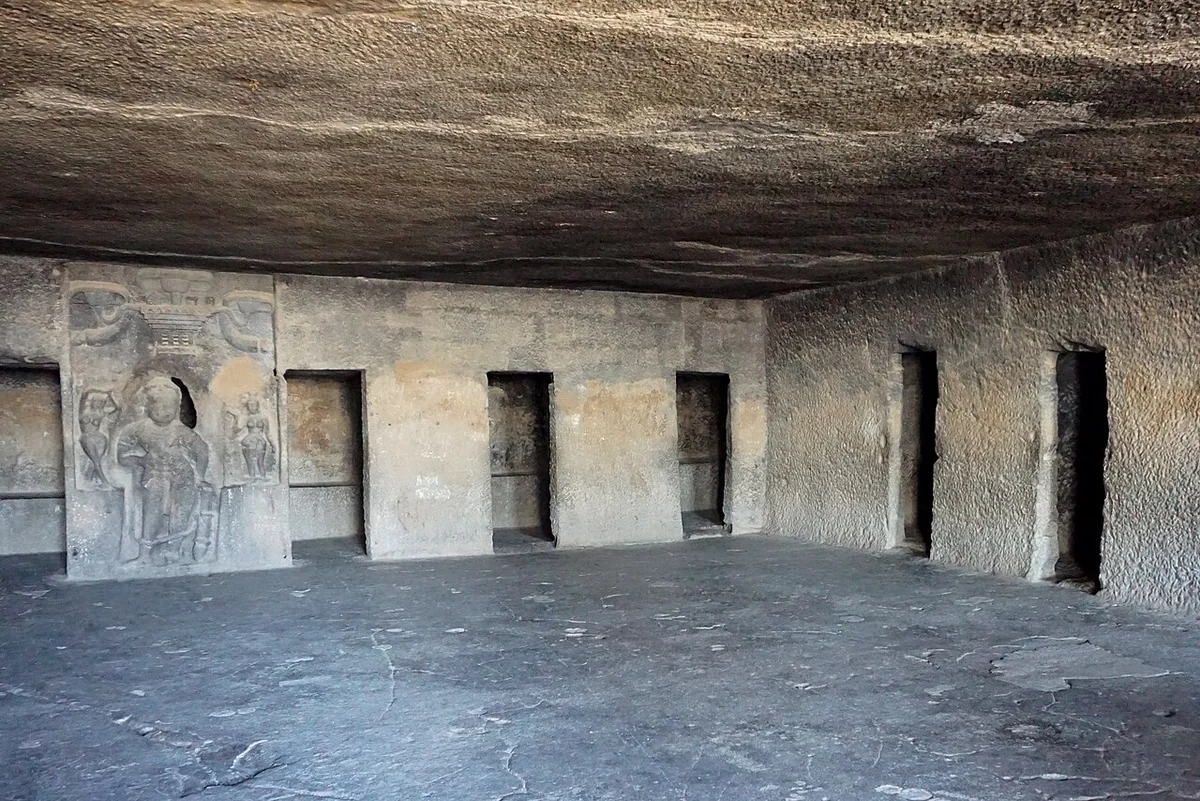
A śreṇi was an occupational or corporate association, often translated as guild. One way to see what that meant in practice is to follow the money in Nasik Cave 10. Inscription no. 12 in Émile Senart's edition records a cave and an endowment by Uṣavadāta, son-in-law of Nahapāna. It gives year 42 and the month Vesākha. Those are the date details the inscription supplies, and preserving them avoids implying a secure conversion to an exact Gregorian year.
The endowment totalled 3,000 kahāpaṇas, divided into capital sums of 2,000 and 1,000 entrusted to two weaver guilds at Govardhana. Proceeds were to support Buddhist monastics, including provision for robes and other needs. The split helps explain the role of the guilds. They were named institutions entrusted with funds whose proceeds would serve a religious community. A shared occupational name therefore identifies two corporate bodies in this transaction, without resolving how their members were related by birth.
| Record | Type | Dated or textual reference | People and institutions named |
|---|---|---|---|
| Purusha Sukta | Literary or prescriptive text | Rigveda 10.90.12 | Brāhmaṇa, Rājanya, Vaiśya and Śūdra in a creation hymn. |
| Vāseṭṭha Sutta | Literary or prescriptive text | Majjhima Nikāya 98 | Two brahmin students debate birth and conduct before the Buddha. |
| Uṣavadāta endowment | Inscription | Nashik Cave 10, Senart no. 12, year 42, Vesākha | Named donor and two weaver guilds at Govardhana, using income from 3,000 kahāpaṇas to support Buddhist monastics. |
| Viṣṇudattā endowment | Inscription | Nashik Cave 10, Senart no. 15, Īśvarasena year 9 | A female lay devotee used guild investment to support medicines for sick Buddhist monastics. |
| Silk weavers’ guild | Inscription | Mandsaur, Mālava years 493 and 529, c.436–437 and 473 CE | Guild families moved from Lāṭa to Daśapura, where the community funded a temple and later restored it. |
A second inscription from Cave 10 records year 9 of Īśvarasena and names Viṣṇudattā, a female lay devotee. She arranged investment through guilds to provide medicine for sick monastics at Triraśmi. The wording also records kin relations. Her inscription shows a woman acting as a named donor and connects guild finance to a different recurring need. Missing or damaged figures should remain open when comparing her endowment with Uṣavadāta's.
Reading the two records side by side brings the donor, financial institution and beneficiary into view. It also shows why familiarity with a profession can carry an inference only so far. The institutions were visible to a public audience because they had a role in the gifts. A detailed account of the members' marriage ties, recruitment or ancestry would require another kind of record. The wording of the donations and the survival of inscriptions shape which people enter this history.
- NCERT Themes in Indian History I: Kinship, Caste and Class, via IIT Kanpur SATHEE
- Epigraphia Indica VIII: Émile Senart, Nasik Cave Inscriptions, no. 12
- Royal Netherlands Academy of Arts and Sciences: Upinder Singh, Inscribing Power on the Realm, 2022
- Pramāṇa: Nasik Cave 10 inscription of Īśvarasena's ninth regnal year, Senart edition no. 15
- Indira Gandhi National Centre for the Arts Vedic Heritage Portal: Rigveda 10.90, Purusha Sukta
- SuttaCentral: Vāseṭṭha Sutta, Majjhima Nikāya 98, Bhikkhu Sujato translation
- DHARMA and Siddham: Mandsaur Stone Inscription of the Silk Weavers
The silk weavers who moved to Mandsaur
The Mandsaur stone inscription describes silk weavers moving with their families from Lāṭa, in western India, to Daśapura, modern Mandsaur. The presence of families matters because the account describes the movement of a community as well as of people with a shared trade. The inscription names Kumāragupta and Bandhuvarman and records the guild's collective patronage of a temple. These details connect work, migration and public patronage in one fifth-century account.
The poem assigns the original dedication to Mālava year 493, around 436–437 CE, and the restoration to Mālava year 529, conventionally dated to 473 CE in Dániel Balogh's edition. The two dates give the group a history across roughly 36 years of recorded patronage. They date different events, so a reference to the earlier year should identify the original temple and a reference to the later year should identify the restoration and the surviving record.
The guild commissioned the poem, and the text names Vatsabhaṭṭi as its composer. In verses 15–21 the poem credits people of the guild community with activities including music, storytelling, religious discussion and study alongside silk production. The details give some sense of how the community wanted its range of accomplishments remembered. Since the verses are public praise, they are especially useful for studying that self-presentation. They cannot establish the distribution of occupations among members.
The move and the temple work make this a useful case for distinguishing occupational identity from a claim about caste. Silk weaving gave the group a recognisable collective name, and the inscription represents families moving and supporting a public institution together. To establish a jati identity or boundaries of marriage from this case, a reader would need wording or corroborating evidence that explicitly bears on those questions.
The dated verses and the record’s physical location answer distinct questions. Balogh identifies the Sanskrit inscription as object OB00036 and text IN00040, on a sandstone slab now at Gujri Mahal Museum, Gwalior. The guild named in the poem concerns fifth-century Daśapura. The museum tells you where the surviving object is held. A quotation from the inscription should also name its modern edition and translator.
- NCERT Themes in Indian History I: Kinship, Caste and Class, via IIT Kanpur SATHEE
- DHARMA and Siddham: Mandsaur Stone Inscription of the Silk Weavers
- Siddham: Mandsaur inscription English translation, Bhandarkar, Chhabra and Gai
- Dániel Balogh, Inscriptions of the Aulikaras and Their Associates, section A6, pp. 87–99
How to check a claim about ancient caste
When an account makes a claim about ancient caste, identify the passage or object on which it rests. Then match the scale of the claim to what survives. A prescription can support a statement about assigned duties. An inscription that names an endowment can support a statement about a transaction, its participants and its purpose. To assess a broader statement about a region or period, look for multiple records that address the same question.
| Claim | Place to check | What the evidence supports |
|---|---|---|
| The Rigveda names four groups in the creation hymn | Rigveda 10.90.12 in Sanskrit | The four terms, including Rājanya, and their place in the hymn |
| Manu assigns duties and distinguishes ritual standing | Mānava-Dharmaśāstra 1.87–91 and 10.4 | The hierarchy prescribed in the text |
| A Nasik endowment used two weaver guilds | Nasik Cave 10, Senart no. 12, pp. 82–83 | The sums, guilds and purpose of Uṣavadāta's gift |
| Guild investment funded medicine | Nasik Cave 10, Senart no. 15 | Viṣṇudattā's named role and the purpose of the provision |
| The weavers' temple was restored in the fifth century | Mandsaur inscription IN00040, Mālava year 529 | A recorded restoration conventionally dated to 473 CE |
If a caption gives 473 CE without naming the event, use the inscription record IN00040 or section A6 of Balogh's edition to check what the year refers to. The Sanskrit era year and the edition's conversion can be compared directly. For the slab's present display or location, check the museum's current information using the object identifier OB00036 and the inscription name. Balogh records the slab at Gujri Mahal Museum in Gwalior. That attribution has a publication date, while a museum display can change.
Modern legal terms require a different source. Article 17 of the Constitution of India abolishes untouchability. Article 341 concerns the identification of Scheduled Castes for constitutional purposes. If a modern category appears in an account of an ancient group, check whether the author has supplied historical evidence for the connection, with a place and period. The constitutional category has a specific legal function, and the ancient sources discussed here supply their own terms for the people and relationships they describe.
Medieval India timeline, dates, kingdoms and monumentsAncient India timeline: Harappan cities, Ashoka, Gupta and Nalanda
- NCERT Themes in Indian History I: Kinship, Caste and Class, via IIT Kanpur SATHEE
- Indira Gandhi National Centre for the Arts Vedic Heritage Portal: Rigveda 10.90, Purusha Sukta
- Oxford University Press: Patrick Olivelle, Manu's Code of Law, critical edition and translation
- Ganganatha Jha translation of Manusmriti with Medhatithi: verse 10.4 and index
- SuttaCentral: Vāseṭṭha Sutta, Majjhima Nikāya 98, Bhikkhu Sujato translation
- Epigraphia Indica VIII: Émile Senart, Nasik Cave Inscriptions, no. 12
- Pramāṇa: Nasik Cave 10 inscription of Īśvarasena's ninth regnal year, Senart edition no. 15
- DHARMA and Siddham: Mandsaur Stone Inscription of the Silk Weavers
- Dániel Balogh, Inscriptions of the Aulikaras and Their Associates, section A6, pp. 87–99
- Legislative Department, Government of India: Constitution of India
- IGNOU: India from 200 BCE to 300 CE, University Unit
- Swayam Panda, IGNOU MHI-06: Changing Social Pattern, Varna and Jati, §11.3
Sources
- NCERT Themes in Indian History I: Kinship, Caste and Class, via IIT Kanpur SATHEE
- Indira Gandhi National Centre for the Arts Vedic Heritage Portal: Rigveda 10.90, Purusha Sukta
- R. T. H. Griffith historical English translation: Rigveda Hymn 10.90
- Oxford University Press: Patrick Olivelle, Manu's Code of Law, critical edition and translation
- Ganganatha Jha translation of Manusmriti with Medhatithi: verse 10.4 and index
- SuttaCentral: Vāseṭṭha Sutta, Majjhima Nikāya 98, Bhikkhu Sujato translation
- Epigraphia Indica VIII: Émile Senart, Nasik Cave Inscriptions, no. 12
- Royal Netherlands Academy of Arts and Sciences: Upinder Singh, Inscribing Power on the Realm, 2022
- Pramāṇa: Nasik Cave 10 inscription of Īśvarasena's ninth regnal year, Senart edition no. 15
- DHARMA and Siddham: Mandsaur Stone Inscription of the Silk Weavers
- Siddham: Mandsaur inscription English translation, Bhandarkar, Chhabra and Gai
- Dániel Balogh, Inscriptions of the Aulikaras and Their Associates, section A6, pp. 87–99
- Legislative Department, Government of India: Constitution of India
- Wikimedia Commons: Mandsaur inscription of the Silk Weavers Guild
- UNESCO Tentative Lists: Serial Nomination for Ashokan Edicts
- IGNOU: India from 200 BCE to 300 CE, University Unit
- Swayam Panda, IGNOU MHI-06: Changing Social Pattern, Varna and Jati, §11.3
