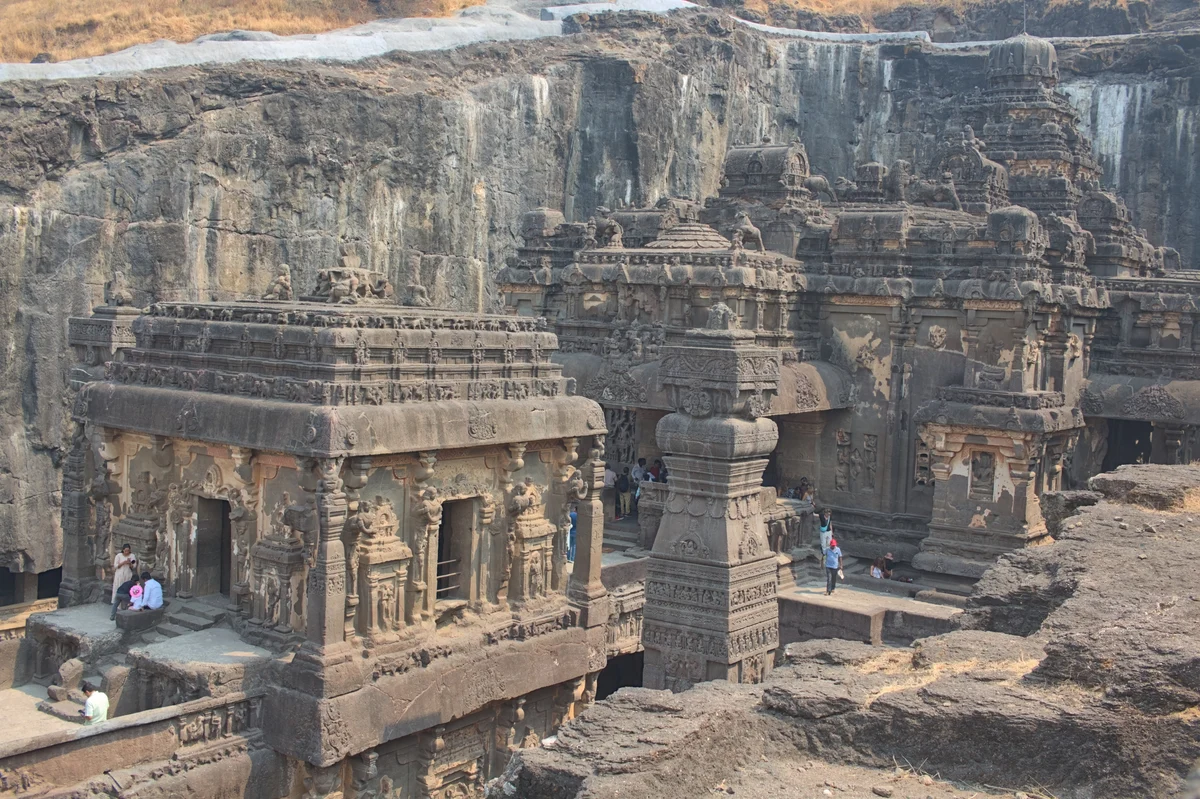
Find Kailasa Temple at Ellora Cave 16
Kailasa Temple is Cave 16 inside the Ellora Caves at Verul, Maharashtra, and the Ellora site ticket covers the visit. The Archaeological Survey of India lists the caves as open from sunrise to sunset and closed on Tuesdays, so check your intended date before arranging transport.
Enter Ellora Caves or Verul Leni as your road destination, then look for Cave 16 inside the archaeological site. Kailasa, Kailash and Kailasanatha are names you may encounter for the same rock-cut Shiva temple. Use the cave number to match a map label to the site itinerary. The district also lists Ghrishneshwar Jyotirlinga Temple in Verul, with its own entrance roughly one kilometre away on foot.
Ellora Caves is also the name of the UNESCO World Heritage property, which encompasses 34 monasteries and temples. That wider name matters when looking at photos or deciding how long to stay. Images of Kailasa’s sculpted temple show one stop in a south-to-north cliff sequence. A visit centred on Cave 16 can work in 60 to 90 minutes, while adding selected Buddhist and Jain caves calls for a longer block.
Check Ellora tickets and entry for your date
ASI publishes a lower online tariff than its counter tariff for both paid categories. The published categories distinguish Indian, SAARC and BIMSTEC nationals from other foreign visitors. A visitor travelling on a US passport falls under the other foreign visitor category by nationality. Children below 15 are listed as free. If you are planning for a group with different nationalities or ages, work out the applicable category for each person before comparing the two purchase channels.
| Visitor category | Counter | Online |
|---|---|---|
| Indian, SAARC and BIMSTEC nationals | ₹40 | ₹35 |
| Other foreign visitors | ₹600 | ₹550 |
| Children below 15 | Free | Free |
Find Ellora Caves in ASI’s official ticketed-monuments directory under Maharashtra’s Aurangabad circle and follow its Buy Ticket option. Select the day in the booking interface and check the entry details and payable amount before payment. The standing tariff and weekly opening pattern can help you budget and pick a day. The booking interface is where you confirm what is available for your visit, including any entry slot it presents.
Read back the monument, date and visitor fields before you pay. ASI’s refund policy says a generated or printed ticket is nonrefundable and treats a failed payment without ticket generation separately. If a payment appears to fail, check whether the system generated a ticket before trying again. For an afternoon arrival, verify the admission cutoff directly with the site. The published sunset closing time gives you the outer limit of the visit, and a fixed last-entry offset remains unverified.
Get to Verul from Chhatrapati Sambhajinagar
Chhatrapati Sambhajinagar is the city to use for rail or air connections to Ellora. The district gives approximate road distances of 31 km from the city, 29 km from the railway station and 36 km from the airport. ASI puts Verul Leni roughly 30 km northwest of the city on the old Aurangabad–Chalisgaon road. Use your actual departure point to estimate the drive, since the official figures refer to different starting points.
For trains, search Indian Railways’ National Train Enquiry System using Chhatrapati Sambhaji Nagar or the current station code CPSN. South Central Railway’s October 2025 circular records the change from Aurangabad and its former code AWB. Older itineraries may still use that name and code. The airport continues to use IXU, and an airline search may show Aurangabad alongside the code. Verify the flight with the airline when planning a same-day connection because the airport authority labels its schedule tentative.
The district lists state transport bus and taxi for the road leg. If a firm return matters, such as when you have an onward train, arrange a pickup at the Ellora Caves entrance and give yourself time to get back there from your last cave. If you choose the bus, confirm the boarding point in the city, where to get off for the caves and the last suitable return with the operator. MSRTC has a dated reservation search for services it sells online. Confirm the local Verul leg separately when you cannot establish it there.
- Archaeological Survey of India — Ellora entry window, ticket categories and cave itinerary
- District Chhatrapati Sambhajinagar — Verul access and two separate temple stops
- South Central Railway and Airports Authority — new railway code, established airport code
- South Central Railway signed station name and code change circular
- Indian Railways National Train Enquiry System
Choose a cave itinerary for the time you have
The Ellora scarp extends nearly two kilometres from south to north. The Buddhist caves lie toward the south, the Hindu caves occupy the central stretch and the Jain caves are toward the north. Use those clusters to plan your walking. Even with only a few caves on your list, moving between the southern and northern groups takes time, especially if you also have a pickup to meet back at the entrance.
With 60 to 90 minutes on site, make Cave 16 the visit. Give yourself time to see the temple in relation to the excavated courtyard from the areas open that day. Consider an available upper viewpoint once you have seen the main complex and know how much time you have left. Keep the walk back to the entrance within your time allowance, particularly if wet surfaces or a slower walking pace will affect it.
For three to four hours, ASI suggests Visvakarma at Cave 10, Kailasa at Cave 16, Ramesvara at Cave 21 and Jain Caves 32 and 34. If you have about three hours and Kailasa is the reason you came, start at 16. Then decide whether your remaining time is better spent seeing a Buddhist cave to the south or reaching the Jain group to the north. With more time, the full suggested selection gives you a sample of all three traditions.
For a full archaeological day, ASI’s longer selection adds Buddhist Caves 2, 5 and 12, Hindu Caves 14, 15 and 29, and Jain Cave 33 to those anchors. Use it as a group-by-group plan, with time to pause at individual monuments. If the northern caves are a priority, give them a definite place in the day and plan for the walk. A dependable internal shuttle timetable and fare remain unverified.
| Time available | ASI cave numbers or visit focus | Planning detail |
|---|---|---|
| 60–90 minutes | 16, Kailasa Temple | Allow walking time and check which viewpoints are open |
| Three to four hours | 10, 16, 21, 32 and 34 | ASI’s shorter selection across Buddhist, Hindu and Jain groups |
| Most of one day | 2, 5, 10, 12, 14, 15, 16, 21, 29 and 32–34 | ASI’s extended selection. Plan for walking to the northern group |
Read the rock-cut temple and its history
Kailasa is a monolithic excavation in Deccan basalt. At an open courtyard viewpoint, look at the space between the temple and the remaining rock faces. The excavation created that space and left the principal temple mass standing within it. An available higher view can make the arrangement easier to read, while a courtyard view lets you look at the mass and sculpted surfaces at closer range. Both views help explain why a temple that appears freestanding belongs to a cave sequence.
ASI attributes Cave 16 to the Rashtrakuta king Krishna I, whose reign it places roughly between 757 and 783 CE. Read that range as the context for the royal attribution. ASI’s historical discussion cites an inscription associated with Dantidurga at Cave 15 and a later copper plate. Cave 15 is therefore a useful addition for a visitor interested in the evidence behind the Rashtrakuta history as well as the architecture of Kailasa.
UNESCO inscribed the Ellora Caves in 1983. Its overview places the wider series broadly between the sixth and tenth centuries and recognises Buddhist, Hindu and Jain monuments. That span describes the cliff sequence as a whole. The narrower eighth-century attribution concerns Kailasa. If you are deciding between more time at Cave 16 and a walk to another group, the first lets you study one excavation in detail and the second shows how differently the cliff was used across the property.
Plan for walking, weather and photography
Maharashtra Tourism favours October through March for cooler walking weather. Its seasonal guidance also describes intense heat from April into June and slippery conditions during the June to September monsoon. Check the forecast for Verul close to your visit. During hot weather, put exposed walking earlier in the day. After rain, allow more time to move between stops and decide about higher viewpoints once you can see the condition of the paths.
If stairs, uneven ground or walking distance affect your visit, ask site staff about specific parts of the route. Useful questions cover the approach from the public entrance to Cave 16, whether you can reach an open courtyard viewing position, and where steps begin on any route to a higher view. Those details can determine whether Cave 16 alone is a workable stop or whether you can comfortably add another group. A current step-free route has yet to be verified.
ASI’s general photography guidance permits ordinary still photography at protected monuments without stands, extra lights or special equipment, subject to site rules. Check Ellora’s posted instructions where you plan to take photos and ask staff before bringing equipment for a professional shoot. If you want to match the angle of a photograph taken from above, establish which viewpoints are open to visitors that day. Build your route around the access staff confirm.
Temple photography in India, compare rules at six named sites
- Archaeological Survey of India — Ellora entry window, ticket categories and cave itinerary
- Archaeological Survey of India — official ticket directory and e-ticket refund policy
- District Chhatrapati Sambhajinagar — Verul access and two separate temple stops
- Maharashtra Tourism — Ellora seasons and regional choices
Fit in Ghrishneshwar, Daulatabad or Ajanta
Ghrishneshwar is the nearby add-on if you want to visit an active Jyotirlinga shrine after seeing Kailasa. The district puts it roughly one kilometre from Ellora on foot. Give it its own time allowance for the walk, entrance and worship. Confirm the shrine’s hours and queue arrangements directly for your date, particularly around a festival. If worship is central to the trip, establish the shrine timing first and fit your Ellora block around it.
Daulatabad, also called Devgiri Fort, is a separate road stop about 16 km from the city by the district’s estimate. The fort visit involves a substantial uphill walk. A separate half day gives that climb room in the itinerary. For a combined day, a shorter Ellora visit focused on Cave 16 leaves more time for the fort. Verify the fort’s hours and entry arrangements for that day before deciding which stop comes first.
Ajanta works best as a separate day from the city base. ASI places it about 107 km north of Chhatrapati Sambhajinagar and lists it as open from 09:00 to 17:00 with a Monday closure. It has its own ticket entry and is a Buddhist site known for painted and rock-cut caves. If your two days in the city are Monday and Tuesday, the published weekly schedules put Ellora on Monday and Ajanta on Tuesday. Check special closures and arrange each road journey before committing to that order.
| Destination | Distance or relationship | Opening distinction |
|---|---|---|
| Ellora Caves, including Kailasa Temple | Verul, approximately 31 km by road from the city | Sunrise to sunset. Closed Tuesday |
| Ghrishneshwar Jyotirlinga | About 1 km from Ellora Caves on foot | Separate active shrine and admission arrangements |
| Ajanta Caves | Approximately 107 km north of the city | 09:00–17:00. Closed Monday |
Sources
- Archaeological Survey of India — Ellora entry window, ticket categories and cave itinerary
- UNESCO World Heritage Centre — Ellora Caves property 243
- Archaeological Survey of India — official ticket directory and e-ticket refund policy
- District Chhatrapati Sambhajinagar — Verul access and two separate temple stops
- South Central Railway and Airports Authority — new railway code, established airport code
- Maharashtra Tourism — Ellora seasons and regional choices
- Archaeological Survey of India — separate Ajanta day and Monday closure
- Wikimedia Commons — Kailasa at Ellora by Shishirdasika
- South Central Railway signed station name and code change circular
- Indian Railways National Train Enquiry System
