Find Mother’s Day in India by year
Second Sunday in May. Family events or service hours can follow their own schedule.
Download 2027–2030 calendar dates (.ics)
| Year | Date |
|---|---|
| 2027 | |
| 2028 | |
| 2029 | |
| 2030 |
Explainer + calendar
Find Mother’s Day in India for any year, save the 2027–2030 dates and compare the Indian observance with Mothering Sunday in the UK.
Second Sunday in May. Family events or service hours can follow their own schedule.
Download 2027–2030 calendar dates (.ics)
| Year | Date |
|---|---|
| 2027 | |
| 2028 | |
| 2029 | |
| 2030 |
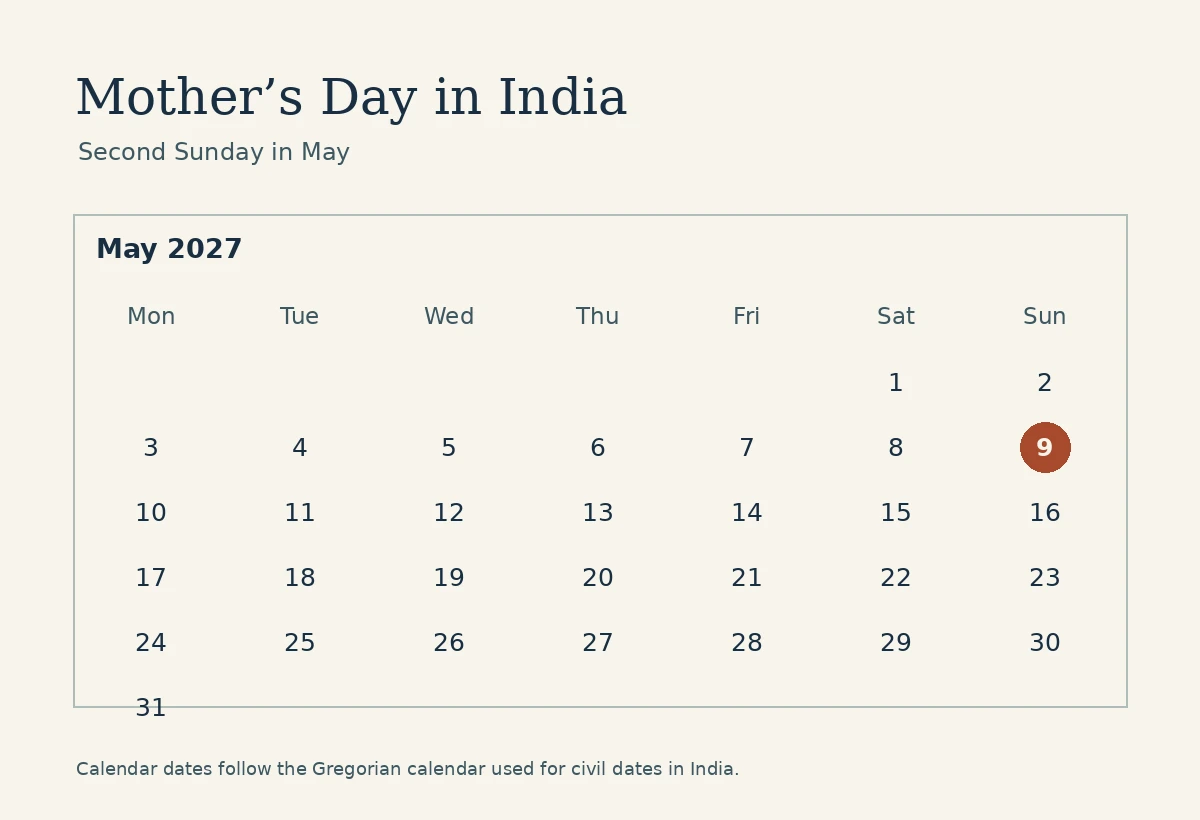
Mother’s Day in India follows the second Sunday in May. In 2027 it falls on Sunday, 9 May. Look up another year with the date finder, or download the 2027–2030 observance dates as all-day calendar entries.
The date moves within May because the observance follows a weekday rule. In 2026, the second Sunday was 10 May. In 2027, it is 9 May. Use the year when forwarding the date or adding it to a shared family calendar, especially if the message might be read again the following spring.
The second-Sunday convention gives families in different Indian cities one date for a call or meal. It also tells you what a post means when it leaves out a day number. The place matters if relatives use a calendar from another country. It also matters when you want a venue’s Sunday hours or a programme arranged by a school.
Akashvani identifies the second Sunday in May as the day of the observance, and an Indian government publication describes the same convention for India. If a search result says “today,” read the item’s publication date before forwarding it. A headline keeps the wording it was published with, so “today” may refer to a Sunday in an earlier year.
Open the May calendar for the year you need and find the first date labelled Sunday. Count forward seven days to reach the second Sunday. The first Sunday is always between 1 and 7 May, which puts the second Sunday between 8 and 14 May. That range gives you a quick way to spot a date copied from the wrong month or a Sunday counted twice.
For example, suppose 1 May is a Wednesday in a hypothetical year. The first Sunday is 5 May, so Mother’s Day would fall on 12 May. If 1 May itself is a Sunday, count it as the first Sunday and move forward to 8 May. The rule works the same way whether the calendar displays Monday or Sunday as the first column.
Check a calendar entry by opening the full month and locating both Sundays. A week view can hide the first one, particularly when the opening days of May share a row with dates from April. In a month view, use the date and weekday together. The second row of dates can begin before the second Sunday arrives.
When copying a date into a message, use a form such as “Sunday, 9 May 2027.” Spelling out the month helps anyone reading a numeric date under a different convention. Including the weekday lets the recipient compare the invitation with their own calendar, and the year gives a saved message enough context to be understood later.
| Place or tradition | Date in 2027 | Calendar rule |
|---|---|---|
| India | Sunday, 9 May | Second Sunday in May |
| United States | Sunday, 9 May | Second Sunday in May |
| Church of England | Sunday, 7 March | Fourth Sunday in Lent |
Save the observance as an all-day entry on the Indian calendar date. If your calendar app supports repeating events by weekday and position within the month, choose an annual event on the second Sunday of May. Open the next year’s occurrence after setting it up. Some repeat controls start with the day of the month, so an annual entry created on 9 May may stay on 9 May.
If your calendar offers only a fixed annual date, add individual entries for the years you have checked. You can also set a recurring reminder in late April to look up the second Sunday and make plans. This works well if the actual celebration depends on visits, shift patterns or family commitments that change from year to year.
For example, a family might keep Mother’s Day as an all-day entry and schedule lunch at 1 p.m. India Standard Time on the same Sunday. The lunch entry can carry the address, any reservation details and the names of people expected to attend. If the family moves lunch to Saturday, update the invitation and keep the all-day entry on Sunday.
For a call with someone abroad, select the India time zone when creating the timed invitation and ask the recipient to check the day and hour shown in their own calendar. For example, a call planned for early Sunday morning in India may appear on Saturday evening for someone farther west. Write out “India Standard Time” in a message if people are coordinating outside a calendar app.
Father’s Day in India, the third Sunday in JuneUS to India time converter and meeting planner
Use the second-Sunday rule to date the observance and the relevant institution’s own calendar to check opening. The Indian Institute of Remote Sensing publishes a gazetted holiday calendar for its offices, with named closures for the years it covers. Its scope is the institute. For an appointment elsewhere, look up the organisation and location you actually plan to visit.
Start with the branch’s normal Sunday hours, then look for a dated notice that changes them. The named holiday list and the weekly opening schedule answer different questions. An office that closes every Sunday may show no separate entry for a particular Sunday. A venue with Sunday hours may publish a special opening window or change how visitors book for a particular date.
For example, someone arranging a family visit might need to know whether a particular museum admits visitors on Sunday, 9 May 2027. Check the museum’s own Sunday schedule and look for a notice covering that day. If the website lists a closing time, check whether it also gives a last admission time. The two can affect whether a visit after lunch is feasible.
For a school activity or workplace gathering, look for the dated circular or invitation that applies to the participants. A gathering could be scheduled on a school day or workday near the Sunday. Before making childcare or travel arrangements, verify the location, whether attendance requires registration, and the arrival and departure times in the institution’s own instructions.
A listing headed “Mother’s Day” may advertise a single session, an activity held on the preceding Saturday or a programme spread over several days. Start with the organiser’s dated notice and match the year, city, venue and session. Search results and social posts can surface older editions with similar titles, especially when the organiser uses the same artwork each year.
For a restaurant meal, check the exact branch and the time the booking covers. A venue’s published opening hours describe when it operates, while a reservation confirmation tells you when your party is expected. If the listing refers to a set menu or timed seating, read the terms for your session before coordinating the rest of the day around it.
For example, a listing might advertise a Sunday workshop under a Mother’s Day weekend heading. The organiser’s notice could show several sessions at the same venue. Check whether your confirmation names the same date and start time you intend to attend. If you need step-free access, space for a pram or permission for an accompanying guest, check the arrangements with that venue before relying on the listing.
When the listing and the organiser show different details, look for a dated update tied to your booking or session. A recent change to one session may leave the other sessions as advertised. Save the confirmation or notice with your calendar entry so you can find the full address and any updated arrival instructions on the day.
There is also a public example of how a local celebration fits the May date. On 10 May 2026, Akashvani reported Mother’s Day services in Nagaland with prayers in churches across the state. The story verifies what took place in that year and place. A family looking for the next service can use the month and weekday to identify the period, then look for the local church’s notice for the actual time.
The United States observes Mother’s Day on the second Sunday in May under 36 U.S.C. § 117. It therefore uses the same date as the convention in India. In the Church of England calendar, Mothering Sunday is the fourth Sunday of Lent. With Easter on 28 March 2027, Mothering Sunday falls on 7 March that year. A March message from the UK and a May reminder in India can therefore both point to a familiar annual observance.
A different date can also come from a local celebration. A school notice, a community invitation and a calendar entry describe different things. Read the wording around the date to see whether it refers to an event, a booking window or the observance. This matters when a screenshot crops out the title or the message forwarding it omits where the date came from.
For example, a relative might share an image showing 10 May without the year. If it was prepared for 2026, the date fits the Indian rule. For a family plan in 2027, use 9 May. Look for a publication date or an explicit year in the original item before assuming that the screenshot announces a separate celebration.
If a calendar app shows an unexpected entry, open its details and look at the calendar it belongs to. A country calendar, a family calendar and a subscribed events calendar can all show entries with the same name. For a family calendar entry you created, check the recurrence setting as well. A fixed date copied forward from a previous year can land on a different weekday.
Once Sunday, 9 May 2027 has ended in India, wording that calls it the next Mother’s Day has expired. A year-specific entry can still help someone checking an old invitation or photo. If a shared note or calendar description is meant to answer when the next observance is, update the date and year together after verifying the first two Sundays in the following May.
Treat office hours and event details as tied to the date or session they cover. For example, an organiser’s notice for one Mother’s Day workshop can confirm the time of that workshop. If you return to it the following year, look for a new announcement before using the old details to book or plan travel. A saved confirmation remains useful for the booking it names.
A delivery, reservation or visit may need an earlier reminder than the calendar entry for the Sunday itself. For example, if a family wants a gift to arrive before the weekend, check the seller’s stated delivery estimate for the recipient’s postcode when ordering. Put the date you need to act on in the reminder and keep the delivery estimate with the order confirmation.