Find Father’s Day in India by year
Third Sunday in June. Family events or service hours can follow their own schedule.
Download 2027–2030 calendar dates (.ics)
| Year | Date |
|---|---|
| 2027 | |
| 2028 | |
| 2029 | |
| 2030 |
Explainer + calendar
Find Father’s Day in India for any year, download reminders for 2027–2030 and see how Indian, US and Australian dates compare.
Third Sunday in June. Family events or service hours can follow their own schedule.
Download 2027–2030 calendar dates (.ics)
| Year | Date |
|---|---|
| 2027 | |
| 2028 | |
| 2029 | |
| 2030 |
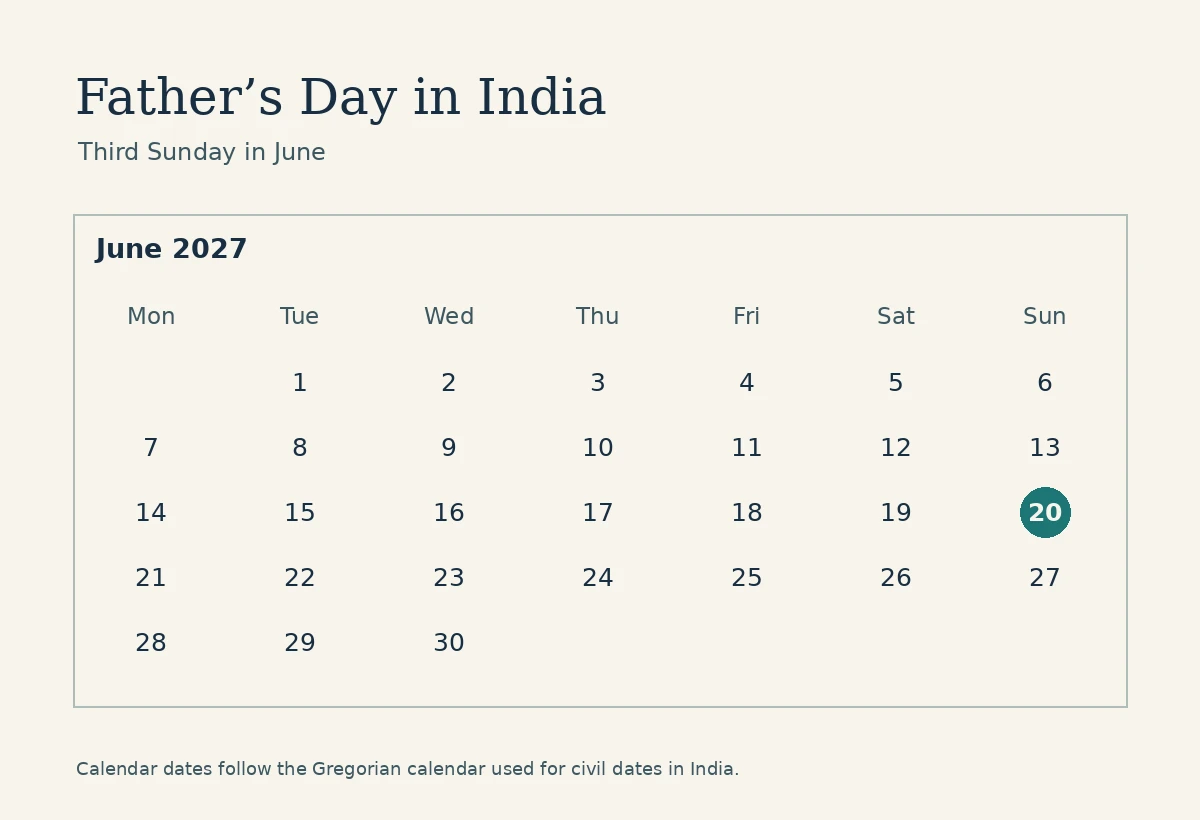
Father’s Day in India follows the third Sunday of June. In 2027 that falls on Sunday, 20 June. The date finder works for other years, and the calendar file gives the four dates from 2027 through 2030.
Akashvani, India’s public broadcaster, describes the third Sunday in June as the observance in India and other countries. That rule gives you the date to put in an Indian calendar, even if the family meal, school activity or local event takes place on another day. When you see a different date on an invitation, first check whether it refers to the observance itself or to the organiser’s chosen date.
The year matters when you look this up. A page showing 21 June can be accurate for 2026 and out of date for 2027. Read the year alongside the date, especially in search previews, forwarded posters and screenshots. If the year is missing, look for the original listing or work out the third Sunday for the year you need. For a named event, use the organiser’s dated notice to confirm when it will actually take place.
For a personal calendar, keep the observance as an all-day entry and give any call or outing a separate timed entry. Example. If your family chooses Saturday for lunch because everyone is free, the invitation can simply show the Saturday booking. The Sunday observance can stay in your calendar, and the people attending lunch have one clear date and time to follow.
| What you are planning | Date to use | What to check |
|---|---|---|
| The next observance in India | Sunday, 20 June 2027 | The calendar entry is set to 2027 |
| A reference to the 2026 observance | Sunday, 21 June 2026 | The source is referring to 2026 |
| A school activity or public event | The date on the organiser’s current notice | The year, start time and venue |
| A delivery | The date available for the recipient’s address | Whether the delivery date is confirmed or estimated |
Open June for the year you need in a calendar that shows weekdays. Find the first date labelled Sunday, then count the next two Sundays. The third one is Father’s Day under the rule used in India. This works whether the calendar displays Sunday at the start of the week or at the end. Counting the dates marked Sunday also avoids a common mistake when June begins partway through a calendar row.
Example using the checked 2027 date. The Sundays in June begin on the 6th, 13th and 20th, so 20 June is the third Sunday. In June 2026 the first three Sundays fell on the 7th, 14th and 21st. If you copy your old calendar entry into a new year, check the recurrence settings before saving it. An event that repeats every 21 June will keep the day of the month and drift away from the Sunday rule.
You can also narrow the check to 15 through 21 June. The first Sunday has to fall in the first seven days of the month, and the third Sunday comes exactly two weeks later. There will be one Sunday in that seven-day stretch. If your calendar supports a yearly repeat on the third Sunday of June, use that option and preview the following occurrence. When it only supports an annual repeat by date, create a separate entry for the year you need.
Use the date in India Standard Time, or IST, when planning around someone in India. For a simple greeting, any suitable time during their Sunday will do. For a video call or a message you want to arrive at a particular hour, first choose the time in India, then check the corresponding time where you will be. The same instant can fall on different calendar dates for the sender and the recipient.
You are abroad and want to call your father on Sunday morning in India. Create a timed invitation with India as the event time zone, enter the hour you have agreed on and inspect the invitation in your own calendar. If it appears on Saturday evening for you, both entries can still describe the same call. Put the India date and time in the invitation text so family members can confirm the intended slot even when their apps display it differently.
The same check helps with scheduled messages. Read the scheduling screen closely enough to see whether it uses the device’s current zone or offers a zone for the message. Example. If you plan to schedule a greeting before travelling, reopen the queued message and check the send time against the recipient’s Sunday in India. If you only need a prompt to send it yourself, a reminder during your own waking hours may be easier to manage.
US to India time converter and meeting plannerMother’s Day in India, the second Sunday in May
Father’s Day gives you the observance date. For an office visit, use the named office’s current working hours and closure notices. IIRS–ISRO publishes a dated gazetted holiday calendar for the Indian Institute of Remote Sensing. Its scope is that institution. If you need a particular service, check the calendar and hours for the office that provides it, using the relevant year and location.
A holiday calendar and a weekly schedule answer different questions. The holiday calendar records named closures for the organisation that issued it. The weekly schedule tells you whether the branch or counter ordinarily serves visitors on Sundays. Check both where they matter, then look for a dated notice about the day of your visit. If you find several pages, use the one that names the exact branch or facility and covers the date you have in mind.
You plan to combine a family outing with a visit to a service counter. The building’s visitor information shows Sunday opening hours. Before setting out, check whether those hours also apply to the counter and whether it requires an appointment. The same distinction applies to places with multiple facilities. An open shopping centre gives you a place to go, while a restaurant reservation or a specific activity inside it depends on that operator’s own hours and availability.
A school, community group or venue can choose a convenient day for its programme. Use the organiser’s current notice as the date for attendance. Check the year and location before making plans, especially if the announcement reaches you through a forwarded image. Read the time labels too. Arrival, registration and the start of the programme can each have their own time, and the right one depends on what the participant needs to do.
A school asks pupils to bring a card on Friday and invites families to an activity on Saturday. Put the Friday deadline and Saturday activity in separate entries. Add the reporting time to the Saturday entry if the circular specifies one. If a later notice changes the activity date, update the invitation shared with anyone attending and check whether the school also moved the Friday deadline.
For an event open to the public, check the organiser’s latest listing before arranging travel. Verify the venue address, how attendance works and whether the advertised session still has places. Example. A venue advertises a Father’s Day activity under one title and offers several sessions. Use the time on the booking confirmation for your group. If the listing has changed since you booked, check for a message about your session or contact the organiser with the booking reference.
Start with the time the recipient or group can actually use. An outing depends on the date, the specific location and the number of people the venue can accommodate. A delivery depends on the address and the options available for the item. A page advertising Father’s Day can help you find an offer. Use the booking or checkout details for the date, slot and location to which the operator is committing.
You want a cake delivered before a Sunday lunch. Enter the recipient’s address or PIN code and check the date and time range available for that cake. If the afternoon end of the range runs past lunch, consider a Saturday delivery or a collection time that fits the meal. Check any storage instructions before choosing early delivery. Where the seller gives an estimated arrival date, build the plan around the possibility that the parcel arrives later in the quoted window.
You are booking a meal for relatives travelling from different parts of a city. Confirm the branch and group size, and check whether the venue has set an arrival window or a time limit for the table. Share the branch address and the confirmed time directly with the group. If the booking is provisional, wait for the operator’s acceptance before anyone makes travel arrangements that depend on that particular slot.
Check the year first when you find a saved reminder, an old invitation or an undated search result. For the observance, compare the stated weekday and date with June in that year, using the third-Sunday rule. For a closure, use the current calendar of the institution concerned. For a booking, look up the current confirmation. These checks let you verify the detail that controls your plan, even when the original item you saw was a screenshot or a short search preview.
You are about to forward a graphic that says Father’s Day is on 21 June. The date matches the Indian observance in 2026. For a message about 2027, use Sunday, 20 June and write the year in the message. If the graphic also promotes a local event, look for a current listing before forwarding its location or time. The calendar check can resolve the observance date, while the event details depend on the organiser.
Treat the phrase “next Father’s Day” as date-sensitive. During Sunday, 20 June 2027 in India, “today” is accurate. From Monday, 21 June in India, roll any saved or published reminder forward only after checking the following year’s calendar. For a notice that people may consult later, write the full date and year. For a timed invitation shared across countries, include the event time zone as well, so the wording holds up when someone opens it in a different place.
The United States also uses the third Sunday in June by statute. Australia observes Father’s Day on the first Sunday of September, according to the Sunshine Coast Council’s history of the observance. The two rules give 20 June and 5 September respectively in 2027. Label the country when sharing a reminder across households in India and Australia. A separate call or trip can use whichever date the group agrees to, and a dated invitation will tell people which Sunday to keep available.
| Country | Date in 2027 | Calendar rule |
|---|---|---|
| India | Sunday, 20 June | Third Sunday in June |
| United States | Sunday, 20 June | Third Sunday in June |
| Australia | Sunday, 5 September | First Sunday in September |