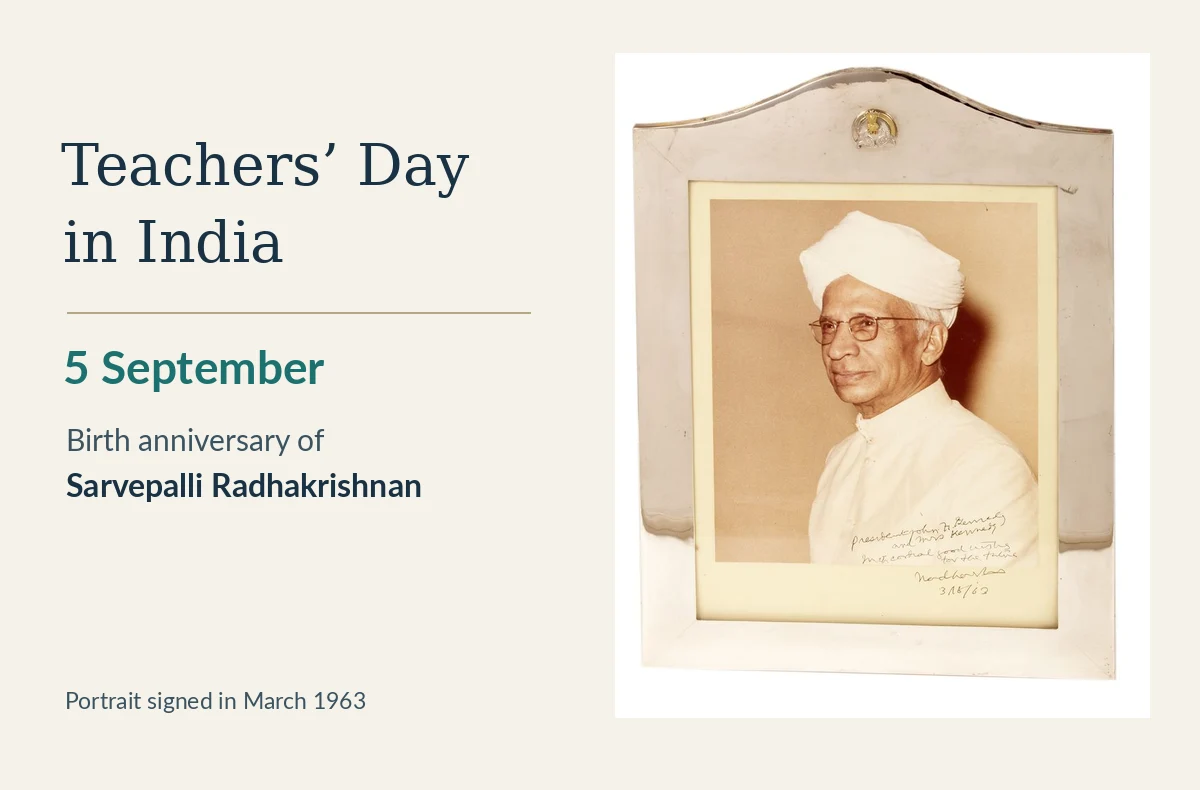
India observes Teachers’ Day every year on 5 September, the birthday of Sarvepalli Radhakrishnan. For a school or college celebration, check the institution’s notice for the programme date, timings and any change to the usual timetable.
The national observance follows a fixed calendar date. The weekday changes each year, so the fact that an assembly took place on a particular weekday last year tells you little about the next one. India’s date is 5 September wherever in the country you are looking. If an Indian institution publishes a local start time for an event you plan to join from abroad, read it in Indian Standard Time unless the notice specifies a different time zone.
The presidential greetings describe the occasion as a recognition of educators’ contributions. A greeting issued on the eve of Teachers’ Day is dated a day ahead of the occasion in the sense that it anticipates the observance. When reading one in an archive, look for the day named in the message itself. The publication date at the top of a release records when the greeting was issued.
Use 5 September for a calendar reminder or a question about the national date. If you are planning a visit, arranging transport or joining a school event online, the institution’s date and time are the ones you need for that decision. Keep the year with any event details you save or share, especially if they come from a forwarded screenshot.
Sarvepalli Radhakrishnan was born on 5 September 1888. His connection to education preceded his time in public office. The President of India’s official biography records his academic work at Mysore and Calcutta. He later served as India’s ambassador to the Soviet Union from 1949 to 1952 and as India’s first Vice-President from 1952 to 1962. He took office as India’s second President on 13 May 1962 and served until 13 May 1967.
A presidential address delivered on 5 September 2012 recounts how his birthday became the occasion for a national observance. According to that address, admirers approached Radhakrishnan about celebrating his birthday when he became President in 1962. He suggested that the day be observed as Teachers’ Day. The account explains how a request to celebrate one person became an occasion to recognise teachers across India.
Keep the dates attached to the events they describe when preparing an assembly introduction or a classroom handout. The year 1888 belongs to his birth. The year 1962 belongs to the start of his presidency and to the episode recalled in the address. The year 2012 belongs to the address that records that recollection. If an image caption gives a conflicting birth year, check it against the official biography, which gives the full date as 5 September 1888.
School programmes can vary by institution. If you want to know whether students should attend at the usual time, whether guests can come or when students will be dismissed, look for a dated notice from the school or college. An announcement may cover only one campus, year group or division. Check the audience named in the notice before using it to make arrangements for a particular student.
Suppose a circular says that the Teachers’ Day assembly will be held on the preceding school day and names the classes taking part. Use the stated assembly date for those classes. If the circular gives an assembly start time and says nothing about dismissal, the pickup time remains unconfirmed. Look for the school’s timetable instructions or contact its office before changing an existing pickup arrangement.
For a holiday or closure question, identify the jurisdiction and the institution first. A state or union territory education calendar can be relevant if it covers the school system in question. The school’s own communication can supply details about classes and programme arrangements on its campus. The presidential sources establish the national observance and its purpose. A claim about a particular region’s holiday status or a school’s opening hours needs a calendar or notice that applies there for that year.
UNESCO marks World Teachers’ Day every year on 5 October. The international observance has been held since 1994 and commemorates the adoption of the ILO and UNESCO Recommendation concerning the Status of Teachers on 5 October 1966. That recommendation concerns schoolteachers. A separate recommendation concerning higher education teaching personnel dates to 1997.
The September and October observances have different origins. In India, the choice of 5 September comes from Radhakrishnan’s birthday and the suggestion recalled in the 2012 presidential address. The October date comes from the adoption of an international recommendation on the status of teachers. The years 1966 and 1994 answer different questions even within the UNESCO account. The first dates the recommendation and the second dates the beginning of the annual observance.
If you are preparing a September calendar for an Indian school with an international readership, use the label Teachers’ Day in India for the entry on 5 September. If the calendar also includes UNESCO observances, give World Teachers’ Day its own entry on 5 October. Both entries can recognise educators, and their full titles tell a reader which occasion each date refers to. Use the same distinction in event invitations and captions, where a reader may see the label without the accompanying historical explanation.
India’s Education Ministry administers the National Teachers Awards. Its school awards FAQ dates their institution to 1958 and describes the awards as honouring educators at the primary, middle and secondary levels on 5 September. The founding year belongs to the awards programme. The episode recounted in the presidential address belongs to 1962, when Radhakrishnan became President. The two timelines explain why accounts of Teachers’ Day and the awards can give different years.
The 2026 school scheme named 48 educators. The separately announced higher education scheme named 21 recipients, with 12 from central higher education institutions, five in the state category that included government and private colleges, and four from polytechnics. The two announcements named Vigyan Bhawan in New Delhi for the 5 September ceremony. After the event, the President’s Secretariat confirmed that President Droupadi Murmu had conferred the awards.
Use the scheme name and the year when quoting a recipient count. The school announcement answers how many teachers were named for the 2026 school awards. The higher education and polytechnic announcement answers the same question for its own scheme. For coverage of what took place on the day, the later release from the President’s Secretariat confirms the ceremony occurred. The ministry announcements supply the cohort figures and the school event venue.
The Education Ministry dates the decision to add higher education institutions and polytechnics to 2023. In the 2026 round it considered teaching effectiveness alongside work such as research, innovation and outreach. A screening committee made a shortlist and a jury selected recipients. These published stages help an educator identify which notice to look for when following a nomination, a shortlist or the final cohort.
A school event, a national award ceremony and a nomination each have a date of their own. For the higher education and polytechnic awards in 2026, the Rashtriya Puraskar portal accepted submissions from 26 May through 20 July. The Ministry accepted self-nomination, nomination by an institution and nomination by peers in that cycle. A future applicant can use the current scheme notice for the opening and closing dates, who is eligible and the evidence the application requires.
Where to verify a Teachers’ Day date
What you need
Date or detail to look for
Source to check
India’s annual observance
5 September
President of India’s biography of Radhakrishnan or a Teachers’ Day address
World Teachers’ Day
5 October
UNESCO’s World Teachers’ Day page
School or college arrangements
Programme date, start time and class or dismissal instructions
Current notice for the relevant campus and group
Award nomination
Opening and closing dates for the relevant scheme and year
Education Ministry notice and the applicable scheme portal
National award ceremony
Date and venue for that year’s event
Ministry announcement for plans and the President’s Secretariat release for confirmation
An announcement for prospective nominees and a release about a ceremony serve different purposes even when both mention 5 September. Look for the year and the words that identify the stage you need, such as nominations, selection or conferral. If a portal shows the previous cycle’s recipients, use the list as a record of that year. Verify that a new call has been published before using anything on the site to plan an application.
For an event invitation, copy the date from the notice that actually names the event. Include the year, venue and any start time the organiser has confirmed. If a programme has been announced without a time, say that the time is pending. That keeps an otherwise accurate calendar entry from turning into an appointment based on a guess.
Keep the recurring 5 September observance as a date-only entry when you are recording it for India. A school assembly, local closure, nomination deadline or ceremony belongs in a dated entry for the relevant year. Refresh a school entry when the institution issues or revises its notice. For details that affect travel or pickup, check the latest communication before acting, since the date of a programme may stay fixed even when its timings change.
For awards, use the issue of a new scheme notice as the point to refresh application information. Once a published nomination window closes, treat the deadline as historical and check for an official extension if you need to know whether submissions are still being accepted. After a scheduled ceremony date passes, look for a release confirming that the awards were conferred before describing the event as completed. Keep any recipient count attached to the year and scheme it covers.
If you find an undated school flyer in a class group, compare it with the current circular or the school calendar before adding the event to your schedule. A weekday and a date printed together can help flag an old notice, but the issuing institution’s current communication is the stronger check. When a school posts a revised notice, use its updated instructions for the campus or group named there and replace the earlier details in any calendar entry you shared.