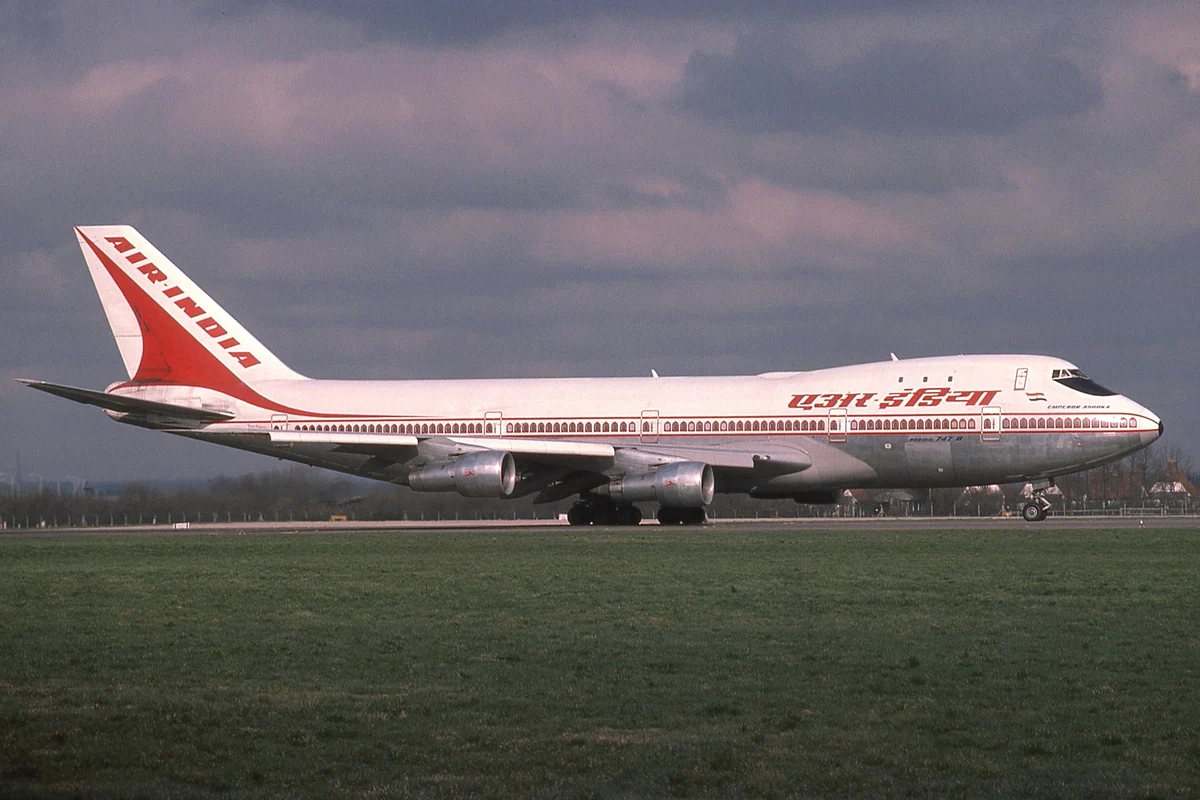
The crash off Bandra
Air India Flight 855, a scheduled Boeing 747 service from Bombay to Dubai, crashed into the sea off Bandra on the evening of 1 January 1978, killing all 213 people aboard. India’s civil aviation minister later told Parliament that the Court of Inquiry linked the loss of awareness of the aircraft’s attitude to a malfunctioning flight instrument and insufficient cross-checking of the other instruments.
The aircraft was Emperor Ashoka, registered VT-EBD. Of the 213 people aboard, 23 were crew, leaving 190 passengers. The passenger figure comes from subtracting the crew count from the total in the minister’s February written answer. A record of his oral statement earlier that month also confirms that nobody survived.
The place names vary with the purpose and date of the record. The Indian parliamentary answer places the crash in the sea off Bandra, Bombay. The US Federal Aviation Administration’s historical entry gives the Arabian Sea. Bandra is the local reference for the offshore location, the Arabian Sea names the larger body of water, and Mumbai is the current name of the city called Bombay in the 1978 record.
For a search that turns up an undated Air India flight listing, anchor the identification to the accident date and registration. The historical records identify a scheduled Bombay to Dubai service on that evening, and VT-EBD identifies the airframe independently of how a catalogue prints the flight number. The evidence for the route is the minister’s account of the 1978 service.
What Parliament recorded in 1978 and 1979
Three dates organize the parliamentary record. The accident occurred on 1 January 1978. The civil aviation minister made an oral statement on 21 February, and written Lok Sabha answers followed on 24 February. The Rajya Sabha reply from March 1979 belongs to a later stage, when the minister could report the inquiry’s conclusions and address its recommendations.
The Journal of Parliamentary Information carries an account of the 21 February statement on printed page 286 of its April–June 1978 issue. The issue date is the publication period of the journal. Use 21 February when dating what the minister told Parliament, and use the issue and printed page when identifying the journal’s summary of that statement.
The two written Lok Sabha answers of 24 February give readers closely overlapping records from the same ministry. Both identify the flight, aircraft, location and death toll. The answer numbered 675 also establishes that the government had set up a Court of Inquiry. The overlap makes the records useful for checking a transcription of the registration or the crew count. Their shared origin matters when weighing them as evidence.
The March 1979 answer supplies later information on the outcome. When tracing a causal statement back through the record, look there for what the minister reported about the court’s findings. Use the February material for what the government had confirmed about the crash and the inquiry by then.
Which body investigated Flight 855
The Indian government established a Court of Inquiry headed by Justice M. N. Chandurkar of the Bombay High Court. The February Lok Sabha answer is the contemporary source for his name and role. In that answer, the court appears as the body charged with investigating the accident, while the minister is the speaker reporting the appointment and the facts the government had established.
The investigation’s findings are also accessible through an Australian Transport Safety Bureau report. That report concerns a different occurrence and includes Flight 855 in an appendix on historical cases. The appendix attributes its account of Flight 855 to the Indian Court of Inquiry and cites a 1978 accidents summary from India’s Civil Aviation Department alongside another source. This gives a reader a lead to an Indian publication that may help trace the findings.
A search can also surface the Federal Aviation Administration’s 2002 certification report, where the accident appears as a historical entry. Its value here is the precise Boeing model and the association of that model with the date and place. The Australian and US reports are later publications from agencies outside the original inquiry. Their different purposes explain why one offers a causal synopsis and the other is useful for identifying the aircraft.
When recording a finding, name the institution that made it and the document through which it reached you. This keeps a later summary of the Indian court’s work from being mistaken for the original report.
What the finding about aircraft attitude means
Aircraft attitude describes the orientation of the aircraft relative to the horizon, including whether the nose is pitched up or down and whether the aircraft is banked. A pilot’s awareness of attitude is the understanding of that orientation. A flight instrument can display information about it, while cross-checking means comparing available instrument indications to see whether they give a consistent picture.
The distinction matters when reading about Flight 855. An instrument malfunction describes a problem with the information presented. Loss of attitude awareness describes the pilot’s resulting difficulty in establishing the aircraft’s actual orientation. The Australian appendix gives that relationship in condensed form, attributing to the Indian court a finding involving an instrument malfunction and the loss of reliable awareness of attitude.
The March 1979 parliamentary reply adds the court’s finding about insufficient cross-checking of other instruments. A reader deciding how to describe the cause in a caption or chronology can preserve both points by attributing them to the minister’s account of the court’s findings. Naming the instrument fault alone would leave out a factor reported to Parliament. A claim about precisely how the crew interpreted individual readings would require evidence beyond that short account.
The parliamentary reply and the Australian investigator’s historical appendix support an explanation at the level of the court’s reported findings. The reply is contemporary, while the appendix is a later summary. Record those publication dates as well as the date of the accident when citing either source. The original Court of Inquiry report would be the proper source for how the court evaluated each piece of evidence.
The inquiry’s reported recommendations
The March 1979 Rajya Sabha reply records 11 recommendations and identifies procedure adherence and the handling of instrument faults among their subjects. That count belongs to the minister’s account in Parliament. The causal finding explains what the court concluded about the accident, while recommendations concern what the court wanted aviation organizations or personnel to address afterward.
A recommendation’s subject can cover several possible actions. For instance, a reference to instrument faults might concern how a fault is recognized, how it is reported or how crews are prepared to respond to it. The broad subject in the parliamentary record supports a description at that level. Each claimed change to a manual, training program or maintenance practice needs a record specifying the change.
The same distinction applies to implementation. The number of recommendations reported to Parliament answers how many the reply recorded. To establish which recommendations were adopted, a researcher would need an official response, an implementation record or a subsequent parliamentary answer that identifies the action and when it took effect. A recommendation can provide the starting point for that search by supplying a subject or recipient.
The official Rajya Sabha scan for 6 March 1979 is available under question 1032. The reply states that relevant action was being taken at the time. That is a dated account of government activity. A reader making a claim about completed implementation should seek a later record that identifies a specific measure, the body carrying it out and the date of adoption.
Identifying Emperor Ashoka in fleet records
Emperor Ashoka is the name the Indian civil aviation minister gave for the aircraft. VT-EBD is its registration, and Boeing 747-237B is the model subvariant given in the FAA’s historical certification report. These identifiers answer different questions. The name connects the aircraft with Air India’s presentation of its fleet, the registration identifies the individual aircraft, and the subvariant places it within the Boeing 747 family.
The February parliamentary answers establish the connection between VT-EBD and the scheduled flight. The FAA’s entry, indexed as Air Claims J1978001, supplies the greater model precision alongside the date and the Arabian Sea location. Taken together, the documents support using Boeing 747-237B when an aircraft index or historical account calls for the full designation. Boeing 747 is the level of detail used in the contemporary ministerial answer.
Air India dates the introduction of its Boeing 747 service and its Palace in the Sky branding to 1971. That date explains where the type fits in the airline’s fleet history. The accident aircraft’s name and registration come from the parliamentary record. Establishing when VT-EBD itself joined the fleet would require a delivery or registration record for that particular airframe.
If a fleet catalogue lists Emperor Ashoka by name alone, look for VT-EBD before connecting the entry to the accident. Registration is the most useful field to take from a parliamentary record into an aircraft catalogue, where the airline name and basic model can occur across many entries.
How to verify a claim about Flight 855
Choose the record that addresses the claim you are checking. The earliest parliamentary material establishes the identity of the service and the initial government response. The later reply reports what the court found. The table gives search terms that can be used in library catalogues, parliamentary repositories or downloaded PDFs, with the claim each record can help settle.
| Claim to check | Record to look for | What it can verify |
|---|---|---|
| Flight, aircraft name and deaths | Lok Sabha, 24 February 1978, written answers 674 and 675 | Bombay to Dubai, VT-EBD, Emperor Ashoka and the total and crew counts |
| No survivors | Journal of Parliamentary Information, April–June 1978, printed page 286 | Account of the minister’s 21 February oral statement |
| Court’s finding and recommendation count | Rajya Sabha, March 1979, question 1032, printed pages 128–129 | Minister’s account of the findings and the 11 recommendations recorded in the reply |
| Later account of the instrument finding | ATSB report AO-2011-102, historical cases appendix | Retrospective attribution to the Indian inquiry and a citation to an Indian accidents summary |
| Precise Boeing model | FAA certification report, 2002, Air Claims J1978001 | Boeing 747-237B, date and Arabian Sea location |
For parliamentary PDFs, start with the chamber, sitting date and question number. Printed pagination can differ from the PDF viewer’s page count, particularly in a journal issue or a scan with cover pages. Check the question heading and the answer on the page before relying on a search result. If text recognition misses VT-EBD or AI-855, navigating to the printed page can recover the entry.
For the original inquiry, the Australian appendix’s citation to the Government of India Civil Aviation Department’s 1978 accidents summary offers a concrete catalogue lead. Search that annual publication and the full inquiry separately, using Chandurkar’s name, the accident date and the registration. If an archive supplies a volume containing several accidents, check whether it contains the court’s report or a departmental account of it.
If you find a candidate report, check the title page, issuing body and any appendices before using it to resolve a disputed detail. A parliamentary reply can establish what the minister reported on a particular date. The court’s own text is the source to seek for its exact language, its evidentiary reasoning and the wording of individual recommendations.
Air India Flight 171 survivor, confirmed facts and investigation statusAir India safety records and the status of the AI171 investigation
- Lok Sabha written answer 675 on the Air India crash, 24 February 1978
- Journal of Parliamentary Information, April–June 1978
- ATSB final report AO-2011-102, historical cases appendix
- FAA 2002 historical aviation certification report
- Lok Sabha | February 1978 answer on the AI855 crash
- Rajya Sabha | March 1979 answer on the AI855 inquiry
Sources
- Lok Sabha written answer 675 on the Air India crash, 24 February 1978
- Journal of Parliamentary Information, April–June 1978
- ATSB final report AO-2011-102, historical cases appendix
- FAA 2002 historical aviation certification report
- Air India company timeline
- Exact aircraft image, VT-EBD at London Heathrow on 27 February 1977
- Lok Sabha | February 1978 answer on the AI855 crash
- Rajya Sabha | March 1979 answer on the AI855 inquiry
